Remove hair from office-chair casters by first exposing the wheel gap, then lifting out accessible strands without cutting the tread, forcing the housing apart, or damaging the brake. If a packed axle cannot be cleaned from outside and the manufacturer does not support wheel disassembly, replacing the complete compatible caster is often the clearer route.
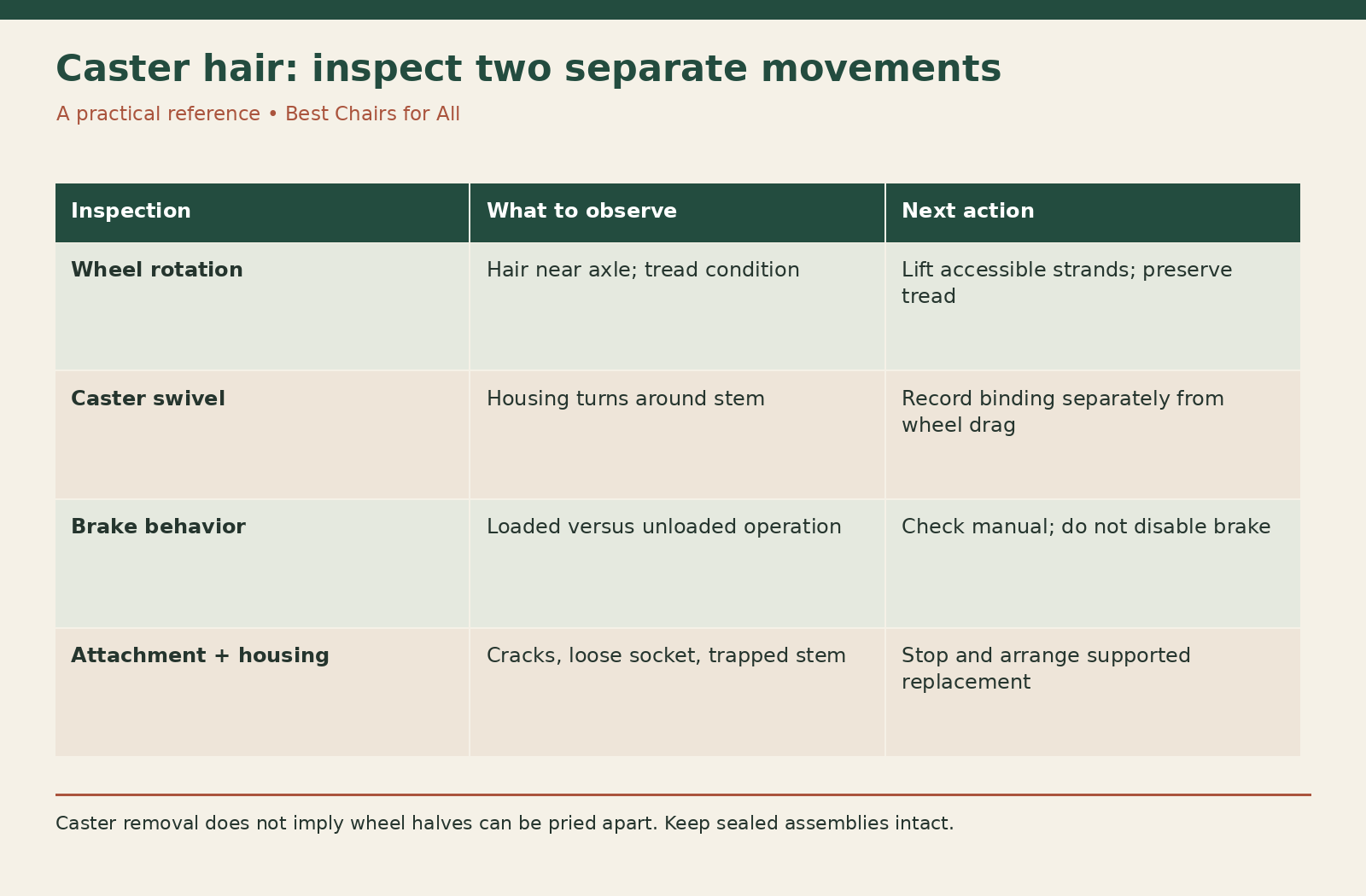
Hair removal and caster replacement are separate operations. Many chairs allow the caster to be removed from the base, but that does not mean the two wheel halves are designed to be pried apart. The plan below uses a wheel-by-wheel inspection record so you can distinguish external hair buildup from a broken bearing, damaged tread, or normal brake behavior.
Confirm that hair is the problem
Look between each wheel and its housing with a light. Long strands often wrap near an axle, while lint and dust can form a compact ring. Check whether the wheel turns and whether the caster swivels; these are different movements. A caster can swivel normally while one wheel drags.
Compare all casters rather than assuming one visible tuft explains every rolling problem. A flat spot, peeling tread, broken fork, or loose socket may remain after the hair is removed. If a caster is cracked or no longer securely attached, stop using the chair and arrange a compatible repair.
Also check the floor. A cord, rug edge, or deep pile can make a clean wheel feel stuck. Move loose obstacles without loading a damaged chair. A helpful first record is simply “wheel 2: visible hair at axle; tread intact; swivels; wheel rotation restricted.” That is more useful than writing “chair rolls badly.”
Check for an intentional brake
Some casters resist rolling when the seat is unloaded. IKEA explains that its pressure-sensitive safety casters can lock when the chair is not in use. For an applicable chair, an unloaded wheel that resists rotation is not automatically jammed with hair.
Read the model instructions before trying to force a wheel to turn or remove a brake component. Do not defeat a brake as a cleaning shortcut. Hair may still need removal, but the expected final behavior should include the intended braking function rather than unrestricted spinning in every condition.
If you are uncertain which caster is installed, photograph it from the side and underneath and contact the manufacturer. A chair bought used can have mixed or aftermarket wheels. Its behavior may therefore differ from the configuration shown in a current product page.
Prepare access without stressing the chair
Unload the chair and clear a protected work area. Support it according to its care or service instructions so it cannot roll or fall while you work. Keep pressure off levers, arm pads, and delicate back mesh. Ask for help if the chair is too heavy or awkward to support securely.
Do not remove the gas cylinder or recline mechanism to reach the casters. There is no cleaning benefit that justifies opening a pressure component. Your work area is the wheel assembly and its accessible exterior, not the internal seat mechanism.
Gather a vacuum with a narrow attachment, a light, tweezers or a small blunt pick, and a container for removed strands. A small blunt-ended scissors can be useful only where a visible strand can be isolated clear of the wheel and your hand. Avoid working blindly with a blade inside a narrow gap.
Decide whether caster removal is supported
Some chairs provide a model-specific removal procedure. For example, Herman Miller publishes a Setu caster and glide replacement instruction. That document concerns a particular assembly and revision; it is not a universal instruction for every office chair or every caster fastening.
If your instructions permit removal, follow them and keep any stem or retaining component with the correct caster. If removal requires unexpected force, the housing separates, or the base socket looks damaged, stop. A caster that leaves part of its attachment behind needs identification before the next step.
You can often remove accessible external hair while a caster remains attached, provided the chair is securely supported. Removing the entire caster is worthwhile only when it improves safe access under a supported procedure. Do not turn a short cleaning job into speculative chair disassembly.
Work from loose debris toward the axle
Vacuum loose lint from around the wheel gap first. Rotate the wheel gently where its normal mechanism allows and inspect the circumference. Pull out loose ends with tweezers, using small movements rather than yanking a thick bundle against the axle.
When strands are wrapped tightly, try to isolate a small visible loop. If it cannot be lifted clear of the tread and housing, do not insert scissors and cut by feel. Damage to a soft tread may create a rough edge that later marks the floor. The goal is to remove hair, not enlarge the gap by force.
Remove released strands into a container immediately. Letting them fall onto the carpet gives the caster another chance to collect them. Work on one caster at a time and check wheel rotation between small removals so you know when the external buildup has actually been cleared. Use the light again at several wheel positions; a bundle hidden behind the fork may become visible only after a partial turn.
Keep sealed wheel assemblies intact
A seam between two plastic halves does not necessarily indicate a serviceable joint. Snapped or pressed assemblies may be damaged by prying even if an online video shows a superficially similar wheel coming apart. Only use a disassembly method documented for your actual caster.
Do not burn hair away, apply a heat gun, or use a solvent to dissolve packed fibers. These approaches can affect tread, housing, lubrication, or brake parts and are unnecessary for routine exterior cleaning. Avoid compressed-air blasting that simply drives debris deeper or scatters it into the room.
If the visible exterior is clean but the wheel still binds, record that result and ask about replacement. You do not need to prove that every hidden fiber has been removed before choosing a complete supported caster. A reliable replacement may be preferable to an unserviceable wheel damaged during attempted opening.
Clean the tread using the appropriate care method
After dry hair removal, wipe the tread only with a method approved for that caster material. The HON product-care guide describes mild soap and water on a clean soft cloth for its caster-cleaning routine and emphasizes keeping the floor clean. Apply such instructions within their product scope.
A controlled cloth wipe is different from soaking the caster in a bowl. Bearings, internal brakes, and attachment hardware may not be designed for immersion. Keep liquid out of openings and dry the accessible surfaces before reinstalling or returning the chair to the floor.
Do not add oil because the wheel used to contain hair. Hair removal does not establish a lubrication need or an approved lubricant. Unspecified spray may leave residue on the tread or floor. Ask the maker whether lubrication is appropriate and where it belongs if the clean caster remains noisy or resistant.
Complete a five-caster inspection sheet
Number the base positions temporarily using a sketch rather than adhesive on finished surfaces. For each caster, record visible buildup, wheel rotation, swivel action, tread condition, attachment condition, and the result after cleaning. Add whether a brake is fitted and how its intended behavior was verified.
A useful completed example might read: “Caster 1: loose lint removed; wheel and swivel normal. Caster 2: tightly wrapped visible hair removed; wheel restored. Caster 3: clean but cracked tread; replacement requested.” The different outcomes prevent you from treating every resistance issue as the same maintenance task.
Keep a photograph of a damaged caster next to the record. If replacing a set is recommended, confirm compatible stem, height, floor type, and brake behavior. Do not mix a tall new wheel with four short old wheels simply because the stem fits. Our caster-replacement guide explains that comparison.
Reinstall and check the completed chair
Follow the model instructions for full attachment engagement. Check all casters are properly seated and that no damaged socket is being disguised by a new part. Return the chair upright on an appropriate level surface and inspect its stance before normal use.
Check rolling in a clear area, without forceful movement or leaning beyond the base. Verify expected brake operation using the manufacturer’s directions. If the chair still drags, listen and watch for the specific caster involved rather than assuming the cleaning failed everywhere.
Stop if a wheel pulls out, a base spoke flexes abnormally, or the chair develops a lean. Those signs call for service assessment. A wheel that turns freely in your hand can still be unsuitable if its attachment or installed geometry is wrong.
Reduce the next buildup at its source
Vacuum the working area and the route the chair uses, including under the desk where hair and thread accumulate. Remove long loose fibers promptly. HON’s floor-cleanliness emphasis is particularly useful here: a clean caster cannot stay clean if it rolls through the same debris every day.
Check caster gaps when you notice a change in rolling, rather than waiting until movement is severely restricted. The appropriate interval depends on the floor and household or workplace conditions. Pet hair, sewing thread, and long human hair create different patterns, so your inspection record can guide a realistic routine.
If repeated entanglement makes the current design impractical, ask the chair maker about compatible alternatives with better debris shielding or easier exterior access. Do not assume a larger roller-style wheel is hair-proof. Compare fit, floor behavior, and serviceability together, then retain the part identity so the next cleaning decision begins with reliable information.
Something unclear or out of date? Send a correction with this article’s title and the detail to check.
Sources, research & corrections policy ↗