Inspect a hanging egg chair before using it, after storage, and whenever its behavior changes. Work from the product label and assembly manual so you can distinguish an ordinary adjustment from a missing part or damaged load-bearing connection. The suspension, basket frame, upright, base, and any restraint form one system. A tidy cushion or freshly painted frame does not establish that the system is sound.
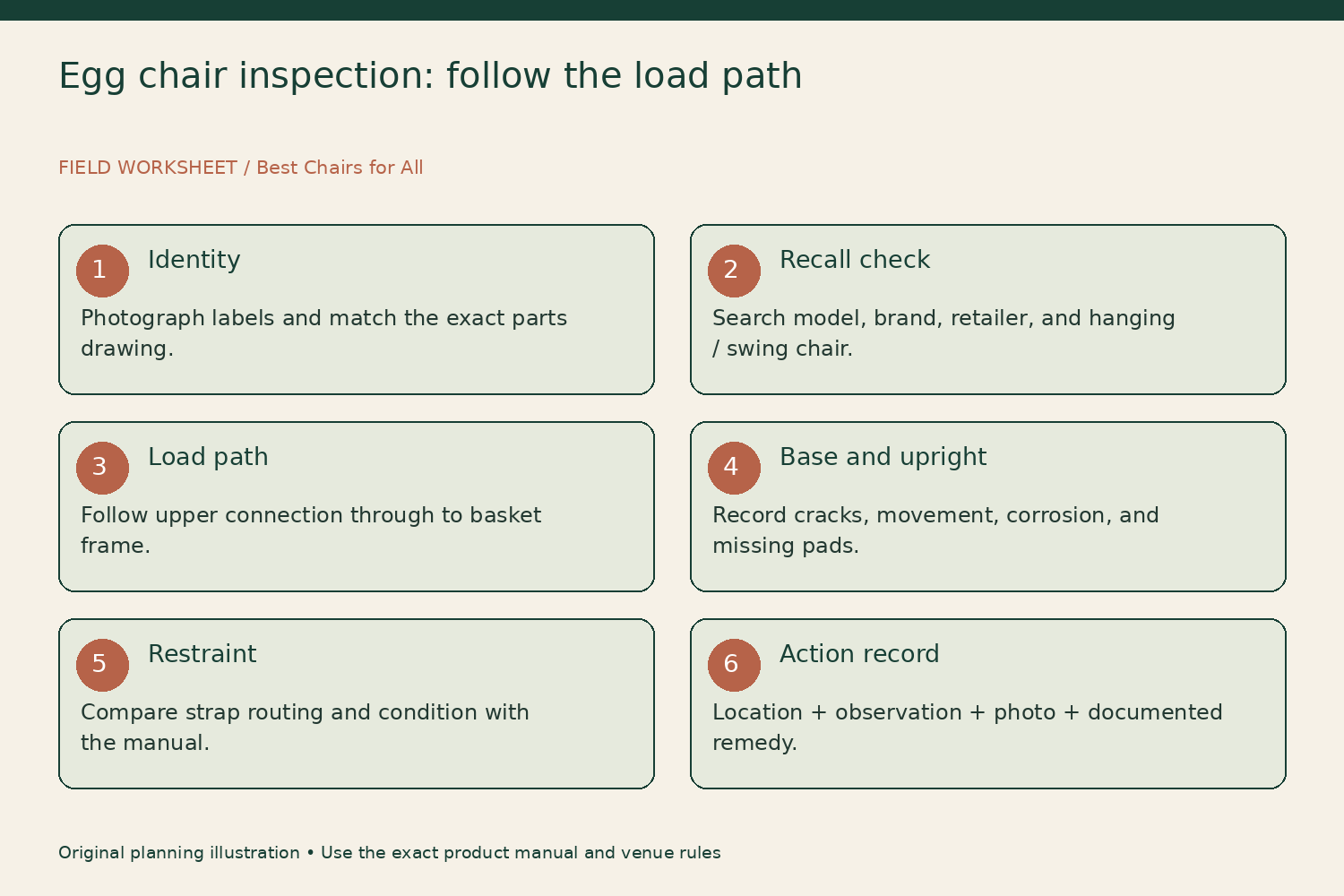
This is a visual inspection and documentation guide, not a procedure for proof-loading furniture or repairing structural damage. Keep the chair unoccupied while you inspect it. If a crack, distorted connector, unstable base, unidentified replacement part, or recall match appears, stop using it and contact the manufacturer. Do not invite someone to sit down to confirm whether a suspicious joint will hold.
Identify the chair before touching hardware
Find the brand, model, style number, purchase record, and assembly instructions. Labels may be under the basket, on a base tube, or attached to paperwork. Photograph them clearly, including any serial or production code. If you have a secondhand basket and a separate stand, identify each. The label on one part cannot establish the load limit or compatibility of the other part.
Lay the manual beside the chair and compare its parts drawing with what is installed. Count specified connectors, washers, bolts, caps, springs, and straps without dismantling the suspension. Note substitutions, especially hardware of a different shape from the drawing. A smooth-looking repair may conceal a change the manufacturer never approved. If the manual is unavailable, request it using the exact model before trying to decide which pieces are optional.
Search recalls before the physical inspection
Use the CPSC recall database to search the brand, retailer, model, and both ‘hanging chair’ and ‘swing chair.’ Check again when bringing a stored or used chair into service. A search that returns nothing does not prove that the chair is safe; it simply does not identify a matching notice through that search. Save the model identity rather than a vague note saying ‘egg chair checked.’
For a concrete example, the 2022 Novogratz hanging-chair recall concerns specified outdoor metal chairs with tipping or suspension-breakage hazards. The notice provides identifying style numbers and a stop-use remedy. Follow the current notice if your chair matches. Replacing a chain yourself or making the base heavier is not the recall remedy and does not remove the product from that recall.
Trace the load path from top to bottom
Start where the stand supports the suspension and follow every connection down to the basket’s structural frame. Look for visible cracks, abnormal gaps, an opened hook, bent metal, loose attachment points, or wear where metal parts bear against each other. Compare connector orientation and closure with the manual. Keep fingers away from pinch points, and do not lift or twist the chair to expose a joint if doing so can release it.
A spring may be supplied as part of a specific assembly; it is not a universal accessory. Likewise, a carabiner-shaped fitting can have a particular closure and installation direction. If you cannot establish that the component is original or manufacturer approved, record that uncertainty and ask support for identification. Do not use an unrelated load number printed on a replacement connector as approval for the entire suspension.
Examine the stand's base and upright
Check the base on the surface where the chair is used. Look for a foot that does not contact the ground, a loose joint, a missing protective pad, visible deformation, or an upright that has shifted relative to its assembled position. Inspect weld areas and tube junctions without scraping away coatings. Water marks, flaking corrosion, and a new tilt deserve attention, especially around places where water can collect.
Separate surface problems from structural uncertainty. A small finish chip and a crack through a joint are different findings, but a photograph alone may not tell you the depth of corrosion. Send clear close-ups plus an overall photograph to the manufacturer. Do not grind a suspect weld smooth, drill drainage holes, bend the upright back, or add improvised braces. Those changes can obscure the original fault and alter how the stand carries the load.
Check restraint straps against the exact manual
Some egg chairs use a strap that limits basket movement relative to the stand. Its purpose and attachment arrangement must come from the particular instructions. Do not assume that a visible strap is packaging or a carrying handle. Check its routing, connection points, condition, and adjustment against the drawing, including whether it attaches to the basket frame rather than decorative woven material.
One model-specific example is the Sunnydaze Caroline AJ-741. Its manufacturer instructions, reproduced in the Caroline instruction manual, require the supplied safety strap and prohibit swinging, bouncing, jumping, twisting, and spinning. These requirements illustrate why the word ‘hanging’ does not define the permitted movement. Obtain the current instructions directly from the supplier for your exact version before applying a routing diagram or adjustment procedure.
Inspect the basket frame and woven surface
Remove loose cushions only as the care instructions allow, then look at the structural perimeter, seat supports, suspension attachment, and places where woven material meets the frame. Note cracked frame members, separated connections, sharp broken strands, a sagging seat, or a change in basket shape. Decorative weave can hide a metal frame; avoid treating intact outer strands as evidence that the concealed structure is undamaged.
Check the cushion separately for wetness, torn seams, displaced filling, or a slippery underside. A cushion can change the occupied position and how easily someone gets into the chair, but it cannot compensate for a failing seat support. Do not insert boards or extra padding to hide sagging. Ask the manufacturer whether a replacement cushion must match a particular size or thickness, especially if it affects the restraint or floor clearance.
Use a finding-and-action worksheet
Divide a page into four columns: location, observation, evidence, and action. Write ‘upper connector: closure does not match manual photo; close-up image 03; awaiting manufacturer response.’ This is more useful than ‘hardware bad.’ Record what you actually saw without diagnosing an unseen cause. Photograph the whole assembly first so a support representative can locate each detail and understand the stand’s orientation.
Use three action labels: follow the documented routine-care procedure, request identification or replacement guidance, and stop use pending assessment. Structural cracks, substantial corrosion at a connection, an opened load-bearing fitting, missing required restraints, or a recall match belong in the stop-use group. When the evidence is uncertain, do not move an item into routine care just because a wrench or paint can seems likely to conceal it.
Check fasteners without inventing torque settings
The correct tightening method depends on the product. Some joints use specified tools, locking nuts, washers, or a tightening sequence; others have hand-operated knobs. Follow the manual rather than applying a general torque value from the internet. Over-tightening can damage parts, while leaving hardware loose can allow movement. If the instructions omit a value you need, ask the manufacturer instead of borrowing one from another egg chair.
Look for missing washers, different bolt lengths, protruding threads that have changed, or a joint that repeatedly loosens. Marking the date and location of recurrent movement helps support staff understand the problem. Do not add thread-locking compound, extra washers, or a different nut unless the manufacturer permits it. A repeatedly loose joint needs its cause addressed, not simply a stronger chemical or more force at every inspection.
Keep cleaning separate from structural repair
Clean only with products appropriate to the identified materials and coating. The Sunnydaze HH-AHC stand page, for example, specifies a soft cloth, warm water, mild detergent, and drying after cleaning for that powder-coated steel stand. That is a named-product instruction, not a universal recipe for every basket, cushion, or woven finish. Record separate care guidance for each component.
Avoid using cleaner, oil, or paint to make a damaged area less obvious before the manufacturer reviews it. Cleaning can make an inspection easier, but aggressive sanding or solvent treatment may remove evidence and harm a coating. If finish restoration is approved, document the condition first and obtain the correct touch-up product and preparation instructions. Never describe cosmetic touch-up as a repair to a weakened structural member.
Recheck after changes and unusual events
Repeat the identification and visual checks after moving the chair, an impact, strong weather exposure, or replacement of any suspension part. Check that the base remains on the required surface and that nearby furniture has not intruded into the operating space. A chair relocated from a patio to a lawn may face a different footing problem even though its hardware has not changed.
Keep the inspection record with the receipt and manual. Write the date, observer, findings, photographs, and any manufacturer case number. Close each unresolved item with the documented remedy, rather than deleting the old note. That history makes recurring faults easier to spot and gives a future owner useful information. The result should be a chair with identifiable parts and resolved findings, not merely a completed checklist.
If a seller provides only a basket photograph, request a second image showing the complete stand and all suspension parts. Ask whether anything has been replaced or lost. The absence of the original paperwork is not proof of damage, but it leaves work to do before use: identify the product, obtain the instructions, check recalls, and verify that every required component is present.
Label an unusable chair clearly while awaiting advice so another household member does not mistake its location in the garden for permission to sit. Store loose approved replacement parts with the case record until the manufacturer specifies their installation.
Something unclear or out of date? Send a correction with this article’s title and the detail to check.
Sources, research & corrections policy ↗