Protect hardwood floors from an office chair by matching the casters and any mat to the floor’s care requirements, keeping grit out of the rolling path, and checking the floor beneath the protection. A softer wheel or a mat can help, but neither creates a universal guarantee against scratches, dents, finish changes, or trapped debris.
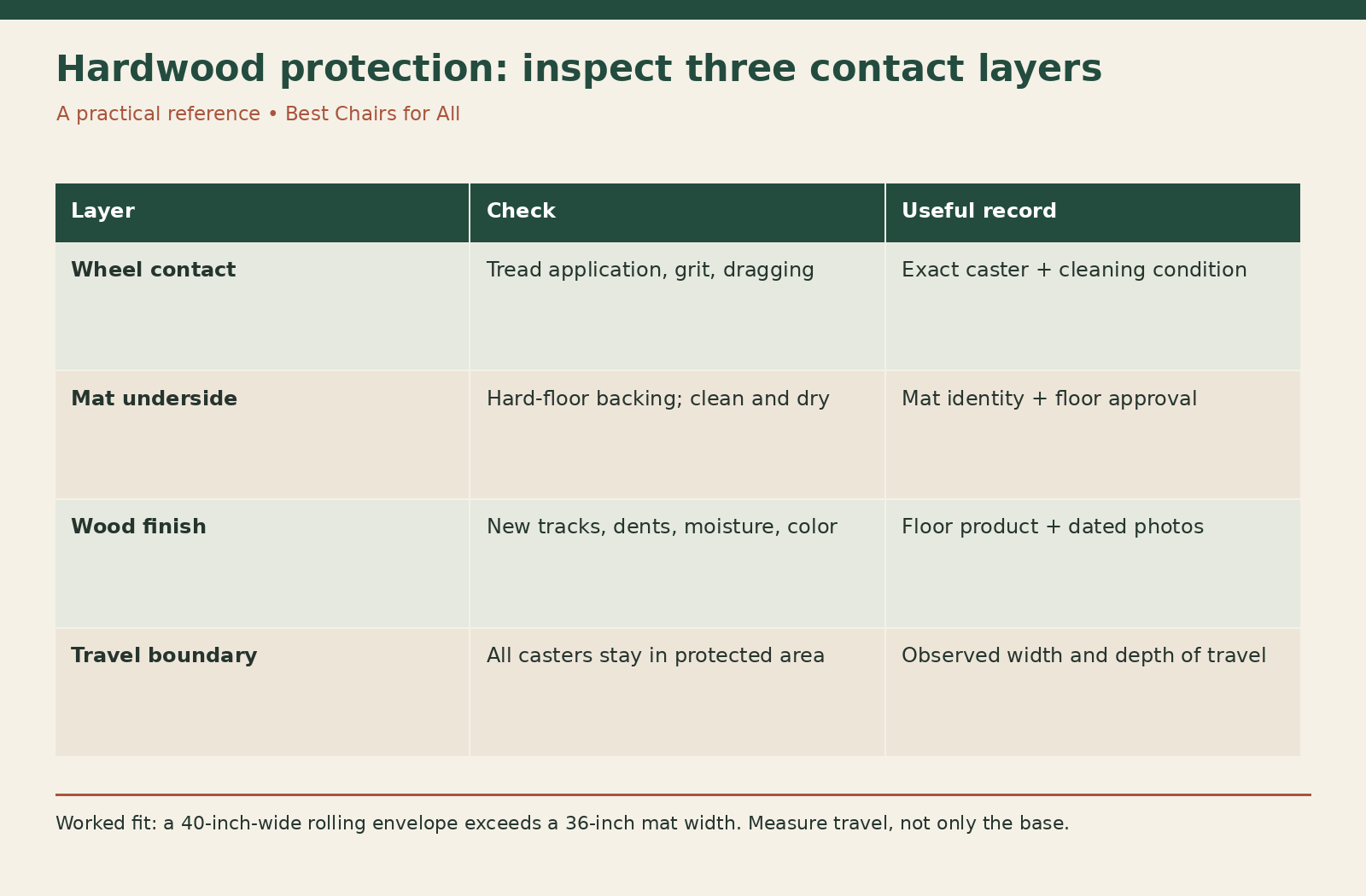
Begin with the floor, not an accessory advertised as safe for every surface. Identify its finish and care instructions, then inspect the chair’s contact points. The protection map below covers the full path the chair uses and separates rolling abrasion, concentrated loading, and mat-related problems so you can choose a practical arrangement.
Identify the floor and its finish
Find the flooring invoice, product name, installer information, or care document. Solid wood, engineered wood, and wood-look laminate are different products. Even within wood flooring, the finish and maintenance requirements can differ. Do not assume that a treatment suitable for one room applies to another surface that looks similar.
Ask the floor supplier whether rolling chairs require a particular caster or protective mat and whether any backing materials are restricted. For a recently finished floor, obtain the finish provider’s instructions on when furniture and coverings can be placed. A chair-accessory seller cannot establish the cure condition of your floor.
If the surface is already marked, photograph it before changing the setup. Describe whether the mark appears to be a surface scuff, a scratch, an indentation, or discoloration without attempting an aggressive removal test. A flooring professional can assess repair options; a chair-wheel change does not repair existing damage.
Inspect the actual wheel contacts
Look at every caster tread for embedded grit, rough spots, cracking, or missing material. Check whether the wheel rotates and swivels normally. A jammed caster can drag instead of roll, changing the contact with the floor even when the original tread was suitable.
Identify the installed caster option from the order or manufacturer guidance. The Herman Miller Mirra 2 product information, for example, distinguishes floor-related caster options. A chair photograph does not reliably identify which option you have, especially after a secondhand purchase or replacement.
Do not assume non-marking means scratch-proof. A wheel may avoid leaving its own color while still carrying abrasive dirt. Likewise, a larger wheel is not automatically approved for the base or floor. Verify attachment, installed height, and the floor application before replacing the set.
Keep grit from entering the path
Make routine dry soil removal part of the protection plan. Clean around and under the desk, where the chair repeatedly travels through a small area. Check entry points where outdoor grit can be carried into the room. A clean-looking top surface can still have particles trapped under a wheel or mat edge.
Bona’s hardwood scratch-prevention guidance emphasizes furniture protection and appropriate floor-care tools. Use the method suitable for your floor and avoid adding unapproved wet cleaning or polish to make the rolling area feel smoother. A residue that changes slipperiness is not a floor-protection strategy.
Clean caster treads according to the chair or caster instructions using controlled moisture where permitted. Let them dry before use. Do not spray lubricant onto the tread or allow maintenance chemicals to drip onto the wood. Keep separate cloths for the floor, the wheels, and upholstery.
Decide whether a mat is required or useful
A suitable mat can place a protective working surface between the wheels and the wood and distribute the chair’s contact over a defined area. Its application must match the floor and its own instructions. Check both sources rather than relying only on a general hard-floor label.
The ES ROBBINS chair-mat FAQ distinguishes smooth-backed hard-floor mats from cleated carpet mats and warns against using the carpet version on hard surfaces. A mat with spikes or cleats should not be placed on hardwood merely because its top surface looks suitable for rolling.
For a floor finish sensitive to a particular backing, ask the floor and mat suppliers to confirm compatibility. Do not insert an improvised rubber shelf liner, adhesive layer, or extra rug pad without checking it. A layered arrangement can change stability and the contact chemistry while hiding the surface you are trying to protect.
Size protection for the travel envelope
Measure where all casters go while you work, turn, and roll back to stand. The base footprint at the typing position is only part of that area. A small mat can protect the center while wheels repeatedly cross its edge and return to unprotected wood.
Use a worked planning example. Suppose the observed side-to-side caster travel spans 40 inches and front-to-back travel spans 44 inches. A rectangular 36-by-48-inch mat is too narrow even though its depth exceeds the measured front-to-back travel. A 45-by-53-inch shape might provide more room, but check its actual usable outline and the desk opening before choosing it. These are illustrative measurements, not a product recommendation.
A lipped mat needs special attention because overall dimensions can include a narrow under-desk extension. Draw the full outline and compare it with the caster travel at each part. Include the route used when retrieving an item from a side shelf or filing drawer. Those occasional movements can be the only time a rear wheel leaves the protection, making the damage pattern difficult to explain if you measure only the main typing position. Do not count a narrow lip as full-width rolling space near the back of the chair.
Install on clean, dry, suitable surfaces
Before laying a compatible mat, remove loose debris from both the floor and mat underside. Follow the mat’s flattening and orientation instructions. Do not place it on a wet floor or trap cleaning liquid underneath. A protective covering should not conceal unresolved dampness.
Check that the mat lies flat and remains stable without an edge that catches a wheel or foot. Do not use heat, cutting, or fasteners to force it to fit unless the manufacturer explicitly supports the method. If the size or shape is wrong, obtain a suitable one rather than modifying it blindly.
Keep furniture and concentrated loads off the mat unless its instructions permit them. Anchoring it with a heavy cabinet may affect support and use conditions. A mat that moves under ordinary chair use needs a compatibility or installation review, not simply more weight placed on one corner.
Use a three-layer inspection map
Draw three layers: wheel-to-mat or wheel-to-floor; mat-to-floor if present; and the underlying finish. For each layer, record the contact material, cleaning method, and visible condition. This makes protection an inspectable system rather than a single purchase.
For example, the first layer may show clean hard-floor casters rolling on an approved mat. The second may show dust collecting beneath a front edge. The third may show no new marks after cleaning and repositioning. That record tells you where maintenance is needed without claiming that the setup has been laboratory tested.
Check the floor beneath the mat at a practical interval based on use and the manufacturer’s advice. Lift and move it carefully according to its handling instructions, avoiding scraping grit across the finish. If discoloration, moisture, or new scratches appear, stop using the arrangement and ask the relevant supplier to assess it.
Distinguish abrasion from indentation
Fine scratches along a repeated path can suggest an abrasive contact worth investigating. Dents or concentrated impressions raise a different question about loading and support. Do not promise that a softer tread alone will prevent indentation on every wood species or finish.
Record the pattern: one caster track, a broad mat outline, a series of isolated spots, or an edge line. The pattern can help a flooring professional distinguish likely causes. It is more informative than reporting simply that the chair damaged the wood.
Avoid adding a thicker soft layer underneath the chair as a universal cure. Soft underlays can change mat support and make the chair less predictable. Ask the mat maker whether its product can be used over that layer and whether it still meets the flooring requirements.
Check the chair after a caster change
A replacement set can raise or lower the base and alter rolling resistance. Recheck minimum seat height, desk clearance, and any brake behavior. A floor-friendly wheel that makes the chair too tall or causes unwanted drift is not a complete solution.
Use compatible parts confirmed for the chair rather than multiplying individual wheel ratings into an assumed chair capacity. Keep the original part identification and the new set’s installed height. If a wheel is not fully retained or a socket is damaged, take the chair out of use and resolve the fault.
Our caster replacement guide provides the attachment worksheet. Complete that check alongside the floor assessment. Mechanical fit and finish compatibility are independent requirements; meeting only one leaves the setup incomplete.
Respond to a new mark without making it worse
Stop the repeated contact and photograph the area. Remove loose grit with the floor’s approved dry method. Do not try abrasive pads, solvents, wax, or spot sanding based on an online photograph. A finish-specific care or repair instruction is the appropriate next reference.
Contact the flooring supplier with the product information, chair and caster details, mat identity if used, and pattern of the mark. Explain any recent cleaning or maintenance products. That history can be relevant when a change appears under a covering rather than directly in the rolling tracks.
Once the cause is assessed, update the protection map and verify the new arrangement in normal use. The aim is a compatible floor, clean contact surfaces, adequate rolling coverage, and a record of what is happening underneath. Those checks provide more dependable protection than assuming an accessory’s broad marketing promise settles the question permanently.
Something unclear or out of date? Send a correction with this article’s title and the detail to check.
Sources, research & corrections policy ↗