Before cleaning a recliner, find the upholstery care instructions for its exact cover. The word “fabric,” the appearance of leather, and a removable zipper do not tell you which cleaner is suitable. A cleaning code is a starting permission for a method, not a promise that every stain can be removed safely at home.
The safest useful approach is a short decision sequence: identify the chair and cover, read the permitted method, remove loose material, decide whether the spill is a reasonable home-cleaning job, then test any approved treatment. This guide explains that sequence without offering one homemade mixture for every recliner.
Make a care record before you need it
Look for the product label and cover-care information in the locations described by the maker. Save a clear photograph of the model number, upholstery code and care label. If a label is underneath a heavy chair, do not tip or crawl under it while it can move; ask the retailer how to obtain the information without unsafe handling.
Keep the receipt and selected cover name with the photographs. A chair sold in several fabrics may have different cleaning instructions for each version. The name printed on an online listing might describe a color or finish rather than identify the textile. When the code is missing or unclear, send the retailer the product and cover details before applying a cleaner.
Make a small care folder on your phone with the current instructions and any approved cleaning product. This is especially useful in a shared household: a family member can check the actual guidance instead of reaching for the nearest carpet spray during a spill.
Read the code as a limit on the method
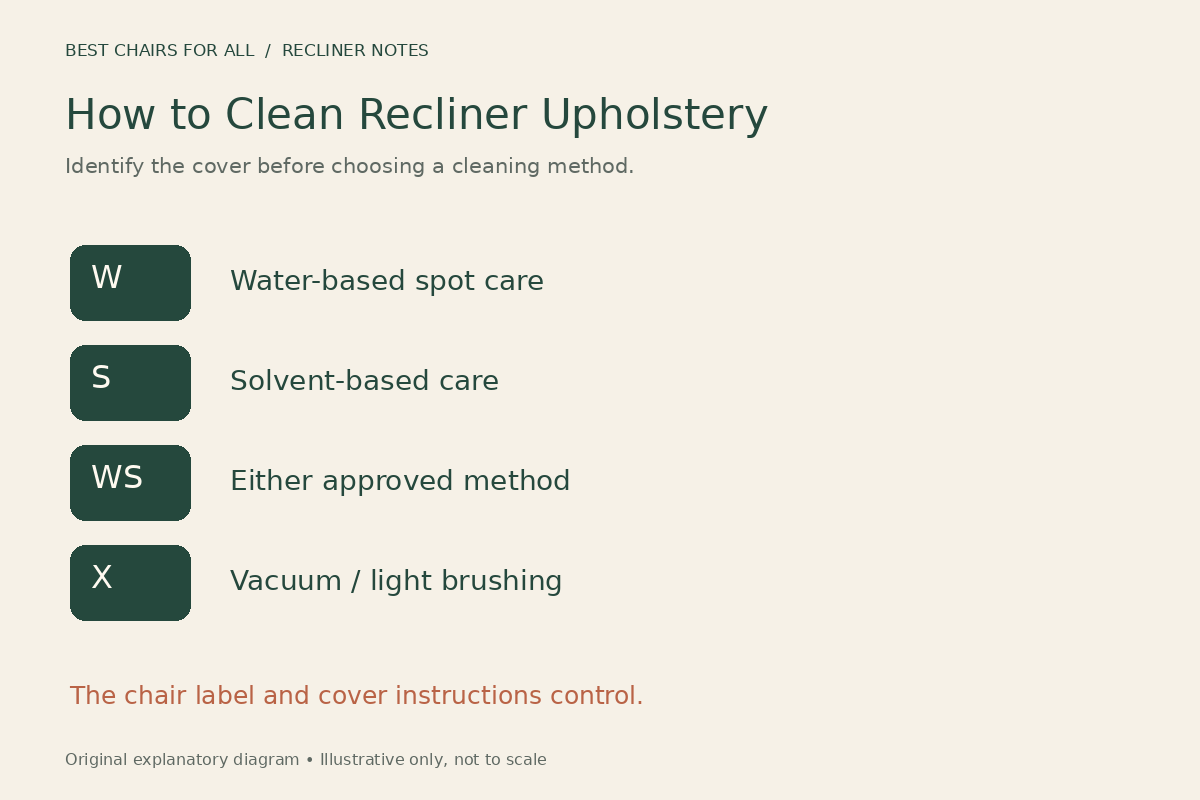
Ashley’s care guide describes the familiar upholstery codes. W calls for an appropriate water-based upholstery shampoo or foam; S calls for a suitable dry-cleaning solvent; WS or SW permits the specified water-based or solvent approach; X limits care to vacuuming or light brushing. Manufacturer-specific instructions and product directions still control.
| Code | Starting direction | Do not assume |
|---|---|---|
| W | Approved water-based spot method | That soaking or machine washing is allowed |
| S | Specified solvent method; consider professional care | That water is a harmless first try |
| WS or SW | Either specified method may be permitted | That combining products is sensible |
| X | Vacuum or light brush as instructed | That a little liquid cleaner is acceptable |
| Unknown | Obtain the actual care information | That fiber appearance identifies the code |
A code does not identify a stain or diagnose an existing finish problem. Ink, dye transfer, adhesive and unknown residues may need a different assessment from a fresh water spill. Likewise, a code may be accompanied by extra restrictions. Read the complete label rather than stopping at the large letter.
Protect the chair’s moving and electrical parts
Bring the recliner into the stable position specified for care, keep the mechanism clear and disconnect powered furniture as directed by its manufacturer. La-Z-Boy’s power-recliner operating manual instructs owners to disconnect the electrical supply before cleaning or moving a powered recliner. Do not spray around buttons, USB sockets, motors or wiring.
Remove loose items from pockets and nearby tables. Place approved cleaning supplies where they cannot spill into the chair. Keep hands, cloths and vacuum attachments away from moving linkages. Cleaning upholstery does not require running the mechanism while fingers or tools are in its path.
If liquid has entered an electrical component, stop using the affected powered functions and contact the manufacturer or an appropriate service provider. Treating the visible upholstery does not establish that hidden components are dry or safe. Do not open a power supply or attempt to dry electronics with a household heat source.
Begin with routine dry care
Follow the maker’s vacuuming or brushing instructions and use a suitable upholstery attachment. Start with accessible seat surfaces and seams, then the back and arms. Check an attachment for rough edges before touching delicate fabric. Avoid pulling strongly on piping, decorative stitching or loose threads.
Keep a consistent routine suited to actual use rather than following an arbitrary deep-cleaning calendar. An arm used daily by a pet may need attention sooner than the back of a rarely used guest chair. A brief visual inspection helps you spot loose material or a small spill while it is still easy to describe to a cleaner.
Record wear separately from dirt. A worn patch, flattened pile, fading and a stain can look similar in a quick photograph, but require different responses. More cleaning is not automatically the answer to a change in texture or color. If you cannot tell what changed, stop before experimenting.
Respond to a fresh spill without improvising
First identify what spilled and where it traveled. Note whether it stayed on the surface or reached a seam, control area or gap. If the maker’s instructions allow, lift loose solids gently and use a clean white absorbent cloth to blot available liquid without scrubbing it farther into the material.
Do not immediately add water, vinegar, dish detergent, baking soda or alcohol. Even familiar household ingredients can be unsuitable for a particular cover or leave residue. A product sold for carpets or automotive leather is not automatically approved for a furniture cover.
Write a quick note with the spill type, approximate time, area affected and anything already applied. That record is helpful if you contact a professional. It also prevents two household members from treating the same spot with different products because neither knows what the other has done.
Use a deliberate test before any approved spot treatment
For a method that the cover instructions allow, read the cleaning-product directions and test in an inconspicuous location that actually uses the same material. Check which surfaces and finishes the product excludes. A successful test on a hidden lining does not tell you how the visible upholstery will respond.
Let the test area dry as directed before judging it. Look for color change, altered sheen, texture difference, rings or transferred dye on the cloth. Compare it in the lighting where the chair normally sits. If the result is uncertain, pause and ask the cover maker or a professional rather than enlarging the test.
The La-Z-Boy fabric and leather care instructions emphasize pretesting and avoiding saturation for applicable fabric codes. They also restrict steam or hot-water extraction for the covers described. A W code by itself should therefore never be treated as general permission to rent an extraction machine.
Keep the treatment small and controlled
Work only within the directions for the approved method. Use the specified application tool and amount; more solution is not a substitute for the right treatment. Keep liquid away from seams and component openings where it can travel beyond the visible patch. Stop if the fabric reacts unexpectedly.
Do not turn a modest stain into an entire-panel experiment in an attempt to hide a ring. Broad soiling, repeated marks or an unsuccessful first treatment are good reasons to seek an upholstery cleaner who can identify the material and assess the chair as a whole. Tell the cleaner every product already used.
After treatment, keep the chair available for the specified drying period and do not cover damp upholstery with a blanket. Use the maker’s guidance for returning a powered unit to service. If anything remains damp near electrical parts, obtain service advice; surface dryness alone does not answer that question.
Distinguish leather types and leather-look materials
Do not use a fabric cleaning-code routine on leather simply because the chair has similar-looking seams. Leather finishes and leather-look covers require their own identification. Match the care directions to the actual cover, including any coated or synthetic components on the sides and back.
Palliser’s warranty and care booklet separates its leather and fabric care information and tells owners to contact the retailer when cleaning codes are unavailable. That is a better next step than assuming a generic conditioner is beneficial to every surface.
Ask whether a proposed cleaner or conditioner is approved for the specific finish. Keep the approval with the care record. Avoid using a product simply because it made a car seat or another piece of furniture look good: that earlier result does not establish compatibility with this chair.
A removable cover is not necessarily washable
A zipper may exist for manufacturing, fitting or service rather than routine laundering. Removing and washing a cover can change its fit, backing, padding or relationship to the frame. Obtain explicit laundering instructions before unzipping and washing anything, even if the fabric itself looks robust.
If a particular cover is washable, follow its complete instructions for removal, cycle, temperature, drying and refitting. Record which parts can be treated and which cannot. Do not generalize instructions from a separate scatter cushion to an attached recliner seat or the fabric around a power control.
For households where washability is a priority, research it before buying. A cover’s care documentation is a useful comparison feature alongside color and feel. It is much harder to change an unsuitable maintenance requirement after a chair is installed.
Know when the next step should be professional help
Get advice for unknown covers, extensive soiling, old or unidentified stains, dye transfer, valuable or delicate upholstery, a failed test, or liquid entering the mechanism and electrical areas. Ask the cleaner whether they regularly handle reclining furniture and whether the proposed method follows the exact manufacturer’s guidance.
Send close photographs plus an overall image of the chair, the care label and your treatment notes. Ask what outcome is realistic and whether an inspection is needed before a quote. No responsible assessment can guarantee every stain will disappear without seeing the material and damage.
For ongoing care, keep the chair’s instructions, inspect accessible areas, and use approved methods consistently. When comparing a replacement, consider manual and powered mechanisms as well as upholstery. The most practical recliner is one whose operation and maintenance fit the household, not merely one whose cover looks easy to wipe.
Something unclear or out of date? Send a correction with this article’s title and the detail to check.
Sources, research & corrections policy ↗