A manual recliner uses a handle, release, or push-back mechanism and your own movement to change position. A power recliner uses an electric motor controlled by buttons or a handset. The useful buying question is whether you can reach, operate, and close the chair comfortably every time you use it.
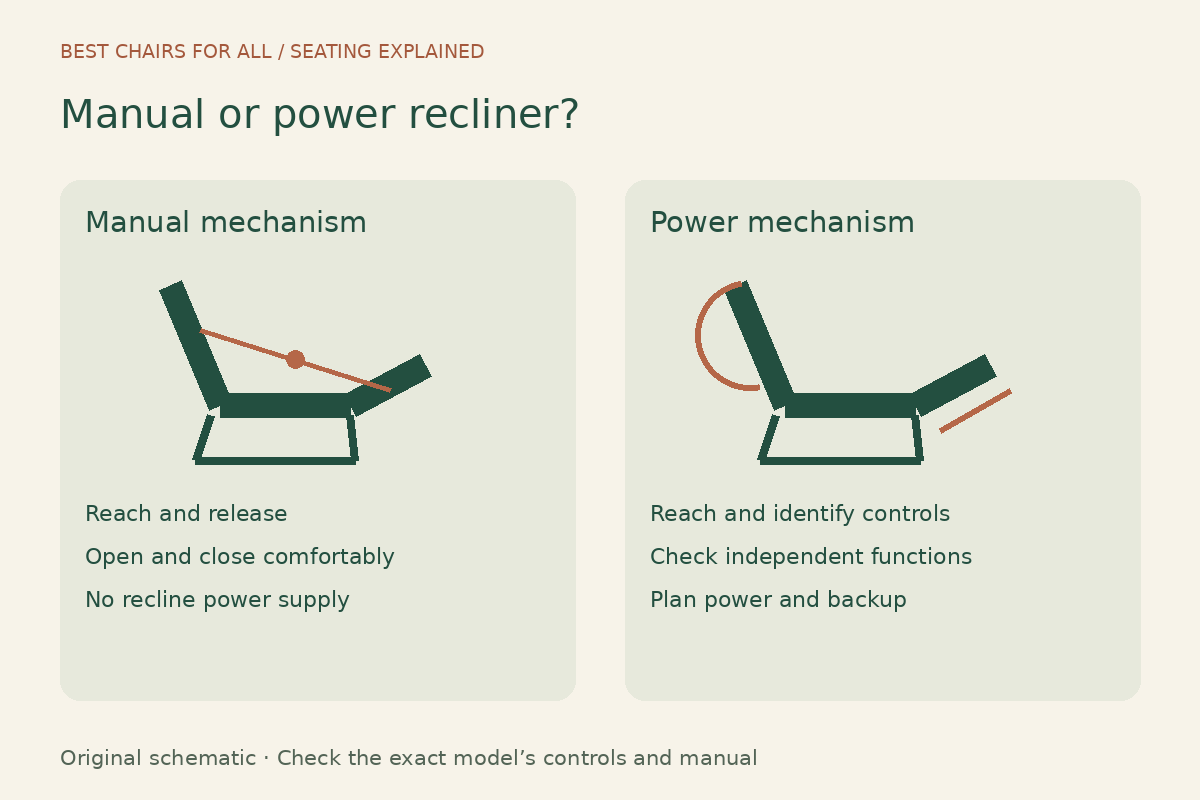
Choose a manual model when its complete opening-and-closing sequence feels easy, your preferred position is available, and you want placement without a power connection. Consider power when gradual adjustment, accessible controls, or separately adjustable support makes a meaningful difference. Neither mechanism guarantees a comfortable seat, a small footprint, or a particular service life.
This guide compares the buying decisions rather than ranking untested chairs. Use the showroom checks below with the exact model and upholstery you are considering.
What actually changes when you choose power?
Power replaces part of the physical operating sequence with motorized movement. It can make fine adjustments easier, but the number of adjustable parts depends on the model. One power button might move the back and footrest together; another chair might have separate headrest or lumbar controls. Do not assume that every button-controlled chair offers independent backrest and footrest adjustment.
La-Z-Boy publishes different operating manuals for different powered configurations, including models with headrest and lumbar functions. That distinction is a reason to obtain the manual for the actual product prefix, rather than rely on a generic online demonstration.
| Decision | Manual recliner | Power recliner |
|---|---|---|
| Operating task | Test reach, release force, body movement, and closure | Test button reach, symbols, response, and closure time |
| Position selection | Depends on the specific linkage and back mechanism | Depends on the number of independently controlled functions |
| Room placement | No electricity needed for reclining | Needs an approved electrical supply or compatible battery arrangement |
| Maintenance questions | Mechanism, handle, upholstery, and frame | Those parts plus controls, power supply, wiring, and actuators |
| Comfort check | Fit the seat and back to the user | The same fit check still applies |
Try the full manual sequence, including closing
A chair that opens easily can still be awkward to close. In the showroom, start seated normally with your feet where you would place them at home. Reach for the handle without twisting into an uncomfortable position. Open the footrest, recline, return upright, and close the footrest using the prescribed technique. Repeat the sequence after a few minutes of sitting.
Ask the salesperson to demonstrate first. There is no universal manual-closing technique. For example, La-Z-Boy’s general operating instructions describe a three-position legrest with a particular operating sequence. Instructions for that mechanism should not be transferred to another brand or a push-back chair.
Give closure its own pass-or-fail result. If you need to brace against furniture, swing your body, or have someone else close the chair, that model fails your independent-use test. Trying a different size or mechanism may resolve the problem. Do not assume a stiff showroom example will become suitable after purchase.
Try power controls as an everyday task
Inspect where the controls sit when you are upright and when you are reclined. A panel tucked beside the seat may look neat while being hard to reach. A handset may be easier to see but needs a consistent storage position. Check whether the cord reaches naturally without crossing the moving mechanism or being pulled taut.
Operate the chair while looking toward a television, as you would at home. Can you identify the right control by touch? Can you stop at your preferred reading angle without repeatedly overshooting? If there is a home button or memory function, ask what it moves and whether you must keep holding it. These are demonstration questions, not features to infer from photographs.
Include the return to upright. Time how long it feels to close rather than assuming slower or faster is inherently better. Someone who frequently answers the door may care about that delay more than someone settling in for a long movie. Record whether the pace suits the actual user.
Separate seat fit from mechanism preference
Evaluate the chair upright before switching anything on. Sit with your back supported and check whether the cushion depth leaves you comfortably positioned near the front edge. Notice whether the arms let your shoulders relax. Then assess head support in the position you actually use for reading or television.
Two chairs with the same overall width can have different usable seat widths because their arms differ. A large padded back can reduce usable depth. A chair described as compact may still have a high seat. Write down seat width, seat depth, seat height, and back height rather than using overall dimensions as a substitute.
Bring the intended user whenever possible. A family member’s impression is useful for fabric or room style but cannot establish whether someone else can reach the handle or feels supported. Compare manual and power only after eliminating chairs that do not fit.
Work out placement before paying for extra functions
Draw the recliner in its upright and fully extended positions. Include the space behind the back, the footrest’s path, and the route around the chair. Wall-hugger describes a motion arrangement, while power describes how it is operated: a power model does not automatically need less clearance.
For powered furniture, identify an appropriate outlet and the intended cable route. A cable stretched across the walking path is a placement problem, even when the chair itself fits. Check the supplied power cord length and the manufacturer’s requirements before deciding that a battery or extension arrangement will solve it.
La-Z-Boy’s Power Plus operating manual includes electrical safety, battery backup, and furniture placement instructions. Its rules apply to the listed models. Ask for equivalent documentation if you are comparing a different chair.
Ask a precise power-outage question
“Does it have a battery?” is incomplete. Ask whether the option is an emergency backup intended for limited return movement or a rechargeable pack approved for ordinary cordless operation. Ask which movements remain available, what maintenance is required, and what the owner should do if power is lost while reclined.
Have the retailer identify the relevant manual section and compatible part number. Do not improvise a battery, adapter, or release method from an online video. An accessory carrying the correct brand name may still be intended for another generation of furniture.
If continued operation during an outage matters to you, make it a written requirement on the order. If the retailer cannot document a suitable arrangement, choose another model or location. A manual recliner avoids dependence on electricity for recline, but it still needs a user who can operate its mechanism.
Compare ownership cost using a five-line worksheet
Rather than inventing a universal price premium, collect two actual quotes for chairs you would genuinely buy. Keep upholstery, delivery method, and size as similar as possible. List the chair price, delivery and assembly, approved optional accessories, protection plan if selected, and any old-chair removal charge.
Next, request the warranty in writing. Identify coverage for the frame, reclining mechanism, controls, motors, and labor separately. A prominent warranty phrase may refer to selected components rather than every repair expense. Ask who performs local service and whether transportation or a home visit is charged.
Flexsteel’s warranty and furniture-care page, for example, distinguishes electrical components, mechanisms, battery packs, and other categories, and explains service-claim arrangements. Read the applicable current terms for your own manufacturer and retailer instead of treating one company’s coverage as an industry standard.
Do not convert this worksheet into a prediction that power will fail sooner or manual will last longer. Without model-specific evidence and comparable use conditions, those are unsupported conclusions. The practical objective is to understand what a repair would involve.
Use three realistic scenarios to narrow the choice
A reading corner far from an outlet: first try manual models that fit the room and close comfortably. If none passes the operating test, investigate a documented power arrangement before redesigning the space. Do not buy an unsuitable mechanism merely to avoid seeing a cord.
A shared television chair: have each regular user repeat the control test. If different people want different back or head positions, independent adjustment may be valuable. Confirm which functions are independent; a powered footrest alone does not establish that capability.
A user who struggles with a lever: test button placement and seat fit on powered models, but distinguish a standard power recliner from a lift chair. A motorized backrest does not mean the seat rises to assist standing. Where transferring is difficult or a health condition affects seating, seek a suitable individual assessment rather than relying on a shopping label.
Questions to answer before placing the order
- Can every regular user open, adjust, and close this exact chair?
- Which parts move together, and which have independent controls?
- Does the chair fit upright and fully reclined with a usable walking route?
- Where will the handset, power supply, and cables sit?
- What is the documented power-outage procedure?
- Who provides service locally, and what costs remain with the owner?
- Does the written return policy cover this upholstery and configuration?
Keep photographs of the model label, written dimensions, and quote together. If the retailer changes the model or specification before delivery, repeat the checks affected by that change. The better mechanism is the one that passes your fit, operating, placement, and ownership checks without an unresolved compromise you will face every day.
A sample comparison note you can copy
Use one page per shortlisted chair. At the top, write the exact model, size, fabric, date, and quoted delivered price. Under “operation,” record the control location, how easily you reached it, whether closing was comfortable, and any step you could not complete alone. Under “positions,” describe your reading and television settings in ordinary language rather than guessing angles.
Under “room,” enter the measured operating footprint and the cable plan if relevant. Under “ownership,” name the local service provider and list which warranty questions remain unanswered. Finish with a single decision: passes, needs a second demonstration, or eliminate. This small record prevents an attractive fabric, a limited promotion, or a persuasive feature name from obscuring a practical problem. Take the notes home before ordering if you are uncertain; a reclining chair is too large to evaluate only by a quick sit.
Something unclear or out of date? Send a correction with this article’s title and the detail to check.
Sources, research & corrections policy ↗