As an Amazon Associate, we earn from qualifying purchases. Read our affiliate disclosure.
The best weatherproof outdoor chair is the one whose materials and documented care match the weather it will actually face. The word weatherproof can imply more than a product specification establishes. Rain drainage, resistance to sunlight, exposed hardware, cushions, and wind handling are separate questions, and a useful buying guide should keep them separate.
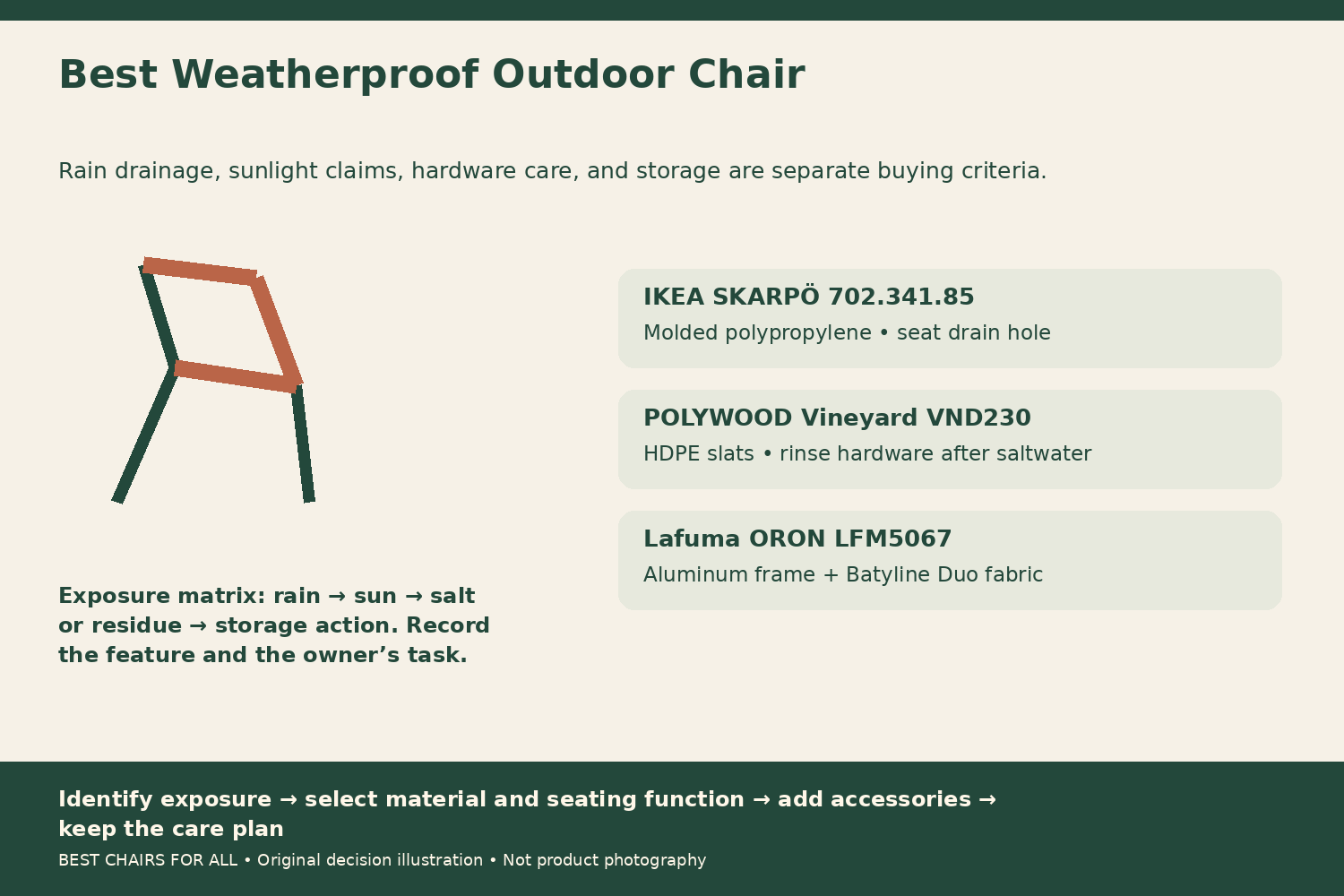
Compare outdoor chair materials and weather resistance before treating a weatherproof label as permission for permanent exposure.
Our shortlist compares IKEA SKARPÖ outdoor armchair 702.341.85, POLYWOOD Vineyard Dining Arm Chair VND230, and Lafuma ORON armchair LFM5067_9717. All three can be used without a separate upholstered cushion system. They offer three documented constructions: molded polypropylene with a drain hole, HDPE lumber with outdoor hardware, and an aluminum frame with Batyline Duo fabric.
We reviewed manufacturer pages November 6, 2026. We have not measured accelerated weathering, fading, corrosion, drying time, or storm performance. These are researched candidates for different exposure and seating needs, not a claim that any chair is invulnerable or requires no ownership attention. Prices and inventory vary by seller and configuration.
Describe the exposure before choosing the material
Write where the chair will live. A sheltered balcony, open lawn, coastal deck, and pool-adjacent patio can expose furniture to different combinations of rain, sun, salt, debris, and frequent moving. A chair that suits one location is not automatically the best answer for another.
Separate occasional wetting from persistent trapped moisture. A draining seat can reduce pooling, while a cushion or closed cover can create another drying task. Do not apply a claim about the visible seat surface to every hidden joint or accessory.
Also describe what happens during bad weather. Will the chair stay outside, be covered, stack in a sheltered area, or move indoors? A design's weight and storage format should support that plan. Marketing about outdoor durability is not an anchoring instruction or a published permissible wind speed.
Three weather-ready chair constructions
IKEA SKARPÖ 702.341.85: for a molded seat with drainage
The IKEA US SKARPÖ page identifies polypropylene plastic with recycled content, UV stabilization, a drain hole in the seat, and stackable construction. Its listed seat height is 14.625 inches and the measurement panel gives a tested-for figure of 243 pounds. The drain hole is a specific feature to compare when standing water on a seat is a concern.
Choose it for consideration when you prefer a low molded lounge shape without separate cushions to bring inside. Its broad arms and curved seat should be tried as a whole. It is not an upright dining-chair substitute simply because it is easy to clean.
The limitation is that a simple surface still needs the care IKEA specifies: mild soapy cleaning, wiping dry, protection where practical, and storage with air circulation. The manufacturer also limits stacking to four chairs and recommends moving stackable furniture one chair at a time. Do not turn stackability into an unsupported large-stack handling plan.
Search matching IKEA SKARPÖ 702.341.85 listings on Amazon (paid link). IKEA is the primary model source; an Amazon match is not guaranteed.
POLYWOOD Vineyard VND230: for rigid HDPE-lumber dining seating
The Vineyard Dining Arm Chair page specifies HDPE lumber, a 300-pound capacity, 26-pound weight, 17-inch seat height, and 19.3-inch seat width. Its purpose is dining-oriented seating rather than the low lounge position of SKARPÖ. The rigid slatted construction avoids making an upholstered cushion necessary for the chair's basic function.
It is worth comparing when frequent outdoor meals and a permanent table arrangement are the primary use. Confirm the arm height and underside relationship with the actual table. Weather resistance does not solve a dining-fit problem, and a material chosen for easy care should still support the way you sit.
The tradeoff is handling weight and exposed hardware that still benefits from correct care. POLYWOOD's current care guidance specifically says to rinse hardware with fresh water and towel-dry after saltwater contact. That instruction is a useful limit on any assumption that marine-grade hardware means salt deposits can simply be ignored.
Check matching POLYWOOD Vineyard VND230 listings on Amazon (paid link). Verify the dining armchair rather than another collection height.
Lafuma ORON LFM5067_9717: for an aluminum frame and fabric seat
The ORON Batyline Duo Mistral sable page describes a corrosion-resistant aluminum structure, polyester UV-resistant paint, reinforced glides, and a fabric seat. It lists a 6.6-pound weight and 18.9-inch seat height, and describes stackability and a back crossbar for handling.
Choose it for consideration when you want a relatively light dining-oriented armchair with a textile contact surface rather than molded plastic or rigid slats. The mid-length arms and higher listed seat make it a different fit comparison. Check it with your table and body rather than choosing only by carrying weight.
The limitation is that frame, coating, fabric, and feet remain separate components. An aluminum frame description does not establish that every connection or accessory requires identical care. Use Lafuma's model instructions for cleaning, stacking, and replacement, and confirm current user limits from the supplied documentation.
Check matching Lafuma ORON listings on Amazon (paid link). Batyline fabric names and package quantities should match the researched chair.
A weather-exposure decision matrix
Make four rows titled rain, direct sun, salt or chemical exposure, and storage or wind action. For each candidate, write the documented feature and the owner's next action. Avoid a simple yes-or-no weatherproof box that hides the difference between material resistance and maintenance.
For SKARPÖ's rain row, record the drain hole, then add keeping that opening clear and following IKEA's wiping and storage directions. For Vineyard, record the slatted rigid seat and the manufacturer's cleaning instructions. For ORON, record its fabric seating and ask how the exact fabric should be cleaned and dried.
In the sun row, record only the manufacturer's material or finish claim. Do not invent a fade-free lifespan or assume a darker finish feels the same as a lighter one after exposure. If contact temperature or color appearance is important to you, assess the actual chair in the conditions where it will be used.
In the salt row, note POLYWOOD's explicit rinse-and-towel-dry instruction for hardware. Obtain the corresponding advice for other models if the location is coastal or regularly exposed to pool residues. Do not transfer one brand's chemical cleaning permission to a different paint, plastic, or sling.
For storage and wind action, write the real routine: who moves the chair, where it goes, and how the manufacturer's instructions apply. If you cannot identify an approved way to secure or store it for the conditions you expect, ask the maker before relying on an improvised arrangement.
Compare the complete system after adding accessories
A chair selected to avoid cushion upkeep changes when you add a thick pad. The frame may still tolerate ordinary outdoor exposure, but the new fabric and filling need their own care, drying, and storage plan. Record those tasks separately.
A protective cover can make cleaning easier or reduce exposure, but it must fit the chair and be used with the ventilation and drying routine the manufacturer recommends. Covering a wet chair or cushion is not automatically the same as protecting a dry one between visits.
Floor protectors and replacement feet also need compatibility. A protective pad that traps debris, changes contact geometry, or interferes with stacking can create a different problem. Use measures appropriate for the exact chair and patio surface rather than attaching something simply because the diameter looks close.
If a side table, shade, or accessory clips onto the frame, verify that the manufacturer approves the match. Weather resistance of the chair's base materials is not evidence that an unrelated accessory is structurally or mechanically compatible.
A realistic after-rain routine
Walk through what you will do when you want to use the patio after rain. Check the seat, arms, joints, and any accessories according to the maker's care instructions. A seat that drains can still have wet surfaces where you rest your arms or set an item.
For the SKARPÖ, the molded format and drainage opening are the relevant physical features; keep the intended drainage unobstructed. For the Vineyard, inspect slats and hardware without assuming the lumber's durability eliminates all cleaning. For ORON, check the fabric and frame through its documented care routine rather than claiming a universal quick-dry time.
If the chair needs to move, use the intended handling points and the weight you can manage. A light chair can be easier to relocate, while a heavier permanent chair may suit a different routine. Neither weight by itself establishes behavior in a storm.
Dry and store accessories in their appropriate place before closing the area for a long period. Choose a routine that fits an ordinary weekday, because a complicated plan is unlikely to be repeated consistently just because the product page promised easy care.
What warranty language can and cannot answer
Read the warranty for the exact model and intended setting. A long warranty headline may apply to one material, one type of use, or a defined category of defects. It does not automatically establish coverage for appearance changes, neglected care, accidental damage, or every environment.
Keep the receipt and model label available. Photograph shipping damage and contact the seller before trying to repair a new chair. For later structural damage, obtain matching parts or manufacturer guidance rather than assuming that a synthetic material can be patched by any convenient adhesive.
Do not confuse a general standard or test claim with proof that the chair suits an unrelated use. A chair intended for outdoor seating is not automatically approved for submersion, a pool ledge, or exposure beyond its documentation. Buy a product specifically intended for those conditions if that is the actual requirement.
A simple written care card can live with the receipt: list the model, material, approved cleaning method, and exposure-specific action. That prevents a later owner or helper from treating every synthetic outdoor chair with the same product or storage routine.
Match resilience to the way you sit
Try SKARPÖ for low molded lounging and drainage, Vineyard for rigid HDPE dining seating, and ORON for a lighter aluminum-and-fabric dining chair. The material choice should complement the activity rather than replace a personal fit assessment.
Check exact product number, quantity, accessories, delivery, and return costs. This guide makes no hard budget promise because prices and configurations vary. A low advertised chair price can also omit a cushion shown in a photograph or refer to a multi-chair pack differently than expected.
Your exposure matrix should explain the decision in practical terms: what resists the expected weather, what still needs care, and what you will do when conditions change. That is a more useful definition of a weather-ready purchase than treating one broad label as a promise about every part of the chair.
Something unclear or out of date? Send a correction with this article’s title and the detail to check.
Sources, research & corrections policy ↗