An Adirondack chair is itself a kind of outdoor lounge chair, so the useful comparison is between seating positions and footprints rather than two completely separate categories. A classic low Adirondack, an upright Adirondack, a cushioned lounge armchair and a full-length chaise can all suit different versions of relaxing outdoors. Decide whether you want feet on the ground, feet on a separate ottoman, or a supported full-length position.
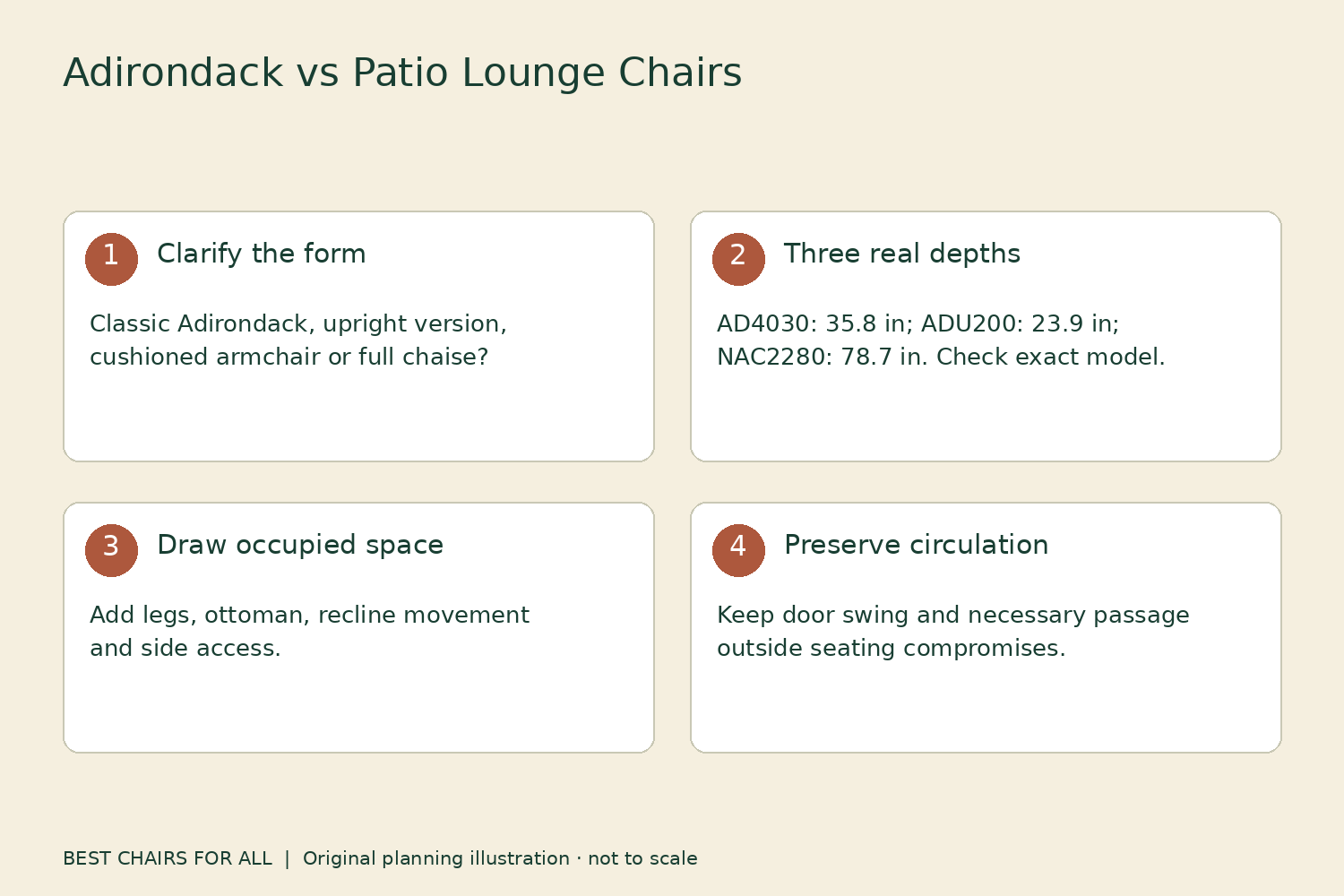
Then check how much usable patio space remains when someone is actually seated. Overall chair dimensions do not include every foot, elbow or standing movement. A compact-looking seat can use substantial space once you add an ottoman; a long chaise may simplify leg support while occupying far more of the patio. The layout exercise below makes those differences visible.
Clarify which lounge chair you mean
Retailers use “lounge chair” for several forms. A deep cushioned armchair is not the same as a chaise with an integrated leg platform. A reclining armchair adds another variation, especially if its back moves beyond the normal footprint. Write the actual configuration in your comparison notes before collecting dimensions.
For each candidate, record whether the back angle is fixed or adjustable and whether leg support is integrated, optional or absent. Do not assume that a tall back reclines, that a low seat includes a footrest, or that an ottoman is supplied. Pictures often show accessories whose dimensions and storage needs belong in a separate part of the plan.
Describe the intended activity as well. Reading, conversation, looking at the garden and reclining after a swim use different positions. A chair can be excellent for one without being a versatile dining seat. Keep the purchase centered on the outdoor routine you want instead of asking one design to perform every sitting task equally well.
A classic Adirondack is usually a committed position
The POLYWOOD Classic Adirondack AD4030 is described with a relaxed recline and low sitting position. Its current specification lists an overall depth of 35.8 inches. That example illustrates why the traditional silhouette needs more depth than a narrow seat-width figure might suggest.
Sit fully into a candidate and try ordinary standing. A sloped seat can place the occupied position lower toward the back than the front-edge measurement implies. Check whether your feet can move where you naturally need them. If the chair does not suit your movement, do not assume a cushion or different material will solve the geometry.
The wide arms associated with many Adirondack designs can be convenient, but overall width includes them. Compare usable seat width separately from outer width. A chair can occupy a broad patio position while having a relatively narrow sitting area. Try the intended clothing and avoid treating a product’s “oversized” name as a reliable measurement.
Upright Adirondacks change the comparison
The POLYWOOD Classic Upright Adirondack ADU200 has a different geometry from the Classic model. The linked dimensions list 23.9 inches of overall depth and a 17.5-inch seat height. Those are model-specific figures, but they demonstrate that an Adirondack silhouette does not guarantee one low, deep position.
Use the current dimension table for the exact version, and clarify any conflicting information before purchase. Product questions and older catalog entries may describe a previous configuration. A good comparison keeps the model identifier alongside the measurements rather than combining a seat height from one listing with a footprint from another.
An upright variation may suit conversation or regular entry and exit better for some users, but only a personal fit trial establishes whether it works for you. Do not interpret a higher seat as a universal accessibility solution. Arm spacing, seat angle, stability and the person’s movement still matter. Seek individualized advice when needed for a specific mobility requirement.
Cushioned lounge armchairs use depth differently
A cushioned patio armchair often relies on both the frame and cushions to establish the occupied position. A bare frame measurement does not describe the usable seat once thick back cushions are installed. Measure with the intended cushion system, especially if you are replacing existing furniture and want a comparable depth.
The IKEA NÄMMARÖ guide lists its lounge chair at 27⅛ inches wide and 30⅝ inches deep. This provides another real footprint to compare with the named Adirondacks. It is not a claim that all cushioned chairs are shallower or that the bare dimensional rectangle predicts comfort.
Check how the cushion stays in position and where it goes when removed. A deep lounge chair may be appealing for an evening, yet its cushions can require more storage than the frame suggests. Include their quantity and thickness in the ownership plan. A chair that depends on cushions for its intended fit also depends on having dry cushions ready to use.
A chaise is a separate space commitment
The POLYWOOD Nautical Chaise NAC2280 lists a 78.7-inch overall depth and multiple lounging positions. Its length makes clear why a chaise should be drawn separately rather than represented by a generic chair symbol. Check the full operating envelope for the selected back position and the maker’s adjustment instructions.
Try entering and leaving the chaise from the side where you intend to place the access route. A long seat can fit against a wall while leaving no convenient side approach. Keep space for your feet to reach the ground and for ordinary standing. Do not evaluate the layout only from an overhead photograph of an unoccupied chaise.
If the chaise folds or stacks, confirm the exact storage procedure and permitted stack arrangement. Those features are model-specific. Folding can reduce storage volume without making a heavy chair easy to carry through a narrow door. Record the folded dimensions, item weight and available handling points before treating storage as solved.
Draw four layers of space
Start with a scale drawing of the usable patio area. Add fixed obstacles and the door’s actual swing. Next draw the chair’s overall width and depth. Then add the occupied space: legs, ottoman or chaise approach, plus any permitted recline movement. Finally draw a separate route for people passing through.
Use a hypothetical 10-foot-deep patio to see the arithmetic. A 36-inch chair footprint leaves 84 inches before any occupied legroom, table or path is considered. A 79-inch chaise footprint leaves 41 inches. These rounded invented dimensions explain the subtraction; they do not establish a suitable clearance or specify a particular product arrangement.
Keep door operation, required egress and applicable building or venue rules outside furniture compromises. Do not reduce a necessary route merely because the chair technically fits within the floor boundary. If the arrangement only works when nobody stands or opens the door, it does not provide usable seating for that location.
A position-and-footprint worksheet
| Measure or observe | Why it matters |
|---|---|
| Overall width and depth | Locates the frame within the patio |
| Occupied seat position | Shows the actual depth and height you use |
| Back movement if adjustable | Identifies space behind the normal footprint |
| Ottoman or integrated leg support | Accounts for the full lounging arrangement |
| Entry and standing area | Tests ordinary access from the intended side |
| Passage and door swing | Preserves circulation around seated users |
| Storage form | Confirms where frame and cushions go off season |
Use the worksheet on each actual candidate. Avoid category shortcuts such as “Adirondacks are too large” or “lounge chairs are easier to move.” A particular upright Adirondack may occupy less depth than a deep cushioned armchair. A chaise can be narrow yet dominate the long dimension. The record makes the specific compromise clear.
Test reach and conversation
Set an unheated side table beside the candidate during a fit trial. Check whether its surface is within a comfortable ordinary reach without twisting over an arm or leaning beyond the chair. A low reclined position may call for a different table than an upright seat. Do not infer a suitable table height from chair overall height.
If several chairs will form a conversation group, compare occupied eye levels and the angle toward the shared center. One deeply reclined chair among upright armchairs can feel disconnected even when the colors match. Rotate positions in the layout before buying a larger table or squeezing chairs closer together. A small orientation change can improve the arrangement without sacrificing a passage.
Keep hot objects and flames out of these fit trials. A fire-pit layout needs its own appliance clearances and local fire rules, not merely a pleasing chair circle. Materials such as cushions, wood and polymer may be combustible or heat-sensitive. A chair’s outdoor-use label does not give a universal safe distance from a fire source.
Choose the complete lounging arrangement
Favor a classic Adirondack if you want its specific reclined position and the personal fit trial works. Consider an upright variation for a different sitting angle and potentially different footprint. Consider a cushioned lounge armchair when its cushion-dependent support and storage demands fit the routine. Choose a chaise when full-length support justifies the floor area and access it needs.
For a shared patio, ask each regular user to try the proposed arrangement. A position that suits one person can leave another wishing for a different back angle or firmer arm support. Two complementary chairs may serve the household better than a matched pair selected only for symmetry. Keep their outer dimensions in the same drawing so the mixed arrangement remains practical.
Before ordering, mark the selected outline in the actual space with removable materials suitable for the surface. Open doors, walk the route and simulate the ottoman or chaise length without creating a trip hazard. Keep the dimension sheet and model identifier with the plan. The right chair leaves a patio you can use while occupied, including the ordinary movements around the relaxing position you chose.
Something unclear or out of date? Send a correction with this article’s title and the detail to check.
Sources, research & corrections policy ↗