Choose an Adirondack chair by checking two sets of dimensions: the space your body uses and the space the chair occupies. Seat height, usable width, depth, slope, and arm position influence fit. Overall width and depth, plus room to approach and stand, determine whether the chair works on your patio.
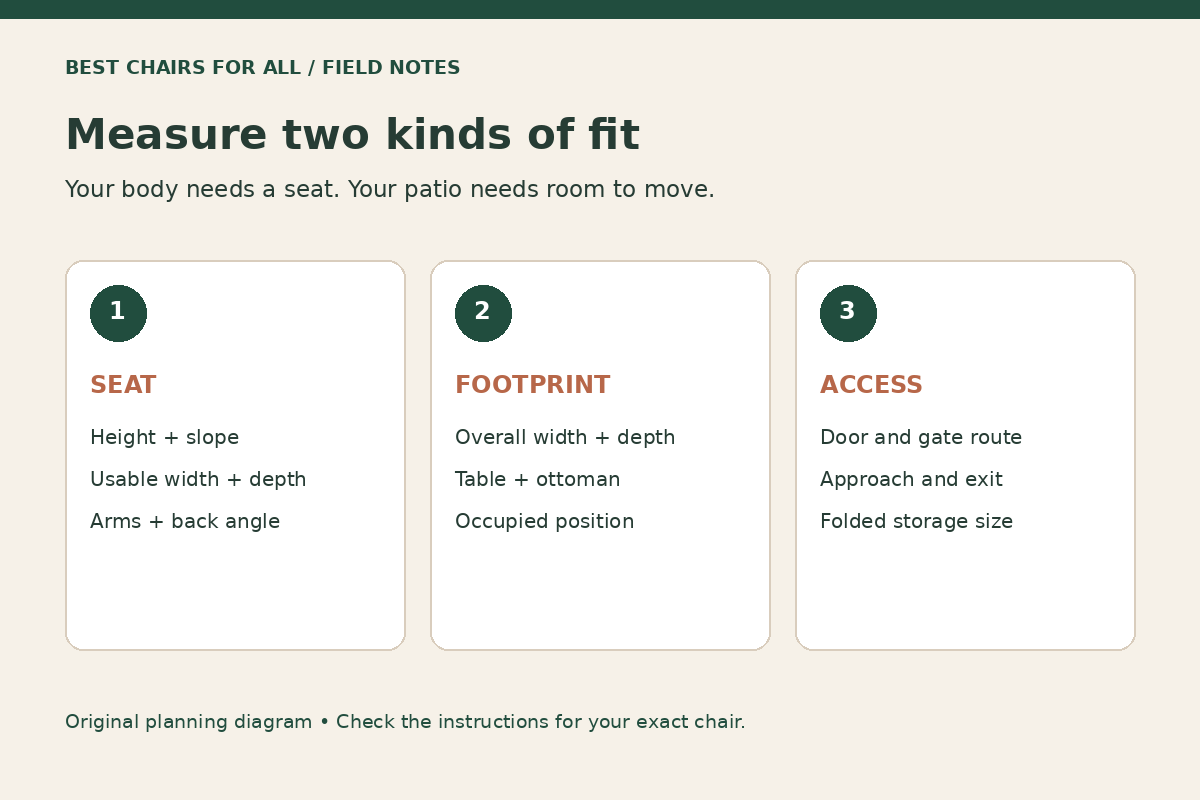
There is no single Adirondack size that suits every person or every setting. A low, reclining design can feel appealing for a long rest but awkward for someone who wants an upright seat and frequent easy exits. Measure before buying, then try the actual design if possible. Numbers narrow the shortlist; they cannot fully describe a contoured seat.
Read overall dimensions and seat dimensions separately
Overall width is the broadest outside measurement, often across the arms. Seat width is the usable sitting area. Overall depth describes how far the chair extends from front to back; seat depth describes the area under you. Confusing those pairs can produce a chair that takes up plenty of patio space without offering the room you expected.
As one documented example, the current dimensions table for the POLYWOOD Classic Adirondack AD4030 lists 28.8 inches overall width and 20 inches seat width. The same table lists 35.8 inches overall depth and 16.9 inches seat depth. These figures demonstrate the distinction rather than establish an ideal size.
Make a short comparison sheet for every candidate. Copy the model code, seat height, seat width, seat depth, arm height, overall width, overall depth, and overall height into separate fields. Leave missing fields blank and ask the manufacturer. Do not fill a gap with a measurement from a visually similar chair.
Seat height needs a location and a context
An Adirondack seat usually slopes, so ask where a quoted height is measured. The front edge and the place where your weight settles are not necessarily the same height. A cushion can change the sitting position again. If the specification is unclear, request a side drawing or a measurement explanation.
Compare with a chair you already use comfortably. Wear your usual outdoor footwear, sit back, and observe whether your feet rest comfortably, whether the front edge bothers your legs, and whether standing requires an effort you would rather avoid. Record that chair’s measurements as a personal reference.
A higher number is not automatically better. If it leaves your feet poorly supported, it creates a different mismatch. Your goal is a workable combination of height, slope, and depth. A short in-person trial is especially useful when changing from a level dining chair to a much more reclined outdoor seat.
For a comparison outside the POLYWOOD examples, L.L.Bean’s All-Weather Adirondack Chair, Square-Back (item TA528193) lists a seat height of 13.76 inches, a seat area 17.9 inches deep by 20.5 inches wide, and an overall footprint 29.25 inches wide by 32.11 inches deep. Those are that named model’s published dimensions, not a standard for every Adirondack. Keep seat measurements and the full footprint in separate worksheet columns, then verify the version and cushion arrangement you intend to order.
Traditional and upright designs can fit very differently
Do not reject the entire Adirondack style after trying one unusually low chair. Upright versions change the sitting geometry while retaining familiar arms and slatted styling. Look for drawings and descriptions that identify the seat position rather than treating a tall back as evidence of a high seat.
POLYWOOD’s comfort and ease-of-use guide lists its Classic Upright Adirondack at a 17-inch seat height and its Modern Upright at 17.75 inches. That is different from the Classic AD4030’s listed 13.9 inches. These model-specific examples show why the word Adirondack alone is insufficient.
For a person who needs particular support while standing, ask about the real movement and use. Explain whether they push on the arms, require a less reclined seat, or use other equipment nearby. Leisure-chair dimensions do not certify a chair as a mobility aid. Resolve specific accessibility needs with appropriate professional guidance and the manufacturer.
Seat width should be usable width
Measure between the areas that actually constrain your body, including arms or inward-curving components. A seat may widen toward the front, so a single maximum width can hide a narrower area nearer the back. Ask where the manufacturer’s width was taken if that distinction matters to your fit.
Use a familiar chair to estimate the width you prefer, allowing for the clothes you wear outdoors. A broad seat can be welcome, but arms placed far apart may be inconvenient if you want to rest both forearms. Compare the whole relationship rather than selecting the widest option available.
If several people will use the chair, record their differences. Buying identical chairs for visual symmetry is a design choice, not proof that everyone will find the same dimensions comfortable. You may prefer coordinating chairs with different seat geometry, or a mix of Adirondack and upright seating in the same area.
Seat depth and back angle work together
A deep seat can make it difficult to sit fully back while keeping your legs in a comfortable position. A shallow seat may not give you the support you prefer. Back angle and seat slope change that experience, which is why depth alone should not decide the purchase.
During a trial, sit as you expect to sit at home. Put your hands on the arms, look toward the view, and notice whether you naturally slide forward or add a cushion behind your back. Needing a small cushion by preference is different from relying on one to rescue a fundamentally unsuitable fit.
If you plan to use an ottoman, check the matching accessory’s dimensions and position. It extends your occupied space and changes the way you use the seat. Avoid assuming a random footrest will align with the chair simply because both pieces are sold as outdoor furniture.
Arm height affects use as well as appearance
Wide Adirondack arms are visually prominent, but their height and spacing affect how you rest your shoulders and forearms. An arm that feels too high or too far away can reduce the comfort you expected from a larger chair. Try both relaxed sitting and the movement of standing.
Check whether side tables sit conveniently beside the arms. If a table is much lower, you may repeatedly lean to reach it; if it is too close, it can block your approach. Mock up the chair and table together rather than treating the table as an unrelated purchase.
Do not assume an arm is designed to carry any load you place on it. Follow the manufacturer’s use instructions, including restrictions on sitting or standing on components. A broad horizontal surface may look like a perch without being intended as an additional seat.
Measure the patio with the chair in use
Mark the overall footprint on the ground using removable tape or cardboard, then include the way a person approaches, sits, stands, and walks past. A rectangle matching the product dimensions is only the beginning. Your knees and feet can extend beyond it, and another chair or table can make the remaining route awkward.
Open nearby doors and gates. Check the route to a grill, hose, stairs, and storage. Place the mock-up where you want to enjoy the view, then walk through the area carrying the things you normally carry. This exposes problems that a photograph or simple area calculation may miss.
Keep furniture clear of door operation and required exits, and follow applicable building rules for circulation and accessible routes. This guide does not prescribe a universal clearance. Your setting, users, and local requirements determine what must remain open.
Use an illustrative two-chair calculation
Suppose each candidate chair is 30 inches wide and 36 inches deep, and you want a 20-inch-wide table between them. The furniture alone occupies 30 + 20 + 30 = 80 inches across before you add separation, approach space, or walking room. This is an example using hypothetical dimensions, not a spacing standard.
If the usable patio strip is 90 inches wide, fitting those objects into the strip leaves only 10 inches in total for every additional gap. That may be impractical for your chosen arrangement. The useful response is to build the mock-up, consider another layout, or select narrower pieces before ordering.
Add ottomans as separate objects and test where you will move them when they are not in use. If chairs will face inward, account for their angled footprints rather than simply lining up their catalog widths. A sketch with actual measurements is more reliable than judging whether the patio looks big enough.
Plan storage and delivery before choosing a larger chair
Check the narrowest doorway or gate between delivery and the final location. Confirm whether the chair arrives assembled, partly assembled, or as components. An overall assembled width that exceeds a door opening does not automatically prevent delivery, but it means you need a documented assembly and access plan.
For folding models, obtain folded dimensions. The assembled footprint does not tell you the shape it takes in a shed or garage. Measure the storage space and consider whether you can carry the chair safely along the full route. Do not buy a folding design solely because the label suggests convenient storage.
If you are comparing larger models, POLYWOOD’s tall and roomy seating guide provides separate model dimensions and capacities. Use such tables to identify candidates, then verify current specifications and handling instructions for the exact item.
A measurement worksheet to use before ordering
| Record | Why it matters |
|---|---|
| Exact model code | Keeps specifications and accessories aligned |
| Seat height and measuring point | Helps compare the actual sitting position |
| Usable width and depth | Separates body fit from exterior size |
| Arm height and spacing | Helps assess forearm support and table reach |
| Overall width and depth | Defines the initial patio mock-up |
| Ottoman or movement space | Accounts for the chair while occupied |
| Folded or delivery dimensions | Checks access and seasonal storage |
| Capacity and return terms | Resolves eligibility and fit uncertainty |
Keep your own measurements beside each candidate’s figures. If a crucial dimension is missing, send the brand one clear question with the model number rather than relying on a marketplace answer about a different version. Save the reply so you can check the delivered chair against what you expected.
When the chair arrives, assemble it exactly as instructed and inspect it before use. Confirm the model and recheck the fit in your planned location. A successful choice gives you a comfortable sitting position, a workable exit, and a patio that still functions when the furniture is occupied.
Something unclear or out of date? Send a correction with this article’s title and the detail to check.
Sources, research & corrections policy ↗