As an Amazon Associate, we earn from qualifying purchases. Read our affiliate disclosure.
A camping chair with a canopy is useful when you want a small personal patch of shade without carrying a separate shelter. The best one depends on whether you need to follow a moving sun, carry the chair a long way, or sit within a crowded sideline. Canopy fabric, chair fit, and actual coverage need separate checks.
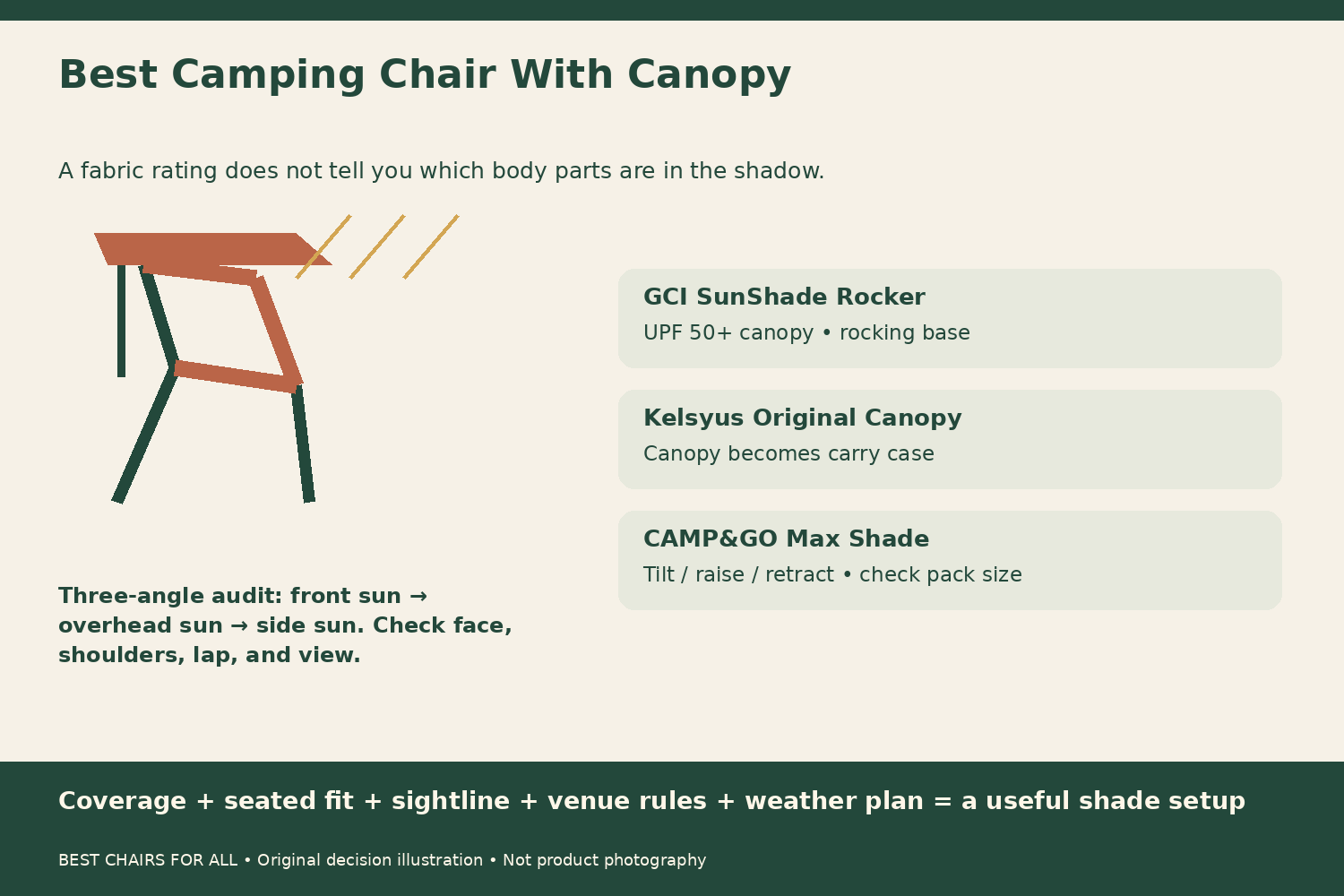
The models worth comparing are the GCI Outdoor SunShade Rocker, Kelsyus Original Canopy Chair, and CAMP&GO Heavy Duty Max Shade Quad Camping Chair. They combine a portable seat with shade in different ways: adjustable shade plus rocking, a canopy that doubles as a carrying case, and an adjustable Max Shade arrangement. They are researched candidates rather than chairs we have personally tested.
Research was reviewed November 6, 2026. Stock is an explicit limitation: GCI and the researched Lowe's Kelsyus listing showed unavailable or out-of-stock messaging in the retrieved pages. They remain useful model comparisons, but verify an actual delivery date with your chosen seller. Amazon search links are not a promise that an identical chair is currently available.
Shade rating and shade coverage are different questions
A UPF rating describes a fabric's performance under its test conditions. It does not tell you how much of your body the canopy shades at a particular hour. A highly rated fabric cannot block sunlight that passes under its side or reaches your legs beyond the edge.
CDC's sun-safety guidance recommends combining shade with protective clothing and sunscreen, and notes that UV can reflect from surfaces including water, sand, and concrete. A canopy chair should fit into that broader plan. It should not be described as complete sun protection merely because its roof fabric carries a rating.
For this reason, judge the seat and shade as an assembly. A tall canopy may feel open and airy yet admit more low-angle light. A low tilted canopy may improve face shade but obstruct your view of a game. The most useful design is the one you can position for the activity without repeatedly leaning into an uncomfortable posture.
Three model-specific comparisons
GCI Outdoor SunShade Rocker: for adjustable shade and motion
The SunShade Rocker manufacturer page lists an adjustable UPF 50+ canopy, a tall angled backrest, mesh back panel, phone pocket, and spring-action rocking. Its stated capacity is 250 pounds and item weight is 13 pounds. GCI describes the canopy as rotating forward and back or collapsing when not needed.
Choose it for consideration if rocking is part of the reason you want the chair and you prefer to adjust shade with the sun's direction. The combination can simplify a sports-day setup by putting shade and motion in one item. Check the viewing position with the canopy lowered, because the shade that helps your face may occupy the same space as your sightline.
The limitations are the weight you must carry, the capacity, and the need for suitable level ground. A rocker adds movement to a shade-supported chair, so test both features together. GCI's researched page showed sold-out messaging for the selected option; confirm the exact color and delivery status elsewhere.
Check matching GCI SunShade Rocker listings on Amazon (paid link). SunShade Eazy and beach variants are different chairs.
Kelsyus Original Canopy Chair: for a case built into the shade
The researched Kelsyus listing at Lowe's describes a canopy that folds around the chair to become its carrying case, with straps for transport, a cup holder, and a 250-pound user limit. It reports 50+ UPF canopy protection. The packing arrangement is its strongest distinguishing feature.
It is worth considering when separate chair bags regularly get lost or become difficult to repack. Combining the case and canopy removes that loose item from the departure checklist. However, the arrangement also means the shade must be folded and secured correctly before carrying; try that process rather than judging convenience from a staged image.
The Lowe's page was out of stock at research time. Confirm the exact version in any alternative listing, since Original, Premium, and all-weather names may not describe an identical chair. Use Spin Master's SwimWays support to find the correct Kelsyus folding instructions rather than forcing unfamiliar supports.
Check matching Kelsyus Original Canopy Chair listings on Amazon (paid link). Verify the adult model and included carry arrangement.
CAMP&GO Heavy Duty Max Shade: for adjustable stationary seating
The ShelterLogic product page describes manually tilting, raising, and adjusting the Max Shade, with the canopy retracting behind the seat when not needed. It also identifies an oversized cup holder and a phone holder. This is the stationary-seat alternative to the SunShade Rocker's moving base.
The feature to evaluate is how easily the available canopy positions match your face and upper-body coverage while preserving the view. A stationary chair may be preferable if rocking would bother adjacent spectators or if you simply want a conventional quad-chair experience. The adjustable roof is the relevant function, not the presence of a large shade in a photo.
Read quantity information especially carefully: the researched page identifies model QC300CP-454PDQ4 and a pack-of-four arrangement. Confirm whether the checkout price is per chair or per pack. We do not infer a capacity or UPF number from the words heavy duty or Max Shade when the retrieved specification does not establish it.
Check matching CAMP&GO Max Shade listings on Amazon (paid link). Verify the model and pack quantity.
A three-angle shade audit
Use this simple exercise before deciding whether a canopy design suits your day. Imagine the sun in front of the chair, high above it, and to one side. For each position, record which areas you expect to shade: face, neck, shoulders, lap, and lower legs. Mark uncertain coverage rather than assuming the entire silhouette is protected.
If you can try the chair outside, repeat the exercise with the actual shadow while remaining appropriately protected. Keep your normal posture and activity. Do not lean forward merely to bring your face inside the shadow if that is a posture you would dislike through a whole game.
At the front-angle position, check whether tilting the canopy blocks the scoreboard, stage, trail view, or person you are speaking with. At the overhead position, check headroom and whether the canopy meets your head when you stand. At the side position, ask whether the shade adjusts laterally or whether you must rotate the entire chair.
Now add the event constraint. A camper can often reposition a chair; a spectator in a designated row may have little freedom to turn. A design that works in an open campsite may therefore disappoint beside a sports field. Check the venue's chair and canopy rules as well as its available space.
Finish the audit by listing what remains exposed and how you will handle it. The result should be a realistic coverage plan, not a claim that one canopy eliminates all UV exposure. A hat or other sun-protection measure may still matter when the sun approaches from a direction the chair cannot address.
Think about the people around the chair
A canopy expands the occupied space above and around a seat. In a crowded row, it can intrude into another person's view or touch neighboring equipment. Examine the full deployed shape and its adjustment path, not just the seat's footprint.
Leave room to enter and leave without ducking into hinges or stepping across supports. For children accompanying an adult, keep small hands away from folding mechanisms and supervise the setup. This guide compares adult chairs; it does not establish that a canopy seat is suitable for a child simply because the child is below a listed weight.
Consider a stationary option if nearby movement would be distracting. Consider whether a tall back and canopy would block spectators behind you. The most convenient personal shade is still subject to event rules and ordinary shared-space courtesy.
Wind, rain, and the limits of a personal canopy
A shade canopy is not automatically a rain shelter or a wind-rated structure. Unless the exact product documentation states otherwise, do not infer waterproof performance, storm resistance, or a permissible wind speed. A small roof can still catch wind when the chair is unoccupied.
Review camping chair canopy wind precautions and the exact manufacturer’s instructions before relying on a canopy at an exposed site.
Follow the manufacturer's instructions for retracting or storing the canopy. Do not add weights to hinges, tie it to unrelated structures, or alter the support poles to keep it open. If conditions make the chair unstable or the canopy difficult to control, pack it away and use an appropriate sheltered location.
For damp fabric, allow drying before long storage. Inspect the canopy supports and seams after transport, particularly if the frame has been squeezed into a full vehicle. The case-conversion design on a Kelsyus needs its own folding sequence; a generic quad-chair routine may stress the wrong parts.
A sideline example that reveals the tradeoff
Consider an afternoon game where the seating row faces a fixed direction. Early in the event, the sun may approach from the side; later, a forward canopy tilt may place more of your face in shadow. If the chair only adjusts front to back, rotating the seat could improve shade while turning you away from the play. Record that conflict in the audit rather than assuming a larger canopy resolves it.
Now compare a campsite where the chair can be moved freely around a picnic area. The same adjustment range may be sufficient because you can rotate the entire chair while it is unoccupied. The product has not changed, but the setting has changed which feature matters. This is why a canopy recommendation should name an activity as well as a model.
Also plan where the folded chair goes during a break. A canopy that is easy to retract can matter when you repeatedly move between games or need to clear a walkway. Try the transition with an empty cup holder and no loose items on the seat before assuming the chair will move as one convenient package.
A buying decision for your actual outing
Choose your first comparison by activity. Start with the SunShade Rocker if motion is a priority and its carrying weight is acceptable. Examine the Kelsyus when an integrated carrying case solves a real packing problem. Compare the CAMP&GO when adjustable shade on a stationary chair better suits the setting.
Then apply the shade audit, seated fit, venue rules, and confirmed availability. Prices shown in a search result may refer to a pack, a particular color, or a different generation, so compare delivered quantity before drawing budget conclusions. None of these model-search links is a verified fixed-price recommendation.
A successful canopy chair purchase gives you shade you can actually position, a seat you want to use, and a package you can transport. Checking all three is more useful than choosing the largest roof or the boldest sun-protection phrase in the listing.
Something unclear or out of date? Send a correction with this article’s title and the detail to check.
Sources, research & corrections policy ↗