A camping chair canopy adds an exposed fabric surface above the seat, so wind decisions need more than the chair’s load rating. Read the canopy instructions for the exact model, check the current weather and put the shade away before conditions make it difficult to control. If the manufacturer does not publish a wind limit, do not invent one from a weather app, the chair’s weight or how firmly an occupant can hold it.
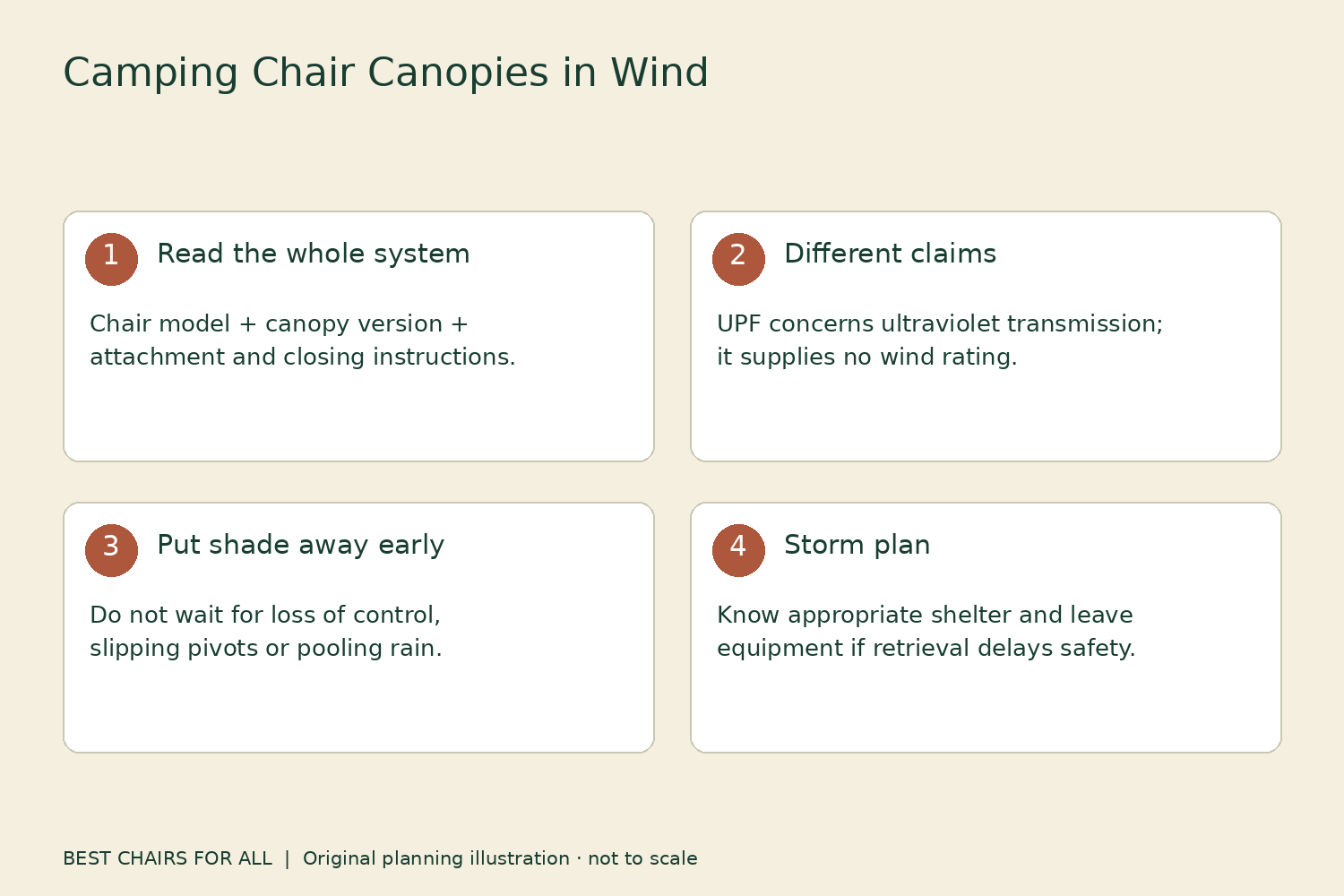
A personal sunshade is also different from a storm shelter. A UPF rating concerns ultraviolet protection through the rated material, not wind resistance, waterproofing, lightning protection or the strength of the frame. The practical goal is to use shade within its intended conditions and have a simple plan for closing and storing the chair when those conditions change.
Find the instructions for the whole assembly
Identify the chair model and whether the canopy is original, an approved accessory or a third-party attachment. Each configuration can have different connectors and folding instructions. A clamp that fits a tube does not establish that the chair was designed for the added loads. Ask the chair and canopy makers about compatibility before attaching an unfamiliar shade.
Read the setup, adjustment, closing and weather sections together. A canopy may need a particular position before folding the chair. There may be straps or clips that hold the packed assembly. Know which components remain attached and which must be removed. Practice without an occupant and keep fingers away from joints as the shade moves.
For an example of a defined design, the GCI Outdoor SunShade Rocker page describes an adjustable canopy that rotates forward and backward and can collapse. That information explains its shade function; it does not supply a universal operating wind speed. Follow the instructions for the actual model you own rather than transferring its adjustment method to another product.
Separate sun coverage from weather protection
Look at where shade falls during the intended sitting period. Sun position changes, and the fabric can shade the head while leaving arms or legs exposed. Adjust only through the canopy’s permitted range. Do not extend it by hanging a towel or extra panel from the frame unless the manufacturer specifically approves that arrangement.
An added towel can change the exposed area and pull on attachment points in ways the original design did not anticipate. It can also obscure your view of other people or a changing sky. If the canopy does not provide the coverage you want within its designed adjustment, use appropriate personal sun protection or a different approved shade arrangement for suitable weather.
Rain protection requires separate confirmation. GCI’s product support says its canopies are not waterproof, should not be used in heavy rain, and can be damaged by pooling water. That is a named manufacturer’s limitation. Do not assume a curved fabric roof sheds every shower or that sitting underneath it makes its frame suitable for accumulating water.
Check the forecast before opening the canopy
Use the forecast for the actual venue and time of the outing, including gusts and warnings, rather than the weather near your home several hours earlier. A beach, ridge, open sports field and sheltered yard can have different exposure. The forecast does not certify equipment suitability, but it helps you decide whether using a canopy is appropriate at all.
The National Weather Service wind hazards page warns about loose outdoor objects and falling or blowing hazards. A chair canopy belongs in that broader site assessment. Look above and around the intended seat as well as at the shade itself. Avoid placing a chair where branches, signs or unsecured nearby equipment create additional hazards.
Do not wait for an official warning before following a stricter product restriction or putting away equipment that is moving unexpectedly. Conversely, do not treat a lack of warning as proof that a particular canopy is safe. Weather alerts describe broader conditions and hazards; a product’s operating limits still need to come from its own manufacturer.
Watch the attachment points
Before use, check the canopy fabric, seams, support rods, pivots, clips and any fasteners the manual identifies. Look for cracks, bent components, loose attachment or stitching that has started to open. Do not use a damaged canopy on the assumption that the seat frame remains sound. The shade assembly has its own condition requirements.
Move the canopy through its allowed adjustment while the chair is unoccupied and conditions are suitable. Confirm that it stays in the positions the design intends. If a pivot slips, a clip releases or the fabric pulls asymmetrically, stop and ask support. Tightening an unidentified joint or adding a cable tie may interfere with its intended operation.
Keep the canopy’s folding path clear of bags, clothing and fingers. A child should not be asked to hold a support while an adult folds the chair. If the shade becomes difficult to control in wind, prioritize moving people to an appropriate safe place rather than struggling with a mechanism beside them. Equipment can be replaced; do not turn retrieval into the main objective during deteriorating weather.
Do not calculate a personal wind rating
It is tempting to estimate a safe speed from the size of the fabric or the occupant’s weight. That calculation would require much more information than a product listing provides, including the shape, connection strength, gust behavior and support conditions. A household estimate cannot replace the manufacturer’s limits or establish a safe threshold.
An occupied chair and an empty chair behave differently, but remaining seated to act as ballast is not a safety plan. People need to get up, use facilities and leave. The seat’s capacity rating concerns its intended seating load, not resistance to uplift or sideways wind forces. It should never be repurposed as a canopy anchoring specification.
Avoid hanging weights from the canopy rods, clamping it to a fence or tying the upper frame to nearby furniture without explicit product instructions. These modifications change how forces reach the chair and can create trip lines or other hazards. A manufacturer-designed anchor for one chair is not automatically approved for another chair or for a canopy attachment.
Make a simple pack-away decision card
| Situation | Decision |
|---|---|
| Manufacturer prohibits the current conditions | Do not use the canopy |
| No published wind limit | Do not invent a threshold; use maker guidance and conservative judgment |
| Loose clip, slipping pivot or damaged support | Stop use and seek the correct repair |
| Chair will be unattended | Close and store or secure only as instructed |
| Rain pools on fabric | Stop canopy use and follow maker guidance |
| Thunder or storm warning | Follow weather safety guidance and reach appropriate shelter |
Keep the closing instructions with the card, particularly if different household members carry the chair. An effective plan identifies where the folded chair goes and how you leave the site. Do not rely on a vague promise to “watch the weather” while your phone, bag and keys are scattered around the seating area.
Plan for an empty chair
At a sports event or campsite, the chair may spend more time empty than expected. Fold the shade when the instructions require it and store the chair when conditions could move it. Do not leave lightweight gear standing at the edge of a path, water or a drop where a gust could carry it into another person or out of reach.
If event rules prohibit canopies or specific chair styles, follow those rules even in calm weather. Venue restrictions can involve sightlines, crowd movement and other concerns separate from wind. Verify the current policy for the actual event. A product’s marketing phrase about sports use does not establish permission to deploy its shade in every seating area.
For a group outing, assign responsibility for packing shared equipment. This avoids everyone assuming someone else will fold an empty chair. Keep the carry strap and closure accessible rather than buried in a car. Knowing the packed sequence reduces the chance that someone forces the canopy into an incorrect folded position while trying to leave quickly.
A chair canopy is not lightning shelter
The National Weather Service lightning safety guidance makes clear that outdoor thunderstorm decisions require appropriate shelter. A fabric chair shade does not provide it. Plan where you will go before a storm approaches and follow official guidance when thunder or other warning signs occur.
Do not seek shelter under an isolated tree because it also seems to reduce wind around the chair. Site hazards need to be considered together. Keep the route to appropriate shelter available and leave equipment behind if collecting it would delay getting safe. A shade adjustment cannot solve a thunderstorm exposure problem.
After difficult weather, inspect the chair and canopy before the next use. Check for bent supports, damaged clips and new fabric tears, even if the assembly still opens. Dry wet components fully according to the maker’s instructions before packing. Record any unresolved damage so the next person does not mistake a folded canopy for one that has been checked and is ready.
Choose convenience within the product’s limits
A canopy chair can be useful when its shade coverage, packed size and adjustment suit your normal outings. Choose a model with clear instructions and a closing sequence you can manage. Evaluate the complete package, including how it will be carried and stored, rather than counting only the shade’s advertised features.
The most useful wind rule is the one you can actually follow: know the manufacturer’s restrictions, monitor conditions, keep attachments sound and put the equipment away before control becomes difficult. When the documentation leaves a safety question unresolved, contact the maker or use a simpler seating arrangement. Do not fill that gap with a guessed speed or an improvised anchoring system.
Something unclear or out of date? Send a correction with this article’s title and the detail to check.
Sources, research & corrections policy ↗