As an Amazon Associate, we earn from qualifying purchases. Read our affiliate disclosure. Amazon buttons open model-matching searches; verify the seller, exact configuration, current price and stock.
For a camper who weighs around 400 lb, start with a chair rated above the full load it will support, then check usable seat width and getting in and out. A400 lb headline is not enough when clothing or anything else supported by the seat brings the total above 400. A higher published rating also does not guarantee fit, durability on every surface or tolerance of bouncing and uneven loading.
Our first model to examine is the Coleman Big-N-Tall Quad Chair 2000035476: its current US page specifies a 600 lb limit and 24-inch seat width. The YETI Trailhead is a 500 lb alternative with documented setup tensioners and a long folded package. The Bass Pro Shops XL Padded Club Chair 4705479 also lists 500 lb, with a narrower 20.5-inch seat and padded construction. These are manufacturer-document comparisons, not load tests we performed.
| Exact chair | Published capacity statement | Fit or transport tradeoff |
|---|---|---|
| Coleman 2000035476 | Supports up to 600 lb | 24 in seat; roughly 19 in seat height |
| YETI Trailhead | Tested to support up to 500 lb | 13.3 lb chair;43 in folded height |
| Bass Pro XL Padded Club 4705479 | Maximum 500 lb | 20.5 in seat;14 lb chair |
Product documentation checked November 6, 2026: Coleman Big-N-Tall Quad Chair2000035476 current US specifications, YETI Trailhead Camp Chair US official FAQ, Bass Pro Shops XL Padded Club Chair4705479 own-brand specifications, Kijaro Dual Lock XXL:400 lb capacity and exact seat dimensions. The model-specific comparison below uses those published details rather than physical tests.
1. Coleman Big-N-Tall Quad Chair 2000035476
Best for: First model to examine around 400 lb.
This exact Coleman model has the widest explicitly documented seat among the two shortlist products with published seat widths.
The current US page lists 600 lb capacity, 24-inch seat width and approximately 19-inch seat height. Its 39-inch folded length gives a useful starting point for car-fit checks.
Product Details
| Brand | Coleman |
|---|---|
| Published limit | 600 lb |
| Seat width | 24 in |
| Seat height | 19 in description;18.9 in specification |
| Published chair weight | 10.6 lb |
| Folded dimensions | 39.0 ×7.6 ×6.8 in |
Pros
- 600 lb published limit
- 24-inch published seat width
Cons
- Fit still requires a personal trial
- Confirm exact SKU; other Coleman chairs rate lower
Start here when the supported-load worksheet and seat geometry suit you.
2. YETI Trailhead Camp Chair
Best for: Tensioned-mesh alternative.
The Trailhead is a candidate when its actual seat fits and you can accommodate its long folded package.
YETI states that the chair is tested to support up to 500 lb. The 13.3 lb chair uses arm and back tensioners; setup is part of the decision, not an optional finishing step.
Product Details
| Brand | YETI |
|---|---|
| Published test statement | Tested to support up to 500 lb |
| Chair weight | 13.3 lb |
| Folded dimensions | 43 H ×9 W ×11.75 D in |
| Usable seat width | Not established by overall dimensions |
Pros
- Official 500 lb test statement
- Clearly documented folded dimensions
Cons
- Overall width is not usable seat width
- 43-inch folded height; no puncture resistance
Try the seat and confirm the complete tensioning procedure before choosing it.
3. Bass Pro Shops XL Padded Club Chair 4705479
Best for: Padded option with a narrower seat.
The XL Padded Club Chair is worth considering for a camper who prefers padding and fits the listed 20.5-inch seat.
Bass Pro specifies a 500 lb maximum, 18.1-inch seat height and 14 lb chair weight. These belong to the nonrocking single club chair identified here.
Product Details
| Brand | Bass Pro Shops |
|---|---|
| Published maximum | 500 lb |
| Seat width | 20.5 in |
| Seat height | 18.1 in |
| Chair weight | 14 lb |
| Material | Padded polyester; steel frame |
Pros
- Published 500 lb maximum
- Padded polyester seat and back
Cons
- 20.5-inch seat may exclude some body shapes
- Folded package dimensions need confirmation
Choose for verified personal fit, not because XL guarantees spaciousness.
Use a complete supported-load figure
Take the number you need the chair to support and compare it with the current label for the exact model. Include the clothing you are wearing and items whose weight rests on the seat or on you. Do not add the chair’s own 13.3 lb or 14 lb carrying weight to its occupant figure; that is a different measurement. If the instructions distinguish occupant weight, accessory weight or another loading category, follow that wording and ask the manufacturer when unclear.
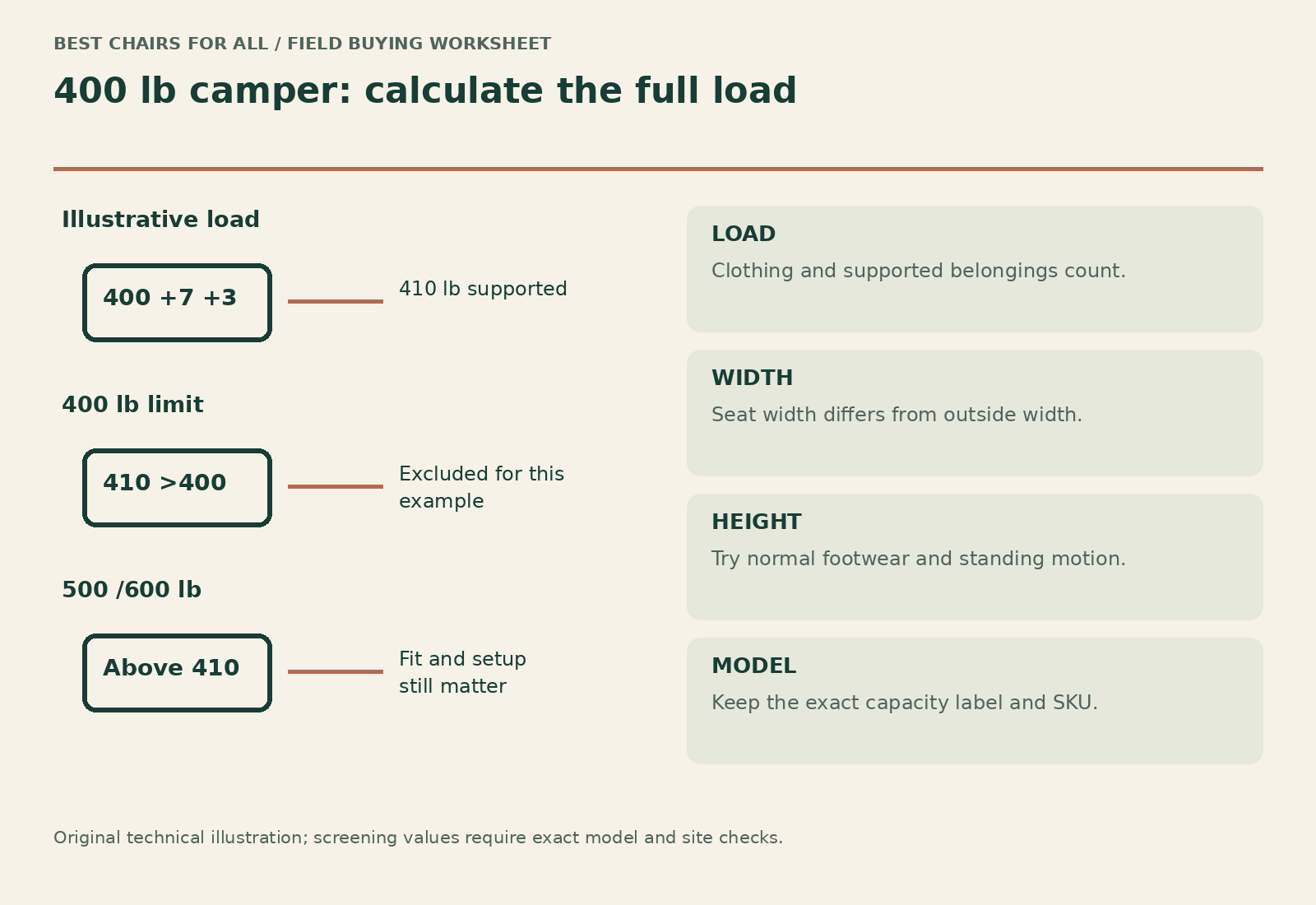
Here is an illustrative purchasing worksheet, not a load test. A400 lb body weight plus 7 lb of clothing and 3 lb of supported belongings totals 410 lb. A chair rated 400 lb fails that simple comparison. A500 lb published limit exceeds 410 by 90 lb and a 600 lb limit exceeds it by 190 lb. Those differences are arithmetic only. They are not certified safety factors, permission to exceed instructions, or a prediction of how long either chair will last.
Avoid choosing a limit by rounding your weight down or treating an advertising number as a target to reach. If weight fluctuates, compare against the higher realistic supported load relevant to your use. If you cannot establish a reliable load requirement or the maker’s exact restriction, pause that purchase until the manufacturer answers. A label with no stated capacity is not adequate evidence for this particular search.
The Kijaro Dual Lock XXL is a useful boundary example, rather than a main recommendation for someone whose fully dressed load exceeds 400 lb. Its own page clearly lists 400 lb, while the standard Dual Lock is a separate 300 lb product. The XXL’s wider seat does not raise its stated rating. For the 410 lb worksheet above it is excluded, even though it is a real oversized chair with attractive dimensions. That is why the shortlist focuses on 500 and 600 lb published limits.
Capacity and seat width are independent decisions
A higher capacity does not automatically mean a wider usable seat. Coleman publishes 24 inches of seat width, while the Bass Pro club chair lists 20.5 inches. That 3.5-inch difference is relevant to a body-fit trial, but neither figure tells us the exact comfortable space between rigid frame members under load. Padding and the way a fabric seat curves can change how a quoted width feels.
Measure an ordinary seat you already find comfortable, including the clearance your hips and thighs need in normal camping clothes. Record the useful width between obstructions rather than the outside armrest span. Then compare a similar chair in person when possible. A comfortable posture should not require squeezing past hard supports, perching on the front edge or folding your arms inward to avoid the armrests.
We have not assigned the YETI a usable seat-width number from its overall dimensions. The FAQ’s 25.125-inch deployed width includes the chair’s external shape; it is not a measurement of open space for your body. Ask for a current seat drawing or try the exact chair. Comparing that external width directly with Coleman’s 24-inch seat figure would make the YETI look larger without establishing that it actually fits better.
The Kijaro XXL example is informative here too: the manufacturer publishes 24-inch seat width, 18-inch seat depth and 20-inch seat height. That geometry may suit a different user whose supported load remains within 400 lb. It cannot override the rating for our 410 lb example. Fit and capacity are two gates, and passing either one does not pass the other.
Read camping chair weight ratings before comparing these models, keeping the exact published capacity separate from seat fit and ground conditions.
Check seat height and ordinary standing movement
A seat can have ample width yet be too low, too deep or too high for your preferred movement. Coleman’s description lists a 19-inch seat height, with 18.9 inches in its specification field; treat that as approximately 19 inches. Bass Pro lists 18.1 inches for the club chair. The difference on paper is less than an inch, so do not turn it into a confident claim about which is easier for a particular person to stand from.
Fabric compression matters. The loaded front edge may sit differently from an unloaded tape-measure reading. During an appropriate in-store fit trial, use your normal footwear and notice whether your feet rest naturally and your thighs clear the front edge. Stand in an ordinary controlled motion, following the chair’s instructions. A product labelled camping chair is not automatically a transfer aid or mobility device.
Also notice the distance to the front cross member. If it contacts your legs or requires you to sit too far forward, additional capacity will not solve that problem. If the chair feels too deep, do not stack improvised cushions until the seating position becomes unstable. Choose geometry that works or use only an accessory configuration the manufacturer supports.
For someone whose purchase depends on a specific transfer method or assistance arrangement, seek guidance from the relevant professional and the chair maker. This guide cannot verify an armrest’s assistive load rating from an occupant-capacity claim. A hard armrest may be a design preference, but it is not proof that the chair is suitable for that use.
What distinguishes the three documented choices?
Coleman combines the largest published limit in this shortlist with an explicitly wide seat, an approximately 19-inch seating position and a draining seat/cup-holder design. Those features make it our first paper comparison for a camper around 400 lb. The drain is about collected water, not permission to store the chair wet. Confirm the exact 2000035476 version rather than taking specifications from a different Coleman cooler chair or older similarly named product.
The YETI choice centers on a tensioned fabric system with instructions for both arm and back tensioners. Follow that sequence before sitting rather than assuming that unfolding the frame completes setup. Its FAQ documents the 500 lb test statement and a 13.3 lb chair weight. That makes it a plausible candidate when its actual seat fit works and the longer transport package is acceptable; we have not established that it feels firmer or lasts longer than either alternative.
The Bass Pro club chair presents a different tradeoff: padding and a published 500 lb maximum in a seat listed 20.5 inches wide. It deserves attention if you prefer a contained padded seat and that width fits you. It is the heaviest published chair here at 14 lb. Do not confuse it with the brand’s rocking club chair or loveseat, whose shape and capacities can differ.
None wins merely by having a familiar brand or the largest number. The Coleman might fail a personal front-edge comfort check. The YETI could be impractical in a small trunk. The Bass Pro could be too narrow despite its rating. The best outcome is the first model that passes supported load, actual fit and transport in that order, with its current instructions available.
Transport: compare the folded object, not just chair weight
Coleman lists a 39.0 by 7.6 by 6.8-inch folded package and a 10.6 lb chair weight. YETI lists 43 inches high by 9 inches wide by 11.75 inches deep when folded. Before ordering, measure the vehicle opening and the space remaining after your other camping equipment. A long bundle can fit diagonally in one car and block the hatch in another.
For a worked trunk example, a straight 40-inch usable slot appears long enough for the Coleman’s 39-inch folded length before allowing for the bag and opening shape. It is shorter than the YETI’s 43-inch folded height. This example does not establish a universal packing orientation; you must check the actual package and clearance. Volume alone would miss the problem.
The Bass Pro page supplies a 14 lb chair weight but not a clearly established folded package size. Request it if space is tight. Its overall deployed measurements are not packed dimensions. A padded chair can create a bulky bundle even when its weight resembles another model’s. Carrying distance is equally personal: a difference of a few pounds may be minor beside a campsite parking spot and matter much more along a long access path.
When loading the chair, keep its fabric away from sharp tent stakes, cooking tools and other pointed equipment. YETI explicitly states that its mesh is not puncture-resistant. That is a material limitation, not a reason to assume other fabric chairs resist sharp objects better. Protect the seat and carrying bag according to the maker’s instructions, and inspect them again when unpacking.
The ground and the chair’s condition remain separate gates
A published maximum does not certify every campsite surface. Use the supporting surface required by the manufacturer, open the chair fully and check its locking or tensioning mechanism before use. Do not select a chair for this load requirement by assuming wide feet make soft ground adequate. A settling or rocking foot calls for a better location rather than a higher advertised capacity.
Inspect fabric attachment points, seams, frame members, feet and the opening mechanism. Stop using a chair with structural damage and ask the maker about replacement or service. Do not increase a chair’s rating by adding a strap, extra bolt, plywood panel or improvised brace. There is no reliable capacity conversion for a repaired or modified camping chair in this comparison.
A500 or 600 lb statement is for the stated product and intended use; it does not authorize two people sharing a single-person seat, jumping into it or sitting on an armrest. Follow the current label and instructions. Keep proof of the exact model and capacity with the purchase so an ambiguous replacement listing cannot silently change the specification later.
For a camper whose realistic supported load is around 410 lb, begin by trying the Coleman 600 lb model, then compare the two 500 lb options for fit. Exclude the 400 lb Kijaro for that particular requirement. If the wider seat, load documentation or transport measurements do not work, keep searching rather than accepting a compromise on the essential gate. The useful chair is the one whose documented limit and actual geometry both match the person using it.
Something unclear or out of date? Send a correction with this article’s title and the detail to check.
Sources, research & corrections policy ↗