A camping chair’s weight rating is a limit to respect, but it is only one part of deciding whether the chair suits you. A high advertised number does not tell you whether the seat is wide enough, whether its front edge presses into your thighs, or whether the feet work on the ground where you camp. Start with the exact model’s capacity, then check fit, setup, and condition separately.
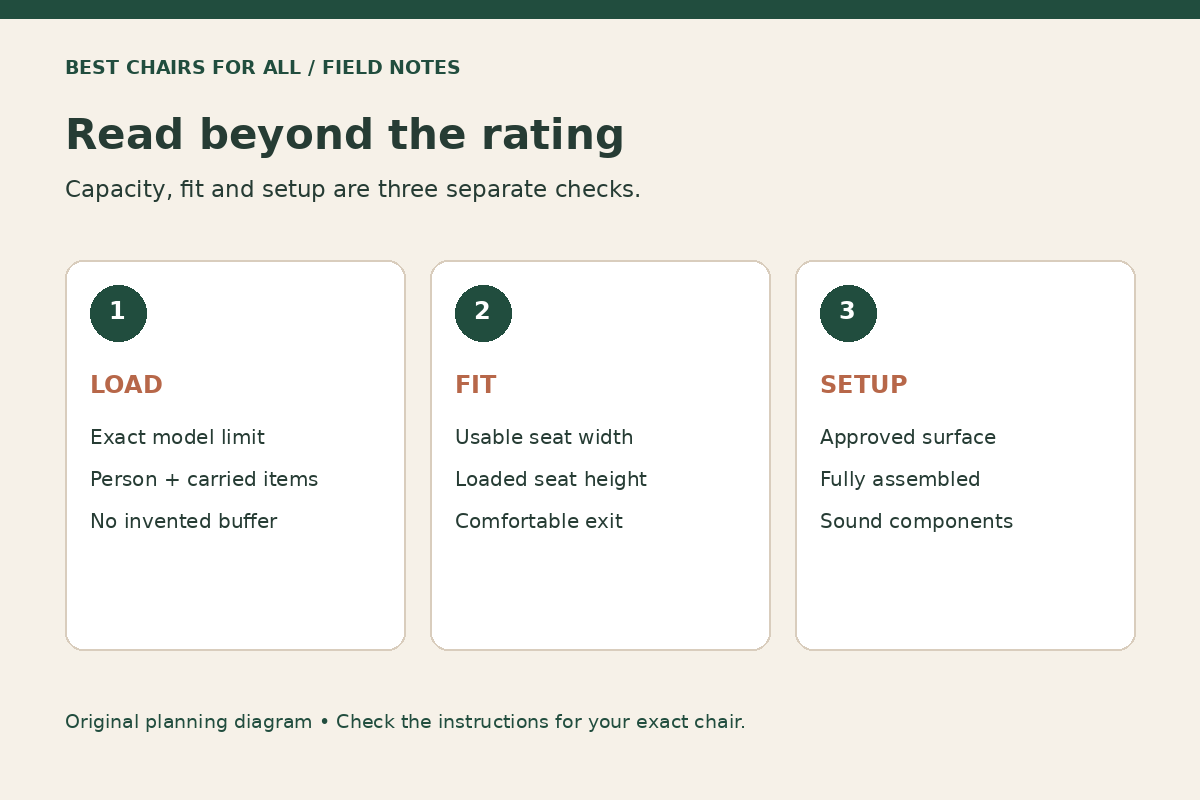
This guide explains how to turn a product listing into a buying decision without inventing a safety factor or treating a large capacity claim as proof of comfort. We researched manufacturer instructions rather than load-testing chairs. The examples below illustrate how to read specifications; they are not product rankings.
What the weight capacity actually tells you
The stated capacity is the manufacturer’s limit for the assembled chair under its stated conditions. Those conditions matter. The Helinox Chair One High-Back (re) guide, for example, specifies a 320-pound capacity, evenly distributed weight, and use on flat, solid surfaces. That is a much narrower promise than supporting any load in any position on any terrain.
Read a capacity as a complete sentence: this particular chair, assembled correctly, used as instructed, supports no more than this stated load. Do not convert it into an estimate for standing on the seat, leaning far sideways, bouncing, or using the arms as a lifting device. A chair designed for ordinary sitting is not automatically a step stool or transfer aid.
If a listing provides a large number without identifying the manufacturer, model, manual, or seller, put that chair in an unresolved pile. The sensible next step is to ask for the documentation. A missing limit is not the same as an unlimited chair, and a marketplace title is not a substitute for instructions supplied with the product.
Count the load you will actually put on the seat
Compare the capacity with the person and anything else that will sit on the chair. Winter clothing, a heavy coat across your lap, a carried bag, or a child can change the total. This does not mean ordinary clothing requires a complicated calculation. It means you should avoid choosing a chair that only works by ignoring obvious additional weight.
For example, imagine an adult who weighs 240 pounds and expects to place a 15-pound bag on their lap. Their planned seated load is 255 pounds. A chair rated for 250 pounds fails that comparison; a 300-pound chair passes the numerical comparison. Passing does not establish comfort, ground stability, or permission to share the seat with another person.
This is arithmetic, not a recommendation for a universal percentage buffer. We do not know every manufacturer’s test method, allowable loading pattern, or design assumptions. If your expected use is close to a stated limit, choose a more suitable model or ask the manufacturer about that use rather than applying an internet rule such as always multiplying your weight by 1.5.
Static numbers do not make every movement equivalent
Sitting down gently and dropping into a seat are different actions. The same person can also change how the chair is loaded by twisting toward a cooler, pushing hard on one arm, or balancing on two legs. The practical response is straightforward: sit down under control, keep the chair on all its intended supports, and stay within the usage instructions.
A higher weight rating does not give permission to ignore those habits. Nor does a steel frame automatically make a chair suitable for rocking. If you want movement, buy a model specifically designed for it and read its setup requirements. Treat an improvised rocking motion in a fixed chair as a separate problem from the weight printed on the label.
Do not attempt a home proof test with stacked weights or two adults. A chair that survives one experiment can still be damaged, and you may be testing a loading pattern the manufacturer never authorized. If the documentation leaves an important question unanswered, obtain an answer before relying on the chair.
Separate capacity from the dimensions you need
A larger capacity can coexist with an awkwardly narrow seat. Compare usable seat width between the points that touch your body, not just the overall width of the chair. Cup holders and arms can add inches to the footprint without adding any sitting room. On a bucket-style seat, the fabric can wrap inward when loaded, so an unloaded fabric measurement may overstate the feeling of space.
Seat height and depth deserve the same attention. A low seat may be pleasant for stretching out but inconvenient when you need to stand frequently. A deep seat can feel supportive to one person and prevent another from sitting back with their feet comfortably placed. Those are fit questions that a capacity number cannot answer.
Before shopping, sit in a chair you already find comfortable and record its usable width, approximate loaded seat height, and depth. These are personal comparison measurements, not universal ergonomic targets. Look for an outdoor chair close enough to justify trying, and use a return policy to resolve the difference between dimensions on paper and the feel of a suspended fabric seat.
Check the exact model, not the family name
Product families often contain standard, compact, extra-wide, and high-back versions. A seller’s photo may show one while its selectable size or color points to another. Record the model code from the listing, open the manufacturer’s page, and verify that the stated capacity belongs to that version.
Use three checks before ordering: the model name and code match; the capacity matches the manual or official specification; and the item arriving at your door carries matching identification. If the packaging states a lower limit than the listing, stop and resolve the discrepancy with the seller or manufacturer. Do not average the two figures or adopt the more convenient one.
A double chair needs an additional question: is the advertised capacity for the whole chair or each seating position? Do not assume that an 800-pound loveseat can safely place the full load at one end. Ask for the permitted distribution and use the instructions for that exact design.
Ground conditions can defeat a good numerical match
A chair can be within its capacity and still sit badly on the chosen spot. A small foot can sink into loose soil; one support can rest in a depression; a stone can leave the frame uneven. Inspect the area before unfolding the chair and move it if the supports cannot sit as intended.
Consider ground accessories as compatibility questions. If a manufacturer offers a fitted ground sheet or wider feet, verify the exact chair generation and intended terrain. A makeshift board or homemade foot attachment may introduce movement, height differences, or a connection the chair was never designed to accept.
At a campsite, prepare the chair where you will actually use it, rather than checking it on level pavement beside the car and carrying it blindly to a slope. Put drinks and equipment within easy reach so you are less tempted to lean beyond the chair’s base. A different spot may improve the situation more than buying a chair with a higher printed limit.
Inspect the load-bearing parts before every trip
Open the chair fully without sitting in it. Check the fabric where it attaches to the frame, look for torn stitching or stretched pockets, and examine the tubes for bends or cracks. Confirm that the feet are present and that any intended locking mechanism engages. Stop using a chair with damage to a structural part until the manufacturer advises an appropriate remedy.
Distinguish a cosmetic mark from an uncertain structural defect without pretending you can certify the chair yourself. A scuff on a carry bag is different from a split hub or torn support pocket. When you cannot tell, photograph the part, note the model, and ask the manufacturer. Avoid concealing damage with tape and then assuming the original capacity still applies.
Spare-part availability can make that process easier. Helinox’s repair and care program describes replacement components for supported products. That is a reason to investigate repair support before buying, rather than a suggestion that parts from different chair models are interchangeable.
Use this shortlist worksheet
| Question | Evidence to record | Decision |
|---|---|---|
| Does the load fit? | Expected seated load and exact model capacity | Reject if over the limit |
| Does your body fit? | Usable seat width, depth, loaded height | Try in person or confirm returns |
| Does the terrain fit? | Instructions and compatible ground accessories | Choose an appropriate spot and setup |
| Can you maintain it? | Care instructions and parts support | Prefer a documented maintenance path |
| Can you carry it? | Packed dimensions and complete carried weight | Measure the actual transport space |
Use the worksheet to eliminate mismatches before comparing colors, pockets, or extras. An enormous stated capacity has little value if you cannot transport the chair or if getting out of its seat is difficult. Conversely, a light compact model may suit your trip perfectly when its capacity and fit meet your needs.
Capacity is not a promise of weather resistance
Rain exposure is a separate specification. GCI Outdoor’s product support guidance distinguishes its portable chairs from weatherproof furniture and says to dry wet gear before storage. A strong camping chair should still be treated according to its care instructions.
After a trip, inspect and dry the chair before its next outing. Record a developing problem instead of relying on the fact that it felt fine last season. If you regularly leave seating outside, compare dedicated patio furniture rather than treating a camping chair’s capacity as evidence that it can live outdoors permanently.
Questions worth sending the manufacturer
If the shortlist remains unclear, send one focused message containing the model number, your intended activity, the expected load, and the terrain. Ask whether the published limit covers that use, whether the capacity is per person or total, and whether any accessory changes the usage instructions. Keep the answer with the receipt.
For a chair intended to support a particular physical need, describe the actual movement rather than using broad labels. Saying you need to push down on both arms while standing tells the manufacturer more than asking whether the chair is comfortable for everyone. If you need a mobility aid, select equipment designed for that purpose with suitable professional guidance.
The useful buying decision is a match across four things: documented capacity, personal fit, permitted setup, and sound condition. Once all four work, you can compare the convenient extras. That sequence makes the weight rating useful without asking it to answer questions it was never meant to settle.
Something unclear or out of date? Send a correction with this article’s title and the detail to check.
Sources, research & corrections policy ↗