As an Amazon Associate, we earn from qualifying purchases; see our affiliate disclosure.
For an older beachgoer who wants to avoid a very low seat, start by comparing the seventeen-inch Shibumi Tall Chair and SUNFLOW Tall Sand Dune with the sixteen-inch PARKIT Voyager. The Shibumi has the highest published capacity of these three and the lightest listed chair weight. SUNFLOW publishes useful seating and backrest dimensions but has a much lower seated-weight limit. PARKIT offers a documented seat width and depth with a heavier carry package. None is an automatic fit for someone because of age.
This guide uses manufacturer specifications reviewed in November 2026 and original fitting reasoning. It does not report hands-on testing, clinical assessment, or a guarantee of easy transfers or fall prevention. If sitting, standing, balance, or mobility raises a personal health concern, ask the relevant qualified professional about your individual situation. Furniture marketing cannot determine what assistance or equipment you need. The aim here is to turn a vague request for a senior-friendly chair into concrete dimensions and a reviewable outing plan.
Start with the user's own experience
Ask the actual beachgoer what makes the present chair awkward. The problem may be the distance down to the seat, an armrest that blocks entry, a deep sling, the effort of carrying, or a folding latch that is hard to operate. Those are different problems. A higher chair may address the first while leaving the others unresolved. Write down the difficult step in ordinary language before choosing a model, and make that step part of a permitted trial.
Use a familiar chair only as a measurement reference: note its occupied seat height, the clear space between its arms, and the user’s description of it. Do not treat a household chair as a laboratory simulator for sand or a fabric sling. Avoid improvised risers, stacked cushions, or unsupported platforms to create a preferred beach-chair height. If a beach chair does not fit in its documented setup, select another design rather than changing its support arrangement.
Compare low versus high beach chair seats with the intended user’s transfer needs and the actual seat height, rather than an age label.
Three higher-seat candidates with important differences
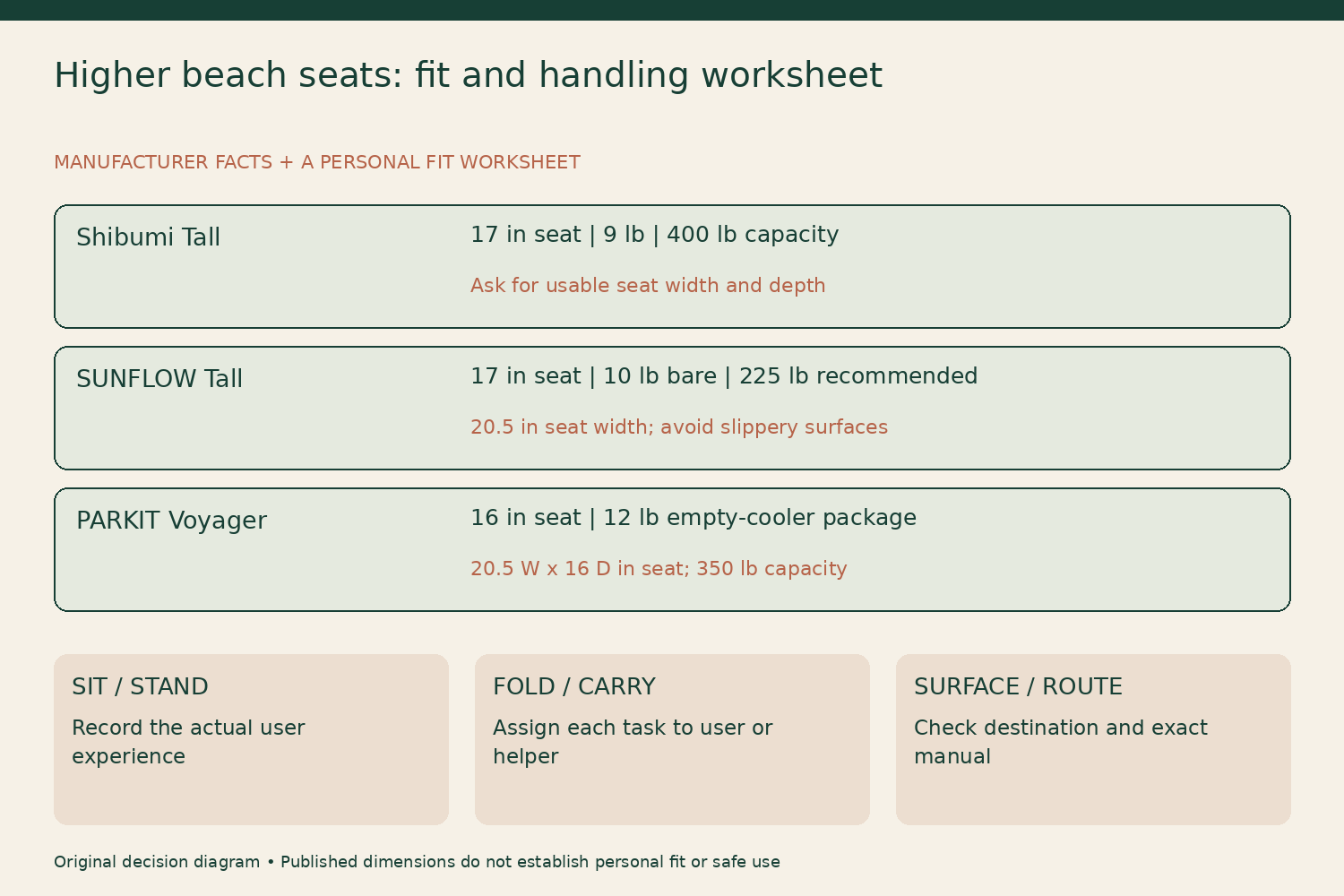
The Shibumi Tall Chair is listed at seventeen inches from the ground, nine pounds, four reclining positions, and a 400-pound capacity. It folds to 36.75 by 24.5 by 3.95 inches and has padded backpack straps. The source does not provide every usable seating measurement needed for an individual fit assessment. In particular, obtain seat width and depth instead of substituting the folded frame width.
The SUNFLOW Tall Sand Dune specifications list a seventeen-inch seat, a 20.5-inch seat width, a 27-inch backrest height, and ten pounds without accessories. Its recommended seated weight is 225 pounds. Folded dimensions are 25.5 by 35 by 6 inches, and the chair has three reclining positions. SUNFLOW specifically warns against using it on slick or slippery surfaces, a relevant limitation when a beach trip includes a wet pool deck.
The PARKIT Voyager Midnight page gives a sixteen-inch seat height, 20.5-inch seating width, sixteen-inch seating depth, and a 21-inch backrest. Capacity is 350 pounds. The quoted twelve-pound weight includes an empty cooler. It has backpack straps and a folding frame, but the source does not establish an adjustable reclining mechanism for this model. A fixed lounging angle and multiple reclining positions are different features.
1. Shibumi Tall Chair
Best for: Higher seat with highest listed capacity.
A sensible first inquiry for someone who wants a higher beach seat without the heaviest carry package in this group.
The tall version has four positions and backpack straps. Its folded length is substantial, and usable seating width still needs confirmation.
Product Details
| Brand | Shibumi |
|---|---|
| Seat height | 17 in |
| Chair weight | 9 lb |
| Capacity | 400 lb |
Pros
- Nine-pound published chair weight.
Cons
- Published folded size cannot establish seated clearance.
Arrange an individual fit trial; a high capacity is not a transfer guarantee.
2. SUNFLOW Tall Sand Dune Chair
Best for: More published seating geometry.
Worth comparing when known seat width and backrest height help narrow an individual fitting question.
The bare chair weighs ten pounds and has three positions. Its lower seated-weight recommendation is a firm distinction from the others.
Product Details
| Brand | SUNFLOW |
|---|---|
| Seat height | 17 in |
| Seat width | 20.5 in |
| Recommended seated weight | 225 lb |
Pros
- A 27-inch published backrest height.
Cons
- Manufacturer warns against slick or slippery surfaces.
Choose only within the exact model limit and documented surface conditions.
3. PARKIT Voyager Midnight Chair
Best for: Known seat depth.
A candidate for a user who prefers a folding woven seat with documented width and depth.
The detachable cooler is part of the listed empty-package weight; loaded contents add to the outing burden.
Product Details
| Brand | PARKIT |
|---|---|
| Seat | 20.5 W x 16 D x 16 H in |
| Weight | 12 lb with empty cooler |
| Capacity | 350 lb |
Pros
- Published 20.5-inch seat width and sixteen-inch depth.
Cons
- Heaviest quoted package in this shortlist.
Confirm current color availability and do not assume adjustable reclining positions.
A sit, stand, fold, carry worksheet
Draw four boxes labeled sit, stand, fold, and carry. In the first, note whether the actual user can reach and use the seat comfortably in its permitted upright configuration. In the second, record their experience leaving it in the manner the manufacturer allows. In the third, record whether the intended person can operate the folding and locking mechanism. In the fourth, identify who carries the chair and whether the packed shape fits the vehicle. Leave a box unresolved when it has not been checked.
This worksheet prevents a common purchasing mistake: evaluating the chair only after somebody else has opened it. The beachgoer may be comfortable once seated but unable to manage its latch or shoulder straps. That can be entirely workable when a companion has deliberately accepted those tasks, but it should be planned. Do not imply independence merely because the product has backpack straps. Identify the user and the helper for each step separately, and make sure both agree with the arrangement.
For each trial, record the model, surface, normal cushion or accessories, and what was actually observed. A note such as ‘the arm spacing felt restrictive when sitting in a coat’ is more useful than a vague comfort score. Trials should follow the manual and stop when the arrangement is unsuitable. Do not use a person as a test load for an uncertain frame, damaged hinge, or undocumented ground support.
Seventeen inches is a starting point, not a promise
The Shibumi and SUNFLOW share a nominal seventeen-inch seat height, yet their occupied shape, back angle, and arm geometry can differ. A fabric seat may settle under a user; a published height can refer to a particular unloaded point. Ask the seller how a critical dimension was measured. The right question is whether the actual supported seating arrangement suits the person, not whether a number resembles the height of a familiar dining chair.
PARKIT’s sixteen-inch seat is one inch lower on paper. That difference is meaningful enough to check but too small to predict personal ease of use by itself. The accessible approach to the chair and the ability to position feet matter as practical observations. Keep the space in front clear during a trial. Do not position a low table, cooler, or loose straps where the user needs to approach and leave the chair.
Armrests also deserve direct attention. Verify that the manufacturer’s instructions permit the way the person intends to use them during sitting or standing. A padded or attractive arm is not automatically a transfer aid, and a beach chair is not a mobility device. If the person needs a specific support function, seek equipment designed and documented for that function instead of assigning it to an ordinary folding chair on the basis of appearance.
Capacity and clearance are separate filters
SUNFLOW’s 225-pound recommended seated weight can rule it out even when its height and published width appear ideal. PARKIT’s 350-pound and Shibumi Tall’s 400-pound figures give different eligibility limits; they do not guarantee equal comfort or stability for every user below those limits. Use the exact model rating and the intended single-person use. Do not borrow Shibumi Tall’s figure for its lower Classic chair or assume all SUNFLOW frames share one capacity.
For width, measure the narrowest space the user must pass through and occupy, including arms and frame members. PARKIT and SUNFLOW publish a 20.5-inch seat width, but that does not necessarily describe every clearance at every height. Ask for arm spacing if the user needs it. Shibumi’s 24.5-inch folded width describes storage, not an exceptionally wide seat. Keeping those labels explicit avoids a potentially expensive misunderstanding before delivery.
Plan the surface and the route together
A chair selected for sand may have restrictions that matter on a boardwalk, paved terrace, or wet deck. SUNFLOW’s slick-surface warning is explicit. For each candidate, read the current setup instructions and choose an appropriate supported site; a general beach label does not approve use on every slope or material. If the intended spot cannot support the chair as documented, move to a suitable permitted location. Avoid makeshift boards or blocks under individual feet.
The route may be harder than the seat. Note the actual walking distance, stairs, soft-sand section, and the point where a companion can set down equipment. These are planning observations rather than an accessibility certification. Ask the destination about its actual access arrangements when needed. A higher seat cannot compensate for an impractical route, and a backpack chair does not establish that its intended user can carry it across sand.
Carry weight includes the parts you bring
Shibumi Tall’s nine pounds, SUNFLOW’s ten pounds without accessories, and PARKIT’s twelve pounds with an empty cooler are different manufacturer conventions. Do not compare a stocked cooler against a bare chair and call the difference a frame penalty. Write down the purchased configuration. If PARKIT’s cooler will contain drinks and ice, account for those separately; its twelve-pound published number is not the loaded package.
At home, check the folded chair against the actual trunk opening and storage location. Shibumi Tall’s 36.75-inch folded length is a meaningful packing demand, while SUNFLOW’s six-inch folded depth affects stacking. A helper also needs enough room to grip and lift the frame without awkward contact with other luggage. Decide who handles the chair before adding a canopy, beach bag, and cooler to the same person’s return load.
Make a conditional choice, then resolve the unknowns
Shibumi Tall is the strongest first inquiry here when a seventeen-inch seat, a 400-pound capacity, and a nine-pound chair align with the user’s needs. Request the missing seating clearances before assuming fit. SUNFLOW Tall Sand Dune is a useful comparison for a user within its 225-pound recommendation who values its published backrest and seat width, with its surface restriction kept explicit. PARKIT suits a different preference: a sixteen-inch seat with known width and depth and a heavier integrated-cooler package.
Choose only after the four worksheet boxes have an answer or a specific planned helper. Keep a copy of the current manual and the exact product identity, confirm retailer returns and current stock, and recheck any changed accessories. The most useful beach chair for an older person is one that matches that person’s seating, handling, and outing circumstances. Age alone cannot supply those measurements, and no ordinary folding chair removes the need to plan them.
Something unclear or out of date? Send a correction with this article’s title and the detail to check.
Sources, research & corrections policy ↗