Low and high beach chairs create different sitting positions, but seat height alone does not determine which one you will find comfortable or easy to leave. A low seat places you closer to the sand and often suits a relaxed position with legs extended. A higher seat can reduce how far you lower yourself, while its depth, angle, arms, and footing still affect the experience. Compare the complete chair and try it before relying on a height label.
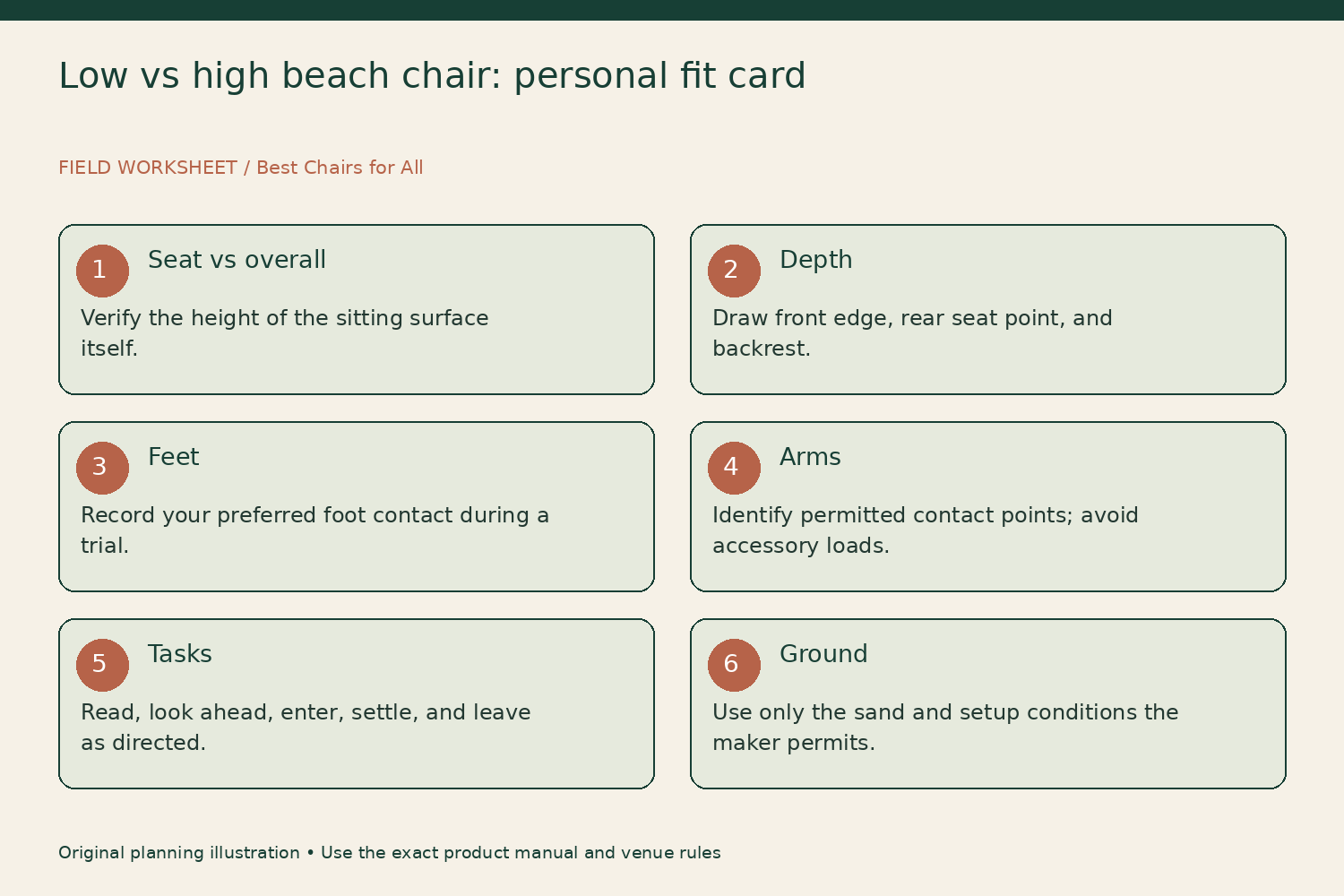
This guide uses a personal fit card and a side-view measurement method. It does not prescribe a chair for a health condition or promise that a named height will make standing easy for everyone. If you need seating for a specific mobility or medical requirement, discuss the requirement with an appropriate professional and the product supplier. For ordinary shopping, a careful trial is more informative than the words ‘low,’ ‘high,’ or ‘easy out.’
Define height at the seat, not at the back
Overall chair height measures the entire object, usually to the top of the back. Seat height describes the sitting surface above the supporting ground. Listings sometimes place similar numbers in neighboring rows, so verify which one you are reading. A tall back does not imply a high seat. Ask the manufacturer when a table gives an implausible value or conflicts with the product photograph.
On your own chair, measure the front edge and the center of the unloaded seating surface on a suitable level surface, noting both if the seat slopes. Follow any manufacturer measurement definition when comparing published figures. Fabric can change position under an occupant, and a low rear portion can feel different from a front-edge number. Label your home measurements as unloaded observations rather than replacing the manufacturer’s stated specification.
Compare documented examples carefully
The RIO SC617-2005-1 tall beach chair page specifies a seventeen-inch seat height and four backrest positions. That is a clear named-product height example. The manufacturer’s Canadian page is used here for dimensional information, not as evidence of current United States availability, price, or identical specifications for another regional or revised model.
For a lower example, GCI’s manufacturer catalog page for the SunShade Backpack Event Chair identifies an eleven-inch seat height for the listed version. A catalog measurement can help explain the difference, but check the current product and model before buying. A six-inch difference between these examples is meaningful geometry; it is not a measured difference in effort, comfort, or suitability for an individual.
Draw a side-view fit card
Draw ground, front seat edge, rear seat point, backrest, and the place your feet rest. Add the seat height, usable depth, back angle options, and arm height if known. Put a second chair outline next to it at the same scale. This makes it easier to see that a deeper seat can move your hips farther behind the front edge even when two chairs have similar front heights.
Use the diagram to ask specific questions. Can you sit with your feet where you prefer? Does the front edge feel intrusive? Can you reach the ground without sliding to the edge? Does a reclined position suit reading, looking at the water, or talking? These are personal observations to record during a permitted trial. Avoid turning a drawing into a clinical calculation or assigning a universal ideal knee angle.
Understand the low-seat experience
A low chair keeps the sitting surface near the beach and may make it convenient to stretch your legs along the sand. It can place a small side table or bag relatively high beside you. Reaching items on the ground may feel different from reaching them from a taller chair. Compare those everyday tasks rather than assuming proximity to the sand is automatically a benefit or a problem.
Getting into and out of a low chair involves a larger vertical change than with a higher sitting surface, all else equal. However, all else is rarely equal: seat slope, depth, arm placement, and sand conditions change the movement. Try the actual model in the permitted manner. If a low chair feels difficult to leave during a simple trial, do not assume extra padding or a different technique will make an unsuitable product appropriate.
Understand the higher-seat experience
A higher chair can support a more upright sitting arrangement and reduce the distance between standing and the seat. It may suit conversations around taller portable tables or activities where you frequently get up. Yet a seat can also be too high for your preferred foot contact, particularly when it is deep or has a pronounced front edge. ‘Higher’ should describe a dimension rather than stand in for ‘better.’
Look at the lower frame and feet, not only the sitting height. A chair used on sand has to be intended for that surface, opened correctly, and placed as its instructions require. Do not convert a general tall folding chair into a beach chair by adding homemade foot plates. Ask the manufacturer whether the design is intended for sand and whether approved accessories are available for the model.
Compare depth before judging the arms
Measure or obtain the usable seat depth from the front edge to the point where the backrest meets the seat. Notice where you naturally settle during a trial. If you have to slide forward to reach the ground, the backrest may no longer support you as intended. A high seat with a shallow usable depth can feel very different from an equally high chair that places you far back.
Check the arm gap and arm height separately. Arms can provide a place to rest your forearms, but their strength and permitted use depend on the design. Do not assume a cupholder extension is a suitable push-off point. The Cape Cod Beach Chair care and use guidance, for example, specifically cautions against loading certain parts of its arms and front crossbar. Follow the actual chair’s instructions when entering or leaving it.
Try the chair with beach clothing and footwear
Wear the clothing and footwear you expect to use, within the conditions allowed by the retailer or manufacturer. A slippery wet swimsuit, a towel, or a bulky cover-up can change the contact surface. Do not add loose layers to solve sliding without checking whether the product permits them. Keep the trial simple and stop if you feel uncertain about your balance or the chair’s stability.
Check ordinary actions: sitting down, settling against the back, reaching a nearby book, and standing again. Record where your hands naturally go. If that location is a fragile accessory or a part the manual says not to load, the chair may be a poor match for you. A brief trial should reveal a practical mismatch, not become an attempt to prove that you can manage an uncomfortable design.
Account for the actual sand
Packed sand near an access route and loose dry sand higher on the beach can support feet differently. Use only the surfaces and setup the maker permits. Check that all feet or bars contact the supporting surface as intended before sitting. If the chair settles unevenly or develops a new tilt, get out carefully and reassess the location according to its instructions rather than continuing to use an unstable setup.
Do not place a chair in moving water or at the waterline unless its manufacturer expressly permits that use. A beach marketing photograph does not establish suitability for submersion or changing ground. Also consider the route to your chosen spot: a chair that suits the sitting position may be too awkward for the dune crossing or access stairs. Seat fit and carrying fit should each receive their own decision.
Add recline and viewing tasks
Compare the chair in the position you will actually use most. Reading often involves a different head and arm position from looking across the beach or resting. The number of recline positions does not reveal their angles, and a lay-flat claim needs its own setup instructions. Ask whether the selected chair reaches the desired position and what support bars or adjustments are required.
A low chair does not automatically lie flat, and a higher chair does not automatically remain upright. Record the available positions and the adjustment sequence separately from seat height. Try transitions only as the manual permits, keeping hands clear of specified pinch points. If you must stand to adjust a model, include that task in the practical comparison rather than assuming every chair adjusts while occupied.
Use a two-person comparison without averaging away fit
If two people will share one chair, have each complete a separate fit card. Record foot contact, usable depth, arm access, preferred position, and ease of the ordinary entry and exit sequence. Do not average the results into a single score that hides one person’s difficulty. A chair that works for one user may not be a sensible shared purchase, even when its capacity accommodates both individually.
For multiple chairs, choosing different heights may be more practical than buying an identical set. Compare how the seated eye levels and nearby table heights work together, but prioritize each person’s usable sitting position. Coordinated fabric can be a preference; it should not override an obvious fit problem. Keep the model numbers clear so the correct instructions and parts remain associated with each chair.
Choose from the trial, then confirm the model
Your final fit card should explain the choice in concrete terms: feet rest where preferred, the back meets your body in the selected position, the arms are usable as intended, and the entry and exit sequence feels manageable. Add the chair’s sand-use instructions and carried dimensions. This is a stronger basis for selection than a height category or a broad comfort promise.
When the chair arrives, verify that the model, height, and mechanism match the one researched. Keep packaging while resolving any discrepancy. Low and high beach chairs are different tools for different sitting preferences, not competing universal solutions. Measuring the actual seat and trying the complete arrangement lets you choose the position you want without overlooking the ground, arms, depth, and movement that make that position usable.
Something unclear or out of date? Send a correction with this article’s title and the detail to check.
Sources, research & corrections policy ↗