As an Amazon Associate, we earn from qualifying purchases. Read our affiliate disclosure.
For a small space, the best accent chair is the one with the right shape of footprint, not simply the smallest width in a product title. Our shortlist is IKEA EKENÄSET for narrow width and modest depth, West Elm Auburn for a low upholstered form, and Article Otio 26-inch lounge chair for an open wood frame when a deeper position is available. The three have different tradeoffs even when two occupy almost the same number of square feet.
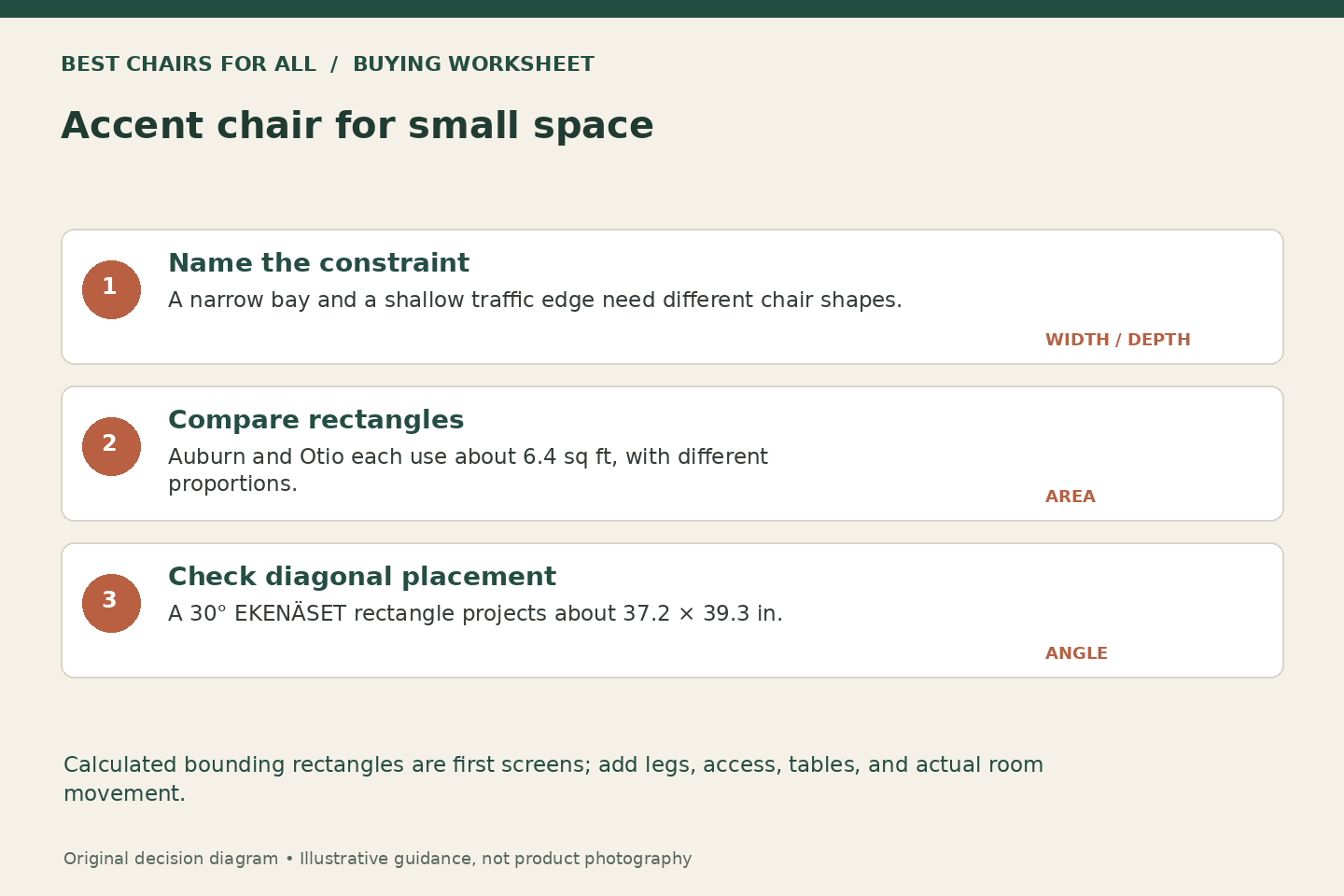
We checked current official US product information online on November 6, 2026. We have not tested the chairs’ comfort or durability. Our comparison uses published measurements and a worked floor-plan calculation to help you decide what deserves a trial. It also distinguishes visual lightness from physical space: seeing through an open frame can make a room look less crowded, but it does not create more room for your feet or open a blocked doorway.
Compare width and depth separately
| Model | Published W × D | Rectangle area, calculated | Small-space advantage |
|---|---|---|---|
| IKEA EKENÄSET | 25¼ × 30¾ inches | About 5.4 sq ft | Narrowest and shallowest of these three |
| West Elm Auburn | 29.6 × 31 inches | About 6.4 sq ft | Low upholstered back preserves sightlines |
| Article Otio Welsh Taupe/Walnut | 26.5 × 34.5 inches | About 6.3 sq ft | Narrow open frame where extra depth is available |
These calculated rectangles exclude the user’s legs, access space, tables, and room needed to move the chair. They are a first comparison, not a complete layout requirement. The Otio product title rounds its nominal width to 26 inches; the current specification gives 26.5 inches, which is the figure used here.
EKENÄSET: the smallest rectangle in this shortlist
The EKENÄSET Kilanda light beige manufacturer listing gives overall dimensions of 25¼ inches wide by 30¾ inches deep by 29⅞ inches high. The seat is 22 inches wide, 19⅝ inches deep, and 17¾ inches high. Construction includes solid wood, exposed beech arms, foam, and zigzag springs. The current selected article showed a $199 clearance promotion while supplies last at our research check, before tax and delivery.
Its best small-space role is a spare or reading seat where exterior width is the hard limit. The slim wood arms leave more of the overall width available to the sitting area than a broad upholstered shell might. Visible floor beneath the legs can also preserve an open appearance next to a sofa or window. That is a visual advantage to compare with your room, not proof that the chair will feel larger under every body.
The exposed arms and angled fixed back may be less appealing if you want a soft corner to curl against. A small chair can still fail if its sitting posture is wrong. Bring a book or imitate the way you normally sit during a showroom trial, and check elbow contact with the wood. Avoid solving a firm preference for padded arms by immediately adding cushions that consume the space you were trying to save.
Its non-removable cover calls for vacuuming and wiping with a damp cloth. If the chair will be squeezed into a busy dining-and-living area with frequent spills, that care limitation should be part of the decision. The clearance status also means you should not assume a matching second chair will be available months later. Check the current article and stock before planning a future pair around this exact fabric.
Check matching IKEA EKENASET Kilanda light beige listings on Amazon (paid link) (search results; verify the exact model and seller).
Auburn: compact upholstery with a lower visual line
The West Elm Auburn specification lists 29.6-inch overall width, 31-inch depth, and 30.5-inch height. Interior seat width is 23.75 inches, depth is 20 inches, and seat height is 17 inches. Its wood frame, webbed support, and fiber-wrapped foam seat create a conventional upholstered accent-chair format. The back rises 13.5 inches above the seat, so its low profile is a real geometric distinction from a tall wing chair.
This is the candidate to compare when the room has enough width but a tall upholstered back would interrupt the view across a studio or between a sofa and dining table. Its shallow depth relative to Otio may suit a narrow front-to-back zone. Two chairs can use nearly equal rectangle areas yet work differently because one is wider and the other deeper. Look at the limiting direction in your room, not the calculated area alone.
Auburn’s upholstered outline is fuller than an exposed frame, which may be exactly the look you want beside a fabric sofa. The compromise is that the low back provides less height behind the torso. If you want head contact for reading, compact exterior measurements should not override that preference. A chair that is rarely used because the posture is wrong has not earned even a small footprint.
Ask for a current quote and delivery estimate for the exact fabric. Configurable upholstery can carry different lead times and return rules. West Elm’s care guidance describes prompt blotting, suitable spot cleaning, and professional cleaning for stubborn stains; it does not authorize machine washing. Check fabric samples in the actual corner, because a low chair that blends with a wall can feel visually quieter than a contrasting bulky-looking weave.
Check matching West Elm Auburn chair listings on Amazon (paid link) (search results; verify the exact model and seller).
Otio: narrow width when the room can spare more depth
The Article Otio 26-inch lounge chair in Walnut and Welsh Taupe currently measures 26.5 inches wide by 34.5 inches deep by 33 inches high. It lists an 18.5-inch seat height, 20.5-inch seat depth, and 22-inch arm height. The frame is solid black walnut with foam padding and a mixed-fiber fabric. Article lists weight tested to 300 pounds and displayed $699 on the research date.
Its small-space case is a narrow bay with more depth than width, such as a window-side reading location that does not cross the main route. The open frame can show more floor and wall behind it, and the lower arms create a different silhouette from a tub chair. The taller seat also provides another option to trial if a 17-inch upholstered seat feels too low for your preferred ordinary sitting position.
The depth is the reason to be cautious. At 34.5 inches, Otio projects farther into the room than either alternative. Adding the matching ottoman would create a separate extended-use footprint, so do not assume a chair-and-ottoman photograph represents a compact arrangement. If your main route passes in front of the seat, the extra depth may matter more than its narrow width ever helps.
The manufacturer’s current Welsh Taupe care calls for blotting spills with a dry cloth, allowing the fabric to air dry, and avoiding chemical cleaners. A stain-repellent finish slows absorption; it does not make every spill harmless. Choose it for the specific open-frame lounge geometry and wood preference, after checking the deeper footprint. Do not apply dimensions from an old Otio listing, because current specifications can differ from archived trade books.
Check matching Article Otio Walnut Welsh Taupe lounge chair listings on Amazon (paid link) (search results; verify the exact model and seller).
The limiting-direction worksheet
Measure the available zone in both directions and label the constraint. A “width-limited” zone might be between a cabinet and a wall. A “depth-limited” zone might run alongside the path from the entrance to the sofa. Put each chair’s published width and depth into the relevant rectangle. Then add the user’s leg area and an entry route. Do not average the two dimensions into a single compactness score.
For a worked example, imagine a bay 28 inches wide and 36 inches deep before personal access space is considered. EKENÄSET and Otio pass the nominal width screen; Auburn does not. In another zone 32 inches wide but only 32 inches deep, EKENÄSET and Auburn pass the nominal rectangle screen, while Otio does not. These are first-pass examples, not complete room recommendations. They demonstrate that the same two “small” chairs may solve different constraints.
The area totals underline the point. Auburn’s 29.6-by-31 rectangle is about 917.6 square inches. Otio’s 26.5-by-34.5 rectangle is about 914.25 square inches. They use almost the same rectangle area, yet one is 3.1 inches wider and the other 3.5 inches deeper. In a tight room, that shape difference can decide whether a drawer opens or a route remains usable.
Angling a chair can increase its projected footprint
A diagonal placement may look neat in a corner, but it often uses more of the surrounding rectangle than a straight placement. For an illustrative calculation, rotate EKENÄSET’s 25.25-by-30.75-inch outline by 30 degrees. Its projected width becomes about 37.2 inches and projected depth about 39.3 inches, using width times cosine plus depth times sine for each relevant direction. The chair has not grown; its bounding box has changed.
That calculation assumes a simple rectangular outline and is not a manufacturer clearance requirement. It is useful because it challenges the intuition that turning furniture automatically saves space. Cut a paper rectangle to scale or tape the angled outline on the floor, then check the actual chair’s arms and back. A corner arrangement might still work well, but it should earn its place through a real layout rather than a styling habit.
Use vertical space without blocking everyday functions
Consider the chair’s height beside windows, shelving, and radiators. A low back can preserve sightlines, while an open frame can reduce visual mass. Neither should block a heater or prevent curtains moving as intended. Follow the relevant equipment and furniture instructions for placement. If the only available corner contains a door swing or necessary access panel, the room may need a different furniture arrangement rather than a smaller chair forced into that spot.
Check where a book, remote, or drink will go. A separate table may consume the gap you planned as access space, so test the complete combination. A stable compact table can help if it is reachable from the seat without leaning across a route. Avoid balancing a drink on an exposed wood arm simply because there is no room for the surface you actually need.
Measure the package and the final trial
A compact assembled chair can arrive in a larger carton, and a narrow hallway turn can matter more than a doorway width. Compare the seller’s package or delivery measurements with the full route to the room. Removable legs help only where the manufacturer’s process permits removal. Check who handles assembly and packaging, and whether a selected fabric is eligible for return if the chair fits the doorway but not your preferred posture.
Plan how to move an armchair through a narrow door before buying a model that fits the room but may not fit the delivery route.
During the first trial, leave the chair where it will live and perform an ordinary day’s movements around it. Open drawers, pull out a dining chair nearby, walk past carrying a basket, and sit with your feet in their normal position. A taped rectangle is a useful screen, but actual human movement decides the final fit. Keep the return window and packaging in mind until the whole arrangement works.
Which small-space chair to choose
Choose EKENÄSET when both narrow width and modest depth are valuable. Choose Auburn when a lower upholstered form suits a depth-limited zone with a little more width. Choose Otio when a narrow open-frame lounge fits a deeper bay and its higher seat suits you. Use the limiting-direction worksheet and diagonal calculation before ordering. The best small-space accent chair saves the dimension your room actually lacks while remaining a seat you want to use.
Something unclear or out of date? Send a correction with this article’s title and the detail to check.
Sources, research & corrections policy ↗