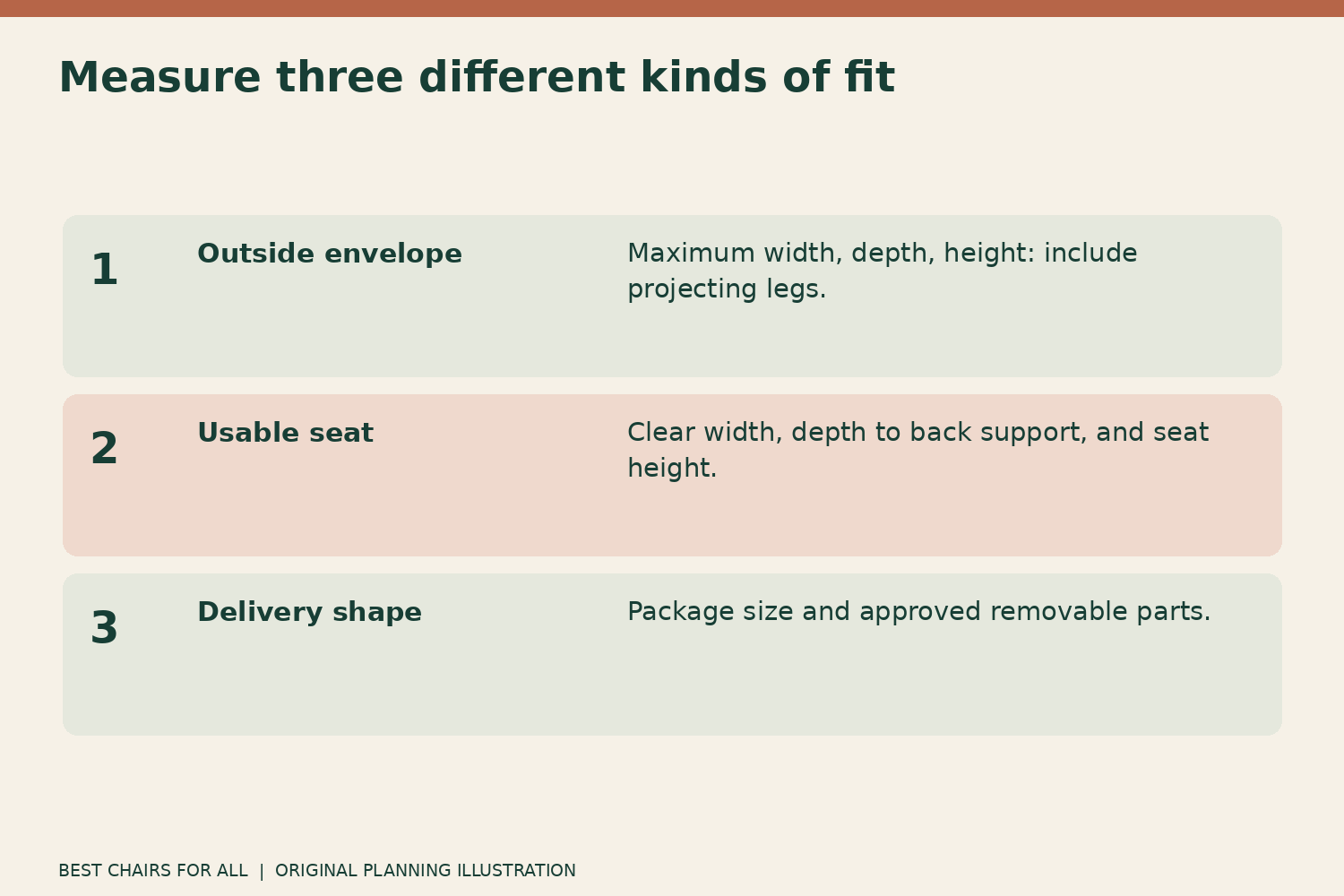
Measure an accent chair in three separate ways: its outside envelope for the room, its usable seat for the person, and its delivered shape for the route into the home. Those measurements overlap, but none can substitute for the others. A chair may have a small seat inside bulky arms, or fit its final corner while failing to clear a tight hallway turn.
You need a tape measure, paper, a pencil, and ideally a second person to hold a straight reference at the chair’s widest point. Work in one unit throughout. Record fractions clearly, photograph important endpoints where possible, and label whether cushions and removable legs were included. This creates a measurement record you can actually compare with a retailer’s drawing.
Start with the maximum outside dimensions
Overall width is the greatest side-to-side distance, which may occur at the arms, back wings, or projecting legs. Overall depth runs from the farthest forward point to the farthest rearward point when the chair is in its normal position. Overall height runs vertically from the floor to its highest point. Keep the tape level or vertical instead of following upholstery contours.
For a chair with angled legs, measure beyond the upholstered body if the feet extend farther. A curved back can project behind the base, and a rolled arm can project forward of the seat. If it helps, place a straight object vertically beside the projection and measure between reference planes. Do not tip a heavy chair simply to get a more convenient reading.
Check the manufacturer’s method before comparing your result. Crate & Barrel’s furniture measuring guide uses product dimensions and delivery-route checks as separate steps. That separation is useful: an outside dimension describes the furniture but does not by itself show whether there is enough room to rotate it into place.
Measure usable seat width and depth
Seat width is the clear sitting space between arms or other boundaries at the cushion. It may narrow toward the back, so take a front and rear measurement when the shape changes substantially. If a chair has no arms, measure the supported cushion area rather than including a loose edge that offers little sitting support.
Seat depth is the distance from the front edge to the face of the back support. Include the normal back cushion. If the cushion is loose, note whether you measured it unoccupied or after settling into the chair. Avoid quietly switching between these methods, because a thick pillow can make the effective depth change by a noticeable amount.
The distinction is visible in IKEA’s EKENÄSET product information, which lists seat measurements separately from overall measurements. Use the same separation in your own notes even when a listing does not. If usable seat figures are absent, ask the seller to measure them rather than estimating from a photograph.
For a bucket or barrel chair, sketch the curve and label where you measured. A single maximum width can exaggerate the space available at hip level. If you sit diagonally, take an additional diagonal measurement in that position, but retain the ordinary center measurement so you can still make a fair comparison with published specifications.
Record seat height in a repeatable way
Measure vertically from the floor to the seat surface near the front center, then note any significant slope. For soft upholstery, record an unloaded figure and describe how far it seems to settle during a normal sitting trial. Do not press down with a hand and present that result as a standardized occupied measurement; a person’s load and position differ.
Use your usual footwear when checking whether the height works for you. A low seat may suit relaxed lounging yet feel awkward to leave, while a high seat may leave your feet unsupported. Judge height with depth: moving forward to reach the floor can remove your back from the support even if the height looks reasonable on paper.
Measure arm height from the floor and, if useful, from the seat surface. Floor-to-arm height helps compare a side table; seat-to-arm height helps describe elbow position. An angled arm needs more than one point. Record front and rear arm heights if a table or reading support will meet the arm at a particular location.
Add the operating envelope
A stationary chair usually occupies its outside rectangle, but people still need space to approach it and stand. A swivel chair sweeps through a larger area as corners and arms rotate. A rocker moves behind and ahead of its parked position. A recliner can extend its footrest and move its back. Measure each function using the manufacturer’s directions.
Do not treat an advertised base diameter as the swivel clearance. The upholstered body may extend beyond the base, and an off-center pivot can create an asymmetric turning path. Mark the actual outermost travel during a controlled trial. Keep fingers and objects away from mechanisms, and do not place anything beneath a moving base to improve a measurement.
For a powered or reclining chair, obtain the required clearances from the exact manual. A broad product family can contain mechanisms with different travel. If the manual specifies wall clearance, follow its definition and still check nearby tables, curtains, and walkways. A minimum wall figure does not necessarily describe the space needed for every surrounding activity.
Map the route before testing a doorway
Walk from the delivery vehicle’s likely unloading point to the final room. List every entrance, hallway, corner, stair, and elevator. Measure clear openings at the narrowest usable points, accounting for the open door leaf, handles, trim, fixed handrails, and overhead fixtures. The size printed on a door is not necessarily the clear opening available during delivery.
Room & Board’s delivery measuring instructions call attention to doorway and hallway dimensions, elevator interiors, stair landings, and ceiling height. This is why a route sheet is better than one front-door number. A chair can pass through the entrance but lack the turning room needed immediately beyond it.
Write down entry clearance: the distance from the doorway to the opposite obstruction. Photograph the approach and exit sides of tight turns. A flat floor plan misses low ceilings and projecting fixtures, so add a side sketch for stairs or sloped hallways. Send the complete record to the retailer or delivery team when the fit is close.
Distinguish assembled dimensions from package dimensions
A boxed chair can be larger than the assembled product in one direction and smaller in another if the legs or back are packed separately. Obtain the actual number and size of packages. Confirm whether delivery includes carrying them to the room and assembly there. A package that fits the building entrance still has to pass through the rest of the route.
Ask which parts the manufacturer permits removing. Threaded legs may be removable; upholstered arms may be structural. Do not assume a back can come off because a similar-looking chair has that feature. Removal can affect handling, reassembly, and warranty terms, so keep the exact instructions with the measurement sheet.
Diagonal depth can be useful for some upholstered shapes, but it is not a universal pass-or-fail formula. The chair is a three-dimensional object, and its route may involve simultaneous rotation and tilting. If the seller supplies a diagonal dimension, ask how it was measured and have the delivery team assess it against your complete route.
A completed example measurement sheet
The following figures are hypothetical and illustrate how to document a chair. They are not a recommendation for a particular seat size or a guarantee of delivery. The important feature is that each number has a named purpose and reference point, which prevents an overall width from being mistaken for usable seat space.
| Measurement | Example record | Use |
|---|---|---|
| Overall width | 32 inches, across outer arms | Room footprint and route |
| Overall depth | 35 inches, front arm to rear back | Projection into room |
| Overall height | 37 inches, legs installed | Window, sightline, delivery |
| Usable seat | 21 inches wide × 20 inches deep | Occupied fit trial |
| Seat height | 18 inches, unloaded front center | Foot and knee check |
| Packaging | Supplier confirmation pending | Unresolved delivery question |
Suppose your clear doorway is 30 inches wide. The example’s 32-inch overall width does not prove failure, because a permitted orientation might use a different profile. It also does not prove success merely because another dimension looks smaller. Record the doorway height and approach space, then obtain a delivery assessment instead of forcing the chair through experimentally.
Verify the final room with a physical outline
Tape the overall rectangle onto the floor, including any swivel or motion envelope. Add the ottoman, side table, lamp base, and existing furniture. Open doors and drawers, reach the outlets, and walk the route you use while carrying ordinary household items. A chair can fit within the room’s walls while blocking an activity you perform every day.
Use boxes to suggest arm and back height if scale is difficult to visualize. Check whether the chair will obscure a low window, project into a curtain, or prevent access to a shelf. Avoid placing furniture against a heat source without checking that appliance’s required clearance. The chair’s own dimensions cannot override other equipment’s instructions.
Finish with a short list of unresolved items: occupied comfort, missing seat dimensions, package size, permitted disassembly, or a tight stair turn. Resolve those before ordering, especially for custom upholstery with restricted returns. A good measurement sheet does not eliminate every uncertainty, but it makes the remaining questions specific enough for a seller or delivery professional to answer.
Keep a dated copy of the final drawing with the order confirmation. If the seller changes the cushion, base, or model version before delivery, request the dimensions again. A revised product can share a collection name with an older chair while having a different frame or packaged shape.
Something unclear or out of date? Send a correction with this article’s title and the detail to check.
Sources, research & corrections policy ↗