An armchair describes a physical feature: the chair has arms. An accent chair describes a role in a room: it adds a contrasting or distinctive seat to the arrangement. A single chair can be both. The labels do not establish seat size, comfort, construction quality, or how often the chair can be used.
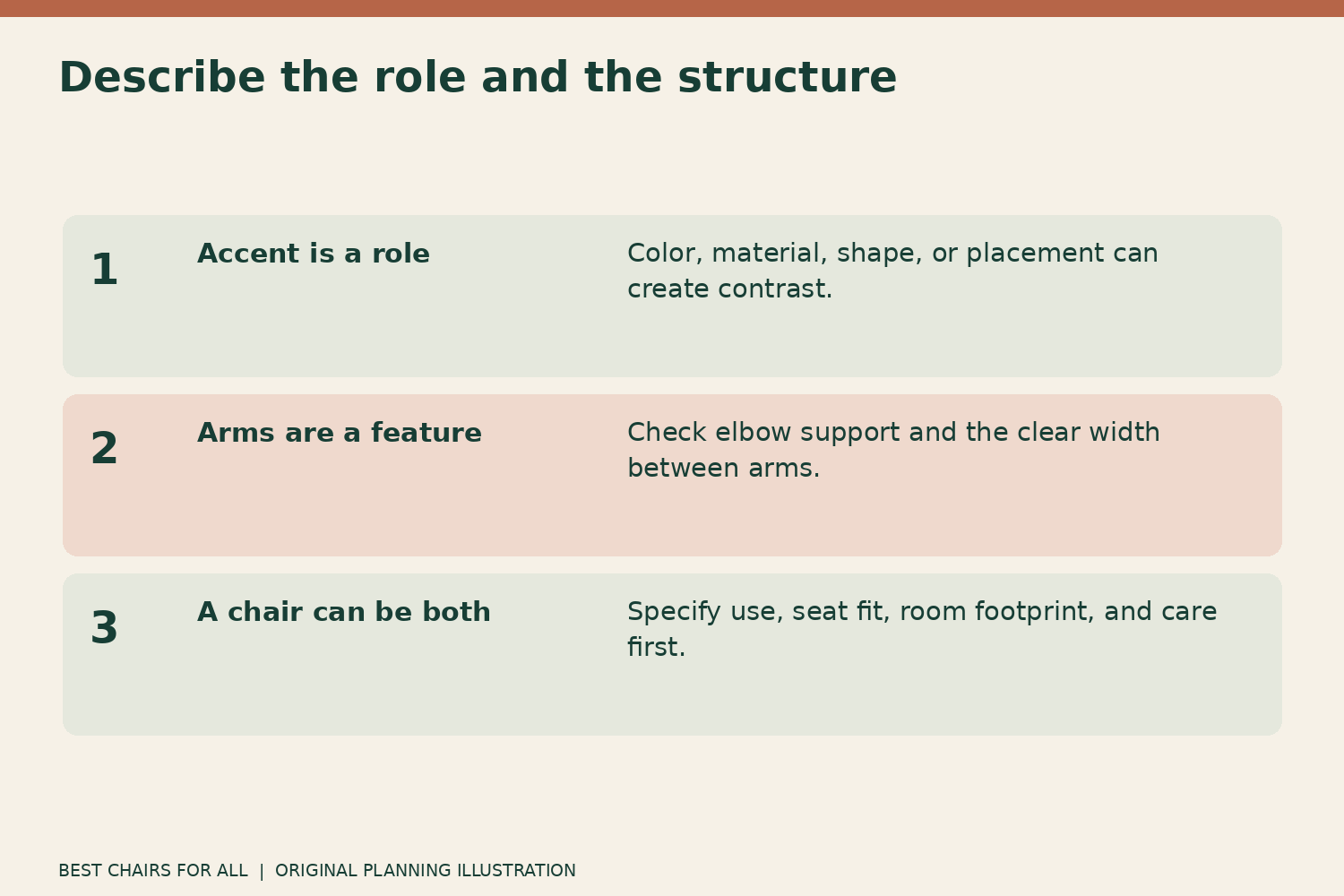
That overlap explains why searching for an accent chair can return everything from a small armless slipper chair to a broad upholstered armchair. Instead of choosing between the words, identify the features you need and the visual role you want. Then compare the actual seat, frame, fabric, and footprint of the candidates.
Read accent as a room role
A chair can provide an accent through color, pattern, material, silhouette, or placement. It need not be brightly colored: a simple wood-framed chair can stand out beside a heavily upholstered sofa, and a textured neutral chair can provide contrast in a smooth, minimalist room. Accent describes that relationship rather than a fixed furniture construction.
Retail categories demonstrate the breadth. Article’s accent chair category includes lounge seating in different materials and forms. That shopping label helps gather visually distinctive seating, but you still need the individual product page to learn how the chair sits, how large it is, and what its upholstery requires.
Do not interpret accent as occasional-use-only. A chair with an expressive color can be your main reading seat if it fits and is built for the intended use. Equally, a quiet neutral chair may be chosen mostly to fill a corner. Frequency of use is a separate requirement that should guide construction and care questions.
Read armchair as a structural description
An armchair has armrests, which may be open wood rails, padded blocks, rolled upholstery, or part of a continuous curved shell. Those designs offer different contact points and occupy different amounts of width. The presence of arms tells you little about whether they meet your elbows or support the posture you prefer.
IKEA groups armchairs and accent chairs together, including varied back shapes, frames, and functions. This illustrates how the terms overlap in ordinary retail use. Treat the category as an entry point, then check the exact model’s dimensions and instructions instead of inferring them from the heading.
An open-frame armchair can appear visually light because you see floor and wall through its sides. A solid upholstered armchair can feel more enclosing and provide a broad padded contact. Neither construction is automatically more comfortable or durable. Comfort depends on contact geometry; durability depends on the frame, joints, suspension, upholstery, and intended use.
Where armless accent chairs fit
Armless chairs remove the side barriers and can simplify entry from different directions. Slipper chairs are a familiar example in contemporary retail categories. Castlery’s slipper chair category explicitly connects slipper chairs with armless accent seating. The practical difference is the missing elbow support, not a guarantee of a tiny footprint.
Without arms, you may be able to turn toward another person or sit briefly while putting on shoes. But if you read with a heavy book, an armless chair may leave your forearms with nowhere to rest. A book pillow can change that experience, provided it fits the seat and remains stable. Test the activity instead of assuming that open access outweighs support.
Armless does not necessarily mean narrow. Some lounge chairs have broad seats and substantial depth even though the silhouette is simple. Compare maximum outside width and usable seat width separately. Also inspect the exposed cushion edges: a seat intended for one central occupant may not be designed to support someone perched on its side.
Use two independent questions to classify a chair
The following original worksheet separates construction from room role. It avoids the false choice between accent chair and armchair by letting you describe both at once. Fill it in before shopping, then use the descriptions as search terms. The examples are planning scenarios rather than recommendations for particular products.
| Construction | Quiet supporting role | Distinctive accent role |
|---|---|---|
| Arms present | Neutral upholstered armchair beside a similar sofa | Wood-framed armchair contrasting with the sofa |
| Arms absent | Simple armless seat in a matching fabric | Patterned slipper chair in a neutral room |
| Motion added | Subtle swivel chair linking two seating areas | Sculptural swivel chair as a focal seat |
For each box that interests you, add a practical sentence: “I need forearm support for reading,” or “I need side access near the bedroom door.” That sentence has more buying value than a style adjective. If the attractive chair conflicts with the practical requirement, look for another example within the same visual category.
Measure seat fit before comparing visual scale
Start with usable seat width, seat depth to the back support, and seat height. A broad armchair may have a surprisingly narrow seat because padded arms consume the outside width. An armless chair may offer more open sitting space within a smaller outside envelope, but its lack of boundaries can feel less supportive to someone who likes an enclosing seat.
During a trial, sit against the back with feet in the intended position. Check whether the seat edge presses behind your knees and whether the back meets you comfortably. For an armchair, let your shoulders relax while testing the arms. High arms can raise your shoulders; low or widely spaced arms may contribute little to your preferred activity.
For an armless candidate, try the same task rather than merely sitting with hands folded. Read, reach for a nearby table, and change position. Check whether you keep sliding toward a side or placing your hand on an unsupported cushion edge. These observations help identify a fit problem that a simple seat-width number cannot capture.
Match the visual weight to the room
Visual weight comes from more than width. A high solid back, dark upholstery, thick arms, and a skirt extending to the floor can make a chair feel substantial. Visible legs, open sides, a low back, and lighter contrast can make a similarly sized chair seem more open. Use photographs and a physical outline together to judge the effect.
Place the chair’s taped footprint beside the sofa, then use a box or cardboard panel to suggest back height. Check sightlines from the entrance and from other seats. A high-backed accent can create a pleasant reading corner but interrupt a view across an open room. A low armless seat preserves that view but may not provide the back support you want.
Choose one or two intentional connections to the room: a repeated wood tone, a related color, or a curve echoed elsewhere. You do not need every leg, fabric, and arm shape to match. If several contrasting features compete, simplify the surrounding accessories before concluding that the chair itself is wrong.
Construction and care matter more than the label
Ask what the frame is made from and how the seat is supported. Look for clear information about assembly, intended load, and normal use. A decorative description such as statement chair does not tell you whether a joint is well executed or a cushion can be replaced. Avoid treating a heavy chair as automatically better built; weight can come from many components.
For upholstered candidates, obtain the exact fabric composition and cleaning directions. Texture words such as velvet, bouclé, or linen-look do not establish a safe cleaning method. A removable cover may still require professional cleaning, and a zipper may exist for assembly rather than routine removal. Keep a swatch if the retailer offers one.
Inspect the parts you will touch during ordinary use. Open wood arms need a finish that suits the care routine, while fully upholstered arms introduce fabric wear at frequent contact points. Loose cushions offer different access from a fixed seat. Compare these details against pets, children, food, sunlight, and how frequently the chair will be moved.
A practical comparison of two hypothetical candidates
Imagine Candidate A is an upholstered armchair with a 34-inch outside width and a 21-inch usable seat. Candidate B is an armless accent chair with a 29-inch outside width and a 25-inch usable seat. The smaller chair has more clear sitting width, but that does not prove it is the better reading seat because it lacks elbow support.
Suppose the room needs a chair beside a sofa for long reading sessions. Candidate A may justify its extra width if its arms and back suit the reader. If the room instead needs a briefly used bedroom seat with easy side entry, Candidate B may fit the task more naturally. The use case changes the answer even though the labels stay the same.
Now add delivery and placement. Candidate A’s broad fixed arms might complicate a narrow turn, while Candidate B might be too low for the intended user to leave comfortably. Ask for package dimensions and permitted removable components. A smaller outside footprint helps only if the complete chair still meets the person’s requirements.
Write a feature brief that survives changing terminology
Before ordering, describe your target chair in a single practical brief: intended activity, arms or no arms, preferred sitting position, maximum room footprint, usable seat needs, upholstery care limits, and delivery constraints. Add the desired accent effect afterward. This gives a salesperson or search engine something more precise than “a comfortable accent chair.”
For example: “One everyday reading seat with supportive arms, a back I can reach with feet down, an open wood frame, and a fabric I can maintain according to its instructions.” That brief leaves room for different styles while preserving the functional requirements. Whether the successful product is called an accent chair, armchair, or lounge chair becomes a minor detail.
Keep this brief with the measurements and fabric swatches. When a listing uses several overlapping names, you can return to the requirements instead of restarting the search around another label.
Something unclear or out of date? Send a correction with this article’s title and the detail to check.
Sources, research & corrections policy ↗