Choose a chair mat, replacement casters, or both according to the problem you need to solve. A mat adds a defined rolling and protection surface. Casters change the chair’s contact with that surface and its movement behavior. Neither option automatically corrects an incompatible floor, a sloping workstation, a damaged wheel, or a chair that no longer fits after a height change.
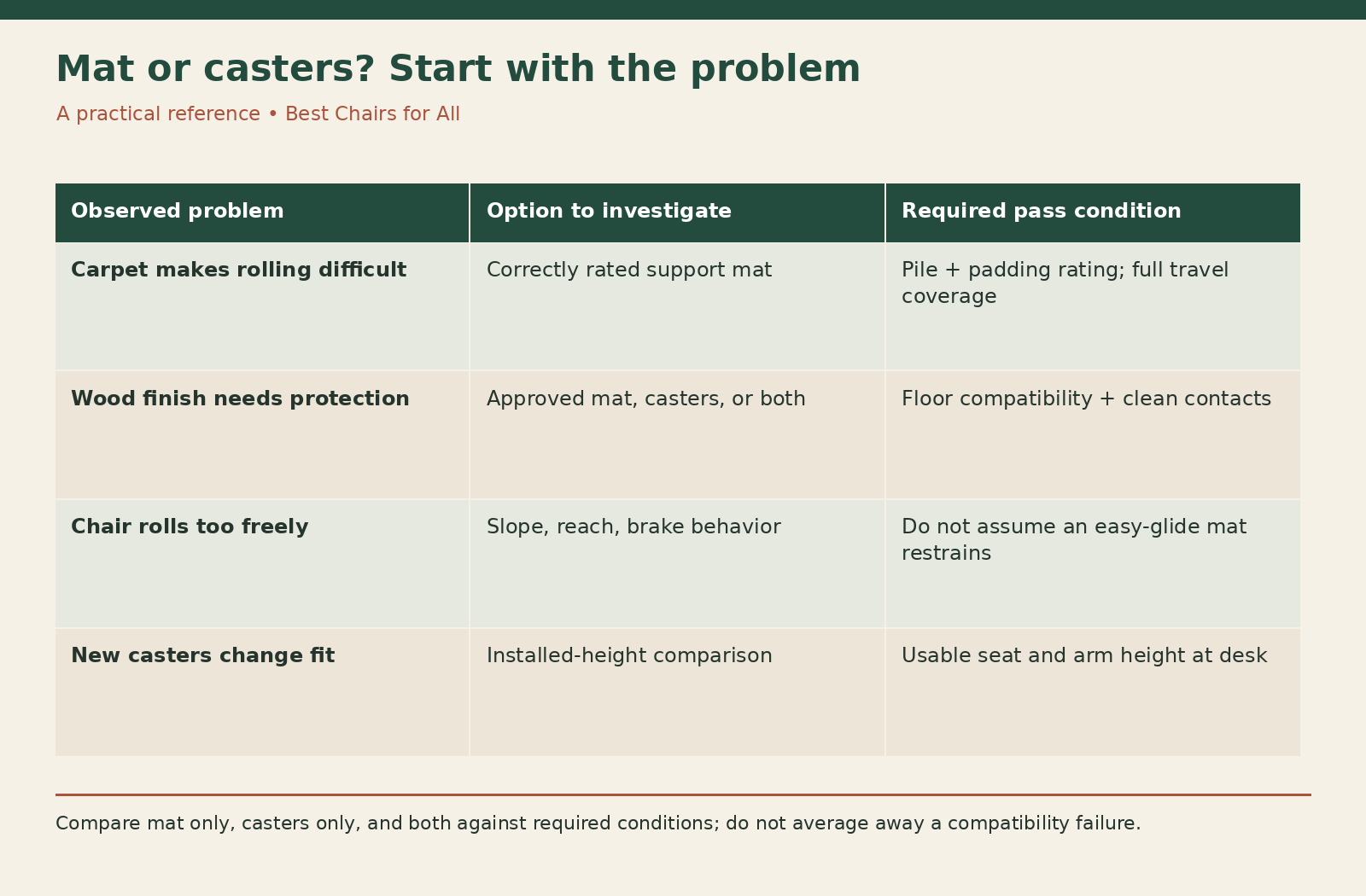
The decision is therefore a system comparison rather than a contest between accessories. Use the three-case worksheet below to compare floor protection, rolling effort, movement control, available space, and installation constraints. Start by reading the requirements for the chair and floor, then evaluate any mat under its own instructions.
Define the actual problem
Write the observation in one sentence. “The carpet compresses and the chair is hard to move” calls for a different comparison from “hard wheels leave marks on wood” or “the chair rolls away on a smooth surface.” An accessory chosen for the wrong problem can make movement worse.
Inspect the chair first. Hair, damaged tread, a loose caster, or a cracked socket needs maintenance or repair before judging the merits of mats and new wheels. A mat can hide a dragging caster’s effect without restoring the wheel’s proper operation.
Also record the location and task. A chair that remains at one desk has a different coverage requirement from one moved between a carpeted office and a hard-floor meeting room. A solution that works in only one of those locations may be inconvenient or unsuitable for the actual pattern.
What a mat changes
A chair mat provides a separate surface over a defined area. On a compatible carpet, a correctly selected mat can support rolling across the pile. On a suitable hard floor, it can create a protective boundary between the wheel path and the finish. Its size, backing, rigidity, and support requirements determine its usefulness.
The ES ROBBINS FAQ distinguishes carpet and hard-floor applications and ties carpet selection to thickness. Those are product-selection requirements, not decorative preferences. A mat too thin for its carpet application may not provide the support you expected.
A mat also introduces an edge and a second contact layer beneath it. Check whether wheels will repeatedly cross that edge, whether a door can clear it, and whether you can inspect and clean below it. These practical costs matter alongside the benefit of protecting a defined area.
What casters change
Replacement casters change tread, wheel geometry, attachment, installed height, and sometimes braking. A compatible hard-floor set may be appropriate where the floor and chair maker permit it. A carpet-specific set may roll differently on pile, but it does not necessarily distribute loading over the same area as a mat.
The Herman Miller Mirra 2 information gives a concrete example of floor-related caster options. Confirm which option is on the actual chair rather than inferring from its family name. Aftermarket wheels should receive the same compatibility review as any other replacement component.
Changing wheels can also change chair fit. Compare the complete installed caster height, not just diameter. If a new set raises the base 18 mm in a hypothetical installation, the seat and arms generally begin 18 mm higher before normal adjustments. That can matter at a low desk or for someone already using the minimum seat height.
Case one: dense carpet and difficult rolling
Suppose a chair is hard to reposition on carpet, its casters are clean and intact, and the task involves frequent movement between keyboard and side table. Measure the carpet according to the mat maker’s method, including any padding the specification includes. Choose a mat rated for that actual support condition.
Larger or different casters may improve some rolling conditions if approved for the chair and carpet, but do not assume they solve deep or soft support universally. Ask the chair maker which options it supports, then compare the installed height and movement in your working area.
The provisional worksheet result may favor a correctly rated mat, with the existing compatible casters retained. Record the reason: rolling support over the pile within the measured area. It is not a conclusion that every carpet needs a mat or that wheel changes never help; it follows from this case’s stated problem and constraints.
Case two: wood floor with finish concerns
Now suppose the chair moves easily on wood, but the fitted wheels are not documented for that floor and there are new tracks in the finish. Identify the floor product and ask its supplier about chair protection. Inspect the treads for grit and damage before selecting an accessory.
The choice may involve approved hard-floor casters, a compatible smooth-backed mat, or both. Bona’s hardwood scratch-prevention guidance provides useful context for keeping dirt and unsuitable contact from damaging a finish. It does not establish that any particular aftermarket wheel is suitable for every wood floor.
The worksheet should keep floor approval and chair compatibility as separate checkboxes. A wheel that fits the chair but violates the floor’s care requirement fails one check; a mat approved for the floor but too small for caster travel fails another. The selected combination must satisfy the whole use case.
Case three: the chair rolls too freely
For unwanted movement, start with the floor slope, task reach, and actual brake behavior. An easy-glide mat can increase mobility rather than restrain the chair. Do not purchase it as a wheel stop merely because its surface looks textured.
A compatible braking caster may answer a specific need, but find out whether it brakes while loaded, while unloaded, or through manual operation. Those mechanisms serve different situations. Our rolling-away diagnostic separates empty-chair drift, movement during work, and entry or exit.
The worksheet result may be “no accessory until slope and movement pattern are resolved.” That is a valid purchasing outcome. Buying a mat and a freely rolling larger caster set together could make the original complaint worse while introducing new height and coverage issues.
Measure the rolling envelope for a mat
Observe the outside caster positions while working, turning, and moving back to stand, using an intact chair in a clear area. Transfer the span to a sketch. Include the full movement toward side equipment, not only the centered typing position.
For a hypothetical envelope 40 inches wide and 44 inches deep, a 36-by-48-inch rectangle is too narrow. A lipped mat listed at a larger overall size may still have a narrow usable section. Compare the outline with the path at each part instead of comparing only total area.
Mark door swings, drawers, floor vents, and walkways on the same sketch. A larger mat that blocks a door or creates an exposed edge in circulation is not automatically better. A custom shape may help where supported by the manufacturer; do not cut a mat unless its instructions permit it.
Compare cleaning and maintenance needs
Casters need inspection for debris and tread condition whichever surface they roll on. A mat needs cleaning on top and inspection below. A smoother wheel does not make hair disappear, and a clear mat does not reveal every particle hidden at its edges.
Record whether you can move the mat safely for cleaning. A heavy or fragile product can create a handling burden that matters in a small workspace. Follow the specific mat’s instructions rather than assuming all rigid mats can be bent, lifted by a corner, or stored the same way.
Avoid adding improvised liners or tapes to keep a mat in place. They can affect finish compatibility and support. Ask the mat maker about approved anti-slip provisions and check the floor supplier’s requirements before adding another material beneath the chair.
Compare complete costs without invented savings
For casters, include the confirmed compatible set, any service labor, shipping, and the practical effect of changed height or braking. For a mat, include the required size and floor rating, delivery, and any necessary handling help. You do not need a fictional lifespan to compare those real costs.
Do not multiply a single caster’s load rating by five to create a new chair capacity. Likewise, a mat’s advertised strength does not increase the chair’s user limit. Keep the chair’s supported configuration and the mat’s application limits separate.
A low accessory price can be misleading if it leaves the original problem unresolved. If a mat is too narrow, a second small mat is not necessarily a suitable extension. If a wheel is almost the right stem size, an improvised adapter is not a complete installation. Compare usable results rather than item prices in isolation.
Use a decision matrix with pass conditions
Create columns for your current setup, mat only, casters only, and both. Use rows for floor approval, chair attachment, installed height, required rolling area, desired movement, maintenance access, and total known cost. Mark each as pass, fail, or needs confirmation.
For the carpet case, mat only may pass once carpet depth and coverage are confirmed. For the wood case, both may pass if the floor supplier supports the backing and the caster maker confirms the chair fit. For the drift case, all purchases may remain on hold until brake behavior and slope are understood.
Keep the reason beside each mark. This avoids a vague score where a cheap accessory compensates numerically for a failed safety or compatibility condition. Certain requirements must be satisfied, not averaged with attractive features in unrelated columns.
Verify the chosen combination
After a supported installation, inspect the stance, caster retention, mat flatness, and floor contacts. Recheck working height and desk clearance. Confirm the chair’s normal movement and any brake behavior according to the manufacturer’s directions in a clear area.
Observe whether all caster travel remains within the intended mat boundary and inspect for unexpected movement or marks. If the setup introduces drift, edge catching, or instability, stop and resolve it rather than adapting your movements around the new problem.
Keep the matrix and part or mat identifiers with your records. Revisit them when the chair, desk, or flooring changes. The best choice is the combination that meets the documented floor and chair requirements and solves the observed task problem, with enough room and access to keep it working.
Something unclear or out of date? Send a correction with this article’s title and the detail to check.
Sources, research & corrections policy ↗