An office chair that gradually loses height may have a worn gas lift, but replacing the cylinder is not always the first or correct answer. A height-control mechanism that keeps the valve engaged, an incompatible replacement part, or damage around the base can produce different versions of the same complaint. Start by documenting what moves and when. Stop using the chair if it drops abruptly, feels unstable, or shows structural damage.
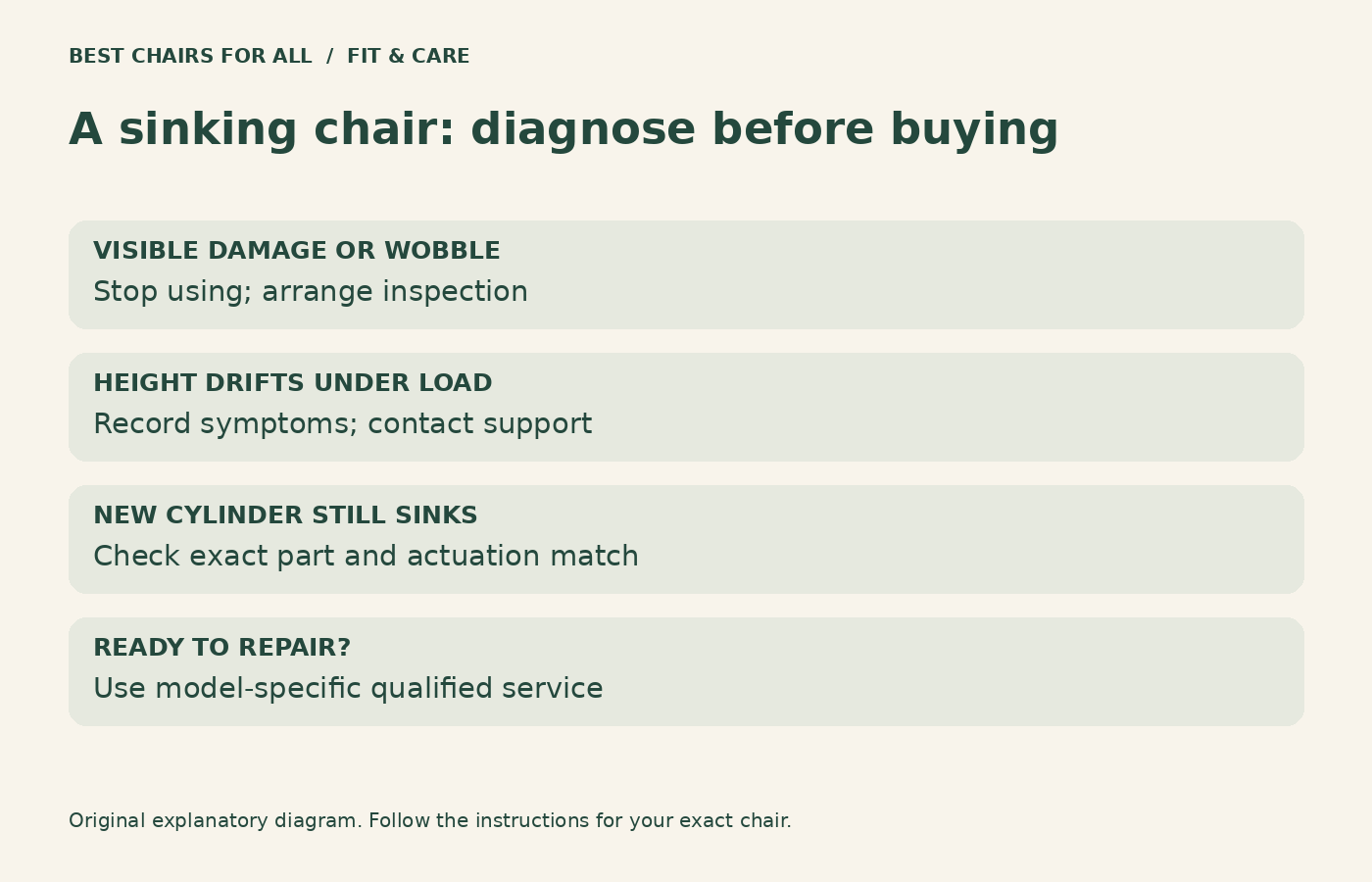
This guide helps you gather useful evidence, choose a repair route, and avoid buying parts on guesswork. It does not provide instructions for opening a pressurized cylinder or improvising a load-bearing repair. Those jobs are outside a safe general troubleshooting guide.
What the cylinder does, and what “sinking” can mean
In a typical pneumatic task chair, the height lever operates a valve in a gas-lift assembly. The cylinder allows the seat height to change when operated and should retain the selected position during normal use. The exact actuation design and fit vary. Some chairs use top activation; others have a different control arrangement. The visible metal column is only one part of the height system.
The word sinking can describe several observations: the seat slowly descends under load, the whole chair feels lower because a caster has failed, or the column projects farther through a damaged base. Separate these observations before shopping. A new gas lift will not restore a cracked base, and a new set of casters will not correct an internal cylinder problem.
A specialist parts supplier’s symptom checker distinguishes loss of height from other faults and notes that a newly replaced cylinder can still sink when the activation setup is wrong. Use this as a reason to inspect the system, not as a diagnosis of your particular chair.
First make the chair safe to inspect
Move work to another sound chair if the seat is unreliable. Keep the suspect chair away from children and other people who might sit without knowing about the fault. Look from the outside for a broken base spoke, a missing or damaged caster, unusual tilt, loose parts, or a column contacting the floor. Do not load the chair again to see whether an obvious crack will hold.
Photograph the underside label and the visible problem without dismantling the chair. If moving it requires lifting, get help appropriate to its weight. Do not pull a heavy chair up by an arm pad or loose backrest. Keep fingers away from pinch points and avoid reaching into the mechanism while another person changes the seat height.
The IKEA Malskär instructions restrict seat-height energy-accumulator repair and replacement to trained personnel. The instructions for your specific model take precedence. Pressurized gas lifts must not be drilled, cut open, heated, burned, or modified. Do not attempt to refill one. Gas-spring manufacturer Stabilus also warns against modifying, heating, or installing damaged gas springs. A repair normally involves replacing an approved assembly or correcting an identified external mechanism under the relevant service instructions. “Replace the cylinder” and “open the cylinder” are very different operations.
Ask the supplier or a trained technician to identify the exact replacement part using the chair label, mechanism, and manufacturer’s compatibility information before a cylinder is ordered.
Record the symptom using five questions
- When does it descend? Immediately, gradually during normal sitting, or only when the height lever moves?
- Does it rise normally? Note what happens during normal unloaded height adjustment, if the chair is otherwise stable.
- What changed recently? Assembly, moving house, a replacement cylinder, a new control, or no obvious event?
- What actually moves? Seat relative to base, one side of the base, or a caster or floor mat?
- Is there another warning sign? A crack, sudden drop, wobble, metal-to-floor contact, or a loose control?
You do not need to reproduce the fault repeatedly or involve a heavier person. A brief description of ordinary use is usually more helpful than a dramatic stress test. If the chair is stable enough for routine observation, place a reference mark on a nearby fixed object or take a photograph from the same position. Do not put tape over controls or attach anything to moving parts.
Use the timeline to narrow the next step
| Observation | What it suggests checking | Practical next step |
|---|---|---|
| Old chair gradually loses height | Cylinder condition and height control | Ask support for diagnosis and compatible service options |
| New chair sinks from first use | Assembly, shipping protection, wrong part, or defect | Contact seller before modifying anything |
| Replacement cylinder sinks immediately | Exact part compatibility and valve actuation | Send part numbers and photos to supplier |
| Chair leans or column approaches floor | Base, caster, or structural fault | Stop using and arrange inspection |
This table is a triage tool rather than a component diagnosis. A cylinder can fail on a relatively new chair; an old chair can have an external control problem. The important distinction is the evidence you give the person who can confirm the part and repair procedure.
Why a replacement cylinder can still sink
Some height mechanisms rely on fine adjustment between the control and the cylinder valve. If a control is continuously pressing the valve, a sound cylinder may behave as though someone is holding the height lever. That does not establish that your chair has an adjustable screw, or that turning any visible screw is safe.
Crandall Office Furniture’s explanation of set-screw adjustment identifies specific top-activated chair designs where this relationship matters. Its examples include particular generations, so the lesson is to identify the model and production date. Do not copy a procedure for an Aeron or an early Leap onto an unrelated chair.
The same caution applies to a listing labeled universal. Similar-looking cylinders can differ in actuation type, body dimensions, travel, and finished seating height. A part that enters the base is not thereby confirmed suitable for the chair. Ask the supplier to confirm compatibility in writing using the model label and the exact replacement SKU.
Gather a repair request that support can act on
Send a concise message with the brand, model, serial or manufacturing label, approximate purchase date, seller, and symptom timeline. Include the receipt if you have it. Add photos of the complete chair, label, underside control, and base. If a replacement was recently installed, attach its order number and product page.
A useful message might read: “The seat descends during ordinary sitting without the lever being touched. It began last week. The chair is stable and I cannot see a cracked base. The label and underside photos are attached. Please confirm the compatible cylinder and whether inspection of the height mechanism is required.” Adjust that wording to the facts; do not claim the cylinder is definitely defective.
For an unstable chair, say so explicitly and state that you have stopped using it. Avoid sending a video that requires someone to sit on visibly damaged furniture. Ask whether the manufacturer needs a particular photograph or measurement before arranging service.
Check warranty and service before ordering parts
Warranty coverage can depend on the model, component, purchase channel, owner, and documentation. Do not assume the period advertised for a current product applies to your older or secondhand chair. Also distinguish a manufacturer’s warranty from a refurbisher’s separate promise. Ask the seller who is responsible for the claim.
Herman Miller’s customer-service page provides routes for product support and adjustment information. Other brands have their own dealer or service processes. Start with the channel connected to the actual purchase, and ask whether an authorized technician is required. Keep the damaged component until the claim handler tells you whether it needs to be inspected or returned.
If the chair belongs to an employer, report the fault through workplace facilities or safety procedures. Do not privately install an unapproved part on company furniture. A shared chair should be clearly taken out of service so a colleague does not discover the fault by sitting down.
What to compare in a repair quote
Ask for the part number, what the job includes, who performs it, and what warranty applies to the repair. Confirm whether the quoted work also checks the control and base. If the technician discovers another worn component, agree on how additional work will be approved before they proceed.
Use a simple worksheet with four lines: approved part, labor, shipping or collection, and any other confirmed work. Add the time you will be without the chair. Compare that complete cost with a suitable replacement, rather than comparing a loose cylinder price with the retail price of a finished chair.
Consider the rest of the chair honestly. A chair that fits well and has sound upholstery, arms, base, and recline may justify professional repair. If it has several faults and never fitted your body or desk, a cylinder repair may restore height without solving the reason you dislike using it. There is no useful universal percentage that decides this for every chair.
Why clamps, sleeves, and improvised spacers are a poor default
Online advice often suggests blocking the seat at a fixed height with a clamp, pipe, or stack of material. Such a modification changes the way loads are carried and can hide the underlying problem. It may also prevent future adjustment or interfere with normal mechanism movement. This guide does not recommend those workarounds.
Even if the seat stops descending, that observation does not verify the assembly’s safety, long-term strength, or compatibility. A fixed height may also be wrong for another user. Use a sound replacement chair temporarily and get an approved repair assessment instead of treating the disappearance of one symptom as proof of a safe fix.
After an approved repair, verify the complete chair
Ask the technician to demonstrate normal height adjustment and confirm that the chair is ready for use. Check the expected range, stable support, and clearance from the floor. Keep the service record and part details. If the problem returns, stop using the chair and report the recurrence rather than repeatedly tightening or modifying parts.
Reset your workstation because a replacement can change the available height range. CCOHS adjustment guidance explains the relationship between seat height, supported feet, and a fixed work surface. Recheck those relationships using the repaired chair; returning every control to a remembered number may not reproduce the previous fit.
Finally, retain a short maintenance note: repair date, service provider, approved part, and what changed. That record makes a later support request easier and helps a future owner understand the work. The successful outcome is a stable chair that retains its adjustment and fits its task, rather than merely a seat that has been prevented from moving down.
Something unclear or out of date? Send a correction with this article’s title and the detail to check.
Sources, research & corrections policy ↗