As an Amazon Associate, we earn from qualifying purchases. Read our affiliate disclosure. Retailer links below search for matching listings; verify the exact model and seller before ordering.
The best portable stadium chair is one you can carry to the seat and use under that event’s rules. I would first compare the GCI Outdoor BleacherBack for its low listed weight, the TravelChair 1669 for a compact steel-frame buckle design, and the regular Cascade Mountain Tech Ultralight for a hook-mounted padded seat. Those choices remain conditional on bench compatibility and admission; stadium branding is not entry approval.
We checked manufacturer information and official policy and recall sources on November 6, 2026. This is a research-based shortlist, not a seating or load test. All three named products list a 250-pound user capacity. If that is insufficient for your requirement, these choices do not pass, regardless of how portable they look.
The documents behind the comparison
The primary product sources are the current GCI BleacherBack listing, TravelChair 1669 page, and Cascade regular Ultralight specifications. We compare their dimensional labels as published and flag missing attachment limits rather than inventing a universal bleacher thickness.
Stock can differ by color, seller, and revision. A matching-listing search may show a different width or an old used unit. Confirm the model, the actual item condition, included straps or hook, and return terms. This guide makes no fixed budget promise and does not infer price or availability from a search-button label.
Portable-seat shortlist
1. GCI Outdoor BleacherBack Stadium Seat
Best for: a low listed carry weight and narrow current outline.
The current BleacherBack is my first portable-seat comparison for a buyer who needs a backrest and can use its buckle attachment on an approved bench. At a listed 2.9 pounds, it is the lightest of these three candidates. Its flat fold and shoulder strap are useful for a parking-to-seat trip where carrying a wider rigid panel would be inconvenient.
Check the complete product and event policy: its storage pocket and backrest can be prohibited even when the 16-inch width is acceptable. The securing buckle also needs the compatible bench route shown by the maker. Buying used adds an important identification step because certain older BleacherBack seats were recalled. A current product name does not establish the history of a secondhand unit.
Confirm stadium seat width restrictions with the venue before choosing a portable stadium chair by its open dimensions.
Product Details
| Brand | GCI Outdoor |
|---|---|
| Model | BleacherBack; current product listing |
| Open dimensions W × D × H | 16 × 12.3 × 16.7 inches |
| Folded dimensions W × D × H | 16 × 16.7 × 3.5 inches |
| Listed weight / capacity | 2.9 lb / 250 lb |
| Bench attachment | Single-buckle security strap |
| Carry method | Shoulder strap; flat fold |
Additional Product Information
| Backrest | Adjustable |
|---|
Pros
- Clearly labeled current open and folded dimensions.
- Shoulder carrying and adjustable backrest in a 2.9-pound listing.
Cons
- Pocket, backrest, or attachment can conflict with an event policy.
- Older units need PO-number recall verification, not just a visual comparison.
Choose after confirming permission, bench access, and the exact unit’s recall status where relevant. Do not describe it as approved for a venue simply because it is narrow.
2. TravelChair Stadium Seat Model 1669
Best for: a compact steel-frame alternative with securing buckles.
TravelChair’s 1669 is a useful middle comparison when you want a padded backrest and a stated bleacher-securing system without the heavier listed weight of the Cascade seat. The manufacturer identifies oversized buckles for securing it, a steel frame, and closed-cell foam seating. That is a specific design to investigate, rather than a generic padded ground mat.
The manufacturer lists three-number open and closed dimensions without labeling every axis in the summary, so confirm their orientation and the maximum width if your event has a strict limit. Do not infer a universal strap length or bench-thickness capacity from the word buckle. The page showed the product out of stock during research; a retailer offer needs an exact-model and condition check.
Product Details
| Brand | TravelChair |
|---|---|
| Model | 1669 Stadium Seat |
| Maker open dimensions | 12 × 17 × 19 inches; confirm axis order |
| Maker closed dimensions | 5 × 17 × 18 inches; confirm axis order |
| Listed weight / capacity | 3.2 lb / 250 lb |
| Listed seat height | 1.5 inches above supporting surface |
| Frame | Powder-coated steel |
Additional Product Information
| Bench attachment | Oversized securing buckles; follow current instructions |
|---|
Pros
- Published 3.2-pound weight and 250-pound capacity for model 1669.
- Manufacturer describes both back padding and bench-securing buckles.
Cons
- Axis order and exact bench-routing limits need clarification for a close fit.
- Manufacturer availability was absent; matching retailer stock is unverified.
Consider it if a current matching unit and the attachment instructions are available. If the essential width or bench route remains unclear, postpone the purchase rather than assuming the photograph answers it.
3. Cascade Mountain Tech Ultralight Stadium Seat Regular Width
Best for: a hook-mounted padded seat when a heavier carry is acceptable.
The regular Cascade seat makes the shortlist for people whose bench is compatible with its underside hook and who prefer its padded aluminum-frame arrangement. It is a different attachment route from the two buckle designs. The published regular-width dimensions give a concrete starting point for checking your allocated seating space.
At a listed 5.3 pounds, it adds 2.4 pounds compared with one BleacherBack. That difference can become more noticeable when carrying two seats and a personal bag, but it does not prove which seat feels better in use. Verify that the retailer has the regular 17-inch model; the wider and memory-foam products are separate configurations with different dimensions and carrying weights.
Product Details
| Brand | Cascade Mountain Tech |
|---|---|
| Model | Ultralight Stadium Seat for Bleachers, regular width |
| Listed dimensions W × D × H | 17 × 14 × 15 inches |
| Listed weight / capacity | 5.3 lb / 250 lb |
| Frame / cushion | Aluminum / canvas |
| Bench attachment | Underside bleacher hook |
| Carry method | Shoulder strap and cushioned handle |
Additional Product Information
| Size boundary | Not the 20-inch Extra-Wide version |
|---|
Pros
- Manufacturer publishes the regular size, material, weight, and capacity.
- Both a carry handle and shoulder strap offer transport options.
Cons
- Highest listed carry weight among these three portable choices.
- Hook engagement depends on the actual bench profile and access.
Pick when the hook, bench, and permitted width all match and the extra load fits your route. Do not exchange a failed hook fit for an improvised strap or modification.
Use a parking-to-seat carry worksheet
Count the number of seats, not just the weight of one. Add the actual personal bag, permitted supplies, and any rain layer. Then list the route: parking walk, gate queue, stairs, narrow aisle, and the way you will carry the folded chair while presenting a ticket. A chair’s shoulder strap can free a hand, but only if it works with your other carried items.
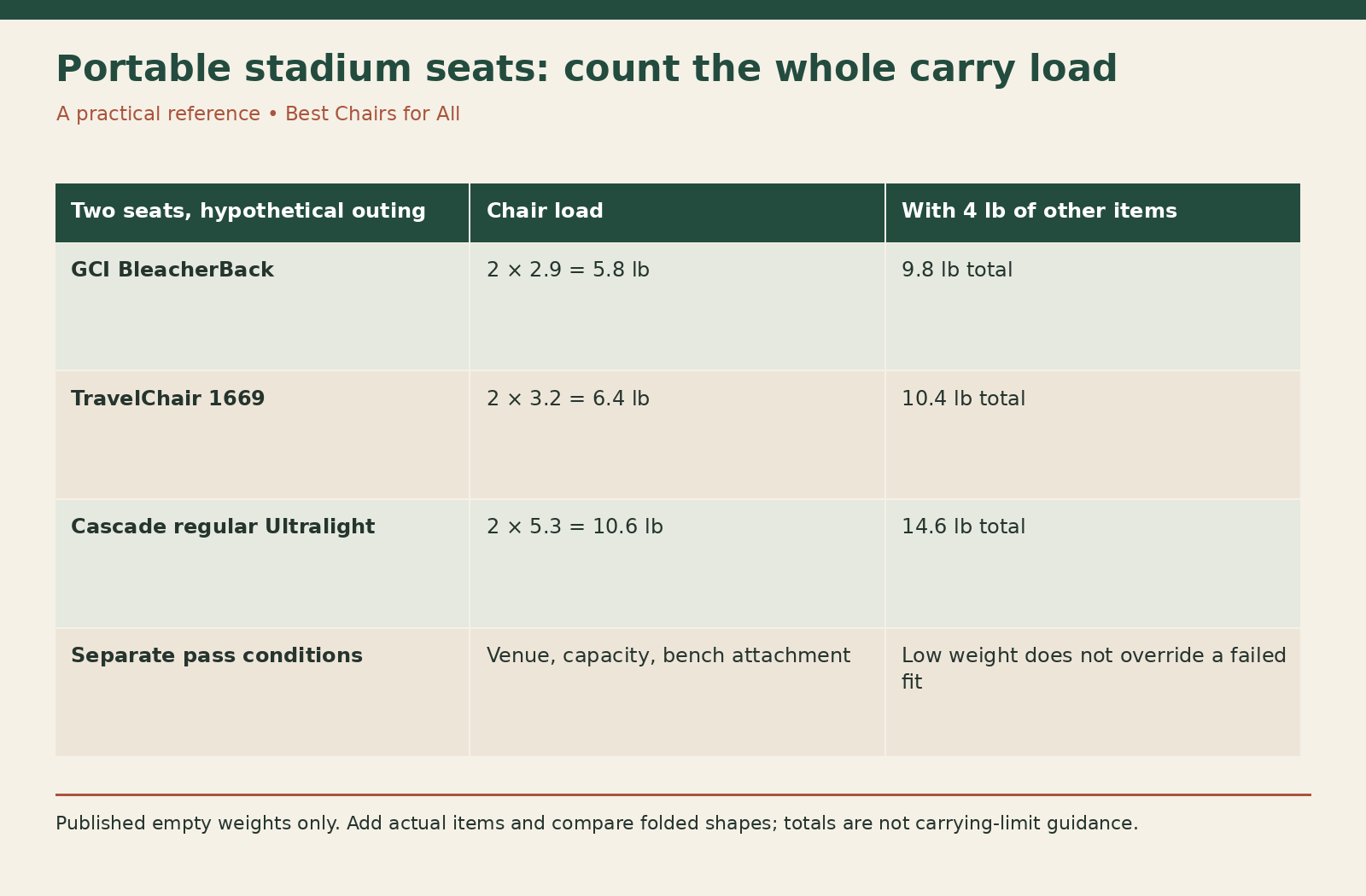
For a hypothetical two-seat outing, two BleacherBack listings total 5.8 pounds, two TravelChair seats total 6.4 pounds, and two regular Cascade seats total 10.6 pounds. With an assumed four-pound personal load, those become 9.8, 10.4, and 14.6 pounds respectively. These totals are planning arithmetic, not personal carrying limits or measured fatigue predictions.
Write the folded shape beside the total. A light wide panel can still interfere with a crowded aisle, while a heavier shape may fit a particular carry method better. Confirm dimensions in the orientation you intend to carry, especially when the maker’s three-number specification does not label each axis.
Check policy before optimizing portability
A venue can prohibit all three backrest seats regardless of their weight. For example, the official Michigan Stadium safety page prohibits seat backs and several attached features while permitting specified simple pads. That is an identified venue example, not a rule for every stadium. Recheck the actual event’s current official instructions before buying or traveling.
Keep the chair, chair case, and personal bag separate in your inventory. Permission for one does not cover the others. Storage pockets on the chair can matter even when empty, and a soft-sided backrest is still a backrest if the policy excludes that category.
If the answer is unclear, send guest services the manufacturer link and open dimensions and ask about the specific product. Do not remove safety hardware, cut off pockets, or modify the chair to make a marketing photograph resemble an allowed cushion. Choose an allowed product or ask about the venue’s own seating options.
Match the attachment to the actual bench
For a hook, inspect the bench edge and underside access required by the maker. A front lip, support member, enclosed underside, or unusual profile can affect engagement. For buckles, confirm the intended route and the supported bench dimensions. A carry strap is not automatically the attachment strap.
Ask for the exact instruction before ordering if the retailer listing only shows a folded chair. Do not assume that every bench described as wood or metal has the same profile. Likewise, the presence of an attachment does not mean it can be tightened around stadium property in any convenient way.
Our hook-versus-strap guide covers those mechanisms in more detail. Use it to prepare your questions, then apply the actual seat instructions. If no supported attachment route exists on your bench, that candidate fails even if it is the easiest one to carry.
Check an older BleacherBack by its identifiers
The CPSC BleacherBack recall notice, dated December 10, 2014, identifies certain purchase-order numbers sold during 2013–2014 and a backrest-failure hazard. It directs affected owners to stop use and obtain the specified repair. Match the PO tag and notice, especially for used or stored units.
This does not establish that every current BleacherBack is recalled. It establishes that a familiar model name is insufficient to clear an older chair. If its identifying label is missing, ask GCI how to resolve the history before relying on it. Do not substitute a home-made extra strap for the official remedy.
Keep the documentation with a secondhand purchase. A seller saying it was barely used does not answer a recall question, and a clean fabric surface does not identify the production order. Traceable condition and identifying information matter more than cosmetic appearance here.
Evaluate support without treating it as a medical promise
A padded backrest can offer a place to rest, but it does not guarantee pain relief or a correct posture for every person. Bench height, foot support, seat depth, and the backrest angle affect how the complete setup feels. A seat pad also raises you above the original bench, which can change foot contact.
Try the chair on an appropriate low practice bench under the supplied instructions when practical and return conditions allow. Check ordinary sitting, back contact, standing, and folding. Do not test a suspect attachment by leaning hard or rocking at a bleacher edge. If fit is unsuitable, select a different approved arrangement.
Read cleaning and drying instructions before a wet-weather event. A water-resistant cushion description does not make the assembled seat waterproof or ready to store while damp. Keep buckles, hook, fabric, and stitching visible for inspection rather than covering damage with an aftermarket cushion.
Choose by the whole trip
Complete five pass conditions: event permission, user capacity, compatible attachment, usable seated fit, and manageable carry arrangement. Record the exact variant and seller only after those checks are satisfied. An unresolved width or attachment limit is a purchase question, not a detail to discover at the gate.
The BleacherBack leads this shortlist for published carry weight if its configuration is permitted. TravelChair’s 1669 is a middle-weight buckle alternative when its availability and dimensions are confirmed. The Cascade regular Ultralight is the hook option for a buyer who accepts the heavier load. Choose the seat that passes the whole trip from vehicle to bench and back.
Something unclear or out of date? Send a correction with this article’s title and the detail to check.
Sources, research & corrections policy ↗