Stadium seat width restrictions come from the venue and event, and they do not follow one universal measurement. Some venues permit a narrow backrest but prohibit arms, pockets, or concealed compartments. Others permit only a simple cushion. Before buying, find the current official policy for the event you will attend, identify what kind of seat it allows, and then compare the chair’s overall dimensions with both the policy and your allocated space.
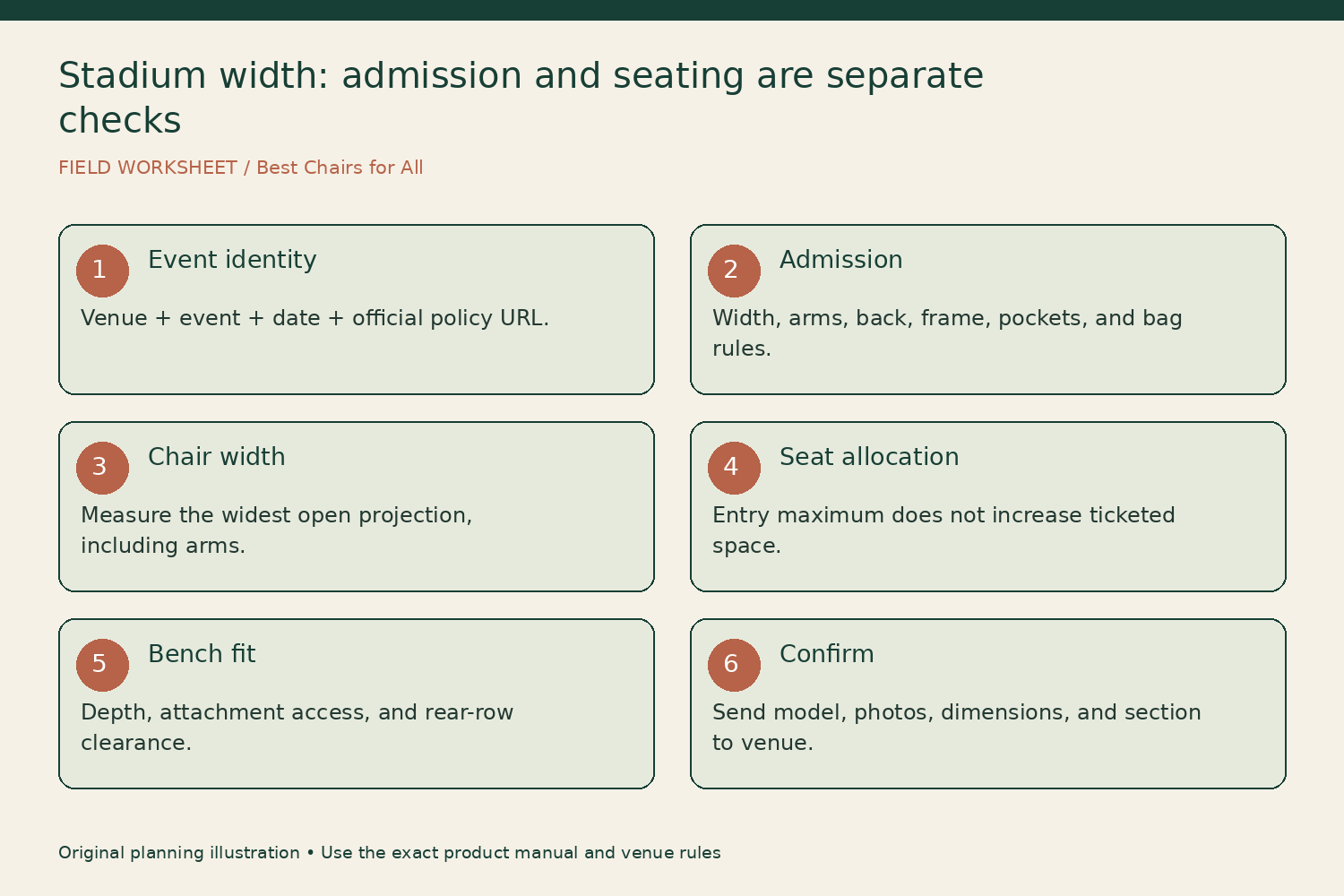
A product advertised as a stadium chair is not automatically admitted to every stadium. Likewise, a seat that meets an entry rule can still be too large for a particular bleacher position. Treat admission, attachment compatibility, and physical fit as three separate checks. This guide gives you a policy-and-measurement worksheet so a promising purchase does not turn into an unexpected walk back to the car.
Find the correct authority and event
Start with the venue’s official guest guide, prohibited-items page, or event information. Confirm the event date and season. A professional team’s game, university ceremony, and concert at the same facility can have different arrangements. A search result may show an old PDF or a discussion of last season’s rules; open the actual source and check what it says now.
Write the venue name, event, date, policy URL, and date checked at the top of your worksheet. If the page gives an event-specific contact, use it for unresolved questions. Do not rely on a product review saying the reviewer carried the chair into a different stadium. That experience does not establish permission for your event, even if both facilities host the same sport or share a league.
Read shape restrictions before width
A width limit is only one possible rule. Look for language about arms, backs, metal frames, pockets, zippers, storage spaces, attachments, and separate carrying bags. A twenty-inch chair does not become acceptable merely because its soft seat compresses into eighteen inches if the policy prohibits its arms or frame. Record each restriction separately rather than summarizing the page as ‘small chairs allowed.’
At Lambeau Field, the Packers carry-in policy describes traditional stadium seats with backs and seat pads no wider than 18 inches, without pockets, zippers, or concealed areas, and excludes armrests and other attachments. That is a named-venue example checked for this guide, not a league-wide rule. Recheck the official page before your visit, since the policy also allows event-by-event changes.
Compare a different venue's approach
The 2026 Michigan Stadium safety page permits foam pads and small non-pocket cushions while prohibiting specified features including metal, seat backs, armrests, and attachments. A chair that meets an eighteen-inch rule elsewhere can therefore fail a different venue’s construction restrictions before its width is considered. This is why a single ‘stadium approved’ label cannot replace checking the destination.
When the policy says ‘small’ without giving dimensions, do not invent a numerical maximum. Send the venue the product dimensions and photographs, and ask whether that specific design is permitted. Keep the reply with your event details. If the answer remains unclear, choose a simpler explicitly permitted option or arrange another seating solution through the venue rather than guessing at the gate.
Measure overall width rather than cushion width
For a chair you already own, open it in the normal use position on a suitable surface and measure between its farthest side projections. Include armrests, hinges, handles, side pockets when filled as intended, and any fixed fittings. Keep the tape straight across the widest point. Measure the seating surface separately and label it clearly, because it answers a comfort question rather than the overall fit question.
For an online purchase, request the overall open width when a listing provides only seat width. Ask whether dimensions include arms and attachments. If two specification tables disagree, identify the model code and version before choosing one. Product families can change across revisions, and a retailer may retain a photograph or specification from an earlier version. Save the manufacturer page associated with the actual item you order.
Use a real product as a rejection example
The GCI Big Comfort Stadium Chair with Armrests page lists an overall open width of 22.8 inches and describes molded arms. Those facts make it an obvious mismatch for a policy that caps width at eighteen inches and forbids arms. This is a documentation comparison, not a criticism of the chair’s intended use at venues that permit it.
The same product page distinguishes open and folded measurements. That distinction matters because a chair can be carried through a gate in one shape and used in another. Unless the venue specifically defines a restriction as folded size, do not assume its entry width concerns only the folded object. Ask which configuration is measured if the wording leaves room for doubt.
Check the assigned bleacher space separately
Ask the venue about your section and seating type. A seat number printed on a long bench is not the same as a molded individual chair with fixed sides. Measure or obtain the allocated width if available, and check whether a rental backrest is already installed. Do not remove venue equipment or claim neighboring space to accommodate a wider portable chair.
A worked example makes the distinction clear. Suppose an event permits an eighteen-inch backrest, but your documented allocated bench width is seventeen inches. An eighteen-inch chair could satisfy the policy’s stated maximum while still exceeding that allocation by one inch. These are illustrative numbers. The decision requires both checks; the entry rule does not grant extra space beyond your ticketed position.
Add depth and the row behind
Record overall open depth, forward projection, and the backrest’s position relative to the bench. Ask whether reclining seats are allowed. A chair can meet a width rule but occupy a walkway or reduce the available space for the person behind it. Check the attachment’s intended bench geometry as well, including any requirement for an open front edge or accessible underside.
Do not assume you can compensate for excessive depth by hanging the chair farther off the bench. Follow the chair instructions and the venue’s positioning rules. A hook or strap must engage the structure it was designed for. If the bleacher has a closed front, unusual trim, a back panel, or a permanent seat installed, obtain confirmation that the chair can be used there instead of improvising an attachment.
Build a two-stage worksheet
Use stage one for admission: product type permitted, width maximum, arms permitted, frame permitted, storage features permitted, carrying-bag rule, and event-specific conditions. Use stage two for installation: allocated width, bench depth, attachment access, row clearance, and existing seating hardware. Put the evidence source beside each answer, distinguishing the official policy, manufacturer specifications, and an actual measurement.
Mark an unanswered item ‘unknown.’ Do not give a candidate an overall pass while a decisive cell is blank. For instance, a chair might pass width and bag checks but have an attachment whose fit cannot be established. The worksheet should reveal that remaining task. A compact chair is not automatically compatible with every bench simply because it creates fewer obvious space concerns.
Send a precise question to guest services
A useful message includes the event date, section and row, chair brand and model, overall open dimensions, folded dimensions, and photographs showing arms, back, pockets, and attachment. Ask two questions: is the design permitted, and can it be used at that seating location? Keep these separate so a reply about entry is not mistaken for a statement about bleacher compatibility.
If the chair is needed for an accessibility or medical reason, contact the venue’s designated access or guest-services team before purchasing. Ask about the available seating arrangements and the procedure for any necessary item. Do not assume that a standard carry-in exception automatically resolves physical fit, installation, or accessible seating needs. The venue can explain its process and the options applicable to the ticketed event.
Plan for arrival and a rejected item
Check the policy again close to the event and read any ticket-holder email. Pack the chair so staff can inspect its features without unloading unrelated belongings. A separate storage bag may have its own restrictions, even when the seat is allowed. Keep a copy of a useful written reply, while recognizing that event security still administers the actual entry process.
Know whether a return to the car is practical before approaching the gate. Do not presume there will be a checkroom or that staff can hold a prohibited chair. If your plan depends on a venue rental, confirm current availability and whether it is tied to a particular seat or season. A backup plan should be an actual permitted arrangement, not a hope that an oversized object will receive special treatment.
Choose for the events you actually attend
For several venues, make one worksheet row per event and compare the strictest relevant features. A simple cushion may cover more destinations than an armed folding backrest, but it offers different support. You may reasonably choose separate equipment for a local school bleacher and a professional stadium. The useful comparison is total suitability across your schedule, including carrying and setup, rather than maximum padding or width alone.
Buy once the official rule and product measurements agree and the installation questions are resolved. Retain the model information for future visits, because policies and chair versions can change independently. The final test is specific: this chair, in this configuration, at this event and seat. That approach makes stadium seat width restrictions understandable without turning one venue’s eighteen-inch example into a rule for everyone. Keep your completed worksheet with the chair so another person borrowing it can check their own destination before carrying it to a gate.
Something unclear or out of date? Send a correction with this article’s title and the detail to check.
Sources, research & corrections policy ↗