A recliner squeak is a symptom to locate, not an instruction to spray every moving part. Note when the sound happens, whether the chair still moves normally, and whether the noise began suddenly or after a change in placement. Stop using the chair if the sound accompanies uneven movement, instability, visible damage, an electrical odor, or a mechanism that catches. Otherwise, gather a short sound-and-motion record for the retailer.
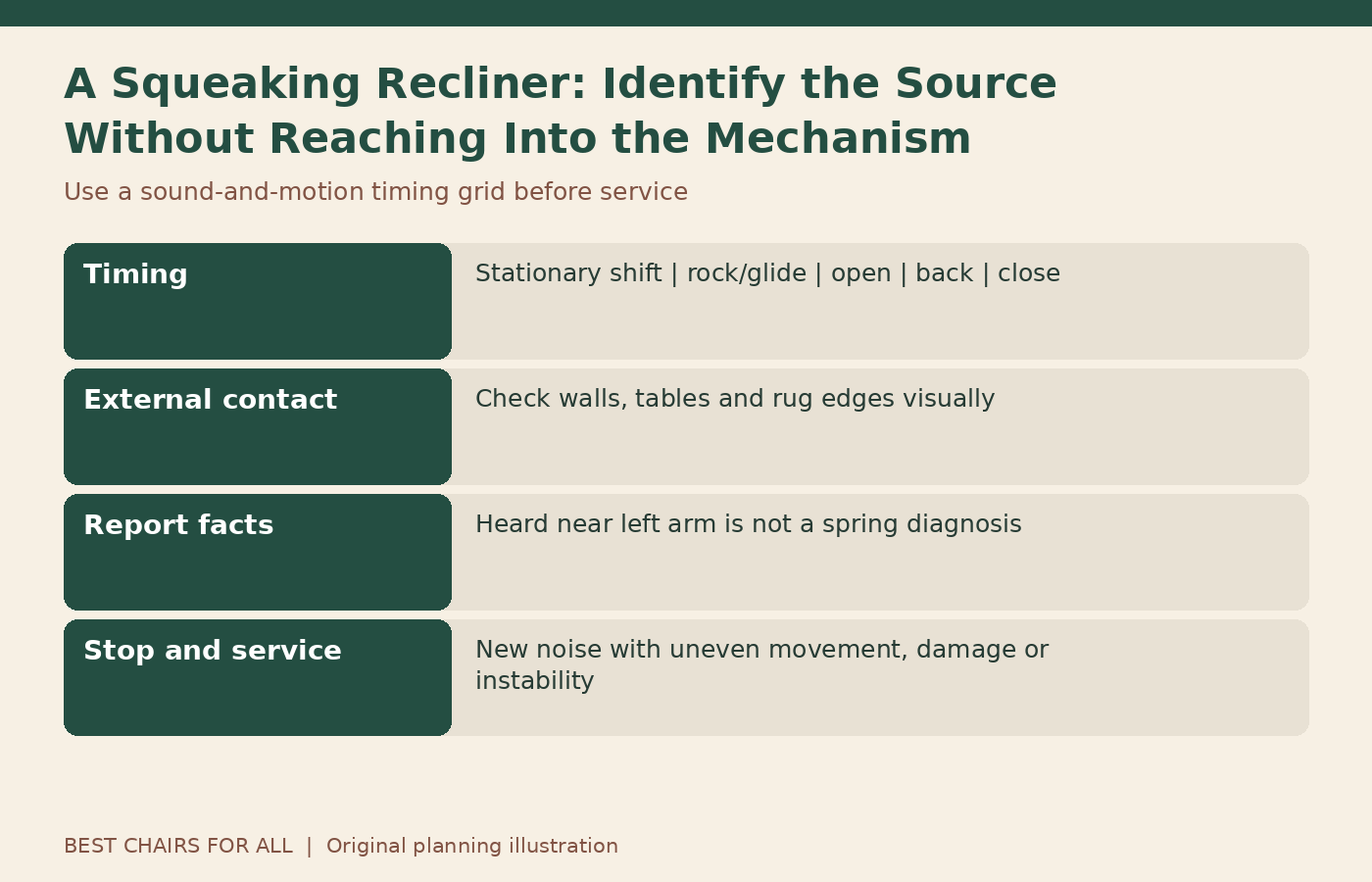
You can make useful observations without reaching underneath, removing upholstery, or handling springs. This guide uses a timing grid to distinguish upholstery rubbing, floor-related sounds, and motion-stage noises as possibilities. It does not diagnose an internal part from its sound or provide a universal lubrication procedure.
Start with the change, not the loudness
Write down when you first noticed the noise and what changed beforehand. Was the chair moved onto a rug, delivered recently, cleaned, or repositioned beside a table? Did the sound appear gradually or after a single event? These details can be more useful than calling the squeak loud, because room acoustics and personal sensitivity differ.
Record whether the chair’s behavior changed at the same time. A familiar sound with otherwise normal operation is different from a new squeak followed by a tilted footrest. Do not keep reproducing an abnormal movement to refine the description. If the chair appears damaged or unstable, stop and give the provider the observations already available.
Identify the exact chair and motion type
Find the model and product ID from accessible records and note whether the chair rocks, glides, swivels, reclines manually, or uses power. A powered headrest and footrest can create different sound events, while a rocker can make noise without the recline mechanism moving. Write down the full configuration rather than simply identifying the brand.
Best Home Furnishings’ FAQ explains that mechanism choices vary by product. That matters for a noise investigation: a service explanation for a rocker should not be assumed to apply to a swivel glider in a similar upholstery style. The provider needs the configuration to connect the symptom with the correct instructions and parts record.
Create a sound-and-motion timing grid
Make six rows: sitting down with the chair stationary, ordinary weight shift, rocking or gliding if permitted, footrest opening, back adjustment, and footrest closing. Add columns for sound description, approximate location heard, movement normal or abnormal, and whether the event is already documented. Fill the grid from ordinary use or memory before attempting any additional observation.
Use descriptions such as high rubbing squeak, single clunk, repeated click, or low creak. These are reporting words, not diagnoses. The apparent location can be misleading because a frame transmits sound. Write heard near left arm rather than left spring failed. A clear uncertainty is more useful than a precise but unsupported component claim.
Keep normal mechanism sounds in context
Some reclining mechanisms make a release or ratchet sound during normal operation. Whether a particular noise is expected depends on the model and operating stage. Do not decide that every click is harmless or every clunk means damage. Compare the sound with the manufacturer’s explanation and report a meaningful change in volume, timing, or movement.
La-Z-Boy’s FAQ discusses noise associated with its footrest mechanisms and advises contacting the dealer about concerns. That explanation belongs to the described products. If you own another brand or a different system, ask for its own guidance rather than treating a familiar sound from a video as a universal standard.
Check nearby contact points from outside
Look for the chair back touching a wall, an arm rubbing a table, or a footrest brushing a rug edge. Keep the chair stationary while inspecting the visible surroundings. A close object can produce or amplify a sound without the chair’s internal mechanism being the source. Clear only objects that can be moved without reaching into the operating envelope.
Do not place your hand between the chair and wall while someone rocks it to test contact. Instead, use the manufacturer’s required clearances and reposition the furniture through an approved handling method. If a sound disappears after an external contact is removed, record that result, but still report any damage or abnormal movement that occurred during the original interference.
Consider the floor without improvising a repair
A chair placed across a rug edge or uneven surface may sit differently than it did before moving. Note whether the base appears properly supported from a normal viewing position and consult the installation instructions. Do not wedge folded cardboard, loose blocks, or an unapproved platform underneath to silence a creak. That can change stability and movement.
If the manual provides a user-level leveling procedure, follow it only for the matching chair and with the required assistance. Otherwise, ask the installer or retailer to assess the placement. A floor-related possibility is not proof that the chair is sound, and a quieter result after moving it does not explain a visibly uneven mechanism.
Distinguish surface rubbing as an observation
Leather panels, upholstery folds, clothing, and nearby covers can make friction sounds. Notice whether the noise occurs when the body shifts while the mechanism stays stationary. Check for a loose cover caught between sections or an accessory contacting the arm. Do not apply powder, oil, wax, or silicone to upholstery as an experiment.
If a rubbing sound appears related to the leather finish, ask the retailer for the appropriate care advice for that exact covering. A treatment suitable for metal hardware may damage upholstery, and a leather protector is not a mechanism lubricant. Keep the two care questions separate in the service record. Removing a loose blanket from a visible external contact is different from altering the chair.
Do not lubricate unidentified parts
Manufacturers can give different lubrication instructions, and some locations must not be lubricated. A general spray-every-joint approach can contaminate upholstery, flooring, controls, or parts intended to remain dry. Avoid aerosol experiments around powered equipment and do not reach into linkages to find the squeak. Ask the provider to identify the source before selecting any product.
La-Z-Boy’s cited FAQ explicitly recommends dealer diagnosis before discussing a particular lubricant and restrictions. That is not permission to apply its product guidance to another chair. The relevant questions are whether lubrication is appropriate, which exact points may be treated, who should do it, and what protection and isolation the manufacturer requires. If those answers are missing, leave the mechanism alone.
Use recordings without provoking a fault
A short audio recording from a safe position can preserve a sound that is difficult to describe over the phone. Ask the provider what evidence would help and record only ordinary permitted operation when there are no warning signs. Keep the phone, cords, hands, and other people clear of the chair. Do not attach a microphone or device near moving components.
State the chair position and action aloud before the event if that helps identify timing. One clean example is usually more useful than several minutes of repeated cycling. A recording cannot establish whether a spring is loose or a bearing needs replacement; it supplements the model information and movement observations rather than replacing an inspection.
A three-pattern example
In a hypothetical first pattern, a squeak occurs only when the chair’s arm touches a side table during a permitted swivel. Removing that external interference through proper placement resolves the contact. In a second pattern, a familiar clunk occurs at the manual footrest’s documented release stage with normal movement. The provider confirms that the specific sound matches normal operation.
In a third pattern, a new squeal accompanies a footrest rising unevenly. That calls for stopping use and service, even if an online discussion suggests a quick oil treatment. These examples are not remote diagnoses. They show how timing, external contact, and movement behavior together lead to different next actions without anyone reaching into the mechanism.
Consult the matching customer-care resource
La-Z-Boy’s customer-care video page includes material about footrest operation and noise for its products. Use a resource only when the chair and mechanism match, and read the accompanying manual warnings. A video thumbnail with a similar chair is not enough to establish that its procedure belongs to your production version.
If a manufacturer library separates customer and dealer resources, respect that distinction and ask the retailer about internal work. Do not remove the back, dust cover, spring, or motor pin merely because a service video makes access look straightforward. The useful home investigation ends at exterior observations and the procedures expressly intended for the owner of that model.
Prepare a focused service request
Send the full model and serial information, the timing grid, the first-noticed date, recent placement changes, and any safe recording. Lead with warning signs or altered movement, then describe the sound. Ask whether continued use is appropriate and whether an in-home inspection is available. The service provider can decide what further evidence or access is needed.
Ask how warranty coverage applies to diagnosis, parts, labor, and travel rather than assuming a squeak is covered or excluded. Keep the reply with the chair records. If a technician identifies a cause, ask for a plain explanation and any model-approved routine that prevents recurrence. This is more useful than keeping a collection of unverified lubricant suggestions.
Judge the outcome by operation as well as sound
After an approved placement correction or professional repair, follow the recommended normal-operation check and note whether movement is even and complete. A temporarily quieter chair is not a successful repair if the footrest still catches or the base feels unstable. Report any remaining symptom with the same timing grid so the comparison remains clear.
Keep the external clearances and floor arrangement consistent after cleaning. If a new sound develops later, start a fresh record rather than assuming it has the previous cause. The aim is a chair operating as its manufacturer intends, with noise concerns documented precisely and internal diagnosis assigned to the appropriate provider.
Something unclear or out of date? Send a correction with this article’s title and the detail to check.
Sources, research & corrections policy ↗