Wheelchair anti-tip devices are components selected and configured to help manage tipping risk, commonly at the rear of a manual chair. Their location, mounting, adjustment and operating position must match the exact chair. They do not make every slope or maneuver safe, and a tube that fits a receiver is not automatically a compatible replacement.
Identify the component before assigning it a purpose
The TiLite CR1 instructions identify anti-tips as a separate wheelchair component and require correct installation when the chair is configured with them. Do not confuse a small rear anti-tip wheel with a main caster, a parking wheel lock or a tube an attendant uses for a specific trained operation. Similar-looking metalwork can have different functions.
Ask the supplier to point out the actual device on the chair, its receiver, locking feature and prescribed working position. Put the component’s name beside a photograph of that exact assembly. If a used chair has empty receivers or an unfamiliar rear attachment, ask what configuration it originally had and what is required now. An empty bracket is not proof that the component is unnecessary.
Understand the limitation as well as the intention
A rear anti-tip assembly can provide an additional contact point when the chair rotates backward, within the product’s designed arrangement. It is not a general guarantee against every rearward, forward or sideways fall. A surface change, collision or unassessed maneuver can create risks outside the intended protection. Do not use the presence of anti-tips as permission to attempt unfamiliar slopes, curbs or balance skills.
The user and any attendant still need appropriate instruction for the actual chair and environment. If a route appears incompatible with the equipment, bring the situation to the responsible team rather than removing the device to clear the obstacle. A perceived conflict between access and a safety component is a reason for assessment, not an automatic instruction to rotate it out of use.
Working position is model-specific
The QUICKIE 2/2HD manual includes anti-tip warnings, user-operation instructions and separate dealer service material. It requires anti-tip tubes to be locked in place when fitted. Read the section matching the actual device rather than copying an adjustment from another chair. Some mechanisms have a documented alternate position or removal operation, but that feature does not authorize routinely leaving them inactive.
Ask the provider to demonstrate how the correct working position is recognized and which checks the user should perform. Do not provide an invented universal gap between wheel and floor. The required geometry can depend on the chair and its configuration. A measurement from another owner, even for the same brand, may concern a different frame, wheel size, seat setting or anti-tip assembly.
Compatibility starts with model and configuration
Record the chair’s model, serial number, frame version and the relevant wheel or seating configuration. Obtain the approved anti-tip part number and matching receiver hardware from the manufacturer or supplier. A listing described as universal may not address the actual mounting, projection, locking system or required adjustment range. Similar tube diameter is only one physical characteristic.
Do not drill new holes, cut an extension, substitute a bolt for a locking button or weld a bracket to create a fit. A component that stays attached during an empty inspection can still be outside the manufacturer’s approved arrangement. If the original part is discontinued, ask the manufacturer about an approved replacement and any required receiver or hardware change. Keep the chair unavailable for tasks that require the unresolved component.
Configuration changes can change stability
The CR1 instructions warn that relationships among footrest, camber tube, seat height, casters and back support affect stability, and that changes can decrease it. The NSW configuration resource likewise treats the chair as a system selected around individual support and function. Anti-tips should therefore be reviewed with the full chair, not treated as an accessory set once and forgotten.
Tell the provider about a different wheel or tire, cushion, back support, power-assist device or other significant approved change. Ask whether the anti-tip arrangement and user training need review. Do not adjust an axle or seat height at home to compensate for a device that now catches unexpectedly. The team needs to establish why the relationship changed and restore an appropriate complete configuration.
Inspect for damage without conducting a tipping test
Follow the exact manual’s inspection schedule and user checks. Look at the small wheels or contact surfaces, tubes, receivers, fasteners and locking features for the conditions the manufacturer identifies. The CR1 maintenance material, for example, includes anti-tip wheel cracks or wear and secure attachment of the receptacle. That is an inspection task, not permission to lean an occupied chair backward until the device catches.
Do not have an attendant deliberately tip a person to prove the assembly works. If engagement, projection or condition is uncertain, stop and ask the provider. Photograph the device in relation to the frame and floor while the chair is safely empty, without creating an unstable setup for the picture. A close-up of a damaged wheel can help, but include a wider view so the service team can identify the assembly and its position.
Separate ordinary operation from service adjustments
An owner manual may describe a routine release or removal operation, while receiver positioning and structural adjustments belong in a service section. Read those roles carefully. The presence of instructions somewhere in a manual does not mean every task is intended for the user. Ask the supplier what the individual or caregiver may do and what requires qualified service.
Keep permitted operating steps with the chair’s handoff information. If a device is moved for an approved transport routine, restoring its working position and checking engagement are part of returning the chair to use. Do not attach it backward, leave a locking feature partly engaged or rely on friction because it seems tight. A difficult release or unusual looseness calls for service guidance rather than greater force.
Describe interference as a problem to investigate
If an anti-tip contacts a threshold or makes a familiar task difficult, record where contact occurs, the surface and whether anything changed recently. Avoid drawing a clinical or engineering conclusion from the noise alone. A low device, altered floor covering, damaged part or different configuration can create different questions. The provider should review the situation with the user’s equipment and route.
Do not solve interference by removing the assembly for all daily use. Likewise, do not raise it arbitrarily so it never contacts anything. Both actions can change its intended effect. Ask whether the route, equipment setting or component selection needs an approved change and what assistance or alternative route is appropriate meanwhile. The user’s independence and participation should remain central to that discussion.
Make the replacement request specific enough to verify
A service message should include model and serial, exact anti-tip type if known, photographs of the receiver and locking feature, the observed problem and any recent equipment change. Ask for the approved part, who installs it and how the completed setup is checked. Do not request only “a pair of rear bars” or select the closest visual match from a search result.
Save the part number and the provider’s response in the chair record. If two caregivers share handling duties, both need to recognize the correct working position and stop conditions. Avoid describing a repaired chair as tip-proof. The defensible record is narrower and more useful: the approved assembly is installed, inspected and used within the individual plan and manufacturer’s limits.
Anti-tip identification and service-request worksheet
| Check | Evidence and decision |
|---|---|
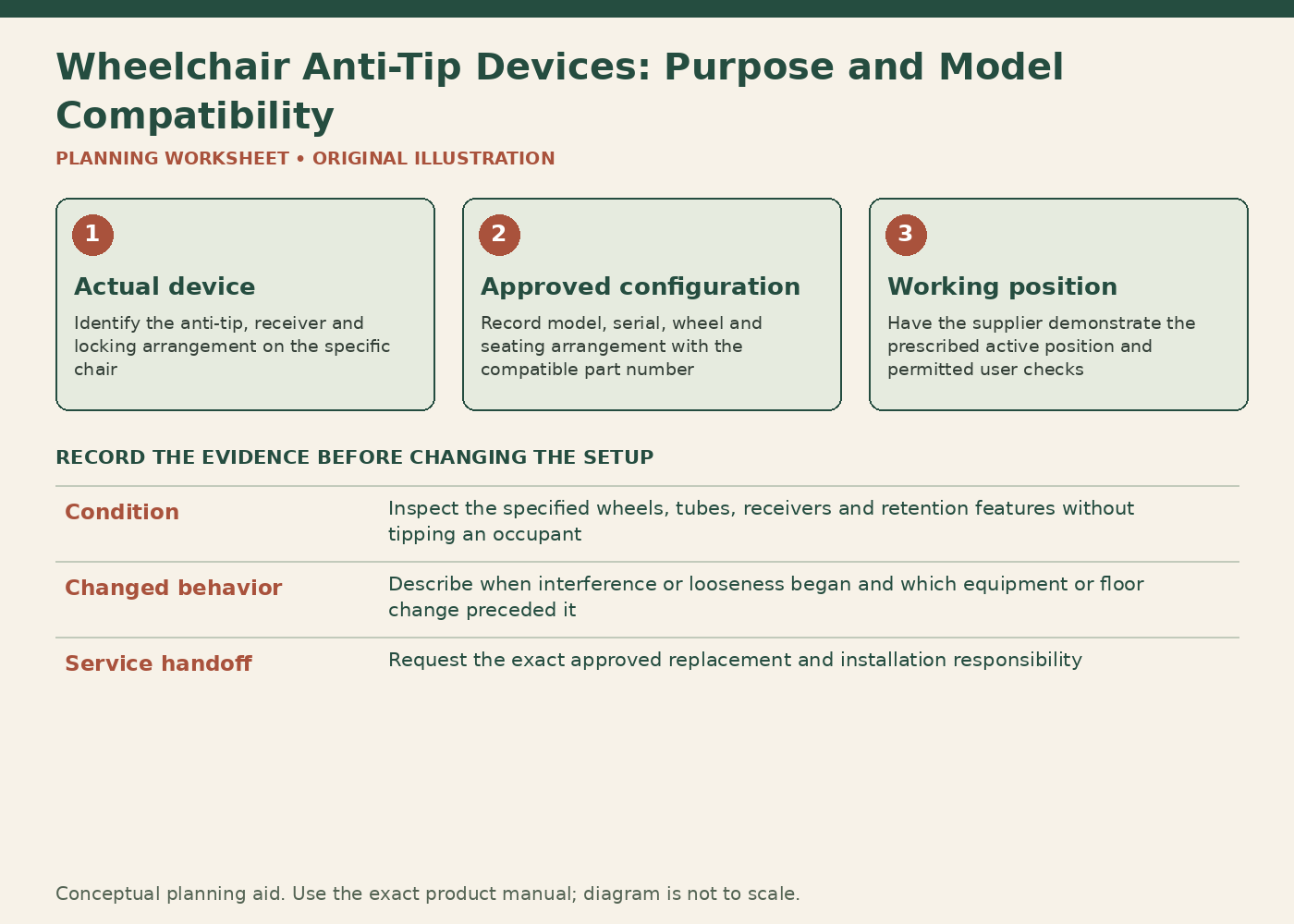
| Actual device | Identify the anti-tip, receiver and locking arrangement on the specific chair. Distinguish it from wheel locks and other rear tubes. Ask the provider to resolve an unidentified attachment before relying on it. |
| Approved configuration | Record model, serial, wheel and seating arrangement with the compatible part number. Similar mounting diameter or a universal sales label is not a complete compatibility statement. |
| Working position | Have the supplier demonstrate the prescribed active position and permitted user checks. Do not copy a floor-clearance value from another chair. Any alternate position needs its documented purpose and restoration routine. |
| Condition | Inspect the specified wheels, tubes, receivers and retention features without tipping an occupant. Remove damaged or insecure equipment from use as directed. A successful empty fit does not prove structural suitability. |
| Changed behavior | Describe when interference or looseness began and which equipment or floor change preceded it. Seek a complete-setup review. Do not compensate by drilling, shortening, raising arbitrarily or removing the device. |
| Service handoff | Request the exact approved replacement and installation responsibility. Save the answer and teach caregivers the restored working-position check. Anti-tips remain one part of the overall mobility and training plan. |
Worked example
A hypothetical wheelchair has rear anti-tip assemblies that previously cleared an indoor route. After an approved wheel change, one begins contacting a threshold. The useful response is to record the change, photograph the complete relationship and contact the supplier. Raising both devices until the noise disappears would not establish that they still provide the intended protection.
The provider reviews the wheel configuration, receiver, device condition and route, then specifies any approved correction and required checks. In a separate secondhand-chair case, the buyer finds empty rear receivers but no record of the missing parts. They obtain the original configuration and current assessment rather than assuming the previous owner removed something optional. Both cases show why compatibility and setup must be traceable. The goal is a correctly specified complete chair used within the user’s training and limits, not a home experiment demonstrating how far it can tilt.
Sources checked November 6, 2026
Use the current document for the exact model, market and production revision. These sources establish the cited instructions and distinctions; they do not certify an individual chair or replace a personal assessment where one is needed.
- Permobil: TiLite CR1 instructions for use
- Sunrise Medical: QUICKIE 2 and 2HD owner’s manual, revision G
- NSW Agency for Clinical Innovation: Wheelchair configuration and individual fit
- Permobil: The Wheelchair Handbook
Something unclear or out of date? Send a correction with this article’s title and the detail to check.
Sources, research & corrections policy ↗