A stadium chair and its carrying bag need separate policy checks. A clear bag rule does not automatically permit a chair, and a permitted chair does not automatically make its opaque storage case acceptable. Before an event, identify the chair’s construction, the way you will carry it, and every storage compartment attached to it. Then compare those objects with the event’s official instructions rather than relying on a ‘stadium approved’ sales label.
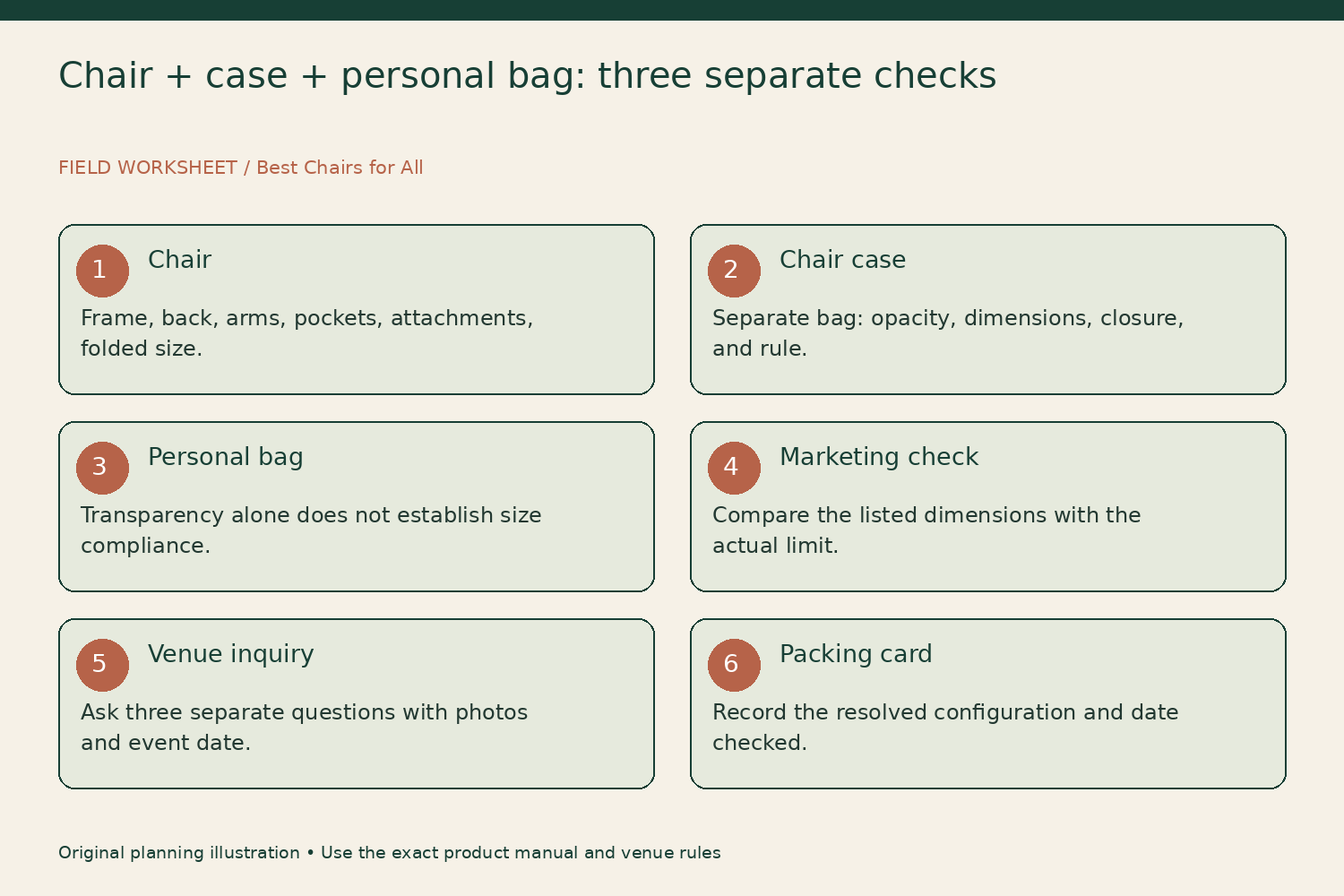
The most useful planning tool is a three-object inventory: chair, chair case, and personal bag. List the features of each and ask the venue about any uncertainty. This guide explains that inventory, shows how marketing and dimensions can disagree, and provides a precise guest-services inquiry. It does not promise admission based on a generic bag measurement or assume that every event at one stadium uses identical restrictions.
Treat the event as the starting point
Find the official event page and its links to carry-in rules. Confirm the stadium, date, sport or performance, and organizer. Save the page and the date you checked it. A venue may host events with different security arrangements, while search results can surface old handbooks. If the ticket email provides updated event instructions, read those alongside the standing venue guide.
Look for separate headings for bags, prohibited items, seat cushions, portable chairs, and accessibility arrangements. The chair rule may appear outside the page titled ‘clear bag policy.’ Searching only that page for the word ‘chair’ can miss a backrest or cushion restriction elsewhere. The NFL policy page itself directs fans to individual team guidance. Follow that direction for the actual destination.
Inventory the chair itself
Write down whether your seat has a metal frame, rigid back, arms, pockets, zippers, removable covers, compartments, hooks, straps, or other attachments. Take front, rear, and underside photographs. Do not describe it only as a cushion if it contains a folding frame or backrest. Accurate description makes a venue response more useful and avoids buying an accessory on the strength of the wrong product category.
Measure its open and folded dimensions separately. The open outline relates to the seating space; the folded shape relates to transport and inspection. A chair may remain prohibited because of its arms even when it folds into a compact rectangle. Do not assume that folding, removing a loose pocket, or covering the chair in transparent plastic changes how the venue classifies the underlying object.
Inventory the chair case
Record whether the case is clear, opaque, padded, zippered, or pocketed, and measure the actual outside dimensions. Some chairs include an ordinary fabric sleeve intended for transport from the car, without making any claim about stadium admission. The case might count as a bag under the event policy even if it contains nothing except a chair. Ask that question explicitly rather than assuming sports equipment always receives a separate exception.
If the chair can be carried without its case according to the manufacturer, ask whether that is the permitted route at your event. Do not cut straps, remove necessary components, or alter the product to avoid classification as a bag. The simplest solution may be leaving the case in the vehicle, but that depends on the venue’s answer and the chair’s intended carrying arrangement. Confirm before packing.
Inventory the personal bag
List the separate bag used for your phone, keys, clothing, or other items. Measure its outside width, height, and depth; note opaque panels, logos, hardware, and extra pouches. A clear bag can still exceed the size allowance. Conversely, a small non-clear item may fall under a particular event’s separate allowance. Use the event’s definitions and measurements, not an assumption that transparency settles the entire question.
Check the stated quantity allowance too. A chair case, personal tote, and attached pouch can create a different situation from a single approved bag. Do not distribute items into extra cases simply because each seems small. Ask how the venue counts the objects you plan to carry, particularly when a chair has built-in storage. Make the complete packing arrangement visible in your inquiry so the reply addresses the actual plan.
Compare a documented venue example
The Packers carry-in page provides separate descriptions for permitted bags and stadium seating. Its clear-bag dimensions and seat restrictions are not the same test. In particular, a transparent tote cannot erase a seat’s prohibited features. Read the entire current page for a Lambeau visit, including its warning that carry-in arrangements may change from game to game.
Contrast that with the 2026 Michigan Stadium policy, which prohibits all bags, including clear bags, while identifying specific permitted simple seating pads. That example shows why ‘clear bag stadium policy’ is a search phrase, not a universal promise that every stadium accepts clear bags. Follow the official destination even when a product has been designed and named for general event use.
Read sales claims alongside dimensions
A useful caution appears on the Picnic Time Clear Stadium Backpack page: it markets stadium-policy compatibility while listing dimensions of 12.1 by 5 by 13.2 inches. Those listed dimensions are larger in two directions than a twelve-by-six-by-twelve-inch maximum. The comparison is arithmetic, not a report that security accepted or rejected the bag at any event. Verify the actual applicable limit and seek clarification before buying for a strict destination.
Do not round a manufacturer’s measurement downward or assume a soft bag will be accepted because it compresses. Ask how the venue measures the object and whether the specific model is permitted. If the manufacturer lists an apparently incompatible dimension, request clarification from it too. A written answer should identify the actual item and event; a general assurance that many customers use it at games leaves the mismatch unresolved.
Make a feature-by-feature matrix
Draw columns for chair, chair case, and personal bag. Add rows for dimensions, material, opaque areas, pockets, zippers, compartments, attachments, and official permission. In each cell, write an observed feature or a source, not simply ‘approved.’ This gives you a compact representation of what security staff would see and highlights the questions that remain unanswered.
For an illustrative inventory, the chair might have a fabric backrest and rear pocket, the case might be an opaque sleeve, and the personal bag might be a clear tote. Even if the tote meets a dimensional rule, the chair pocket and sleeve need their own answers. The matrix prevents the most familiar rule from overshadowing the other objects. Use photographs to document details that a short description could misrepresent.
Ask guest services about the complete arrangement
Send the event date, section if relevant, chair brand and model, open and folded dimensions, and photographs. Then identify the case and personal bag with their dimensions. Ask whether the chair is allowed, whether it may enter in the case, and whether the separate personal bag complies. These are three concrete questions that can receive three clear answers instead of one broad statement about bags.
If you need a particular item for a medical or access reason, use the venue’s designated process and ask what information or inspection arrangement applies. Do this early enough to act on the answer. Do not assume an exception for a bag automatically approves a particular chair configuration or installation. Access seating, entry screening, and the physical use of equipment may need discussion with different venue staff.
Plan the screening sequence
Pack so the chair’s relevant features and the personal bag’s contents can be inspected without untying a complicated bundle. Follow the venue’s arrival instructions and allow enough time for the stated screening process. Keep a useful written reply accessible on your phone. It documents the inquiry but does not replace event staff’s administration of the rules or guarantee that an altered packing arrangement will receive the same answer.
Avoid filling a chair’s hidden pocket after receiving approval for an empty, pocket-free configuration. If a product feature was central to the venue’s reply, keep the plan consistent with the description you sent. Before leaving home, compare the three-object inventory with the actual items by the door. This catches a last-minute switch from an approved tote to a larger opaque bag or an added chair sleeve.
Know the alternative before the gate
Confirm whether a return to the vehicle is feasible and whether any official storage service exists. Do not presume staff can hold an excluded item. If a chair cannot be admitted, investigate venue rentals or a permitted simpler pad before event day. Check current availability and the seating location to which any rental applies rather than assuming that every guest can obtain one on arrival.
For a group, give each person the event-specific instructions instead of a generic statement that clear bags are fine. A borrowed chair may contain pockets or arms missing from the product the group researched. Photograph the actual equipment, especially when different models look similar folded. This small preparation step is more reliable than trying to negotiate a surprising feature while everyone else is waiting in the queue.
Keep a dated event packing card
After resolving the questions, write a short card naming the permitted chair configuration, case arrangement, personal bag, official source, and date checked. Keep it with that event’s tickets, not permanently attached as a universal approval label. For the next venue, repeat the policy check. A transparent bag, a licensed logo, or a previously successful visit cannot establish admission for a new event.
The practical result is a packing plan that matches the current official rules object by object. You know what the chair is, what carries it, and what holds your personal items. That clarity is the real advantage of checking a stadium chair against a clear bag policy: it reveals separate decisions early enough to change the plan, instead of treating one convenient label as permission for everything you bring.
Something unclear or out of date? Send a correction with this article’s title and the detail to check.
Sources, research & corrections policy ↗