Shower chair feet are contact components, often called tips or ferrules, that must match the product and remain in good condition. Inspect for damage and insecure attachment, then obtain the manufacturer-approved replacement. Matching the color or approximate tube diameter is not enough to establish a suitable part.
Inspect the foot, not only the chair above it
The Medic Therapeutics shower-chair instructions tell users to replace ripped, torn or missing rubber tips and require all four tipped support legs to contact the floor together. Those conditions make the feet part of the support arrangement rather than decorative caps. Inspect the actual contact surface and attachment without putting someone into the chair as a test.
Look for the conditions identified in the exact manual: damage, wear, missing pieces or a part that no longer stays attached as specified. A clean upper surface can hide a worn underside. Keep damaged equipment out of use while the correct remedy is arranged. Do not decide that the remaining three feet provide adequate support because the chair appears stable when empty.
Identify what the manufacturer calls the part
A listing may use rubber foot, ferrule, tip or suction cup. These names do not guarantee the same construction or function. A broad flexible ferrule, a plain tube cap and a suction-cup assembly can contact the surface differently. Some manufacturer parts are made from materials other than natural rubber, so do not infer material or cleaning tolerance from a household description.
Find the product model, article number, production information and current parts diagram. Label which leg or position is involved. Ask whether the original chair has different inside and outside feet or model variants. A replacement that fits a walking aid or another chair may use a different contact shape and height even if the visible tube looks similar.
An exact parts example shows why family names are insufficient
The Etac spare-parts list distinguishes a four-piece ferrule set numbered 84006150 from a three-piece Edge ferrule set numbered 84006151. The separate Etac four-piece assembly sheet identifies its covered Swift, Smart and Easy set. These are lookup examples from the researched documents, not a recommendation that either set fits every Etac product or every older version.
Use the compatibility matrix and ask the supplier to confirm the actual chair and market version. Do not order solely because a search result includes the word Swift or because the package contains the number of feet you need. Keep the confirmed part number and the applicable assembly sheet with the product record so a later replacement is based on the same evidence.
Measure only what the supplier requests
A provider may ask for tube dimensions, a photograph of the leg end or the existing part’s markings. Obtain that information through the manual’s permitted empty-product handling, without dismantling structural joints unnecessarily. Use clear units and show the measuring points. An inside opening and an outside tube dimension are different values.
Measurements can help identify a part, but they do not approve a substitute. Contact shape, height, attachment depth and any model-specific design remain relevant. Do not trim a generic tip, enlarge its opening or fill a gap with tape, adhesive or a loose insert. A tight-feeling fit created at home does not establish that the assembly will retain its intended contact or height during use.
Distinguish contamination from material damage
Soap residue or debris on the foot or floor can be a different issue from a torn, hardened, distorted or missing component. Follow the chair manufacturer’s permitted cleaning method and inspect again after appropriate drying. Do not assume that a stronger chemical restores grip, or apply an unapproved oil or lubricant to make a part look renewed.
If a surface remains slippery or the foot’s condition is uncertain, ask the manufacturer or supplier. A photograph can show visible damage but may not reveal material changes. Record cleaners already used and any exposure that preceded the problem. Avoid coating the contact area with an aftermarket nonslip product or gluing a pad beneath it unless that exact modification is expressly approved.
Replace according to the actual attachment instructions
Obtain the assembly direction for the confirmed part. It may show required orientation, insertion and completion checks specific to that design. Follow those directions with the chair empty, keeping detached parts and tools away from children and the bathing route. Do not treat a foot that partly covers the tube as fully installed because it does not fall off immediately.
If the leg end is damaged, corroded, sharp or deformed, report that condition before fitting a new ferrule. A fresh tip cannot repair an underlying structural problem. Ask whether a complete leg or service is required. If the approved part will not install as directed, stop and contact the provider rather than forcing it, heating it or modifying the tube.
Check the whole stance after replacement
The Etac Swift/Smart/Edge/Easy manual provides model-specific setup and maintenance information for its products. Return to those full-product directions after replacing a component. Verify that the chair is restored to its assessed height and configuration and meets its prescribed contact conditions. A new part changes more than appearance if it differs from the old one’s worn height or shape.
Do not compensate for unmatched feet by selecting arbitrary leg settings or putting material under a short corner. Ask the supplier whether a set should be replaced and which parts belong together. This article does not impose a universal all-four-at-once rule; the manufacturer and condition of the complete arrangement determine the appropriate remedy. A remaining worn component still needs its own assessment.
Use the correct surface without overclaiming suction
A foot labeled nonslip or a cup-shaped component does not guarantee adhesion to every tub. Texture, curvature, ridges and floor slope can prevent the contact the product requires. Confirm the actual supporting surface and the manual’s restrictions. A replacement part should restore the documented arrangement, not be chosen as a way to make an unsuitable location work.
Do not conduct an occupied sliding test or place the chair on a loose mat to find out whether it grips better. Ask the therapist or provider to review persistent instability with the exact chair and bathroom. The cause could involve the surface, setup, part condition or the equipment choice. Replacing tips is one possible service task, not a universal solution to every wobble.
Keep a short maintenance history with useful stop conditions
Record the inspection date, observed damage, approved part number, installation responsibility and completed checks. Note whether the chair was moved, stored or cleaned before a problem appeared. This is particularly useful for shared equipment and secondhand chairs, where a previous replacement may not match the original design.
Stop use for a missing foot, insecure part, damaged leg or support condition the manual does not permit. Give other caregivers the same information so they do not substitute a household cap while waiting for delivery. A complete replacement record makes future service simpler and keeps the response focused on restoring the specified chair, rather than accumulating increasingly improvised repairs.
Shower-chair foot inspection and replacement record
| Check | Evidence and decision |
|---|---|
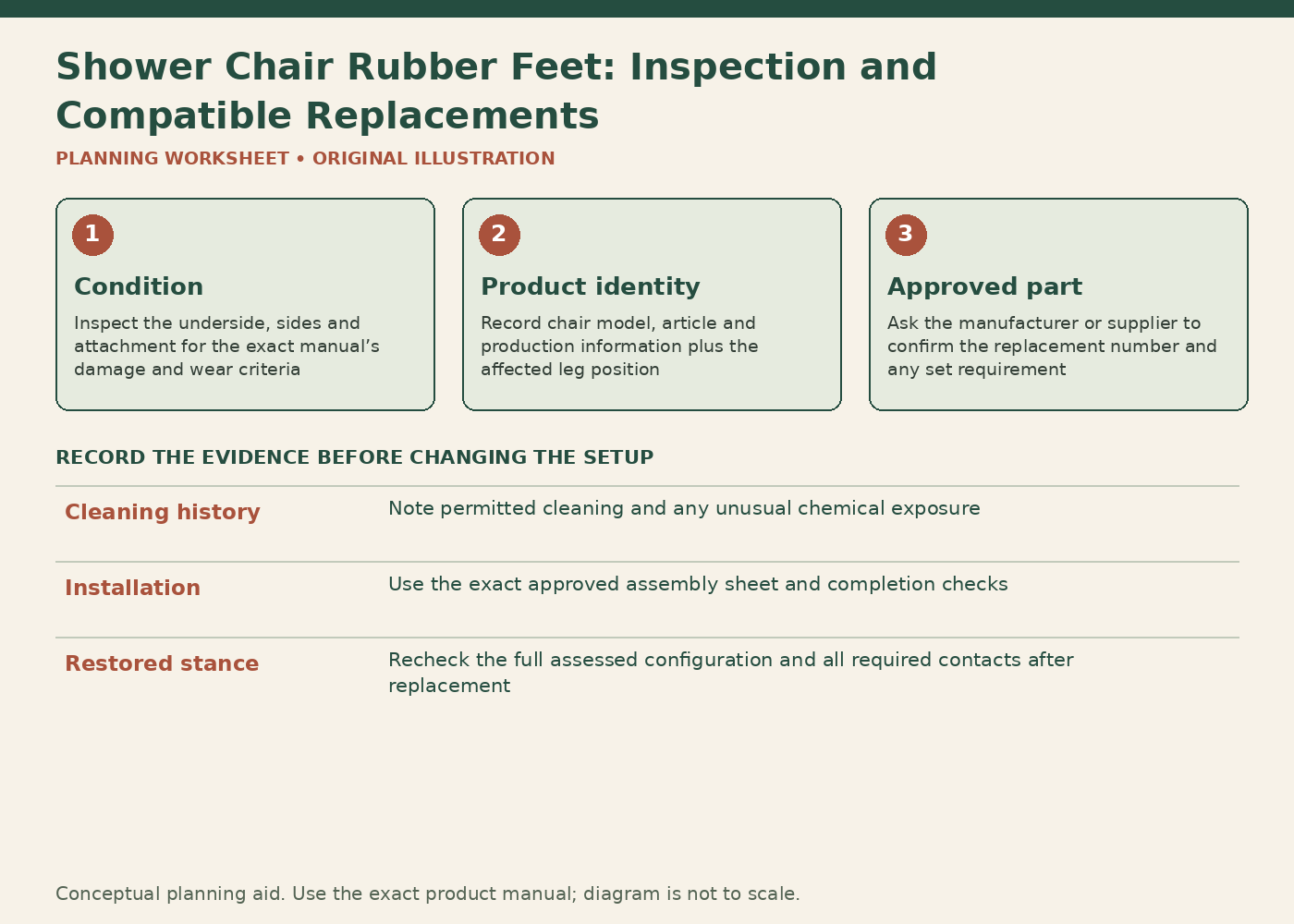
| Condition | Inspect the underside, sides and attachment for the exact manual’s damage and wear criteria. Keep the chair empty during inspection. A missing or compromised foot is not made acceptable by a successful momentary empty-chair balance check. |
| Product identity | Record chair model, article and production information plus the affected leg position. Locate its current parts diagram. Similar names or tube appearance do not establish compatibility across models. |
| Approved part | Ask the manufacturer or supplier to confirm the replacement number and any set requirement. In the Etac example, four-piece and Edge three-piece sets are distinguished. Do not order from package count alone. |
| Cleaning history | Note permitted cleaning and any unusual chemical exposure. Separate removable residue from physical deterioration. Do not apply lubricant, coating or an improvised adhesive pad to renew the contact surface. |
| Installation | Use the exact approved assembly sheet and completion checks. Report a damaged leg end or a part that will not fit as directed. Do not trim, drill, heat or pack a substitute to create a connection. |
| Restored stance | Recheck the full assessed configuration and all required contacts after replacement. Ask about remaining wear or instability. Matching one new foot does not resolve an unsuitable tub surface or unrelated structural fault. |
Worked example
A household finds that one foot on a hypothetical shower chair is split and the tube beneath it is visible. They locate a generic cap with the same apparent diameter, but it is shorter and has a different contact shape. The match is incomplete. Instead of installing it and adjusting another leg to compensate, they identify the chair and request the approved part and installation document.
The supplier also asks for a photograph of the leg end to rule out visible damage requiring service. Once the correct remedy is completed, the empty product is checked according to its instructions and restored to the assessed setup before use. If it remains unstable in the tub, the household requests a surface and equipment review rather than another unverified foot substitution. The inspection process separates part identification, structural condition and bathroom contact so a cheap component cannot conceal a larger unresolved problem.
Sources checked November 6, 2026
Use the current document for the exact model, market and production revision. These sources establish the cited instructions and distinctions; they do not certify an individual chair or replace a personal assessment where one is needed.
- Medic Therapeutics: Adjustable bath and shower chair instructions
- Etac: Swift/Edge/Smart/Easy current spare-parts list, March 2026
- Etac: Ferrule Swift, Smart, Easy four-piece assembly instruction, March 2025
- Etac: Swift/Smart/Edge/Easy user manual, September 2026
Something unclear or out of date? Send a correction with this article’s title and the detail to check.
Sources, research & corrections policy ↗