An office chair that leans to one side may be sitting on uneven support, carrying mismatched or damaged casters, or suffering a fault in the base, seat support, or attachment. A seat that merely feels uneven can also reflect cushion wear, different arm settings, or an intentionally asymmetric back-support adjustment. Distinguish those observations before ordering a cylinder or trying to level the chair.
Stop using a chair with a pronounced new lean, visible deformation, a separating attachment, or an unstable base. Do not keep sitting at an angle while waiting to see whether it gets worse. The inspection below is designed to describe the fault from outside the chair and produce a useful report for a service provider.
Decide whether the seat is visibly tilted
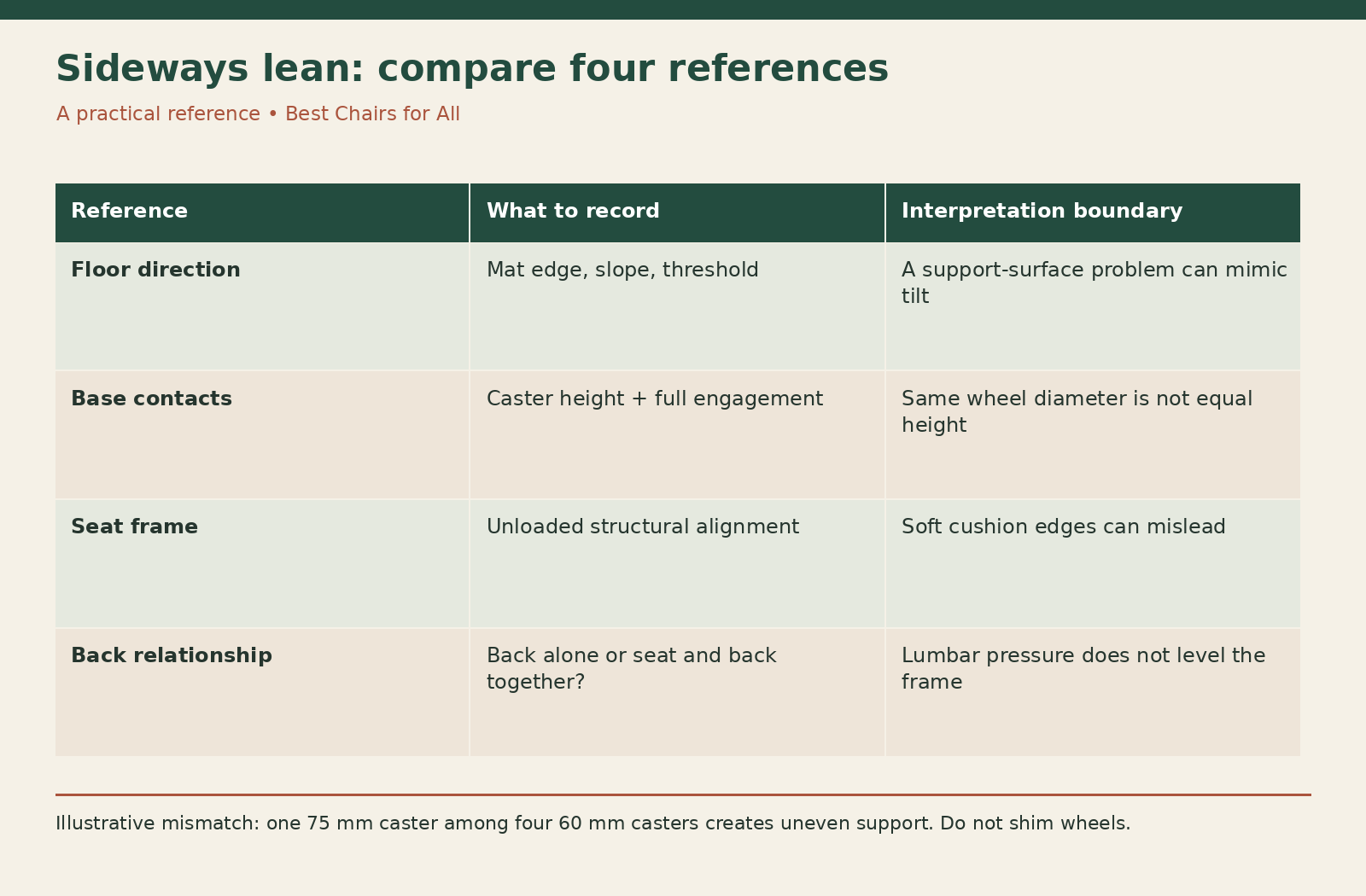
Look at the unloaded chair from directly in front and behind. Use the seat frame or another known structural reference where visible, rather than comparing only soft cushion edges. Upholstery can be shaped or compressed differently on the two sides without the support frame itself being tilted.
Take photographs with the camera upright and centered. A wide-angle photograph from one side can make a symmetrical chair look skewed. Include a wider image showing the base contacts and floor, then a closer image of the seat and back attachment. Avoid drawing a precise angle from a casual phone picture.
Record what you know: “seat frame appears lower on left” is stronger evidence than “the hydraulic part must be bent.” A pressure cylinder is only one component in the load path. Keep the observed geometry separate from the suspected cause until the chair has been assessed.
Check all floor contacts
Inspect whether one caster is on a mat edge, under-desk cable, threshold, or depressed carpet patch. Look at the floor around the entire base rather than only the visible front wheels. A rear caster partly off the mat can change how the chair stands.
If the chair can be moved without loading a damaged assembly, compare its unloaded stance on another suitable level area. Do not roll an unstable chair across a busy room or let it drift away. Seek assistance if moving it would be awkward or put the fault under additional stress.
A chair that stands evenly on a different surface may have a floor or mat problem, but keep the result conditional. It does not prove that every chair component is intact. Address the original support surface and inspect the chair for damage before deciding it is ready to use there again.
Compare the casters as a complete set
Check that all casters have matching supported installed heights and are fully attached. A replacement wheel can have the same diameter as its neighbors but a taller fork or housing. Compare floor-to-base mounting geometry rather than relying on the wheel’s visual size.
For an illustrative case, imagine four casters have a 60 mm installed height and one is 75 mm. That 15 mm mismatch creates an uneven support arrangement; it does not simply raise the entire chair uniformly. Do not calculate the seat’s resulting angle from that difference alone, because contact and base geometry matter. Replace the mismatch with an approved set or part.
Also inspect tread loss, broken forks, and loose sockets. Do not shim the shorter wheel or remove material from the taller one. If a socket is cracked or the base spoke is distorted, the correct problem is the base assembly, not merely the wheel attached to it.
Treat a bent base as a service issue
Look for obvious differences between spokes and for cracks near their roots or caster sockets. Do not attempt to bend the base back into shape, weld it, or clamp a broken area. The chair needs an intact supported load path, not a temporary appearance of levelness.
The March 2026 CPSC Tainoki office-chair recall is a relevant real example: it identifies specified swivel chairs whose bases can bend and directs affected owners to stop use and follow the refund process. Match exact model information rather than deciding from the chrome appearance of a base.
Check your chair’s manufacturer and current recall notices even if it is a different brand. Follow any applicable remedy before ordinary troubleshooting. A recall example does not mean every sideways lean comes from a recalled base, but it shows why structural deformation should not be treated as routine adjustment.
Inspect the seat and back relationship
Observe whether the seat is tilted with the back, the back alone appears skewed, or only one upholstered edge sits lower. These patterns can help identify the assembly needing assessment. Do not loosen a back attachment merely to see whether it can be pushed straight.
If the chair was newly assembled, compare accessible connection positions with the exact instructions. A mounting bracket placed incorrectly or hardware not fully seated is a possibility to investigate through the documented procedure. A joint that will not align or secure should go back to the supplier rather than be forced into place.
If the lean appeared after a fall, relocation, or a new part installation, report that timing. It can guide the inspection toward a damaged or mismatched assembly. It does not prove the most recently touched part is responsible, so retain photographs of the overall chair as well as that component.
Distinguish support settings from structural tilt
Some chairs intentionally allow different back-support pressure on each side. The Haworth Zody II user guide explains independently adjustable asymmetrical lumbar support. That setting can change the feeling of contact against your back without being a mechanism for leveling the seat frame.
If your chair has such a feature, read its adjustment instructions and record the settings. Do not assume that every difference in left-right support indicates a broken frame. Conversely, a visibly tilted seat should not be dismissed as a lumbar adjustment just because the back offers asymmetric settings.
Arm height can create another misleading reference. Two pads set at different positions can make the chair look uneven and can alter how you rest your arms. Compare the underlying seat or frame separately, then set the arms as appropriate for the task. Arm adjustment does not straighten a damaged base.
Examine cushion and upholstery condition
A foam seat may feel lower on one side because of worn filling or a displaced covering. A suspended surface can develop damaged attachment or uneven support. Check visually without pulling on mesh or cutting open upholstery to inspect inside.
Compare your normal working position with the seat’s intended usable area. Sitting partly on a raised edge or leaning consistently toward an offset keyboard can feel like a chair tilt even when the unloaded structure looks level. Record whether the feeling appears only during that task or remains in a centered position.
Avoid adding a wedge to one side as a diagnostic shortcut. It can hide an unresolved mechanical problem and change your working geometry. If the frame is sound but the support surface is worn, ask about a compatible cushion or seat assembly. If discomfort persists, seek appropriate advice without assuming that a chair photograph can identify a medical cause.
Check whether the workstation draws you sideways
Look at the keyboard, mouse, monitor, and any task equipment. A chair centered on the desk may not be centered on the actual work. An offset mouse or document can lead you to spend most of the day reaching toward one side.
The OSHA workstation checklists provide a framework for evaluating the arrangement. Use the relevant reach and support questions after structural concerns have been resolved. They help distinguish a task-position issue from the chair’s unloaded stance.
Make a sketch of the work area with the chair centerline and frequently used items. Reposition items within practical reach and use normal chair adjustments where appropriate. If the chair remains visibly tilted when empty, do not let an improved desk layout substitute for the unresolved repair assessment.
Build a four-reference alignment report
Use four references: the room or floor direction, the base contact pattern, the structural seat reference, and the backrest relationship. For each, write what you can actually observe and attach one clear photograph. Note whether the observation was unloaded and which floor or mat was used. Retain the original images without drawing over the only copy. A service provider may notice a mounting or contact detail that your annotations would obscure. Label left and right from the seated user’s perspective to avoid ordering or discussing the opposite-side component.
A hypothetical report might say: “On a level hard-floor area, all five original casters appear fully seated; seat frame remains lower at left; back leans with seat; no owner-serviceable fastener identified.” Another might say: “Lean appears only where rear caster overlaps curled mat; unloaded frame looks even on a suitable flat area.”
These examples lead to different next steps. The first needs chair-service assessment; the second points toward correcting the support surface and checking for any resulting damage. Neither requires you to open the gas lift or claim a precise internal failure before contacting support.
Keep leveling experiments out of the repair
Do not cut the cylinder, alter its mounting, insert wedges between the seat and mechanism, or drill new holes to shift the seat. Those changes affect the chair’s structure and can make later service harder. Use compatible replacement assemblies installed under the proper procedure.
Ask the manufacturer which part and revision applies, whether installation needs trained personnel, and what completed checks establish normal operation. If the answer is an unsupported generic cylinder advertised as universal, request clarification before proceeding. The visible symptom alone does not identify the correct component.
A repaired chair should stand correctly on its intended surface and retain normal adjustment and rolling behavior. Check those outcomes through the manufacturer’s process, not an improvised tipping test. Keep the alignment photographs and repair record so a returning lean can be reported precisely and addressed before the chair returns to everyday work.
Something unclear or out of date? Send a correction with this article’s title and the detail to check.
Sources, research & corrections policy ↗