A loose seat cushion can be lifted away from the chair; a fixed or tight seat is upholstered into the furniture. That difference affects access for cleaning, routine cushion care, and future repair. It does not by itself establish comfort, quality, washability, or replacement availability. Compare the exact chair’s construction and instructions rather than treating loose as automatically easier to maintain or fixed as maintenance-free.
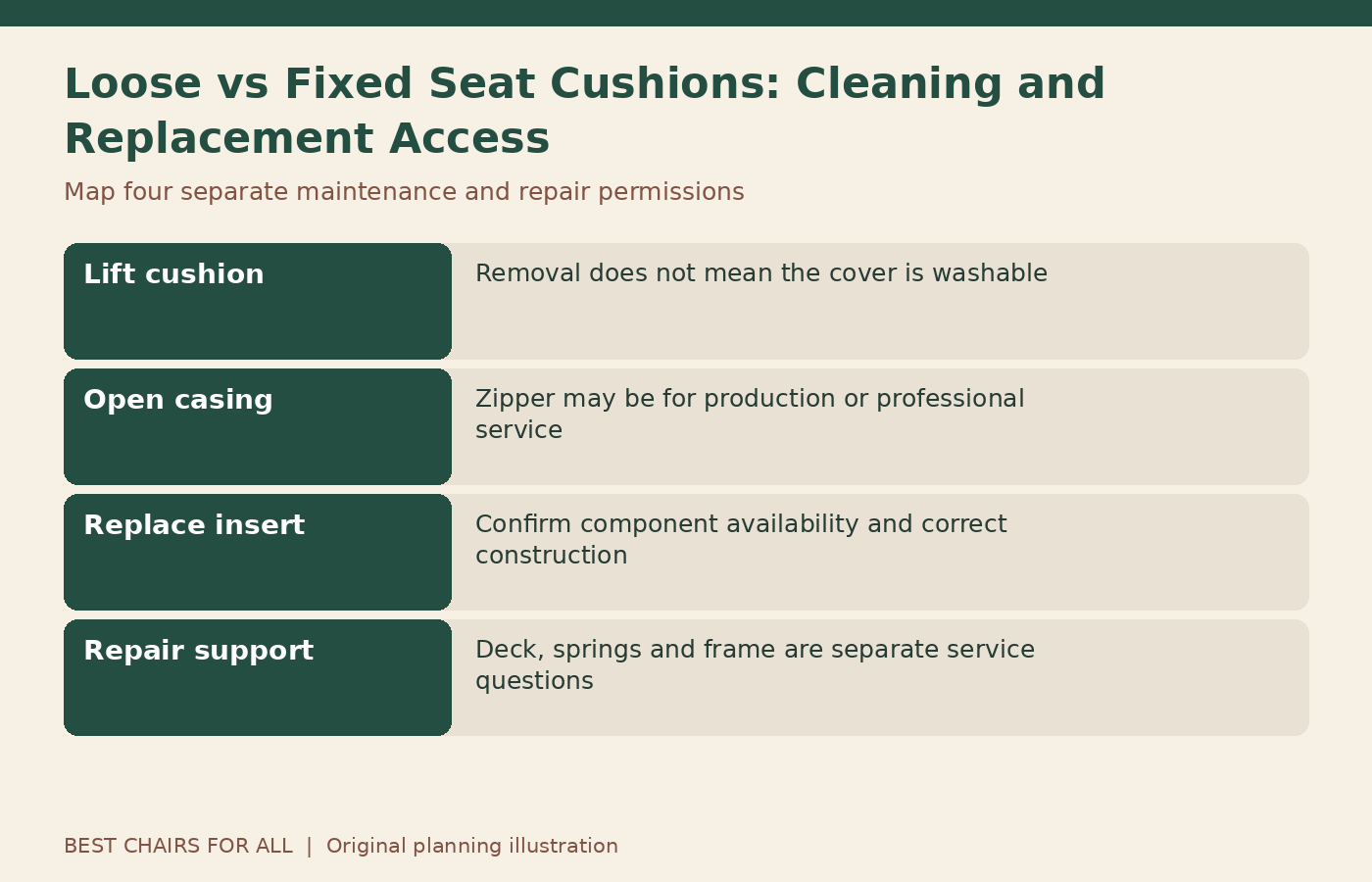
This guide provides a maintenance-and-replacement access map. Use it to ask what can be removed, reversed, cleaned, refilled, or professionally repaired on each candidate. A visible zipper or a cushion that lifts away answers only one part of those questions.
Identify the seat construction accurately
Ask whether the seat cushion is loose, attached, semi-attached, or fixed. A cushion may be secured with a fastener while still having an approved removal method; another may look separate but be sewn to the chair. Do not pull on seams to discover the difference. Have the retailer demonstrate the intended access on the actual model.
Record the construction of the back cushions separately. A chair can combine a fixed seat with loose back pillows or the reverse. Maintenance instructions for one section do not automatically apply to the other. Add any continuous chaise, tufting, buttons, or shaped edges to the map because they can affect access and replacement work.
Separate removal from laundering
A loose cushion can be moved out of the way without its cover being washable. A zippered casing can exist for production or service rather than routine cleaning. Ask for explicit laundering instructions if that feature matters. Do not interpret a water-based spot-cleaning code as permission to wash the entire casing in a machine or soak the insert.
Room & Board’s product-care sheet distinguishes routine cushion care from casing cleaning and warns against machine washing or dry cleaning its cushion casings under the stated guidance. That is a useful real example of removability and washability being separate questions. Follow the exact instructions for the chair and upholstery you buy.
Map access in four levels
Draw four boxes: lift cushion, open casing, replace insert, and repair underlying seat. Mark each Yes, No, or Provider confirmation needed. A chair might allow lifting the cushion and approved insert access while still requiring professional work on the supporting deck. Another might allow only professional access to all upholstered seat components.
Add who is expected to perform each action: owner, retailer, or upholsterer. This turns a vague claim of easy maintenance into a concrete service arrangement. If the seller cannot explain insert access, do not mark replacement as easy merely because a zipper is visible. Ask what parts are actually available and whether the casing can be reused.
Compare routine debris removal
A loose cushion may allow access to crumbs, hair, and small objects beneath it. That can simplify cleaning where the instructions permit removal and the exposed deck is suitable for the approved vacuum attachment. Lift only intended loose parts and avoid pulling linings or reaching into hidden openings. Check for sharp objects visually rather than sweeping a hand blindly into a crevice.
A fixed seat may have fewer removable pieces to manage but can leave narrower accessible seams. Ask how the manufacturer recommends cleaning those areas. Do not remove a dust cover or pry apart upholstery to reach ordinary debris. The useful comparison is the permitted cleaning route, not the assumption that every hidden area should be reachable by the owner.
Check whether cushions are reversible
A loose cushion may have matching upholstery on both faces, a different underside, shaped contours, or attachments that permit only one orientation. Confirm whether it can be flipped, rotated, or exchanged with another cushion. These actions are distinct. A rectangular cushion can rotate without being reversible, while a shaped T-cushion may fit only one position.
Crate & Barrel’s care brochure discusses rotation and reversal within its upholstery and slipcover guidance. Use such advice only where the specific cushion construction supports it. Do not force a one-sided or shaped cushion into a reversed position to follow a generic rotate-your-cushions suggestion.
Understand the care burden of the filling
Foam, fiber, feather, down, and combinations can require different routines. A loose feather-filled cushion may need regular reshaping, while another construction has a more tailored appearance. Fixed upholstery can also stretch or wrinkle with use. Ask which changes are normal for the model and what owner care is intended, rather than treating every crease as a defect.
The Room & Board sheet specifically addresses fluffing removable feather and down cushions and caring for tight cushions. That distinction shows why the maintenance question should include filling and upholstery style. Do not assume that a loose cushion is low effort or that a fixed seat will retain a permanently smooth showroom appearance without any attention.
Compare the assembled sitting experience
Try the chair with its intended cushions in place. Observe seat height, depth, back support, arm position, and whether the cushion moves during normal sitting. A fixed seat may feel stable and tailored; a loose cushion may feel comfortable and flexible. Neither observation establishes that one construction is structurally better. Comfort depends on the whole chair and individual preference.
If a cushion shifts, ask whether its placement and any supplied retaining feature are correct. Do not add adhesive, pins, or unapproved non-slip materials as an immediate fix. Those can affect upholstery or change the intended arrangement. Record the issue and compare another model or a manufacturer-approved solution before accepting a maintenance task you did not intend.
Evaluate spill access realistically
With a loose cushion, a spill may affect the casing, insert, underside, and chair deck. Removing the cushion can reveal the extent, but does not make every layer washable. With a fixed seat, liquid can enter upholstery and filling that are harder to access. Ask the furniture maker how a deeper spill should be handled and when professional cleaning is needed.
La-Z-Boy’s fabric-care guidance distinguishes spot-cleaning codes and restrictions on removing cushion covers for laundering or dry cleaning. Use the matching code and manufacturer instructions for either seat type. Do not soak a fixed seat or wash a loose cover simply because removal appears mechanically possible.
Ask about replacement inserts and casings
A loose cushion may be replaceable, but verify whether the manufacturer supplies the insert, casing, or complete cushion. Ask for the relevant part identification and whether color or pattern matching is guaranteed. A future replacement can differ because of production changes, fabric discontinuation, or normal fading of the original chair. Keep the cover code and model details.
For a fixed seat, ask whether repair requires an upholsterer and what access is involved. A serviceable construction can still have a practical repair route even without owner-removable parts. Conversely, a loose cushion whose casing is damaged and unavailable may not be a simple fix. Compare actual support arrangements rather than judging from appearance alone.
Distinguish cushion wear from support problems
A soft or sagging seat can involve the cushion, underlying deck, springs, frame, or more than one component. New foam will not repair a damaged support system. If the chair feels uneven, unstable, or has exposed hardware, stop use and seek professional assessment rather than adding a board or stuffing extra filling beneath the seat.
Loose cushions can make some observations easier, but internal diagnosis remains a separate task. A fixed seat should not be cut open simply to see whether more foam will help. Ask the provider to identify the cause and quote the appropriate work. Keep structural repair, upholstery repair, and cushion replacement as separate lines in the discussion.
Use a two-chair maintenance comparison
For hypothetical Chair A with a loose seat, the map might show owner-approved lifting, no laundering, reversible faces, and a confirmed replacement insert. For Chair B with a fixed seat, it might show owner vacuum access at seams, professional cleaning, and an upholsterer service route. Those are different maintenance arrangements rather than a winner and loser based solely on cushion attachment.
Add your expected routine to the comparison. If pet hair and dropped crumbs are frequent, approved under-cushion access may be valuable. If you prefer a tailored seat without repositioning loose pieces, the fixed design may fit that preference. The decision should state the tradeoff and preserve the cleaning restrictions for both.
Include maintenance effort and repair cost
Ask what routine actions are required and who in the household will perform them. A cushion that is easy to lift for one person may be heavy or awkward for another. Professional cleaning or future reupholstery can also affect the practical budget. Obtain current quotes where a known repair is part of the purchase decision rather than using imagined low costs.
For a new chair, clarify warranty treatment of filling, upholstery, and support components. These can have different terms, regardless of cushion attachment. Ask whether inspection, labor, pickup, or delivery would be charged. A replacement-friendly design is most useful when parts and service are available on terms the owner understands.
Keep accessories compatible with the seat
A throw, protector, or additional support changes the contact between user and upholstery. Ask whether its backing and attachment method are suitable for the material and chair. Do not use pins or adhesives to keep a loose cushion or cover in place. For a moving chair, loose straps and fabric must stay clear of mechanisms under the manufacturer’s instructions.
If an added cushion is intended to change seat height or depth for a mobility or health need, seek individual guidance and manufacturer compatibility. It should not be treated as a casual solution to an unsuitable chair. Repeat the complete seated-fit check with any approved accessory that will be part of the actual arrangement.
Make the final maintenance map specific
Keep the full item code, upholstery code, filling description, permitted removal steps, orientation limits, cleaning instructions, and replacement contact together. Photograph correct cushion placement where useful. If another person cleans the chair, provide that map so a loose casing is not automatically sent through a washing machine or a shaped cushion reversed by mistake.
The better choice is the exact seat construction whose fit and maintenance route suit the household. Loose cushions can offer access and component flexibility; fixed seats can offer a stable tailored arrangement. Both require specific care and realistic repair planning. Attachment style is the beginning of that comparison, not a complete answer about quality or convenience.
Something unclear or out of date? Send a correction with this article’s title and the detail to check.
Sources, research & corrections policy ↗