Lab stool upholstery should be selected against the site's documented cleaning requirements, not a general promise that the seat is “wipeable.” Identify the exact material and configuration, ask what products and processes it tolerates, and have the responsible site team decide whether it fits the intended laboratory area. Cleanability, chemical compatibility, static control, and cleanroom suitability are separate specifications.
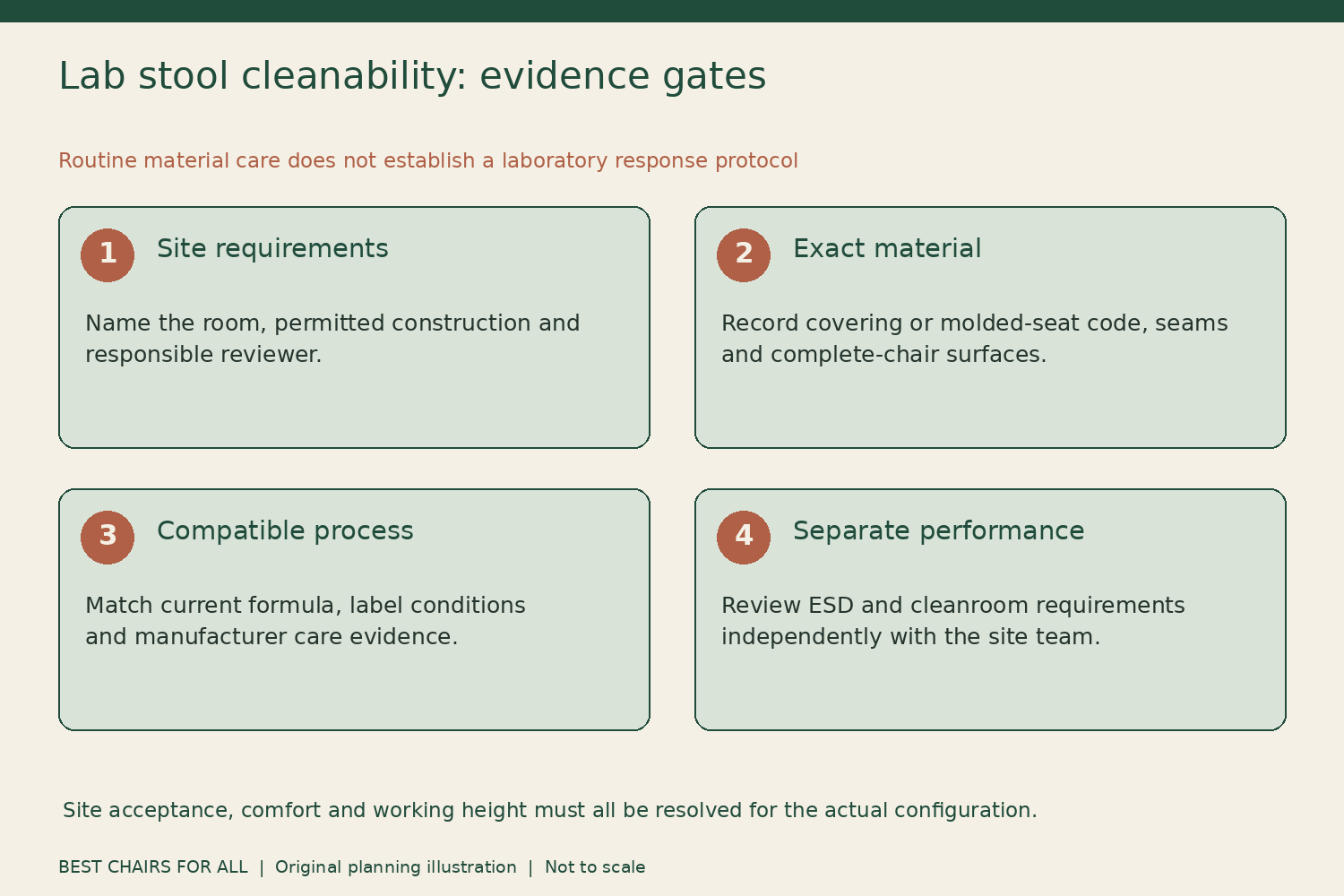
This guide is a purchasing and routine-care planning aid. It does not establish a spill-response, biohazard decontamination, sterilization, or exposure procedure. Those belong to the laboratory's approved protocols and trained responsible staff. If contamination occurs, follow that process rather than improvising from an upholstery care sheet.
Start with the room's requirements
Ask the laboratory manager or relevant environmental health and safety lead what seating is permitted in the proposed area. Record the required cleaning agents, application method, contact time where applicable, frequency, and restrictions on absorbent surfaces or seams. A stool intended for an administrative desk may face different requirements from one used at a laboratory bench.
Include who cleans the equipment and whether the routine involves moving it between areas. A material can be compatible with an occasional wipe yet unsuitable for the repeated process the site actually uses. Likewise, a stool that works in one room should not move into another controlled area simply because it is convenient.
Do not write “laboratory approved” in a purchasing specification without identifying who approves it and against what requirements. A supplier's category label is not the site's acceptance decision. Keep unresolved requirements visible so a low price or comfortable sample seat does not accidentally decide a technical question.
Distinguish the material families
Fabric upholstery, coated vinyl, polyurethane upholstery, molded self-skinned urethane, and rigid polypropylene are not interchangeable surfaces. Terms can be confusing: polyurethane can describe a coating or a molded seat, and “vinyl” can cover different constructions and finishes. Ask for the manufacturer's actual product code and construction description.
BioFit's BioFit comparison of named seating surface families distinguishes its Grade 2 vinyl, polypropylene, and urethane seating options and ties them to named model families. That is useful manufacturer information about its own products. It should not be generalized into a claim that every product made from the same broad polymer tolerates the same cleaning process.
Examine the complete seat, not just a swatch. Seams, edge binding, underside covers, exposed hardware, adjustment handles, and backrest connections can affect access for routine cleaning. A smooth sitting surface may still be mounted above difficult-to-reach recesses. Ask for photographs or a sample of the actual assembled model.
Build the specification around exact chemicals
List the full product names and current label identifiers used at the site. Include the working concentration, application method, required wet contact time where applicable, residue-removal step, and drying instructions. A family name such as “quat cleaner” or “alcohol wipe” does not describe a complete formula or process.
BioFit's BioFit named cleaner compatibility and aftercare list identifies products it lists for use on its vinyl, polypropylene, and urethane seating, with accompanying dilution and aftercare conditions. The page is dated, so confirm current applicability to the proposed material and present-day formula. A historical list is useful evidence to investigate, not an automatic approval for every later product variation.
The EPA disinfectant labeling and contact-time guidance explains that disinfectant labeling determines permitted use and contact-time requirements. Material compatibility and the label need to align. If the seat's care instruction would require removing the chemical sooner than the label permits for the intended use, refer the conflict to the site lead and suppliers before accepting the seating.
Do not transfer standard care to ESD seating
Electrostatic-discharge seating can depend on a complete arrangement of covering, components, floor contact, and the site's control system. A cleaner suitable for ordinary vinyl may not be the approved choice for an ESD version. Identify the exact ESD configuration and ask what cleaning preserves its intended properties.
The BEVCO material-specific and ESD care instructions distinguishes standard fabric, ESD fabric, standard vinyl, ESD vinyl, and polyurethane care. In particular, it calls for ESD-safe cleaning on the relevant ESD surfaces. This manufacturer document illustrates why a single “all lab stools” cleaning instruction can miss a material and performance distinction.
Do not claim that wiping an ESD stool makes it compliant or that a replacement seat covering preserves its original electrical characteristics. Any required verification belongs to the site's established program and the manufacturer's documentation. Avoid replacing casters, glides, upholstery, or grounding components with generic parts without approval.
Cleanroom claims need their own evidence
A surface that is easy to wipe is not automatically suitable for a cleanroom. Ask for the exact model and configuration's documented classification or suitability information, the conditions under which it applies, and the site's acceptance criteria. Do not infer a certification from a product photograph or a general category page.
Likewise, an antimicrobial additive or coating does not replace the required cleaning process. Keep marketing claims separate from the site's documented procedure. If the purchasing team needs evidence of a specific performance standard, request the relevant manufacturer documentation and have the appropriate site professional review it.
Changes to the covering, base, wheels, or other parts may affect the configuration described in the original evidence. Record approved replacements and ask whether any requalification or verification is required by the site. The supplier and site team should answer that question; an upholstery article cannot authorize a controlled-environment change.
A lab seating acceptance worksheet
Create one row for each requirement: permitted material construction, seam restrictions if any, exact cleaner compatibility, process frequency, accessibility of surfaces, required static-control properties, any cleanroom requirement, and routine inspection. In the next columns, record the proposed model, supporting document, supplier response, and site decision.
Use three statuses: supported, unresolved, and unsuitable for the proposed use. Add a named owner and next action to unresolved entries. For example, “supplier to confirm present formula on upholstery code X” is actionable; “probably wipeable” is not. Essential site requirements should be pass/fail gates, not points that can be outweighed by appearance.
Keep comfort and working-height observations on the same sheet but in a separate area. A technically suitable surface still needs a usable stool range and support arrangement for the work. Conversely, a comfortable seat cannot override an unmet cleaning or site requirement. Both groups of evidence must be complete before acceptance.
Worked procurement example
Imagine a laboratory choosing between a sewn upholstered stool and a molded-seat stool. The routine uses a specified disinfectant, followed by the label and site procedure. The upholstered option's sales page says “easy clean,” but the supplier has not identified the material code or confirmed repeated exposure. That option remains unresolved rather than receiving a speculative pass.
The molded option has clearer construction information, yet its adjustment handles and underside include recesses the site wants to inspect. The team requests a sample and checks whether the approved routine can reach the relevant surfaces. A molded label alone does not end the review. The complete product and real procedure remain the reference.
The final decision may favor either option if its evidence meets the site's needs. The exercise does not prove one material family is always superior. It shows how to turn broad cleanability claims into an accountable purchasing decision with named documents, visible gaps, and a site reviewer.
Routine care needs a usable station method
Once the stool is accepted, make a concise care card identifying the exact model, material, approved routine products, and link to the full site procedure. Include surfaces that can be overlooked during ordinary care, such as adjustment handles and foot supports, where the site's method requires attention. Do not add unapproved chemical recipes to simplify the card.
Ensure the person doing the work has the required training, protective equipment, and access to current labels and safety information. A manufacturer's material-care sheet is not a complete laboratory chemical-safety program. If the prescribed process changes, route the change through the same compatibility and site review used at purchase.
Avoid assuming a stronger concentration or longer exposure improves the result. The permitted process comes from the relevant instructions and site protocol. Overexposure can damage materials, while reducing required exposure to protect them can invalidate the intended process. A mismatch calls for an appropriate compatible system, not an improvised compromise.
Inspect condition and control replacement
Include visible cracks, tears, peeling, exposed cushioning, broken seams, damaged handles, or persistent residue in routine reporting. Record where and when the change appears and keep the stool out of use when the site procedure or manufacturer requires it. Do not cover damage with tape as a permanent cleanability repair.
Ask whether replacement upholstery is available in the same identified material and whether the work must be performed by an authorized service provider. A visually matching covering may differ chemically or functionally. Preserve the replacement record and update the acceptance sheet so the technical description remains accurate.
If the stool has been used in an area with special handling restrictions, follow the site's process before moving it for service or disposal. Do not assume ordinary furniture transport is appropriate. The responsible site team determines the required handling; the purchasing worksheet should make that responsibility clear.
Keep evidence attached to the exact stool
Store the approved configuration, current care instructions, supplier compatibility statements, site acceptance, and later change records together. A product page can change, and a stool may outlast the staff member who purchased it. An accessible equipment record prevents the next person from rebuilding the decision from a color name and a faded sticker.
Review the record when the laboratory changes its process, cleaning products, room use, or seating components. Cleanability is a continuing relationship between material, condition, and procedure. Selecting a lab stool well means documenting that relationship without claiming a generic upholstery surface can establish laboratory suitability on its own.
Sources and specifications checked November 6, 2026. Examples are planning exercises, not product testing.
Something unclear or out of date? Send a correction with this article’s title and the detail to check.
Sources, research & corrections policy ↗