Store outdoor cushions as clean, fully dry items in a location and container that match their manufacturer’s instructions. Protecting them from another shower is only one part of the job. You also need to avoid sealing in existing moisture, compressing the filling unnecessarily, or selecting a box that cannot hold the complete set in a usable arrangement.
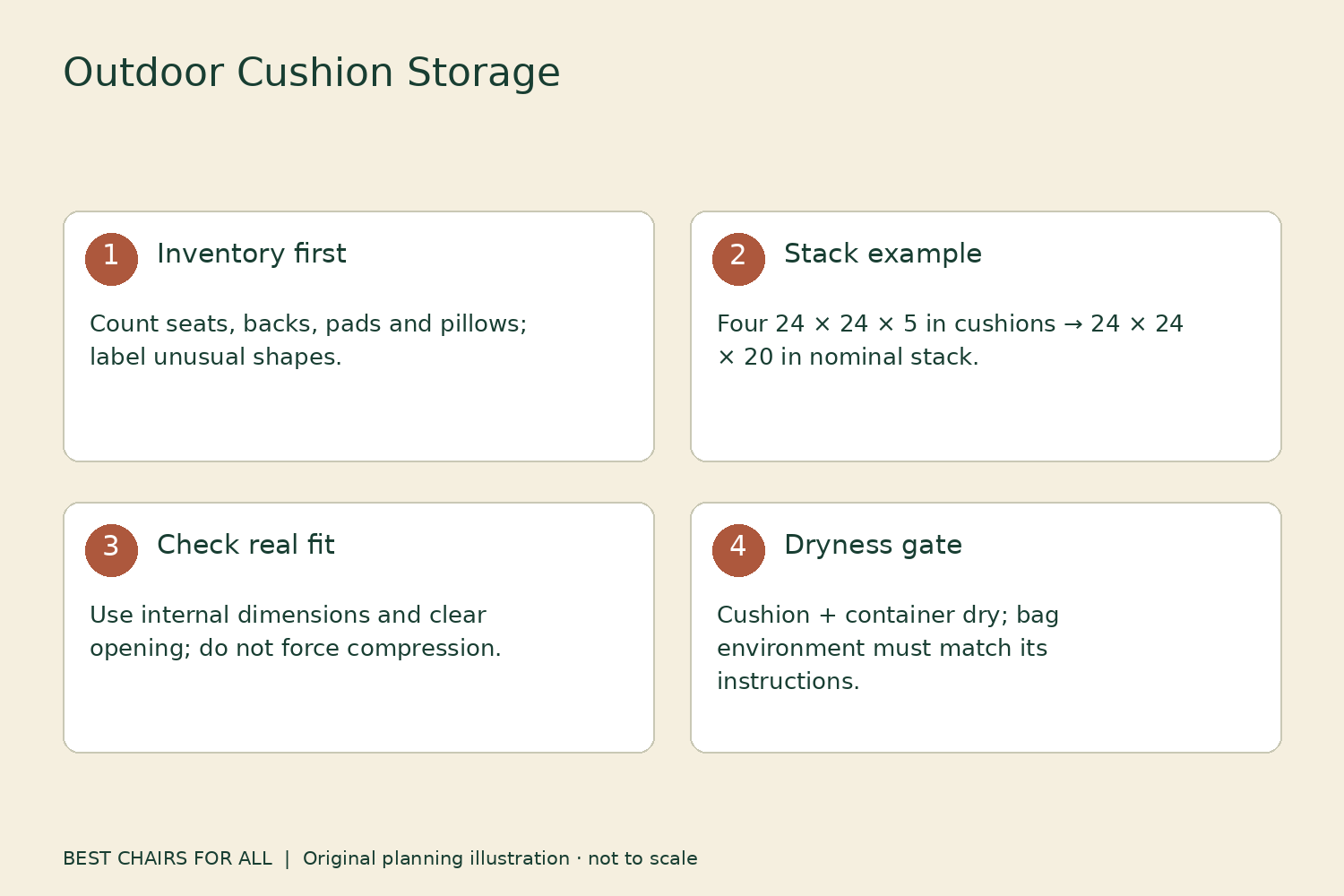
Begin with an inventory and a dry-storage trial before buying a container. Count seats, backs, pads and pillows separately, then measure their actual packed arrangement. A large exterior capacity label does not guarantee the right internal shape or a suitable moisture environment. The worksheet below is designed to identify those problems before the cushions disappear into a box for the season.
Separate daily storage from winter storage
Daily storage needs quick access. If opening the container requires moving planters, removing a cover and dragging a heavy lid, the cushions may stay on the chairs. Choose a practical route from each seat to the storage position. Keep the route clear enough that carrying a stack does not block your view or force you around sharp corners.
Seasonal storage can accept a less convenient location if it remains suitable for the materials and can still be inspected. Do not assume an attic, garage or shed is dry simply because it is enclosed. Check for leaks, floor moisture, condensation and nearby heat sources. The actual environment matters more than the room’s name.
SunVilla’s performance cushion guidance recommends storage when not in use despite the cushions being designed for outdoor conditions. Use the directions for your exact cushions when deciding what can remain outdoors temporarily. Outdoor fabric performance is not a reason to skip a storage plan.
Inventory the complete set
Assign each cushion a simple identifier such as dining seat 1 or lounge back left. Record width, depth and thickness without squeezing the filling. Note shaped corners, hinges and any orientation that must be preserved. Photograph the set arranged on the chairs so you can restore it easily after storage.
Count additional pieces that share the container. Throw pillows, covers and removable pads often consume the space that seemed available when you measured only seat cushions. Keep dirty furniture covers separate from clean upholstery unless their instructions and condition make shared storage appropriate. A wet cover is not harmless because the cushions beneath it are dry.
Check for damage during the inventory. Torn seams, damaged zippers and persistent damp filling deserve attention before packing. Mark any piece that is awaiting a manufacturer response. Storage should not conceal a problem until the next season, and a damaged cover may become harder to repair after a long period of compression against another cushion.
Measure the arrangement, not just individual pieces
Lay the clean dry cushions in the proposed storage arrangement on a clean surface. Use the maker’s guidance about folding or stacking. Do not fold a thick seat cushion sharply simply to fit a small box. A hinged chaise cushion can have an intended fold; a solid foam panel may not.
Measure the resulting maximum length, width and height. Include ties or shaped edges that cannot be compressed without strain. Then compare with the container’s usable internal dimensions and opening, not the exterior product size. A box can have a large internal volume but a narrow lid opening or hardware that prevents a broad cushion from entering easily.
As a hypothetical example, four rectangular cushions each 24 by 24 by 5 inches form a nominal 24 by 24 by 20-inch stack. That stack has a rectangular envelope of 11,520 cubic inches, roughly 189 liters. This is an arithmetic illustration, not a box recommendation. Real filling, rounded edges, lid hardware and needed handling space make the physical trial essential.
Do not turn volume into a fit guarantee
The same nominal volume can be arranged in many shapes. A long shallow box may fail to accept the stack in the example while a taller box accepts it easily. Conversely, a tall container may be inconvenient for retrieving a lower cushion. Prioritize dimensions, opening geometry and access before comparing capacity numbers.
Ask whether the manufacturer includes internal ribs, hinge projections or a raised floor in its stated capacity. A slightly tapered box can have less width at the bottom than the top. Keep a dimension sketch so the seller can answer a precise question. “Will a 24-inch square cushion pass through the clear opening?” is more useful than asking whether the box holds a lounge set.
If using a storage bag, follow the bag maker’s measurement convention. Some custom suppliers add an allowance; others ask you to include it. Do not add several inches twice. The bag needs to close without straining the zipper, but excess fabric can also make a bulky package awkward to carry and store.
Confirm what the bag is meant to do
Coverstore’s linked Elite cushion storage bag includes a mesh vent and specifically says the bag is not intended to be left outside, recommending a cool dry indoor location. This is a good example of why weather-resistant material does not automatically make a bag an outdoor storage shelter.
Read the complete product limitations. A bag may protect clean cushions from dust while relying on the building around it for rain protection. Another product may have different permitted use. Do not infer outdoor suitability from the photograph, fabric denier or a general water-resistance description when the manufacturer gives an explicit storage restriction.
Keep carrying demands realistic. A large bag containing every lounge cushion may be difficult to maneuver even when its handles are sound. Two smaller loads can be easier to place and inspect. Do not drag the bag by a zipper or strap, and do not lift a container by parts that are not intended as handles.
Dry before enclosing
After rain or cleaning, follow the cushion maker’s drying procedure and inspect the thick and concealed areas. The cover can feel dry while moisture remains in filling, seams or the underside. Do not promise a fixed drying time from a generic article. Airflow, temperature, construction and the amount of wetting all vary.
Jensen Outdoor’s winter guidance strongly emphasizes fully clean, dry cushions before enclosed storage. It describes a sealed-bag method for its dry cushions. That is different from using a bag to dry wet cushions, and it should not be generalized to an unknown cushion or a damp storage environment.
Follow the product-specific method when storage advice differs between brands. Some bags are designed with vents; some makers describe sealed protection after complete drying. The common gate is suitable dryness and the stated storage environment. Do not treat ventilation as a magic correction for soaked filling, or a sealed bag as protection against moisture already inside.
Inspect the container itself
Clean the box or storage shelf before adding cushions. Check corners, the underside of the lid, handles and the floor for dirt, water or damage. Allow any cleaned container to dry under its own instructions. A dry cushion placed against a wet box lining can become damp even though the cushion preparation was correct.
Check the closing mechanism without cushions first. Ensure it works normally and does not create a pinch or snag point for fabric. Do not obstruct a vent or drainage feature with a liner unless the manufacturer permits that arrangement. A plastic sheet added to improve apparent waterproofing can change how the box manages moisture.
Keep the container on the surface and in the position its instructions require. Do not assume a storage box can also serve as a seat or step unless it is explicitly designed and rated for that use. Cushion capacity and occupied seating capacity are different specifications. Follow the product’s safety instructions, including any child-related requirements for lids or closures.
Use a storage-location card
| Check | Record before loading |
|---|---|
| Cushion set | Identifiers, quantity and shape |
| Packed arrangement | Measured length, width and height without forced compression |
| Container fit | Clear opening and usable internal dimensions |
| Moisture condition | Cushions and container fully dry |
| Permitted environment | Indoor bag, outdoor box or other maker-approved location |
| Access | Practical carry route and retrieval method |
| Inspection plan | Check after leaks, wet weather or changes in storage conditions |
Keep the card with the model instructions and a photograph of the successful arrangement. This helps another household member repack the cushions without squeezing them into a different shape. If the set expands, repeat the fit trial instead of forcing additional pillows into the original container.
Check during the storage period
Reopen storage after a known leak, unusual moisture or a significant change in the room. Inspect for dampness, odors, staining and evidence of pests. If anything is wet, remove the affected cushions and resolve the source before repacking. Do not add fragrance or another cover to hide an unresolved moisture problem.
Keep the surrounding area clean and address pests as a building or storage-location issue. Avoid placing strong chemicals directly against upholstery unless their labels and the cushion maker permit it. A protective bag can be damaged by rodents and is not a guarantee against them. Make inspections possible without unloading a whole garage.
Desiccant packets, if used under the storage product’s guidance, do not replace drying or repair a leak. They have limited capacity and need their own maintenance. Do not rely on a few packets to make a wet cushion safe for enclosed storage. The useful response to recurring dampness is to correct the environment or choose another permitted location.
Retrieve with a condition check
When the cushions come out, inspect seams, ties, closures and filling before returning them to the chairs. Air them as the maker recommends and ensure the chair supports are clean and dry too. Restore the correct orientation, especially where the underside has a distinct water-management design.
Update the inventory if a cushion needs repair or replacement, and keep the storage bag or box dry while empty. A repeatable storage system should be easy enough for daily use and clear enough for seasonal handover. The best container is the one that holds the actual dry set in its intended environment and leaves you able to inspect and retrieve it without guesswork.
Something unclear or out of date? Send a correction with this article’s title and the detail to check.
Sources, research & corrections policy ↗