Inspect a secondhand armchair before agreeing to bring it home. Check identity and recall information, visible structure, upholstery condition, odors, pest evidence, seated fit, and the delivery route. A low price is only one part of the decision. If a significant structural, pest, moisture, or electrical concern cannot be resolved, walking away can be more practical than planning an uncertain repair.
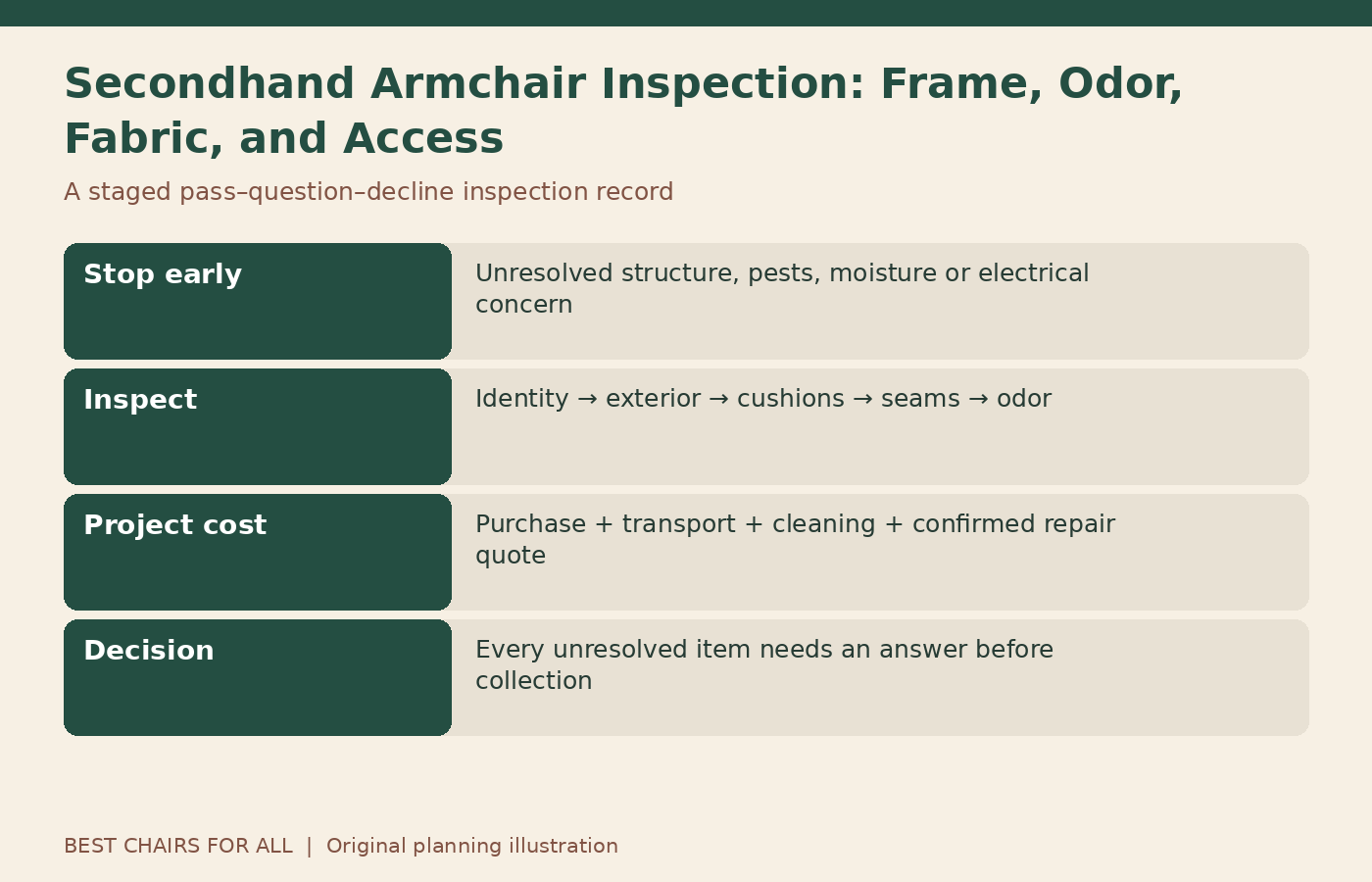
Use a staged inspection so you can stop early instead of becoming committed after arranging transport. This guide provides a pass-question-decline record and a total-project-cost exercise. It does not certify a chair as structurally sound or pest-free and does not provide DIY frame or spring repairs.
Ask for information before visiting
Request clear front, back, side, and label photographs. Ask the seller about the manufacturer, approximate purchase date, repairs, smoke exposure, pets, water damage, storage conditions, and any known pest history. Ask whether cushions are removable and whether the chair has moving or powered functions. Record unknown answers honestly rather than treating silence as confirmation that no problem exists.
Request overall dimensions and access details at the seller’s location. A chair that must come down a narrow stair or out of a basement can create a larger moving job than the listing suggests. Clarify who is responsible for removal and whether you can inspect before paying. Avoid arranging an irreversible transport commitment before the basic questions are answered.
Identify the chair and check recalls
Look for the full model or style code, serial or production label, and brand information. Compare these with any applicable official recall notice and manufacturer instructions. The CPSC recall database is a relevant US starting point. Read exact product, production, and remedy details rather than assuming every chair sharing a collection name is affected or unaffected.
An absent search result is not a safety certification, and a missing label can leave important uncertainty. For a powered or reclining chair, the correct manual is particularly important. If identification cannot be established, do not plan to use an unrelated adapter or operate an unknown mechanism as part of the inspection. Ask the manufacturer or a qualified service provider what can be verified.
Inspect the chair stationary from outside
Place it on a suitable level surface with the seller’s permission and look for leaning, twisted proportions, cracked exposed wood, separated joints, missing feet, and visibly uneven arms. Compare left and right sides without forcing them. Damage covered by a throw or cushion deserves a closer look, but do not remove stapled upholstery or dust covers simply to satisfy curiosity.
A decorative leg that looks loose may involve a fitting or frame problem you cannot assess visually. Record it as unresolved structure rather than assuming a screw will fix it. Do not bounce in the chair or rock it aggressively to test strength. Visible cracks, instability, or a seller’s warning are reasons to stop the trial and obtain professional assessment or decline.
Check accessible cushion and seat areas
With permission, lift only cushions intended to be loose and inspect their undersides and accessible seat surfaces. Look for torn backing, broken zippers, displaced filling, heavy staining, exposed hardware, or sagging that changes the sitting surface. Note whether the cushion returns to its usual shape after ordinary contact, without claiming a formal resilience test.
Separate cushion wear from support-system uncertainty. A flattened foam insert can be replaceable on some chairs, while a sagging deck or damaged frame is a different job. Ask a professional upholsterer for an assessment if the cause is unclear. Do not estimate the repair by pricing a block of foam alone when upholstery access or structural work may be required.
Inspect seams and folds for pest evidence
The EPA advises checking secondhand furniture for bed bugs before bringing it home. Use a flashlight to examine accessible seams, folds, piping, cushion edges, and crevices without dismantling the chair. Do not assume that a clean-looking seat or a pleasant scent rules out pests. Hiding places can be difficult to inspect in upholstered furniture.
The EPA’s identification guidance explains signs such as insects, eggs, shed skins, and characteristic spotting. Identification can be uncertain, so do not declare a pest problem from one unidentified mark or declare the chair clear after a quick look. If suspicious evidence appears, stop the purchase process and seek appropriate identification or decline the item.
Do not turn the purchase inspection into pest treatment
Avoid spraying an unknown chair with household pesticides, using a heater, or saturating it with cleaners at the seller’s home. Those actions can create exposure or material damage without establishing that the chair is suitable to bring home. A casual period in a garage is not a guarantee that an infestation has been eliminated.
If a chair has a known infestation, do not donate it onward or transport it as ordinary clean furniture. Follow relevant local and professional guidance. For a purchase decision, the most useful boundary is often simple: unresolved pest evidence means no collection. Keep your clothing, bags, and vehicle out of unnecessary contact while the concern is being assessed.
Evaluate odors without masking them
Ask that the chair be inspected without fresh fragrance sprays or a newly applied deodorizer. Smell from a normal position and note smoke, mustiness, strong perfume, pet odor, or an unknown chemical scent. Odor alone does not diagnose mold or identify a particular contaminant, but persistent odor can be a practical reason to decline when removal is uncertain.
Check whether the smell is concentrated in a cushion or seems embedded throughout the chair. Do not assume a machine-washable-looking cover solves odor in the filling or frame. Ask the furniture maker about approved cleaning and obtain a professional quote where needed. A promise that sunlight or baking soda will remove every smell is not dependable purchase evidence.
Look for moisture history and finish changes
Inspect accessible lower edges, exposed wood, and cushion undersides for water marks, swelling, discoloration, corrosion, or crumbling material. Ask about basement storage, leaks, flooding, and attempted cleaning. A dry surface today does not explain the chair’s history. If water exposure may have reached powered components, avoid operation and refer the question to an authorized provider.
Do not open walls of upholstery or cut away lining to investigate. If the seller cannot explain significant staining or a persistent musty smell, include that uncertainty in the decision. Cleaning, reupholstery, and structural restoration are different projects, and some chairs are poor candidates for any of them. A bargain does not require accepting an unbounded restoration problem.
Try seated fit only after earlier checks pass
If no warning signs make a trial inappropriate, sit normally and assess seat height, depth, width, arms, and back support. Do not drop your weight into the chair or perform a destructive strength test. Notice whether the chair feels stable and whether a new sound accompanies an unusual shift. Stop if anything feels unsafe or inconsistent with normal operation.
For a moving chair, use only the matching manual and the seller’s appropriate demonstration, keeping everyone clear. A used power chair that works briefly can still have an unresolved cable, control, or mechanical issue. Do not infer long-term reliability from one cycle. Record ordinary observations rather than describing the chair as fully tested.
Verify cleaning access and replacement options
Find the care label and cover code. Ask whether loose covers are actually washable and whether replacement inserts, covers, feet, or other parts are available. A zipper may exist for service, not routine laundering. Obtain model-specific instructions before deciding that a stain or cushion problem is easy to resolve.
If reupholstery is part of the plan, send photographs and dimensions to an upholsterer before purchase and ask what the quote includes. Fabric quantity, labor, filling, trim, and frame work can be separate costs. Avoid assuming that inexpensive new fabric makes the project inexpensive. Some work cannot be quoted confidently without inspection, which should remain an explicit uncertainty.
Check access at both addresses
Measure the chair at its widest, deepest, and highest points and ask whether any parts are designed to be removed for transport. Measure seller-side doors and stairs as well as your own route. Pottery Barn’s delivery-measurement guide illustrates why openings, turns, and low fixtures matter in addition to the destination room.
Do not remove structural rails, cut upholstery, or dismantle powered mechanisms to make a used chair fit. Ask movers or the manufacturer about approved handling and disassembly. A seller’s statement that it came in once does not prove that your current route or moving team can take it out safely. Doors, renovations, and furniture arrangements may have changed.
Calculate the total project cost
Add purchase price, transport, professional cleaning, approved replacement parts, upholstery work, and disposal if the project fails. For an invented example, a $75 chair plus $90 collection, $120 cleaning, and $160 cushion work totals $445 before any unexpected repair. These numbers are arithmetic examples, not current quotes or typical service rates.
Mark uncertain costs separately rather than assigning them zero. Compare that total with another chair whose condition and delivery are clearer. A project can still be worthwhile for design, sentimental value, or restoration interest, but the decision should acknowledge those reasons. It should not depend on pretending every unresolved problem has a cheap home fix.
Use the pass-question-decline record
Create rows for identity, structure, pests, odor, moisture, upholstery, fit, access, and total cost. Mark Pass where evidence is adequate, Question where a specific answer or quote is needed, and Decline where the risk or expense exceeds your limits. Add the observation behind every mark. Avoid a numerical score that lets attractive fabric cancel a serious structural concern.
Complete the unresolved questions before payment and collection wherever possible. Keep label photographs, seller information, and any professional advice with the receipt. A secondhand armchair inspection succeeds when it produces an informed decision, including a well-supported decision to leave the chair behind, rather than merely finding a way to justify bringing it home.
Something unclear or out of date? Send a correction with this article’s title and the detail to check.
Sources, research & corrections policy ↗