Find the chair’s own product identification label before ordering a recliner part. A collection name, upholstery color, or motor brand is usually not enough to establish compatibility. The useful result is an identification packet containing the complete label, purchase information, clear photographs, and a concise description of the problem. Send that packet to the manufacturer or authorized retailer and ask them to confirm the part and installation requirements.
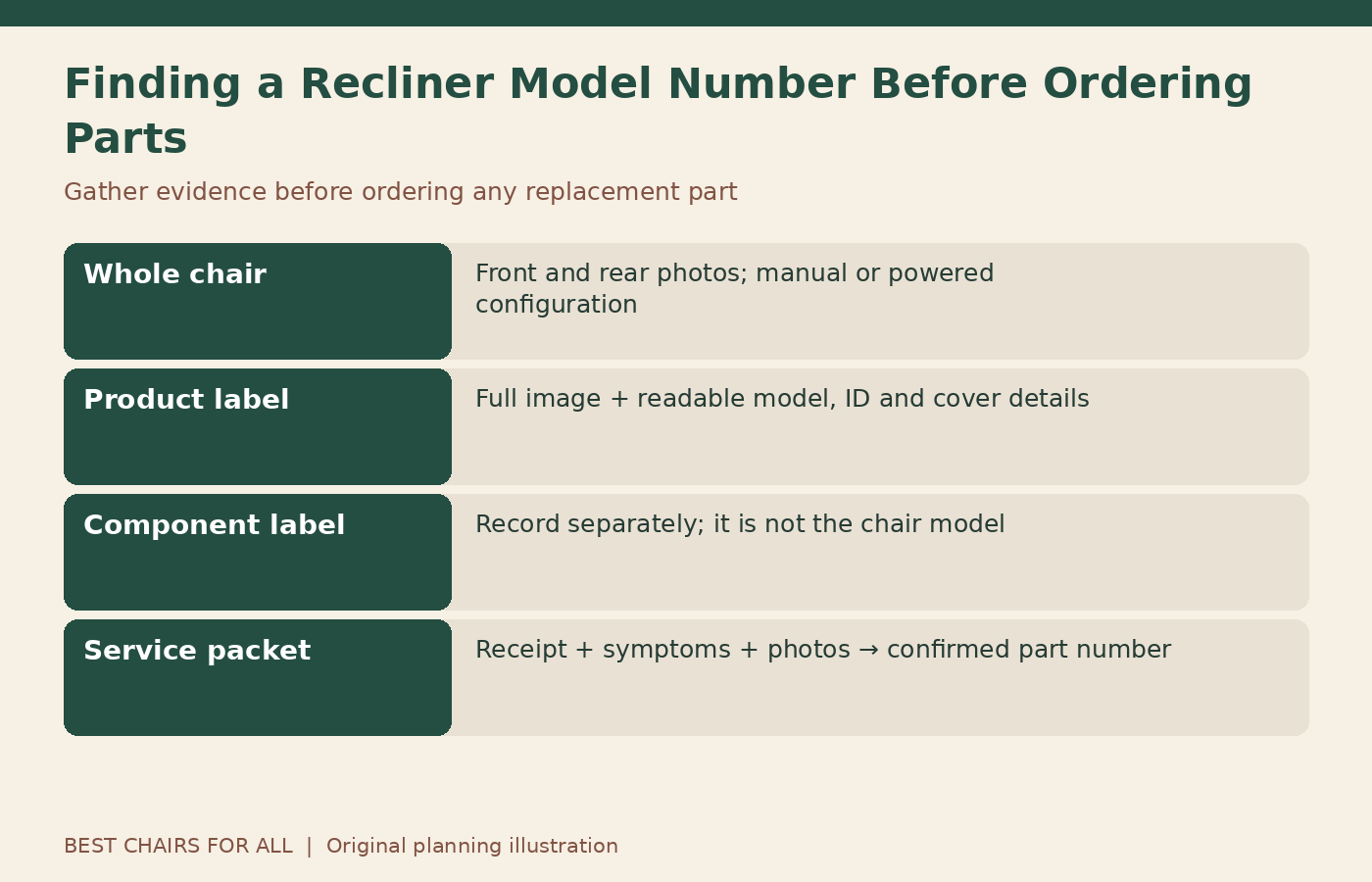
This guide explains how to gather that information without dismantling powered or spring-loaded mechanisms. If the label is hidden underneath or near moving parts, follow the manufacturer’s locating instructions or ask for assistance. Identifying the chair should not require reaching into a pinch area, operating it while someone looks underneath, or tipping a heavy item alone.
Start with paperwork that is already accessible
Look for the receipt, order confirmation, delivery ticket, warranty registration, and original manual. Search email using the retailer’s name and approximate purchase date. Save photographs or scans of documents rather than relying on memory. A sales description may include both a consumer-facing collection name and a longer style or item code; keep both exactly as printed.
If the chair was inherited or bought used, ask the previous owner for the original retailer and approximate date. Do not invent a purchase date to fill a form. Record unknown where information is missing. An honest incomplete packet is more useful than a confident but incorrect model identification that leads to ordering a nonreturnable electrical component.
Understand the numbers on a product label
Manufacturers use different identifiers. A style or model number usually identifies a design or configuration. A serial, production, or acknowledgment number may connect the item to a specific manufacturing record. A cover or fabric code identifies upholstery. A date code can help distinguish revisions. Do not discard a number because it does not resemble the model names on today’s website.
La-Z-Boy’s parts and warranty page identifies ACK, STYLE, and COVER information on its product tag. Those terms apply to its system. Another manufacturer may use ID, model, and serial instead. Photograph the whole label and let the appropriate support team interpret its fields rather than transferring one brand’s naming convention to another.
Locate the label using brand-specific guidance
Start with labels visible from the rear or side while the chair is stationary and everyone is clear of its moving area. Consult the owner’s manual or official support page for the label location. Do not assume that a tag on a loose cushion identifies the whole chair. A fabric care tag may contain only upholstery information and legal notices.
Best Home Furnishings’ FAQ describes an identification card carrying its ID, model, fabric, and manufacturing information. It also explains that warranty-related service uses the product ID. If the card’s specified location is inaccessible, ask the retailer how to obtain it safely rather than removing dust covers, reaching through linkages, or tipping the chair without an approved plan.
Keep powered mechanisms stationary during inspection
Unplugging a chair where the manual instructs can prevent ordinary powered operation, but it does not remove every stored force or make the mechanism safe to handle. Springs and moving assemblies remain. A battery pack may also mean that unplugging the wall cord does not isolate all power. Follow the exact manual and avoid contact with the mechanism regardless of the power state.
The Pride lift-chair owner manual describes label information and moving-frame hazards for the models it covers. Use its instructions only for matching equipment. If a label sits near a motor or scissor mechanism, a provider can help identify it. The goal is a readable photograph, not a home repair inspection.
Take a complete photograph set
Begin with one photograph of the entire chair from the front and one from the rear, taken without moving it into an unsafe position. Add close-ups of the product label and any visible control or power-supply label that can be accessed without reaching into moving parts. Make sure text is in focus and not obscured by flash glare or a folded edge.
Take both a full-label image and a closer image of small numbers. Include the label edges in at least one photograph so a support agent can see whether information is cut off. Photograph connector faces or cable labels only if they are already safely visible and the manufacturer requests them; do not disconnect unknown cables merely to produce a more detailed image.
Transcribe carefully, then verify against the image
Write every character with punctuation, spaces, and leading zeros preserved. Common errors include confusing zero with the letter O, one with I, and five with S. If a character is uncertain, mark it as uncertain and provide the photograph. A guessed character can identify a different production version or prevent the retailer from finding the record.
Use separate fields for chair model, chair serial or ID, upholstery code, power-supply information, and control information. Do not merge them into a single string. Save a plain-text copy that can be pasted into a support form, but keep the image as the source of truth. Avoid repeatedly retyping a number from memory in different messages.
Do not mistake a component label for the chair model
A recliner can contain a motor, transformer, controller, and mechanism from specialist suppliers. Their labels identify those components, not necessarily the complete furniture model. The same component family may appear in several chairs with different harnesses, connectors, firmware, loads, or control arrangements. A matching brand name or housing shape is therefore not proof of compatibility.
If the only visible label belongs to the power supply, record it as power supply label, chair model not yet confirmed. Send it with the chair photographs and purchase information to the furniture manufacturer. Ask the support team which further identifier is needed and whether they can trace the model from the purchase record. This keeps the evidence clear instead of promoting a clue into a conclusion.
Describe the problem without diagnosing the part
Write what the chair does in ordinary use: all functions stopped, only the headrest moves, footrest stops halfway, or a button sometimes sticks. Add when the issue began and whether it followed moving the chair, a spill, a power outage, or another event. Mention burning smell, visible cable damage, uneven movement, or instability immediately and stop use where warranted.
Avoid opening with the motor is dead unless an authorized technician has established that diagnosis. A power interruption, control fault, connection issue, or mechanical obstruction can produce superficially similar symptoms. Identification and symptom recording help the provider choose the next step. They do not make an unverified parts diagnosis reliable, even when an online video shows a similar problem.
Build a one-page service packet
Use these fields: manufacturer, retailer, purchase or delivery date, full chair model, serial or ID, upholstery code, symptom, last normal use, visible warning signs, and attached photos. Add whether the chair is manual, powered, or a lift chair and which functions still operate. Mark missing information clearly and include your preferred contact details only when submitting privately to the provider.
A hypothetical packet might say: model label photographed, receipt available, power footrest unresponsive, headrest still moves, issue began after furniture rearrangement, no disassembly attempted. That gives support a coherent starting point. It is more useful than several separate messages containing close-up motor photos and a request for whichever replacement part looks similar.
Ask the retailer to confirm compatibility in writing
Before paying, ask for the exact part number, the chair configuration it fits, any included cables or adapters, and whether installation must be performed by an authorized technician. Confirm return terms for ordered electrical parts and who pays shipping. A part may be covered while labor or transport is not, so request an itemized explanation rather than assuming warranty means a free repair visit.
If the proposed replacement has a different part number from the original, ask whether it is an approved supersession and whether other components must be changed with it. Do not splice wires, alter connectors, or combine power supplies to make an uncertain part fit. A manufacturer-approved replacement record is more dependable than visual similarity between marketplace listings.
Handle discontinued or unidentified chairs systematically
If the collection no longer appears online, contact the original retailer with the label packet. Manufacturers may have records or approved service routes that are not visible in a current catalog. Ask whether a manual or parts diagram exists for the production version. Do not assume that a newer chair with the same consumer name uses interchangeable components.
For an unbranded chair, document every accessible label and the original seller if known. A qualified furniture service provider may be able to assess it, but some parts may remain unidentified or unavailable. Accept that uncertainty before ordering. Repeatedly buying low-cost lookalike parts can create extra expense without establishing that the chair can be repaired appropriately.
Keep identification separate from recall checking
Once you have the brand, model, and production identifiers, use them when checking official recall information or following a manufacturer’s service notice. A general article or a photograph of a similar chair does not establish whether your unit is affected. If a notice applies, follow its specific remedy and contact instructions rather than continuing an ordinary repair plan.
Keep records of the search and any manufacturer response. Do not assume that the absence of a matching search result certifies the product as safe. The practical value of identification is precision: it allows the support team and any official notice to refer to your actual unit rather than to a broad category such as power recliner.
Save the packet for the chair’s remaining life
After the service issue is resolved, store the identification photographs, manual, receipt, approved part information, and service report together. Add the date and the provider’s name. If the chair is sold or given away, pass the relevant operating and identification records to the next owner while removing private payment or contact details.
This small record also helps with future upholstery questions, warranty claims, and moving arrangements. It prevents another search underneath a heavy chair when a number is needed quickly. The model-identification task is complete when the manufacturer or provider can connect the readable label to the correct chair and confirm the next appropriate action, not when an internet image merely looks familiar.
Something unclear or out of date? Send a correction with this article’s title and the detail to check.
Sources, research & corrections policy ↗