Choose an old armchair’s disposal route by condition first, then confirm what a local charity, reuse recipient, recycler, or collection service will actually accept. A clean, sound chair may have another useful home. A broken, contaminated, infested, or recalled chair can require a different route. Donation is not a way to transfer an unresolved hazard or an expensive waste problem to someone else.
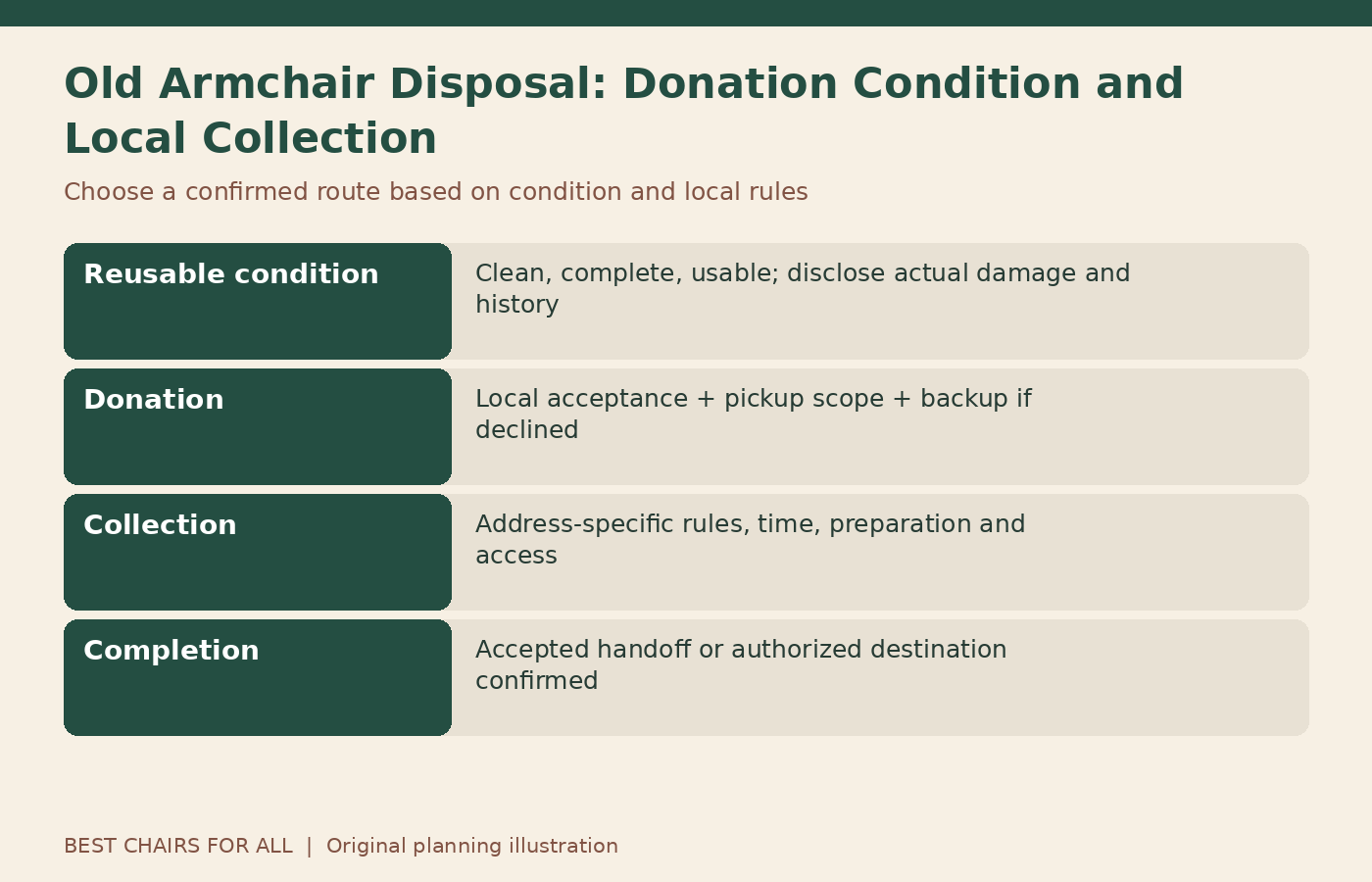
Rules and services vary by location and can change. This guide provides a route-selection record and a collection-readiness worksheet, with specific US examples checked on November 6, 2026. Those examples illustrate what to verify locally; they are not universal pickup schedules or guarantees that an organization accepts upholstered chairs.
Assess condition before choosing a destination
Record whether the chair is complete, stable, usable, clean, and free of significant tears, stains, persistent odors, moisture damage, and known pests. Include powered or moving functions and any missing parts. Be honest about uncertainty. A chair that looks attractive under a throw may still have a damaged seat deck or a problem hidden in the cushion.
Take clear photographs from the front, rear, sides, and any damaged area. Find the model and product identifiers where safely accessible. Do not dismantle the frame or powered mechanism to prepare a disposal listing. The purpose is a truthful condition packet that allows the receiving organization or service to decide whether it can handle the item.
Check recall status before offering reuse
If the chair can be identified, check the manufacturer and official recall information for the exact model, production details, or batch as required. An applicable notice may specify a remedy or disposal process. Follow it rather than listing the chair as ordinary usable furniture. If identification is uncertain, disclose that limitation and ask the manufacturer for help where possible.
Do not treat a missing recall search result as proof of safety. Also do not assume every chair with a similar collection name is affected by one notice. Keep any relevant documentation with the condition packet. A reuse recipient needs accurate information, especially for a powered recliner, lift chair, or item with a documented service concern.
Start donation inquiries with the local organization
Habitat for Humanity’s national ReStore guidance describes gently used or like-new furniture as the appropriate donation category and directs people toward local stores. Individual locations can have different acceptance criteria, capacity, and pickup services. Contact the actual destination before loading a vehicle or paying someone to transport the chair.
Send the condition photographs, dimensions, location, and relevant history. Ask specifically whether upholstered armchairs are currently accepted and whether final acceptance is decided at pickup or arrival. A general website listing furniture does not guarantee acceptance of every textile chair. Record the staff response and date, because storage space and service availability can change.
Read local condition criteria literally
For a concrete example, Habitat Cincinnati’s donation page describes furniture condition requirements and separate pickup arrangements. Its acceptance information excludes problems such as permanent stains, odors, excessive wear, and pet damage. Those are local criteria to verify, not a national rule applied to every ReStore or charity.
Do not mask an odor with fragrance or photograph the chair only from its best side to obtain provisional acceptance. A declined item can create extra handling and cost for the organization. If a modest approved cleaning would make a sound chair genuinely suitable, confirm what condition is required before doing the work. Cleaning cannot make a broken frame ready for use.
Distinguish donation pickup from waste removal
Ask whether a pickup service accepts only approved donations or also removes rejected items for a fee. Clarify whether workers enter the home, use stairs, disassemble approved components, or collect only from ground level. A free donation collection can have narrower access conditions than a paid removal service. Do not assume the driver will carry a heavy chair from an upper floor.
Keep the scope in writing. Ask what happens if the item is declined on inspection and whether another charge applies. If the chair must be placed outside, follow the agreed timing and protect it from weather without creating access problems. Leaving a usable chair in rain before donation can change its condition and acceptance.
Consider direct reuse with full disclosure
If a sound chair is not accepted by a charity, a local recipient may still want it through an appropriate reuse arrangement. Provide accurate dimensions, photographs, condition, known repairs, and pickup constraints. Do not describe it as excellent condition if springs are exposed or a powered function is unreliable. Let the recipient assess whether the chair suits their purpose and access route.
Agree who handles collection and approved transport. Do not pressure someone to lift or dismantle furniture beyond their ability. If the chair has operating instructions or identification records, provide them while removing private payment information. Direct reuse should transfer useful furniture and accurate information, not simply move an unresolved disposal problem to another household.
Handle known pest concerns separately
Do not donate or casually give away a chair with a known or suspected infestation. Ask the appropriate pest professional or local authority about handling and disposal, and disclose the issue to any collection service. EPA’s bed-bug prevention guidance explains why secondhand furniture needs inspection before entering another home. A quick visual check does not certify a suspect chair as clear.
Avoid unapproved pesticide spraying, home heating experiments, or moving the item through shared spaces without a plan. Local procedures may address containment, labeling, and collection. Follow those actual instructions rather than assuming that a cover or a few days in a garage makes the item suitable for reuse. A contamination issue changes the route-selection decision.
Check municipal bulky-item rules at your address
Find the official local waste authority’s current guidance for upholstered furniture or large items. Confirm eligibility for your property, booking requirements, item limits, set-out location, dates or time windows, fees, and preparation instructions. Apartment buildings and commercial properties may use different arrangements from individual houses. Ask the property manager when building rules affect access or collection.
Save the official page or written confirmation with the date checked. Do not rely on a neighbor’s old schedule or an undated social-media comment. If the website distinguishes recyclable and nonrecyclable bulk items, confirm which category applies to the complete chair. Upholstery, wood, metal, and electronics can complicate assumptions based on one visible material.
Use a city example without exporting its rules
New York City’s sanitation furniture page directs residents to bulk-item rules and distinguishes mostly metal or plastic items from other furniture. It also has separate provisions for mattresses and box springs. Those instructions apply within that service system and should not be copied to another city or to every kind of upholstered item.
The useful lesson is to identify the exact item and read the relevant local category. An armchair is not automatically subject to a mattress-bag rule because both contain fabric. Likewise, a metal mechanism inside an upholstered chair does not necessarily establish that the whole item belongs in metal recycling. Ask the authority when the category is unclear.
Verify recycling claims before paying for them
Ask a proposed recycler or removal company what materials it accepts and where the chair will go. Upholstered furniture combines materials that may be difficult to separate, and a generic recycling logo does not establish that local facilities accept cushions or foam. Do not place furniture parts in household recycling bins unless the local program specifically permits them.
If a provider advertises diversion or recycling, ask what that means for this particular chair and whether documentation is available. Avoid promising that every component will be recycled when the destination is unconfirmed. A transparent disposal route with known limits is more useful than a broad environmental claim that cannot be checked.
Keep powered components and batteries identified
Tell the collection service if the chair contains a battery, motor, transformer, heat system, or other electrical equipment. Ask the manufacturer and local waste authority how those components should be handled. A rechargeable pack may need a separate accepted route. Do not open sealed batteries, cut wiring, or remove loaded mechanism parts simply to separate materials.
If the manufacturer provides an owner-removable battery procedure, follow it only for the matching equipment and arrange the correct destination. Otherwise, use a provider able to handle the complete chair appropriately. A damaged or swollen battery needs specific guidance, not ordinary donation or an improvised bin placement. Identify that issue before transport is booked.
Plan the physical removal route
Measure clear doors, hallway turns, stairs, elevator access, and the chair’s approved transport configuration. Tell the service about heavy weight, limited parking, booking rules, or required insurance documents. Ask whether its workers perform in-home removal and what preparation is expected. Do not drag a chair by its arms, back, footrest, or cords without appropriate manufacturer handling guidance.
Remove loose personal items and check pockets and cushion gaps only where safely accessible. Keep children and pets away during removal. If ordinary access is not feasible, obtain professional advice rather than cutting the chair apart inside the home. Structural disassembly and powered mechanisms can introduce hazards that are unrelated to the waste service’s acceptance rules.
Build a route-selection record
Use rows for donation, direct reuse, approved recycling, municipal collection, and private removal. For each, record condition eligibility, acceptance confirmation, access requirements, total quoted cost, timing, and destination. Mark rejected or unconfirmed routes clearly. This prevents a provisional charity email from being mistaken for a booked pickup and keeps a backup plan visible.
For a hypothetical comparison, donation might be suitable but require ground-level staging the owner cannot arrange. Municipal collection might accept the chair but require a particular set-out window. A paid in-home service might solve access at a higher quoted cost. These are planning examples, not price estimates. Choose the route whose condition, access, timing, and responsibility are actually confirmed.
Finish the handoff and retain confirmation
Before collection, reconfirm the item, address, access, preparation, and any condition issue. Follow the agreed schedule rather than leaving furniture beside a donation center after hours or on a curb before local permission allows it. If the chair is rejected, keep responsibility for arranging the next legitimate route instead of abandoning it at the destination.
Retain the donation acknowledgment, collection receipt, or other confirmation and the destination information supplied. Review the space after removal for any left-behind batteries, hardware, or personal items. Disposal is complete when the chair has reached an accepting recipient or authorized collection route under the relevant conditions, not merely when it has been moved outside the home.
Something unclear or out of date? Send a correction with this article’s title and the detail to check.
Sources, research & corrections policy ↗