Compare outdoor chair warranties by component and remedy, not by the biggest number on the product page. A long structural warranty may sit beside much shorter coverage for hardware, sling fabric, woven inserts, or the finish. The useful question is what happens to your particular chair, under your intended use, if a particular part fails. Build the comparison before purchase while the model, seller, and warranty documents are easy to identify.
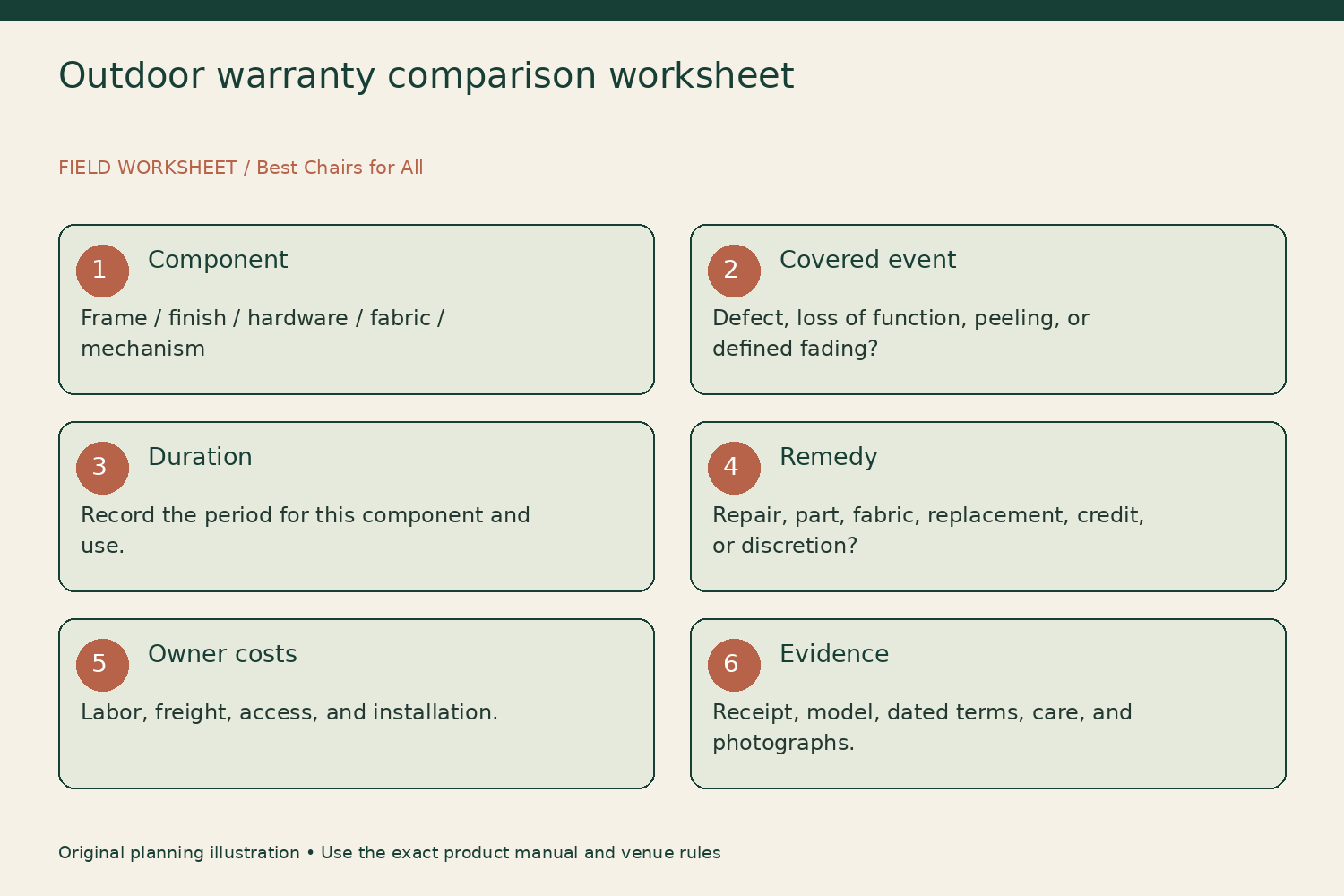
A warranty is also different from a return policy, a spare-parts promise, or a prediction of service life. A chair may remain useful beyond a warranty period, while a claim within that period can still fall outside the written coverage. This guide uses named manufacturer documents as examples and gives you a worksheet for comparing the obligations that matter to your purchase. Terms should be checked again for the exact product and purchase date.
Start with the purchaser and intended setting
Record who can claim: the original buyer, a later owner, or a purchaser through a specified seller. Check whether registration, a receipt, or a particular sales channel is required. If you are buying used furniture, do not assume that a warranty transfers with the chair. A seller’s remaining years of ownership are not automatically years of coverage available to you.
Next identify residential, commercial, rental, or other use. A chair on a private balcony and the same chair on a restaurant terrace can fall under different terms. Tell the supplier how the furniture will be used and obtain the applicable document. Avoid comparing one brand’s residential headline with another brand’s commercial warranty. Those are different promises, even when both products are described as suitable for outdoors.
Split the chair into covered components
Make rows for the structural frame, joints or welds, finish, hardware, sling or woven seat, cushion fabric, cushion filling, and moving mechanism. Add unusual parts such as a reclining latch or replaceable foot. Put ‘not applicable’ beside components a particular chair does not have. This prevents a simple molded chair from appearing to have missing coverage for a sling it never used.
The POLYWOOD limited residential warranty illustrates component-specific periods: its principal residential furniture coverage is twenty years, while listed metal-frame welds and joints, powder coating, and hardware have five-year terms, and sling fabric has a three-year term. These are examples from that document, not a claim that every component receives twenty years. Read the complete current terms and the exceptions for the product you are considering.
Define the event each promise covers
A warranty may cover a manufacturing defect, loss of structural function, excessive fading, or a finish that peels. Those descriptions are not interchangeable. Write the actual covered event in plain language beside the period. ‘Five years’ is incomplete; ‘five years against specified powder-coat peeling under the stated use conditions’ gives you something meaningful to compare with another finish warranty.
Separate appearance changes from functional failure. A scratched arm, a flattened cushion, and a broken joint may all be disappointing but can have different treatment. Do not interpret the word ‘outdoor’ as coverage for every consequence of rain, sunlight, salt, wind, or freezing. Read the exclusions to find where ordinary exposure ends and an excluded condition begins. If that boundary matters at your location, ask before ordering.
Check the remedy as carefully as the duration
Write down whether an approved claim brings a repair, replacement part, replacement furniture, fabric supply, credit, or another remedy chosen by the manufacturer. Check whether an equivalent substitute may be provided if the original finish or collection is discontinued. A replacement part can restore function while creating a color mismatch, so ask how that possibility is handled rather than assuming a complete matching set will be replaced.
A fabric warranty can also change remedy over time. The Sunbrella upholstery five-year limited warranty distinguishes approved claims during the first three years, when specified labor assistance can accompany replacement fabric, from years four and five, when replacement fabric is supplied. It includes conditions and exceptions. That distinction matters if the cost of making a new cushion is greater than the value of the fabric alone.
Add labor, freight, and access costs
Make separate worksheet columns for the part, labor, shipping, collection, and reinstallation. Do not put ‘free replacement’ in every column because a headline uses that phrase. An owner might receive a component but still need help fitting it. A large chair might also be expensive to transport. Ask whether photographs can begin a claim or whether the manufacturer may require inspection or return.
Consider access as well as distance. If the chair is on an upper-floor terrace, a warranty that sends a large assembled replacement may create a different practical burden from one that supplies a small part. This is not a reason to reject either remedy automatically. It is a reason to understand the process before the original packaging is gone and the chair is installed in a difficult location.
Read maintenance obligations alongside exclusions
The Tropitone limited consumer warranty lists exclusions including failures associated with inadequate necessary care, certain fading, cushion compression, wind damage, and freeze damage to tubing. The exact terms and coverage categories require reading the whole document. Its useful lesson for comparison is that a warranty period cannot be understood separately from the product’s required care and environmental exclusions.
Do not invent a maintenance schedule to satisfy a warranty. Save the manufacturer’s care instructions and follow the parts relevant to the chair’s materials. Keep ordinary records such as dated photographs, approved cleaning products, and replacement-part invoices. You do not need an elaborate diary for every wipe-down, but a record of significant care and service makes later explanations more accurate than reconstructing them from memory.
Use a scenario worksheet
Create three realistic scenarios for your intended setting. For a coastal patio, use finish deterioration near a frame joint. For a dining chair, use a failed sling seam. For a swivel chair, use resistance or a failed moving component. In each case, ask what document applies, which covered event might be relevant, what exclusions could matter, and what remedy and owner costs the written terms describe.
Label the results as questions, not claim decisions. For example: ‘Year four, finish flakes near base; document covers specified peeling but excludes certain environmental damage; need manufacturer assessment and care history.’ This is more honest than declaring that the chair will definitely be replaced. The manufacturer evaluates the actual claim, and a hypothetical scenario cannot establish the cause of a future failure.
Compare evidence quality, not marketing confidence
Give each worksheet cell a source: product-specific warranty PDF, general warranty page, written supplier response, or unknown. Save a copy with the date accessed. Product pages change, and a screenshot of a prominent badge may omit the terms linked below it. Include the model number and seller on the saved document so you can connect the promise to the purchase later.
If a retailer’s description and the manufacturer’s document disagree, ask for clarification in writing. Quote the conflicting component and period rather than asking which warranty is ‘better.’ A useful reply identifies the applicable terms and why they apply to your model and purchase. Do not silently choose the more generous interpretation. Unresolved contradictions belong in the decision as uncertainty, especially when the disputed coverage is your main reason for buying.
Ask about parts beyond the warranty
Warranty coverage and parts availability are related practical concerns but separate promises. Ask whether feet, glides, fabric slings, cushions, and moving assemblies can be purchased for the model. Find out how a part is identified and whether the manufacturer supplies fitting instructions. A chair with a modest warranty but replaceable wear components may meet a different ownership goal from a chair with a long headline and little repair information.
Do not count an informal comment that parts are ‘usually available’ as a guaranteed supply period. Record the answer accurately and ask about discontinued collections if that matters. For furniture bought in quantity, keep the original finish and fabric codes. If one seat needs replacement later, those details are more useful than a photograph described as ‘the gray one we bought several years ago.’
Build a purchase file that supports a claim
Keep the receipt, itemized model or SKU, purchase date, seller details, warranty document, care guide, and photographs of the chair when new. For a set, identify how many chairs were purchased and whether cushions or accessories were separate line items. Photograph labels before weather or cleaning makes them difficult to read. Store a digital copy somewhere accessible even if the original paper receipt fades.
If a problem develops, document the location, onset, and effect on use before making alterations. Send clear overall and close-up images through the specified claim route. Ask for assessment before replacing or refinishing a disputed part, because an alteration may complicate the evidence or terms. For a chair that appears structurally unsafe, stop using it while the claim is reviewed; warranty administration is not a reason to keep testing a failure.
Make the final comparison specific
Summarize each candidate in one sentence that includes the component you value most, its covered event, period, remedy, and relevant exclusions. For example: ‘Candidate A provides documented frame coverage under residential use, while sling replacement and owner shipping need separate review.’ That sentence is more useful than awarding a winner based on twenty versus five years without looking inside either promise.
Choose according to your actual exposure, ability to perform the required care, likely service route, and tolerance for owner costs. When an important cell remains unknown, resolve it before purchase or treat it as a limitation. A good warranty comparison leaves you with a documented expectation and a workable claim file. It does not turn a limited promise into a guarantee that every outdoor chair problem will be repaired at no cost.
Something unclear or out of date? Send a correction with this article’s title and the detail to check.
Sources, research & corrections policy ↗