Clean upholstered dining chairs by identifying the exact fabric and furniture care instructions before applying liquid. The common W, S, W-S, and X codes narrow the cleaning approach, but they do not answer every question about a stain, removable cover, foam, trim, or wood frame. Start with approved routine dry care, respond promptly to spills, and use a material-specific plan rather than a universal kitchen-cleaning recipe.
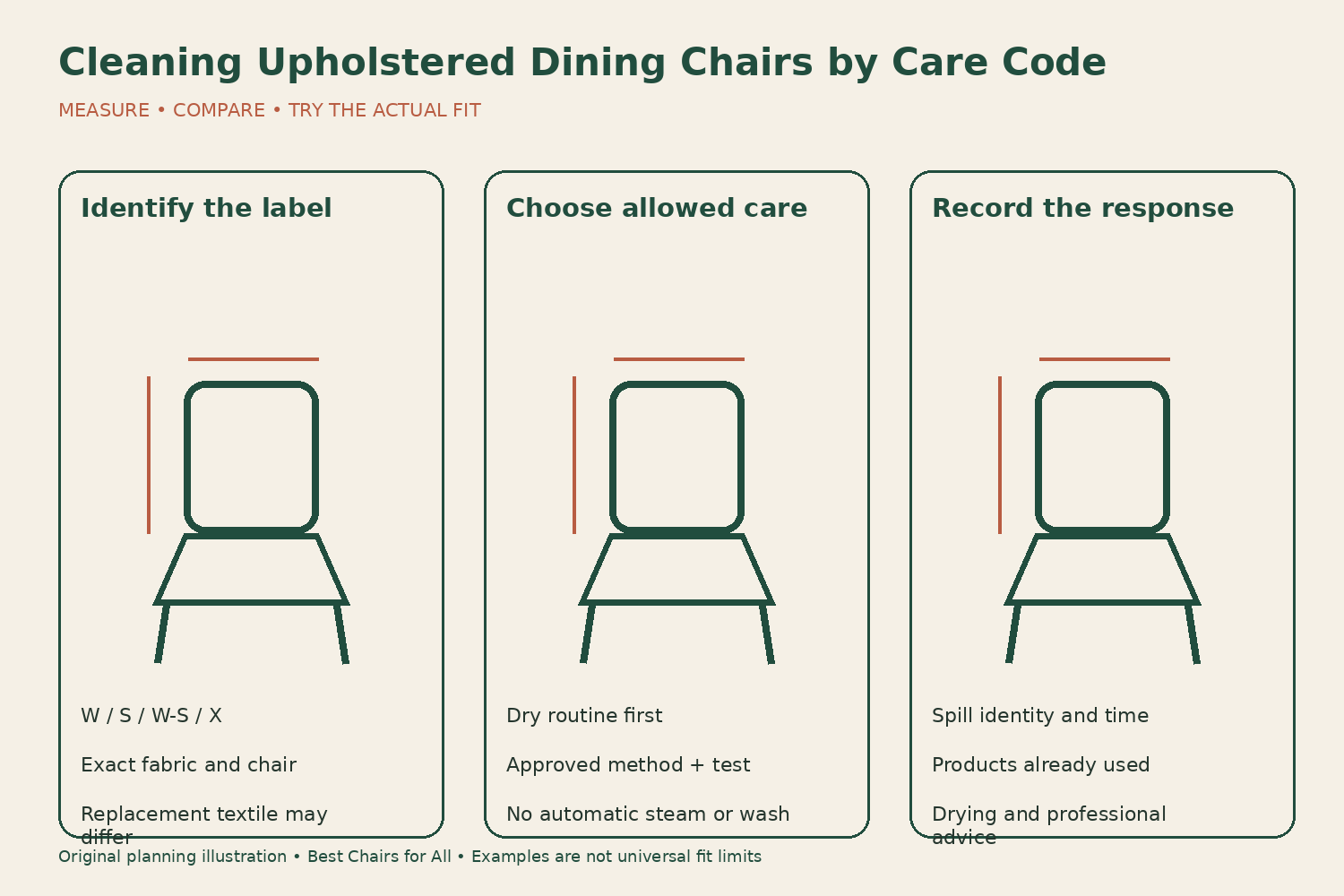
Find the care information first
Look for an upholstery label beneath the seat or in the product documents. Photograph the code, fabric name, and chair model so they remain available after a label becomes hard to read. If the chair has been reupholstered, the original label may describe the old covering. Ask the seller or upholsterer for the replacement textile’s information.
A fabric composition such as polyester, cotton, or viscose is not a complete cleaning instruction. Coatings, dyes, backing, construction, and adjoining materials affect the finished chair. Likewise, “performance fabric” does not mean that bleach, steam, an extractor, or machine washing is allowed. Obtain the guidance for the exact material and chair configuration.
If you cannot identify the care method, keep the response conservative and contact the manufacturer or a qualified upholstery cleaner. Do not test a sequence of household chemicals in the hope that one works. An unknown stain plus an unknown fabric is a reason to seek identification, not a reason to increase cleaning strength.
Understand the codes within their limits
La-Z-Boy’s upholstery-care guide explains these common categories: W uses specified water-based spot-cleaning products; S uses specified solvent-based care; W-S permits the stated water-based or solvent approach; X limits care to vacuuming or light brushing. Read the complete directions because dilution, application, testing, and professional-cleaning advice still matter.
A W code does not mean soak the chair, and S does not mean any solvent from a workshop. W-S is not permission to mix cleaners together. X is not a challenge to find a liquid gentle enough to bypass the restriction. Treat the code as a route to the maker’s full instructions rather than a self-contained cleaning recipe.
The code also does not establish machine washability. A zipper may be present for manufacturing or service access. A removable-looking covering can shrink, distort, or be difficult to refit if laundered against instructions. Confirm removal and laundering explicitly instead of assuming that a visible fastener makes the cover a household laundry item.
Begin with approved routine dry care
Remove dry crumbs and loose particles using the manufacturer’s specified method and a suitable upholstery attachment where permitted. Check the tool for sharp edges or debris before using it near fabric. Work around seams and the seat-back junction gently, without pulling fringe, decorative stitching, or a loose thread. Address a snag as a textile issue instead of cutting or scrubbing it casually.
Keep the frame’s care separate. A vacuum nozzle can scratch exposed wood or metal trim if used carelessly, and a fabric cleaner can run onto a finish that requires a different method. Identify the seat, back, arms, legs, and trim as separate surfaces. A chair with several materials needs several compatible care instructions, not one spray applied everywhere.
Notice changes during routine cleaning. A loose seat, cracked frame, or exposed staple is not a stain-removal problem. Stop using an unsafe chair and seek appropriate repair guidance. Cleaning is a useful opportunity to inspect the furniture, but it does not turn the user into a structural assessor or justify dismantling enclosed components.
Make a spill decision before reaching for a bottle
Identify what spilled if possible and when it happened. Liquid, oily food, dry powder, and an unknown old stain may need different approved responses. Lift loose solids carefully without pushing them into the textile, and follow the manufacturer’s prompt-spill guidance. Avoid vigorous rubbing, which can spread material or change the surface appearance.
Keep a clean white absorbent cloth available for blotting where the fabric instructions permit it. A colored cloth can introduce another uncertainty if its dye transfers. Do not add water automatically to a solvent-care or unidentified fabric. If the spill has reached foam, seams, or the underside, mention that when asking a professional for advice.
Record any product already used before calling a cleaner. The product name, concentration if relevant, and approximate time are more useful than saying the stain was “treated.” Avoid layering another cleaner on top of residue. Mixing products or repeatedly wetting one patch can create a different problem from the original spill.
Test only an approved method
If the instructions call for a test, use an inconspicuous location representative of the same textile and follow the method exactly. Allow the area to dry as directed before judging color, texture, rings, or other changes. A test that looks acceptable while damp has not shown the final appearance. Do not assume success on a separate trim fabric applies to the seat.
Use the specified product amount and application method. More cleaner or longer contact is not necessarily more effective. Keep the surrounding frame protected without trapping moisture against it, and avoid saturating the upholstery or forcing liquid into joints. Follow the cleaner’s label for ventilation and other use requirements.
If the test changes the fabric, stop. Preserve the product information and contact the manufacturer or cleaner rather than attempting to reverse the change with another chemical. A successful test also does not guarantee complete stain removal; it simply supports proceeding within the product’s stated instructions.
Follow named-fabric instructions precisely
Sunbrella’s current upholstery-care page distinguishes indoor upholstery from outdoor applications and discusses furniture construction before washing removable casings. It also warns against abrasive scrubbing and requires appropriate rinsing and drying for its stated methods. These are instructions for Sunbrella applications, not for every fabric advertised as durable.
That distinction matters on a dining chair. A textile may tolerate a particular cleaner while nearby wood, thread, trim, or foam does not tolerate the same exposure. Check the furniture maker’s directions alongside the textile supplier’s. If the two appear to conflict, ask for clarification rather than choosing the more aggressive method.
Do not copy an outdoor cushion treatment onto a fixed indoor chair. The ability to rinse a detached outdoor fabric is different from applying water to upholstery attached over foam and a wood board. The complete construction determines whether the stated method can be carried out appropriately.
Treat washable covers as a separate system
A cover explicitly designed for laundering can make ownership easier, but it still has specific instructions. The BERGMUND Djuparp green-blue cover publishes its own washing and drying restrictions and identifies the compatible frame. Those directions should stay with that cover rather than becoming a general instruction for all BERGMUND textiles or all dining-chair slipcovers.
Before removal, photograph the attachment and orientation if the maker permits owner removal. Keep any ties, hook-and-loop points, or fasteners in their intended configuration. Launder only by the allowed method and refit as directed. Do not force a changed cover onto the chair or use heat to speed drying unless the instructions authorize it.
Plan for the chair’s downtime. Keep damp covers and components out of use until appropriately dry. A spare compatible cover may help if it is available and practical, but verify exact model compatibility before buying. A similar-looking replacement can use different dimensions or attachments.
Know when professional cleaning is the better next step
Seek advice for unknown care codes, extensive soiling, delicate finishes, a failed test, repeated water rings, contamination beneath the surface, or a stain that persists after the allowed process. Explain the fabric and furniture model and ask about the cleaner’s experience with that material. Do not request an aggressive treatment simply because a home method did not work.
Give the cleaner photographs, the label, the spill history, and any previous products. Mention whether covers are fixed and whether wood, cane, metal, or decorative trim sits nearby. Ask what the process involves, what drying conditions are needed, and what outcomes remain uncertain. No responsible plan should promise that every stain will disappear.
For a valuable or historic chair, an appropriate textile or furniture conservator may be the relevant professional rather than an ordinary upholstery-cleaning service. Keep original materials and finishes in mind before choosing a treatment intended for modern everyday furniture.
Create a dining-chair care card
Write the chair model, upholstery identity, code, exact care URL, approved routine dry method, and manufacturer-approved spill steps. Add restrictions in plain language, such as “do not remove cover for laundering,” if that is what the product says. Keep the actual source documents available so a short card does not omit essential instructions.
Include a place to record stains and treatments. A note such as “tomato sauce, blotted promptly, product X used according to label, remaining mark photographed” is more useful than an unexplained bottle stored beneath the sink. This record supports a sensible next decision and prevents repeated incompatible attempts by different household members.
Review the card after reupholstery or a cover change. The chair’s care identity has changed even if the frame and room remain the same. With that information in place, routine cleaning becomes a controlled, material-specific task rather than a search for a stronger cleaner each time dinner leaves a mark.
Keep a spill kit matched to the chair
Store clean white cloths and the care card together, with only products approved for that upholstery. A plain kit reduces the chance that someone grabs a countertop disinfectant during a rushed cleanup. Label a dedicated vacuum attachment if it is appropriate for the fabric, and keep it clean between uses. If the household has chairs with different codes, make the distinction visible on the cards. Do not place several incompatible cleaners in one unlabelled basket and expect a guest to know which chair tolerates which treatment.
Something unclear or out of date? Send a correction with this article’s title and the detail to check.
Sources, research & corrections policy ↗