Clean a velvet chair according to its exact upholstery and finished-chair instructions. Start with dry dust removal using the permitted upholstery attachment and nap direction. For a spill or mark, identify the fabric, distinguish a stain from pile shading, and test only an approved treatment in a discreet area before cleaning the visible surface.
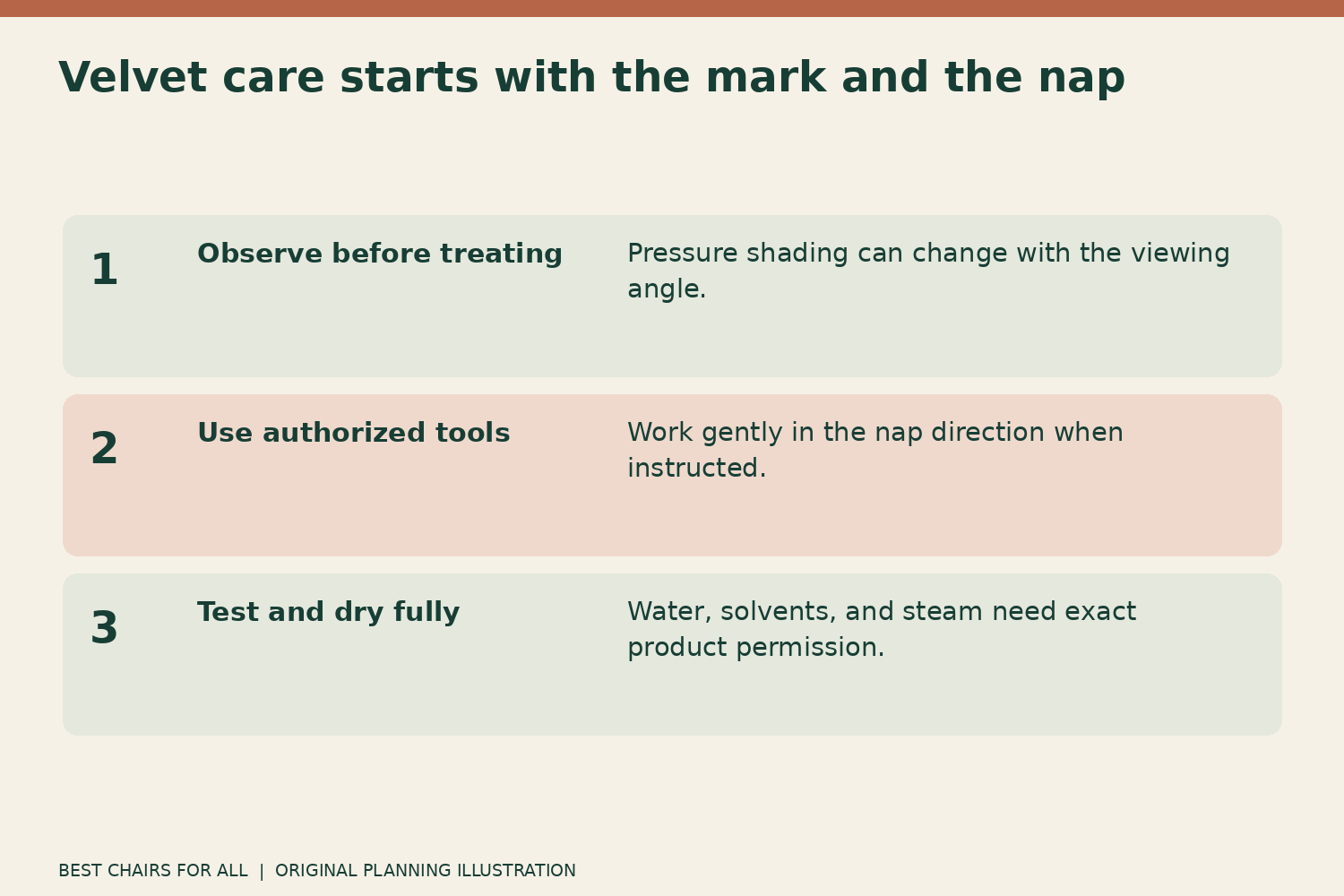
Velvet is a surface construction, not one fiber. Cotton, viscose, wool, mohair, polyester, and blends can require different care. A successful method on another velvet sofa does not establish a safe method for your chair. Avoid adding water, solvent, heat, or a machine-cleaning process until the specific instructions allow it.
Find the model and fabric code
Look for the manufacturer’s label, order confirmation, fabric swatch, or upholstery code. Record the fiber composition and whether the cover is fixed or intended to be removable. A zipper may provide manufacturing access rather than permission to remove and wash the cover. Ask the chair maker when the documentation is unclear.
For a specific example, IKEA’s STRANDMON in Djuparp dark green lists a velvet made from 62% polyester and 38% viscose/rayon. That composition is more useful than simply calling the chair synthetic velvet. Keep the exact version with the care instructions rather than borrowing advice for a different STRANDMON fabric.
If the chair is secondhand and the label is missing, photograph the whole chair and any underside information before contacting the manufacturer or a professional upholstery cleaner. Appearance and touch cannot reliably identify the complete fiber blend or finish. Treat unknown cleaning permission as unresolved rather than guessing from color or sheen.
Determine the direction of the nap
Velvet’s pile reflects light differently depending on direction. With clean dry hands, observe how the surface looks from several angles and gently feel the direction in which the pile lies smoothly, where the manufacturer’s handling guidance permits it. Note that direction for each panel; a curved chair can contain panels oriented differently.
Fritz Hansen’s velvet guidance recommends frequent vacuuming with an upholstery-suitable mouthpiece in the nap direction. Use its advice within the relevant product instructions. The important practical point is controlled handling that respects the pile rather than aggressive back-and-forth scrubbing.
Do not assume the darkest-looking direction is the correct cleaning direction. Light and the angle of the panel can change the visual effect. If you cannot identify the nap without pushing or roughening the fibers, stop and ask for guidance. A cleaning routine should not require flattening the surface to establish its direction.
Remove loose dust with the permitted tools
Inspect the vacuum attachment for rough edges, debris, or a rotating brush that the manufacturer does not permit. Use the specified upholstery tool and suction setting. Work gently along the nap, lifting the attachment between passes rather than dragging hard across the surface or repeatedly working one spot.
Pay attention to seams, piping, and the junction between the seat and arms. Remove loose crumbs without grinding them into the pile. If a cushion is normally removable, follow the maker’s instructions to access underneath it. Do not pull fixed upholstery away from the frame or insert a nozzle into a tight space where it could snag fabric.
The cited Djuparp product page mentions a soft vacuum nozzle and lint-roller use for its velvet’s small loose fibers. That is an example of model-specific permission. Test an authorized lint tool discreetly and stop if it pulls yarn, changes sheen, or leaves residue. Do not assume every adhesive roller is suitable for every velvet.
Check whether the mark is soil or pile shading
Look at the mark from the front, side, and opposite direction under steady light. A pressure impression can appear lighter or darker as the pile orientation changes. A spill may have a defined edge, residue, or a known incident behind it. These observations help decide what to report, but they do not guarantee a diagnosis.
Fritz Hansen describes pressure marks as a characteristic that can occur even with careful use. IKEA similarly notes press marks and directional light reflection for its Djuparp velvet. Do not repeatedly apply stain remover to a suspected pressure mark simply because its color differs from the surrounding pile.
If a mark followed a hot object, prolonged pressure, or previous cleaning, record that history. Heat damage, displaced pile, and residual soil may look similar in a photograph. A professional can assess the condition more usefully when you explain what happened than when the chair has already undergone several undocumented treatments.
Respond to a fresh spill conservatively
Stop the source of the spill and consult the care instructions promptly. Where permitted, lift excess liquid with a clean absorbent white cloth using gentle blotting rather than rubbing. Avoid pressing liquid deeper into seams or spreading it across a larger area. Remove loose dry material with the approved dry method before considering a wet treatment.
Do not choose a household cleaning recipe from the word velvet alone. A cleaning code is useful, but the finished-chair instructions and the actual product’s directions still matter. If the label calls for professional treatment, arrange that instead of testing a water-and-detergent mixture because another chair tolerated it.
Record the spill type, approximate time, and any action already taken. For oil, dye, ink, or an unknown substance, that information helps the manufacturer or cleaner choose an appropriate response. Keep children, pets, and routine use away from the affected area until it is assessed and any permitted treatment has fully dried.
Test an authorized method before treating the face
Use a discreet area of the same upholstery where the manufacturer permits testing. Follow the approved cleaner’s exact dilution and application instructions; do not make it stronger to speed the process. Apply the amount and method specified, and allow the test area to dry fully before judging color, sheen, texture, or residue.
Kvadrat’s Sahco Velvet product guidance calls for testing stain-removal agents in an inconspicuous area and warns that complete stain removal cannot be guaranteed. It is guidance for that textile, illustrating why the exact fabric specification should accompany a cleaning decision.
A test that looks unchanged while damp may show a ring or altered pile after drying. If the result is uneven or uncertain, stop before applying the method to the visible seat. Do not perform successive different tests on the same small patch and then assume you know which product caused a change.
A stain-and-pile assessment record
This original record gives a cleaner or manufacturer the information most likely to change the method. It also prevents a household member from unknowingly repeating a treatment already tried. Fill it in before a visible-area application whenever the stain or fabric is uncertain.
| Field | Record |
|---|---|
| Chair and fabric | Model, upholstery code, composition, fixed or removable |
| Mark history | Spill, pressure, heat, unknown, and time noticed |
| Visual behavior | Changes with viewing angle or remains uniform |
| Nap direction | Panel-specific observation |
| Prior treatment | Product, dilution, tool, and application |
| Approved test | Location, method, and fully dry result |
| Next action | Authorized spot process or professional assessment |
For a worked example, a light patch appears where a book rested overnight and changes brightness when viewed from the other side. Record pressure as the likely event and ask about permitted pile care before treating it as a food stain. If the same patch followed a sugary spill, the residue history would change the next step.
Keep pile restoration separate from steam cleaning
Steam advice is especially easy to overgeneralize. Fritz Hansen’s velvet page identifies Fred and VIA57 under its steam-cleaning permission. That is not a statement authorizing steam on every velvet chair from every maker. Confirm the exact model, upholstery, equipment, and process before using heat.
Kvadrat’s Sahco Velvet page also discusses professional cleaning and cautions against a steam-cleaner process in its guidance. Different documents may distinguish controlled pile restoration from cleaning with a machine that injects moisture. Do not collapse those processes into a blanket instruction to steam all velvet.
Never press a hot iron onto the pile to erase a mark unless the exact manufacturer’s instructions specifically provide an appropriate process. Do not improvise distance, temperature, or dwell time from another fabric. Where heat permission is absent, use the approved dry routine and seek advice about persistent impressions.
Dry and reassess before another treatment
Follow the maker’s drying instructions and keep the chair out of use until the treated area is fully dry. Avoid adding uncontrolled heat to speed the process. A damp-looking mark can be difficult to judge, and repeated cleaning before drying can increase moisture in the upholstery beneath the surface.
Once dry, inspect from the same angles and lighting used before treatment. Check for a ring, changed texture, residual soil, or a displaced nap. If the appearance is worse or the result remains uncertain, document it and stop. More scrubbing is not an evidence-based next step simply because the first treatment did not succeed.
Prevent repeat marks without covering the problem
Keep sharp accessories and hot objects away from the upholstery. Avoid storing heavy items on velvet cushions, and follow the manufacturer’s placement advice concerning sunlight and heat. Use only approved fabric treatments; a protective spray can change a surface and should not be added merely because the chair seems delicate.
For recurring soil on arms or the head-contact area, review the routine with the maker or a professional cleaner. A throw can reduce direct contact but introduces another fabric whose dye, backing, and movement need consideration. Do not hide an actively damp or damaged area beneath a blanket and continue using the chair.
Save the successful dry-care method and any approved stain procedure with the fabric code. The dependable velvet-cleaning routine is specific and repeatable: identify the textile, respect the nap, distinguish the mark, test the permitted method, dry fully, and escalate unresolved damage before adding another treatment.
Something unclear or out of date? Send a correction with this article’s title and the detail to check.
Sources, research & corrections policy ↗