There is no single reliable lifespan for every office chair. Useful service depends on the model, condition, use, environment, maintenance, parts support, and whether it still fits the person and workstation. Age is useful background information, but it does not establish that a chair is safe, comfortable, repairable, or due for replacement. Assess those questions separately rather than treating a generic number of years as an expiration date.
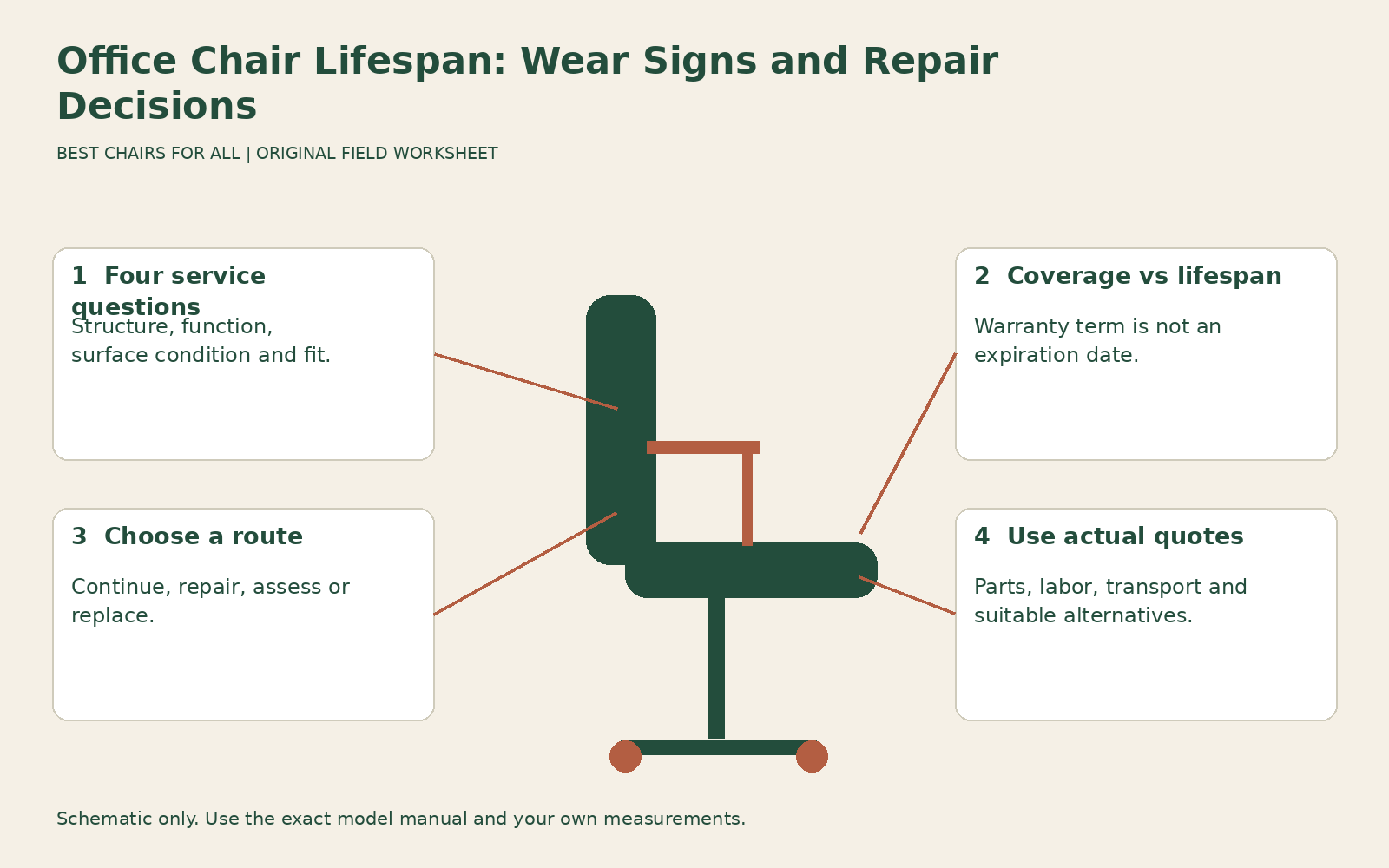
This guide uses a wear-and-repair decision record with four routes: keep using with normal care, arrange a compatible repair, seek assessment before further use, or replace because condition or fit cannot be resolved. It is intended to make an ordinary maintenance decision concrete. It does not certify remaining structural life or prescribe internal repairs to gas lifts and tilt mechanisms.
Distinguish the chair's different service lives
A chair can remain mechanically functional after its upholstery becomes unattractive. It can also look nearly new while a control fails to hold position. A change of user, desk, or task can make a previously suitable chair a poor fit without any component breaking. These are different reasons to reconsider the chair, and they should lead to different next steps.
Write four headings: structure, function, surface condition, and fit. Record concerns under the relevant heading before deciding to replace everything. A worn arm pad may have a straightforward replacement route. A cracked load-bearing part requires a different response. A too-deep seat for a new user is a fitting limitation rather than a problem that cleaning or lubrication will solve.
Keep chronology without letting it dominate the decision. Record purchase date, manufacturing label, known repairs, and changes in use. A chair used occasionally in a guest room and one shared across shifts can have different histories at the same calendar age. The history helps service staff understand the situation, but it is not a home formula for calculating remaining years.
Read a warranty as coverage, not a countdown
A warranty term states a manufacturer’s obligations under its conditions. It is not a promise that every component will remain unchanged for that period, and the end of coverage does not automatically mean a chair has reached the end of useful life. Eligibility, component coverage, exclusions, region, and purchase channel all matter. Save the policy that applies to your actual purchase rather than a generic brand summary.
Herman Miller warranty, parts and service guidance describes warranty and service routes and notes limited exceptions to its broad twelve-year coverage statement. That information is valuable for asking whether a fault can be repaired under the applicable policy. It does not establish twelve years as the correct replacement interval for every Herman Miller chair, every owner, or every component.
The Steelcase current regional and program warranty directory separates regional warranties and directs earlier purchases to archives; it also lists a distinct Remade program warranty. This illustrates why the chair’s date, location, and transaction matter. Do not assume a current new-product policy applies unchanged to an older purchase, a secondhand transaction, or a refurbished program. Confirm the relevant document and ask the responsible seller or manufacturer about eligibility.
Identify changes that require assessment first
Stop routine use and arrange appropriate assessment if a base or load-bearing frame appears cracked or bent, a major attachment separates, or the chair collapses or moves unexpectedly. A failed recline lock or substantial new looseness also needs investigation rather than concealment with another adjustment. Do not continue using a suspect chair simply because its age falls within a generic expected lifespan.
Visible inspection has limits. An owner cannot prove hidden strength by sitting harder, bouncing, or loading the seat with objects. Do not perform improvised fatigue tests or open a mechanism to judge the condition of pressurized or spring-loaded parts. Provide the identifying label, photographs, and symptom to the manufacturer or qualified service channel and follow their instructions.
Check official recalls and manufacturer notices when identity or condition raises a question, and before passing the chair to another user. If a notice applies, its remedy instructions take priority over an ordinary repair-versus-replace calculation. A chair that has not visibly failed can still be covered by a notice; a chair outside a notice can still have a condition problem needing attention.
Separate mechanism wear from setup changes
A chair that seems lower may have been reset, gained a different caster height, developed cushion compression, or begun losing its height setting. Record which part changes and when. If the entire seat moves down during ordinary use, that is different from the sitting surface feeling thinner while the structure stays at the same height. Our sinking-chair diagnosis explains the safe observation process.
Likewise, a backrest that feels harder may have a different tension setting or a failed adjustment, rather than an upholstery problem. A chair that suddenly rolls away may be reacting to a new mat or floor arrangement. List recent changes to equipment, room, and users before declaring the whole chair worn out. That can prevent replacing an intact product while leaving the actual workstation problem unresolved.
If the symptom is a genuine failure, ask for the approved replacement assembly and service route. Compatibility depends on the model and production version, not simply an outside diameter or a similar photograph. A replacement part should restore intended operation. It should not be used to invent a higher capacity, a new range, or a new structural life estimate.
Assess surfaces by function and care limits
Inspect the seat, front edge, back covering, seams, and arm pads for tears, detachment, exposed structures, persistent flattening, or coating deterioration. Cosmetic marks can be acceptable when they do not affect your requirements. A surface that can no longer be cleaned appropriately or that exposes uncomfortable support material creates a different maintenance question from a harmless scratch.
Use the exact material guide. The Herman Miller Aeron care and maintenance instructions distinguishes Aeron’s frame and arm-pad cleaning from its suspension material care and cautions against certain abrasive or brushing methods. Those instructions are a model-specific example, not a universal method for mesh, leather, fabric, and coated upholstery. Aggressive cleaning intended to make an old chair look new can create another damage problem.
Ask whether the affected surface is replaceable as a pad, cushion, cover, or complete assembly. Obtain an actual quote and confirm color or generation differences where relevant. Do not assume a generic cover restores worn support beneath it. Equally, do not discard an otherwise suitable chair solely because a replaceable contact part has reached the end of its useful condition.
Recheck fit when your work changes
A chair can outlast its original task. A new high desk, a different keyboard arrangement, shared use, or changed access needs may expose a range limitation that was previously irrelevant. Recheck height, depth, back contact, arm reach, and desk access before assigning the problem to material aging. A fitting issue may require a workstation change or a differently sized chair rather than a repair.
Do not assume an old favorite must remain suitable because it once worked well. Record the current task and the setting that no longer works. If the chair can adapt within its intended controls, keep the useful setup in your maintenance record. If it cannot, replacement may be justified even when all mechanisms still function. Comfort and access are legitimate requirements, separate from structural condition.
For a workplace, avoid passing a poorly fitting chair to another employee simply to extend its use. Assess the next person’s requirements and preserve the product identification and repair history. Reuse is useful when the chair remains suitable for the next application, not merely when there is an available corner in which to place it.
Use a four-route decision record
Create columns for observed issue, evidence needed, proposed action, actual quote, and decision. Route one is normal continued use with applicable care when no unresolved concern exists. Route two is an approved repair when a compatible part and service path can restore a chair that still fits. Route three is assessment before use when condition or function remains uncertain. Route four is replacement when a meaningful requirement cannot be restored reasonably.
An illustrative entry could read: “Arm pad worn; no structural concern identified; exact replacement available; obtain installed price; repair if the chair’s other functions and fit remain suitable.” Another could read: “Back attachment cracked; stop routine use; manufacturer assessment required; no purchase decision until approved remedy is known.” A third could read: “Seat depth cannot suit new user; mechanism intact; choose a different size.”
These routes prevent cosmetic, service, and fitting questions from being blended into one age judgment. They also stop price from deciding a question that requires assessment first. A cheap part is not useful if its compatibility is unknown, and an expensive repair can still be reasonable when it restores a well-fitting, serviceable chair with clear support.
Compare repair and replacement using real commitments
For a repair, include the quoted part, labor, transport, and time without a suitable chair. For a replacement, include delivery, setup, fit-related return risk, and the verified features you need. Compare actual offers rather than a generic rule that repair should cost a particular percentage of a new chair. Leave uncertain future expenses explicitly uncertain.
For example, a hypothetical 120-dollar part with 70 dollars of labor and 30 dollars of transport creates a 220-dollar repair commitment. Compare that with a real suitable replacement offer, not a random cheap chair that fails your depth requirement. Do not divide either cost by invented remaining years to produce a guaranteed annual saving. Scenario planning is acceptable only when the assumptions remain visible.
Keep a dated record of the decision, approved work, and any follow-up the service provider requires. Use the manufacturer’s inspection and maintenance guidance for the specific chair and respond promptly to new symptoms. Office-chair lifespan is best managed through condition, function, fit, and repair evidence. Those records tell you when continued use is reasonable and when a different action is needed, without pretending that one age answers every question.
Something unclear or out of date? Send a correction with this article’s title and the detail to check.
Sources, research & corrections policy ↗