Store folding chairs only after the chair and its carrying bag meet the manufacturer’s cleaning and drying instructions. The folded shape hides contact surfaces, seams, padding, and pockets that can remain damp after the exposed fabric feels dry. A storage plan should therefore include a temporary drying stage and a separate final storage stage. Putting a wet chair into its sleeve is transport, not completed long-term care.
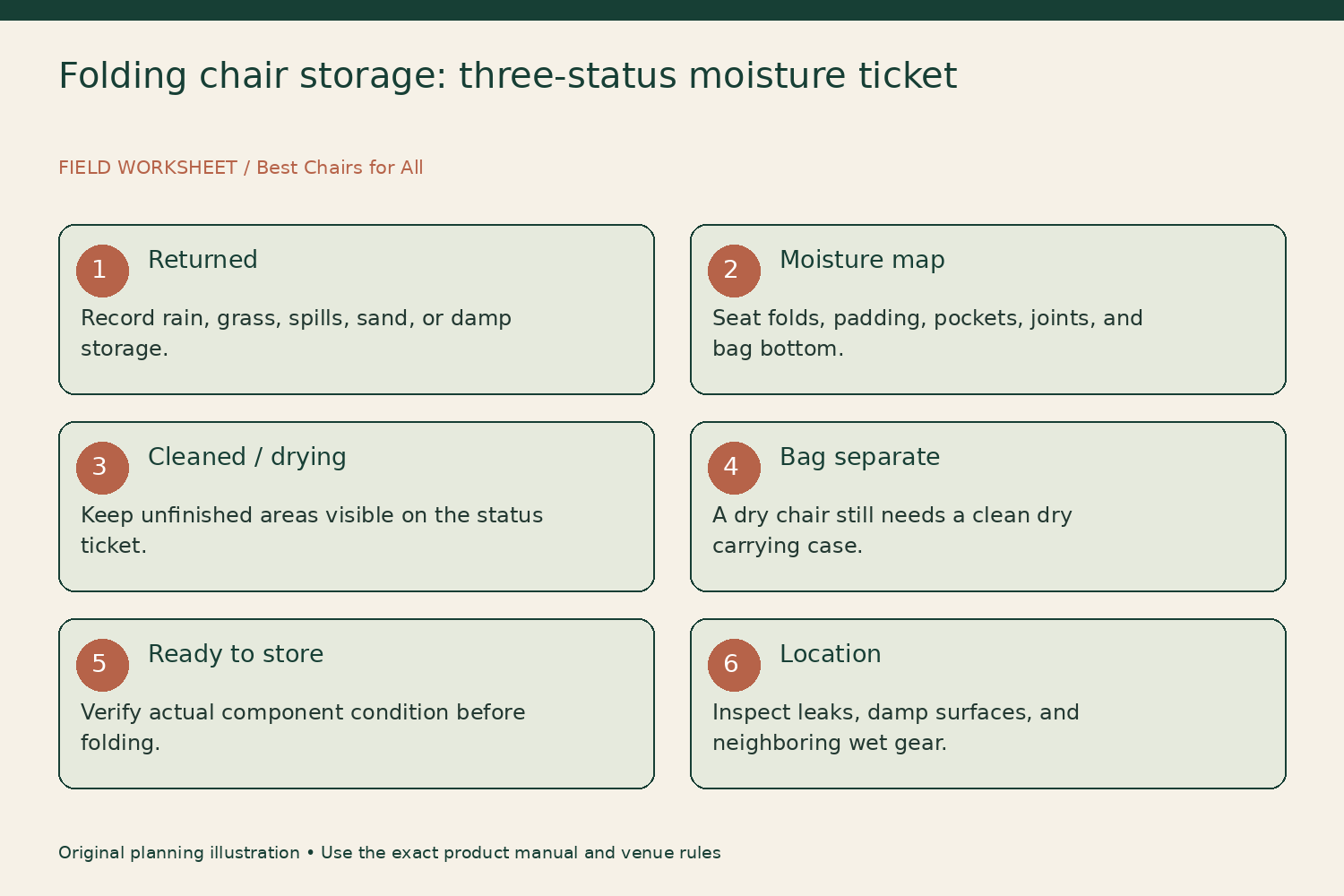
This guide provides a moisture-route map and a three-status storage system for chairs returning from rain, grass, sand, or a damp shed. It does not offer a universal drying time, chemical mildew treatment, or storage orientation. Different frames, textiles, coatings, and bags require different care. Identify the model and materials first, then use the observations below to carry out the instructions without losing track of unfinished drying.
Separate arrival, drying, and storage
Choose three statuses for each chair: returned wet or dirty, cleaned but drying, and ready for storage. Label them on a small card or in a household note. The purpose is to avoid confusing a chair temporarily leaning in the garage with one that has been checked and packed. A clear status is especially useful when another person tidies the equipment after an outing.
Plan a suitable place for the drying stage before the trip. It needs enough room for the chair in the configuration its maker permits, away from traffic and inappropriate heat sources. A narrow storage corner may suit the final folded package but provide little access for checking folds and underside surfaces. Those are different space needs, so do not expect one tightly packed shelf to perform both jobs.
Read the specific storage instruction
GCI’s product-support guidance tells owners to let wet chairs dry fully before folding and storing and notes that some components contain steel. That is a direct manufacturer example of the distinction between outdoor use and permanent exposure. Apply the relevant current instructions to your GCI model rather than assuming the same material arrangement in every folding chair.
The ALPS Brands FAQ also emphasizes appropriate drying and explains why its furniture should not be left continually exposed to weather. Read its advice for the applicable product. A chair can be intended for outdoor activities while still needing protected storage between them. The phrase ‘camping furniture’ does not establish that a cover over a damp chair is an adequate storage routine.
Make a moisture-route map
Draw the chair open and folded, then mark the places where surfaces meet: seat folds, arm sleeves, pocket bottoms, padded headrests, hinge covers, and the inside of the bag. Add likely water sources such as rain, wet grass, a damp towel, or a leaking drink. This map helps you check the concealed areas instead of repeatedly touching only the middle of the backrest.
Add the material and permitted care method beside each marked area. If the chair has a metal frame, coated fabric, plastic fittings, and a padded accessory, there may be more than one instruction to follow. Leave unknown components unresolved until the manufacturer answers. Do not choose a stronger cleaner or higher temperature simply because one area remains damp or stained longer than the rest.
Remove contents before drying
Empty storage pockets, cupholders, cooler compartments, and the carrying bag as the instructions allow. A forgotten cloth or drink container can keep a local area wet even after the main seat dries. Check under flap closures and behind removable accessories without dismantling factory components. Record a spill separately from rain exposure because it may need a different approved cleaning method.
Keep wet items from the outing away from the chair during the drying stage. A clean seat can pick up moisture again when a towel is draped over it. Likewise, a dry carrying bag can become damp if used as a temporary holder for wet footwear. Assign a separate place for those items instead of treating the chair as a convenient drying rack unless its maker expressly permits that use.
Clean only as the material allows
Remove dirt through the manufacturer’s documented method. Do not put an entire chair or its apparently removable fabric into a washing machine without permission. A seam, coating, stay, or attachment can be affected differently from a loose household textile. Follow the specified water temperature, cleaner, rinsing, and drying instructions for the actual component rather than applying a general outdoor-fabric recipe.
For another named example, the Helinox repair and care guidance describes frame cleaning and stresses dry storage for its products, including after salt exposure. Use that guidance for the relevant Helinox construction. Do not infer that a method for a collapsible anodized frame is suitable for an upholstered folding chair or a different coating whose instructions specify another treatment.
Give the bag its own inspection
Turn attention to the bag’s bottom, seams, shoulder padding, and any pocket. Follow its care label or manufacturer instructions. If it can be opened or turned out as directed, inspect the inside for dirt and moisture. Do not assume the sleeve is ready because its outer surface feels dry. A chair folded into a damp bag begins storage in contact with the condition you were trying to remove.
Keep the chair and bag statuses separate when necessary. Write ‘chair dry; bag still drying’ rather than closing the task as complete. If the original bag is damaged, ask about the correct replacement or an approved alternative. A tightly fitting replacement that compresses accessories or has an unsuitable lining can change the storage arrangement even when it appears to hold the chair neatly.
Verify dryness by area, not by the clock
Use the moisture map to check accessible components before folding. Note seams, folded layers, padding, pocket bottoms, and frame contact areas. Drying time varies with the amount of water, humidity, airflow, and material, so a fixed overnight interval is not a reliable universal rule. Follow the maker’s conditions and inspect the actual chair rather than assuming a deadline guarantees completion.
Do not use a heat gun, space heater, tumble dryer, or intense improvised heat unless the product instructions expressly permit that method. Heating can affect fabric, coatings, plastics, or adhesives. If an area cannot be dried through the approved process, ask the manufacturer how to proceed. Making the outside hot does not establish the condition of a concealed padded layer.
Fold through the intended sequence
Once the components are ready, fold the chair as instructed and place accessories in their specified transport positions. Keep fabric and straps out of hinges. A partly folded frame can create unexpected pressure points inside a bag, while a trapped wet strap can remain hidden until the next use. Do not tighten a closure beyond its designed arrangement to make a package smaller for storage.
For chairs with removable poles or legs, use only the disassembly intended for routine packing. Do not take apart a factory mechanism to create a drying route or reduce the package size. Store components together and identify them by model so similar-looking parts are not mixed later. A dry package still needs the correct components and assembly instructions to be useful on its next outing.
Assess the storage location itself
Check whether the chosen space stays dry during rain and seasonal changes. A garage floor, outdoor box, shed wall, or covered porch can have local moisture conditions different from the rest of the building. Look for leaks, damp surfaces, or wet objects stored beside the chairs. Do not assume a roof makes every corner suitable for fabric and metal furniture.
Use shelving or supports appropriate for the chair and location, following its storage instructions. Keep sharp tools, leaking containers, and corrosive materials away. Do not hang a chair by a backrest strap, accessory loop, or moving brace unless the manufacturer identifies it as a storage point. Convenient hooks in a wall do not establish that the attached chair component is intended to carry the package that way.
Avoid sealing an unresolved moisture problem
A waterproof container can keep new rain away but cannot make a damp chair dry. Do not close a wet chair in an airtight bin and regard the moisture task as solved. If the maker recommends a particular case or cover, use it as directed after preparing the chair. Covers and storage containers are parts of a system, not substitutes for the pre-storage condition the instructions require.
If the storage space is persistently damp, address the location or choose another suitable space. Adding scented products, a loose absorbent item, or an improvised chemical does not establish that the chair is dry or its materials are protected. Keep any moisture-control product separate from the furniture unless both sets of instructions allow contact. The useful question is why moisture remains present and how the documented storage conditions can be met.
Investigate recurring odor or visible growth
If a chair repeatedly smells musty or develops marks, reopen the task and document the affected area. Check the bag and neighboring stored items as well as the chair. Do not assume that a fragrance or surface wipe resolves concealed moisture. Ask the manufacturer for the appropriate cleaning and assessment process for the identified fabric, foam, coating, and frame.
Avoid a universal bleach or vinegar recipe. A treatment suitable for one material can discolor, weaken, or otherwise affect another. Keep the chair out of use if fabric strength, frame condition, or a load-bearing seam is uncertain. Persistent contamination or deterioration may require replacement of a specified component or the chair itself; cosmetic improvement alone does not establish structural condition.
Create a return-to-storage ticket
For each wet outing, record model, exposure, cleaning completed, areas still drying, bag condition, and final storage location. Add a completion date only when the chair and bag meet the instructions. This small ticket makes the process visible without creating a rigid schedule. For a household batch, use separate rows so one dry chair does not cause several damp ones to be packed away together.
Before the next trip, inspect the folded contact areas and open the chair according to its manual. Check for new dampness, transferred stains, deterioration, and correct mechanism operation. If the storage environment changed during the season, revisit the location rather than assuming the earlier completion date still describes today’s condition. The ticket is a record of preparation, not a permanent certificate.
Make dry storage easy to repeat
Keep the approved cleaner, care instructions, and status cards accessible near the drying area. Leave enough time after an outing to complete the wet-to-dry transition. A plan that depends on immediate long-term bagging is poorly matched to chairs that commonly return wet. Adjust the household routine or equipment choice so the required drying process is practical.
The key is a clear handoff from returned equipment to cleaned equipment to a verified dry package. Folding-chair storage moisture becomes manageable when the hidden contact points, carrying bag, and storage space each receive attention. Follow the product-specific methods and keep unresolved areas visible until they are addressed. A neatly packed chair should be the result of completed care, not a way to hide an unfinished drying task.
Something unclear or out of date? Send a correction with this article’s title and the detail to check.
Sources, research & corrections policy ↗