Some patio chairs can stay outside in winter under their manufacturer’s instructions; others should be covered, moved to protected storage or kept indoors. Decide by the exact chair and its components rather than by the broad labels metal, wood or plastic. A frame that tolerates winter exposure does not automatically give its cushions, hinges or finish the same permission.
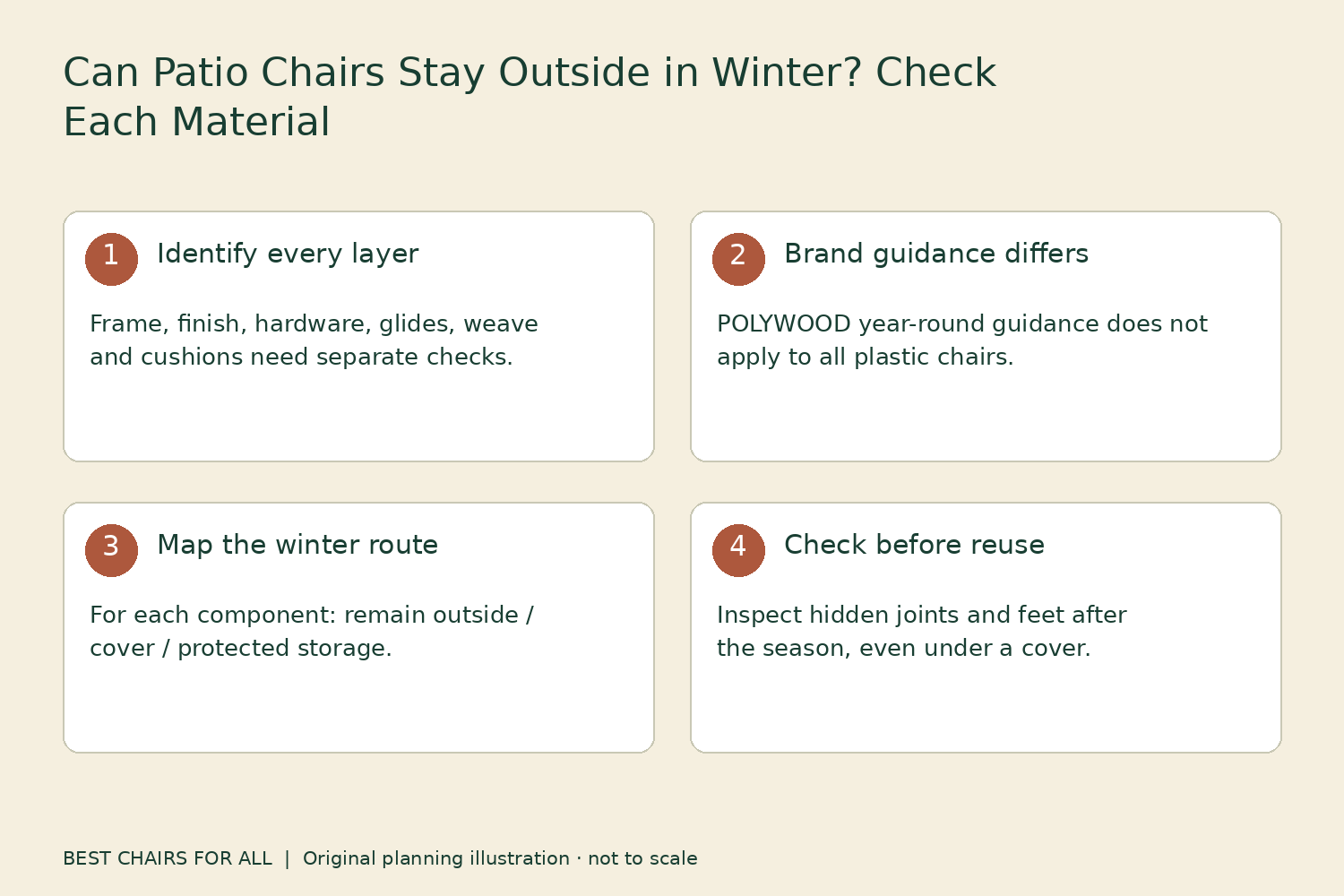
Start with the model’s care manual and list every material involved. Then consider your winter conditions: persistent rain, snow accumulation, freezing temperatures, coastal contamination or strong wind. The decision matrix below turns that information into an action for each component. It avoids a blanket promise that one material always survives outdoors without attention.
Identify the complete chair
Photograph the model label and record the frame, seat, hardware, glides, cushions and any moving mechanisms. A resin-wicker chair may have steel or aluminum hidden beneath the weave. A wooden recliner can depend on metal fittings. A polymer-lumber chair can include cushions that require separate storage. The visible material is only one part of the winter plan.
Find the manual matching the actual version. A current product with a familiar collection name may use different components from an older chair. If your chair was repaired or fitted with replacement upholstery, include those details. Do not assume new fabric or aftermarket hardware inherits every instruction from the original assembly.
Where documentation is missing, ask the maker before the winter weather arrives. Describe the local exposure and intended storage arrangement. An unidentified chair left on an exposed patio is an unresolved risk, not evidence that the material category is winterproof. A protected storage option may be the more practical choice while you establish what you own.
HDPE guidance is brand and model specific
POLYWOOD’s year-round guidance says its furniture is designed for all four seasons and does not require covers, although covers can simplify maintenance. That is explicit manufacturer support for its products. It should not be expanded into a statement about every chair sold as HDPE, poly or plastic.
Check the condition of the actual chair before leaving it outside. A missing glide, loose user-serviceable fastener or damaged hinge needs attention even if the lumber is suited to winter. Keep it on an appropriate stable surface and follow any model-specific instructions. Material durability does not make a chair a suitable load platform for stored garden equipment.
Decide whether a cover makes your own maintenance easier. A cover can reduce accumulated debris while introducing a fit and ventilation routine. Read its instructions and inspect underneath as needed. Do not treat a cover as a required chemical treatment for the polymer or assume it removes the need to check hardware and cushions.
Other plastics can have different limits
IKEA’s outdoor maintenance guide recommends covering or seasonal protected storage for its easy-care materials and specifically discusses plastic and plastic rattan that can crack in freezing conditions. This differs from the named POLYWOOD guidance and shows why the word plastic cannot supply one winter rule.
A thin molded chair, a woven polymer strand and thick assembled polymer lumber are different products. Do not infer their cold-weather behavior from appearance alone. Ask for the exact material and seasonal instructions. If the maker restricts use in freezing temperatures, storing it under a cover outside does not automatically make it suitable to sit in during a freeze.
Avoid moving a frozen or stiff component through its folding range unless the instructions permit it. Do not use force to free a mechanism or break ice from a flexible panel. If you need to retrieve seating during winter, plan a permitted storage location that makes normal handling possible. Convenience should not depend on bending cold components into shape.
Wood decisions include finish and moisture
Natural-finish teak can have a different seasonal routine from stained acacia or painted softwood. Identify the factory finish and what the maker expects you to maintain. Greying can be an intended appearance change for one product while peeling paint signals a different maintenance issue on another. Do not judge all wood by whether it still looks new.
Gloster’s teak guidance discusses natural weathering and, when furniture is stored, recommends a watertight shed or garage rather than a sudden move into a heated room. Apply that instruction to the documented teak system. It is not a reason to select a damp shed or a universal storage-temperature rule for every wooden chair.
Check where legs contact the ground and whether water remains trapped under a cushion or against the lower frame. Follow the maker’s storage orientation and cover guidance. Do not apply an arbitrary oil before winter because it seems protective. A finish treatment must match the wood and existing surface, and may be optional or prohibited for the specific product.
Metal frames require more than a rust label
Find out whether the frame is steel, iron, aluminum, stainless steel or a combination. Then inspect the coating, joints and hardware. An aluminum frame does not form iron rust in the same way as steel, but it can still have corrosion or finish problems. Fasteners can also be a different metal from the main frame.
The SunVilla Knox six-piece set manual recommends covering or dry storage during winter for its aluminum frame and provides separate cover and cushion care. This model-specific document is more useful than the broad assumption that aluminum can always be abandoned outdoors without a seasonal routine.
Look at drainage paths without altering them. Water trapped inside an incorrectly positioned hollow frame can create problems not visible from the exterior. Do not drill holes, seal openings or store the chair upside down unless the maker directs that procedure. If drainage or orientation is unclear, obtain guidance for the exact frame rather than copying a technique for a different chair.
Woven chairs need two material decisions
Synthetic wicker can be designed for outdoor use while the frame beneath it still requires coating care. Coated natural-fiber systems can have their own outdoor permissions and touch-up instructions. Indoor natural rattan remains a different category. A roof or loose cover does not convert an indoor-only product into winter patio furniture.
Inspect weave condition and frame condition separately. A split strand may be cosmetic or structural depending on the design; do not assume it is harmless because the chair still stands. Photograph damage and seek the appropriate repair. Avoid tightening loose strands or applying heat to make them flexible during cold weather.
Remove debris from intersections using permitted gentle tools. Wet leaves and dirt can remain in the weave under a cover and make spring cleaning harder. The winter decision is not only whether the material can endure cold. It also includes whether you can maintain the finished system and inspect the less-visible surfaces during storage.
Cushions get their own route
Read the cushion’s storage instructions even when the frame is approved for year-round exposure. The Knox manual recommends indoor cushion storage during inclement weather and rainy seasons. Its drying directions also distinguish opening a zipper for ventilation from completely removing the cover. That level of detail should guide the actual cushion, not a generic rule about performance fabric.
Pack only clean dry cushions into an appropriate storage arrangement. Check seams, thick filling and the underside before enclosure. A water-resistant cover fabric does not prove the internal filling is dry. Do not assume a furniture cover above the chair creates the same environment as indoor cushion storage.
Measure the complete cushion set and verify the container’s usable internal shape. Separate wet covers or dirty accessories from clean upholstery. If your only proposed location is damp, resolve that problem before the weather changes. A larger sealed box does not solve moisture already inside a cushion or repeated leaks into the storage area.
Use a component-by-component matrix
| Component | Evidence needed | Winter action |
|---|---|---|
| Main frame | Exact material and model’s exposure guidance | Remain outside, cover or store as directed |
| Finish | Condition and approved maintenance system | Clean, repair or treat only under instructions |
| Hardware and moving parts | Inspection and service requirements | Resolve damage; preserve normal operation |
| Feet and glides | Complete, secure and serviceable | Replace correctly before storage or use |
| Cushions | Fabric, filling and storage method | Dry and move to permitted storage |
| Cover | Fit, retention and ventilation | Install on a suitable dry arrangement |
Give every chair a final status rather than one status for the whole patio. A mixed furniture set can need several different routes. Keep a note of what was removed, where it went and which chair is awaiting repair. This prevents a partly dismantled chair from being mistaken for ready seating on an unexpectedly warm winter day.
Keep the storage layout usable
Leave access to doors, drains and essential routes. Do not pile chairs against a railing or stack products that are not designed for stacking. If the maker permits stacking, follow the specified arrangement and avoid trapping cushions between frames. A storage configuration needs to remain stable without relying on a cover to hold it together.
Plan for wind separately from moisture. A durable material can still form loose outdoor cargo. Follow current weather guidance and the product’s instructions for storing or securing furniture before severe conditions. Do not invent a safe wind speed from the chair’s item weight or tie it to an unsuitable part of a building.
Retain the seasonal care record so changed conditions are visible next year.
Before spring use, uncover and inspect every chair, even one that remained outdoors under explicit manufacturer guidance. Check hidden joints, feet and fabric attachments, then operate adjustments as instructed. Winter suitability means the product can be managed through that season; it does not remove the need to verify its actual condition before someone sits down.
Something unclear or out of date? Send a correction with this article’s title and the detail to check.
Sources, research & corrections policy ↗