As an Amazon Associate, we earn from qualifying purchases. Read our affiliate disclosure.
A patio swivel chair is useful when the view, conversation, and table are in different directions. The best model turns comfortably within the space you actually have and provides the kind of movement you want. Swiveling, rocking, and gliding are separate functions, so do not assume one chair supplies all three.
Our researched candidates are the POLYWOOD Braxton Deep Seating Swivel Chair 4501SV, POLYWOOD Vineyard Deep Seating Swivel Chair GNSV23, and Hanover Strathmere swivel-glider seating in the STRATH4PCSW-LS-NVY set. The first two are individual cushioned lounge chairs. The Hanover comparison is explicitly a four-piece set containing two swivel gliders, a loveseat, and a coffee table; it makes sense when furnishing a whole conversation area.
We reviewed manufacturer information November 6, 2026. We have not measured bearing friction, swivel noise, rocking travel, or long-term cushion performance. The recommendations are conditional on your fit and layout. Amazon links are exact-model searches, not confirmation of inventory or a fixed delivered price.
Choose the movement before choosing the upholstery
Swiveling changes the direction you face while the base stays in place. Rocking or gliding adds another movement that may be welcome during a conversation and less welcome during another task. Decide whether you want only rotation or a more mobile lounging experience.
Think about ordinary transitions. You might face a garden, turn toward someone at a table, then return to a view. A swivel can make those changes convenient without dragging the chair. If the patio has only one useful facing direction, the mechanism may offer less value than you expect.
A swivel is not automatically a dining chair. Deep seating, cushion compression, and relaxed back angles can place you differently from a purpose-built dining seat. If meals at a full-height table are the objective, assess that relationship separately rather than choosing a lounge chair because its arms fit under the tabletop.
Three researched seating choices
POLYWOOD Braxton 4501SV: for rotation without rocking
The Braxton Deep Seating Swivel page specifies a 28.4-inch overall width, 31-inch depth, 46-pound weight, 23-inch seat width, and 16.4-inch seat height. Its manufacturer guidance distinguishes the swivel chair from the separate Braxton rocker: this model does not rock.
It is the first candidate to try when you like a cushioned lounge seat but want rotation rather than a rocking motion. Compare where the back cushion supports you and whether the arms feel appropriately placed in your normal posture. The rigid HDPE-lumber frame and upholstered contact surfaces create two different ownership tasks.
The compromise is handling a substantial chair and providing enough clearance for its rotating frame. The listed width describes its ordinary orientation, not its maximum projected width at every angle. Do not position it tightly beside a wall or table using that number alone. Confirm the current model's user limit from its label or manual if capacity determines the purchase.
Check matching Braxton 4501SV listings on Amazon (paid link). Braxton rockers and stationary chairs are separate models.
POLYWOOD Vineyard GNSV23: for a wider lounge-frame comparison
The Vineyard Deep Seating Swivel specification lists full 360-degree rotation, a 300-pound capacity, 30-inch overall width, 31.5-inch depth, 52-pound weight, and 22.5-inch seat width. Its published seat height is 16.5 inches. These figures give you a useful comparison with the Braxton without assuming a wider outside frame creates a wider usable seat.
Choose it for consideration when its particular back shape and collection style work with your patio. Try it against the Braxton rather than ranking comfort from overall dimensions. The Vineyard's outside width is greater, while its listed seat width is slightly smaller, which illustrates why the two measurements must stay separate.
The limitation is moving a 52-pound chair during cleaning or seasonal storage. The swivel feature helps you face another direction; it does not eliminate the need to relocate the base occasionally. Plan the storage and cleaning route as part of a permanent furniture purchase.
Check matching Vineyard GNSV23 listings on Amazon (paid link). Verify cushions and exact swivel configuration.
Hanover Strathmere STRATH4PCSW-LS-NVY: for a complete swivel-glider group
The Hanover Strathmere set page identifies two swivel gliders, a loveseat, and a woven coffee table, with navy cushions and accent pillows. The manufacturer describes reinforced steel frames beneath hand-woven resin strapping and Olefin-covered cushions. This is the woven-surface alternative to the two POLYWOOD lumber designs.
Its strongest use case is a buyer who needs the complete seating group and specifically wants the gliding or rocking character alongside rotation. Assess the whole arrangement, including the loveseat and table, before comparing its price with one individual chair. A set is useful only if the additional pieces fit the space and your household.
The limitation is precisely that purchasing format. It is a weak choice when you need one replacement swivel or do not want a loveseat. Confirm exact chair specifications in Hanover's linked documentation for this SKU; do not borrow a capacity from a different Strathmere armchair or recliner.
Check matching Strathmere STRATH4PCSW-LS-NVY listings on Amazon (paid link). Confirm the entire four-piece package and selected cushion color.
A rotating-footprint exercise
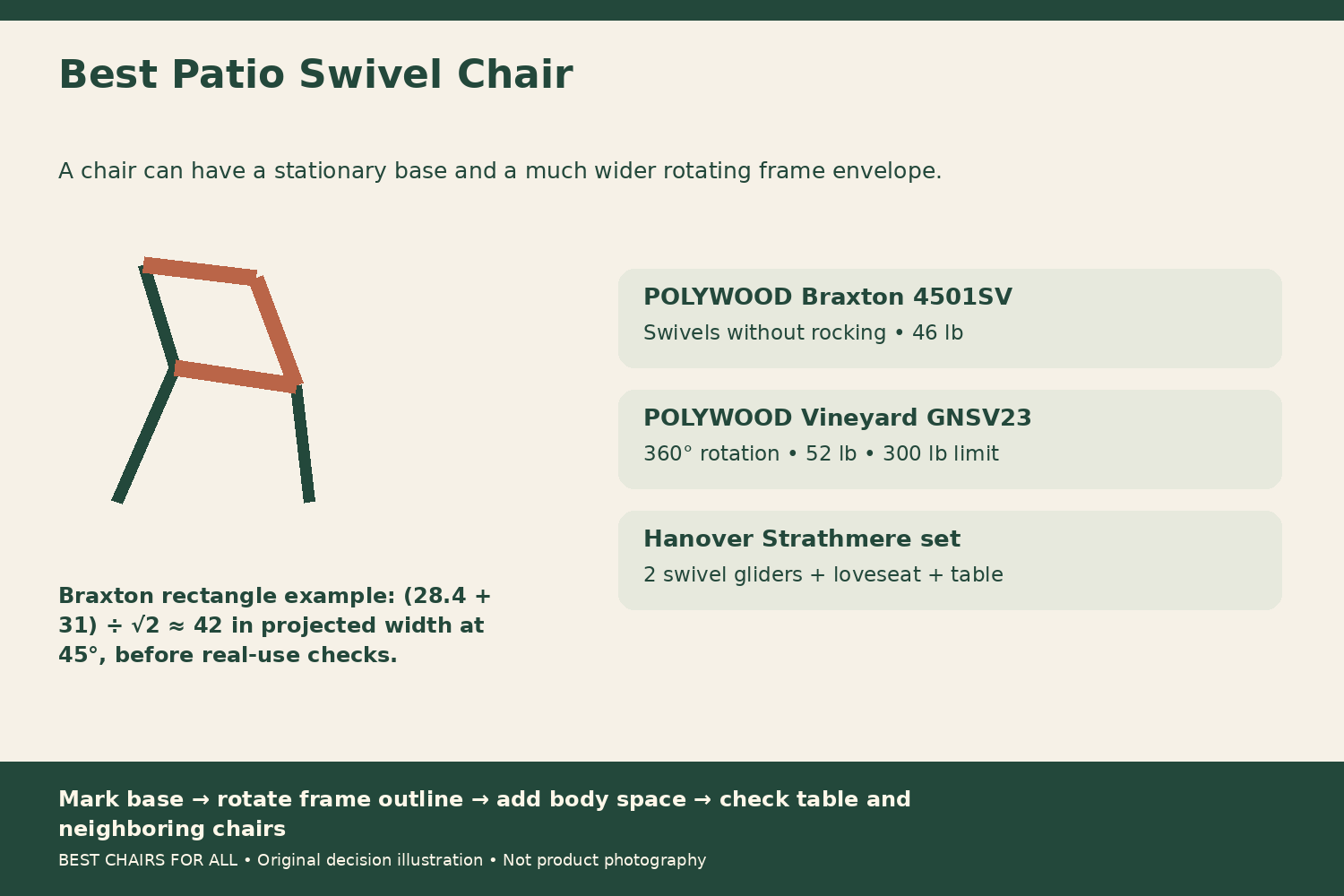
Mark the base position on a patio drawing, then outline the frame in its ordinary orientation. Now rotate a paper outline through the directions you expect to use. Watch its corners, arms, and back in relation to the table, railing, neighboring seat, and path. A stationary base can support a much larger moving outline.
The Braxton's published 28.4-by-31-inch rectangle gives a useful geometry example. At a 45-degree orientation, the rectangle's projected width is approximately the sum of those sides divided by the square root of two: about 42 inches. That is wider than its nominal 28.4-inch front-facing width.
This is a bounding-rectangle planning exercise, not the manufacturer's required clearance or proof of the actual swivel-axis location. Real frame shape, feet, cushion overhang, and your body affect the occupied area. Use the current product drawing and physically inspect the full movement before final placement.
For two chairs, rotate both outlines rather than assuming equal spacing is sufficient. One chair's back may approach the other chair's arm at a particular angle. Include the route someone uses while the other person remains seated. Do not solve a collision by limiting a chair with an improvised strap or mechanism modification.
If a coffee table is shared, check the relationship at the positions you actually use. A table that is easy to reach while facing forward may sit behind your elbow after a turn. The layout should support useful directions, not merely allow the mechanism to spin in an empty area.
Try the rotation and the seat separately
Begin with the chair assembled correctly on a suitable level surface. Sit normally and assess the cushion, back, and arms before turning. If the seat does not fit while stationary, smooth rotation is not a reason to accept the mismatch.
Then make the ordinary changes of direction you expect on the patio. Notice whether you can turn without dragging feet awkwardly or contacting nearby furniture. We have not measured the effort required, so try the exact chair rather than assuming all swivel mechanisms feel identical.
For the Hanover gliders, assess the extra movement deliberately. Try a short conversation and a reading posture. A person who enjoys motion while relaxing may feel differently when holding a book. If the chair will be shared, each user's movement preference deserves the same attention.
Check entry and exit too. POLYWOOD's Braxton guidance says swiveling is possible while stationary and in use, so do not assume the seat locks itself in one facing direction when you stand. If you need a particular transfer or support arrangement, confirm suitability individually rather than treating the swivel base as a mobility feature.
Cushions change the practical comparison
Assess the actual supplied cushions, not only the lumber or wicker frame. Cushion thickness and compression influence seated height, how far you settle back, and where your elbows meet the arms. A replacement cushion chosen only by outside width may change that relationship.
Verify whether seat and back cushions are included in the selected listing. Photographs can show a complete group while a variant selection changes upholstery or accessory inclusion. Keep a record of the fabric and cushion identifiers if maintaining a coordinated patio matters later.
Follow the maker's cleaning instructions for the exact fabric. Do not assume a visible zipper makes a cover machine washable or removable for ordinary laundering. POLYWOOD's product guidance includes specific cleaning and air-drying advice; use the current directions for your supplied upholstery rather than a generic outdoor-cushion recipe.
For Hanover, distinguish the woven resin surface from the cushion and underlying steel frame. Each part can need a different cleaning or drying step. The phrase all-weather furniture does not mean every layer can be left wet and covered indefinitely.
Choose useful facing directions
Draw arrows toward the garden view, conversation partner, and any screen or dining area you intend to face. A full rotation matters less than whether those particular directions remain comfortable and unobstructed. If turning toward one feature places bright light in your eyes or points you away from the shared table, adjust the seating location before treating the swivel as the solution. This direction map helps distinguish a functional reason to buy the mechanism from simply liking a moving chair in the showroom.
Keep the mechanism's service path simple
During routine cleaning, inspect the visible base and connections without disassembling the swivel. Remove loose debris by the method the manufacturer permits. If motion becomes irregular, noisy, or loose, contact the brand with the model identifier rather than spraying an unapproved product into a bearing or tightening concealed parts at random.
Consider access for that inspection when placing the chair. A base hidden tightly between heavy furniture may make ordinary care inconvenient. The same placement can complicate moving the chair for a patio wash, so include the cleaning route in your drawing.
Use protective covers and seasonal storage in ways compatible with the actual furniture. A cover must fit the chair's rest position and allow the care routine the maker recommends. Do not assume the product's maximum rotating envelope is also the correct cover size.
Choose the directions you want to use
Start with the Braxton when rotation without rocking suits your preference, compare the Vineyard for its different frame and seat geometry, and investigate the Strathmere group when swivel gliders and the full conversation set are wanted together.
Confirm exact SKU, upholstery, quantity, delivery placement, and return freight before ordering. We have not validated a fixed delivered price across every finish or bundle. The useful result is a chair that fits your body and turns through the directions your patio actually needs, with enough surrounding space for the entire movement.
Something unclear or out of date? Send a correction with this article’s title and the detail to check.
Sources, research & corrections policy ↗