As an Amazon Associate, we earn from qualifying purchases. Read our affiliate disclosure.
The best outdoor rocking chair depends on whether you want furniture that stays on a porch or a chair that goes back into the car. For a permanent, traditional setup, the POLYWOOD Presidential Rocking Chair is the first model to investigate. The Trex Yacht Club Rocking Chair offers a similar outdoor-furniture approach with different seat and arm dimensions. For transport and occasional storage, the GCI Outdoor Freestyle Rocker solves a different problem with a folding frame and spring-assisted movement.
These are research-based recommendations, based on manufacturer specifications reviewed November 6, 2026. We have not performed comparative sitting, weathering, or durability tests. A model that fits your porch can still fail your body-fit check, and a model that fits your body can still leave too little room for a doorway. Treat those as separate decisions.
The three models and their strongest uses
POLYWOOD Presidential Rocking Chair R100: for an established porch seating area
The Presidential R100 manufacturer page lists HDPE lumber, a contoured seat, a 300-pound capacity, and a 37-pound chair weight. Published seat dimensions are 20 inches wide, 18.6 inches deep, and 16.1 inches high. These are useful starting measurements for a porch rocker that will usually remain in one place.
The important tradeoff is that a substantial outdoor frame also becomes a substantial object to move. Carrying several rockers into storage is a different job from folding one sports chair. Its rigid seat makes the contours worth trying rather than assuming a cushion will correct every mismatch. A cushion also changes effective seat height and can reduce how much backrest remains above your shoulders.
Choose it when you want the traditional appearance and can provide a permanent level location. Pass when you need frequent trunk transport, cannot comfortably manage its weight, or find the seat depth excessive. The manufacturer's current dimensions should take priority over older retailer descriptions that may show a different height.
Check matching Presidential R100 listings on Amazon (paid link). This is a model search, not a verified offer or price comparison.
Trex Yacht Club Rocking Chair TXR100: for comparing arm and seat geometry
The Trex Yacht Club product page lists a 300-pound capacity and 37-pound weight. Its seat is specified as 20 inches wide, 19 inches deep, and 17 inches high, with a 25.8-inch arm height. The dimensions make it a useful alternative when the Presidential's lower seat or arm position does not suit you.
These small differences matter more than the shared traditional silhouette. A higher arm can improve how your forearms rest but can also interfere with a table edge. A deeper seat can suit a longer thigh while encouraging a shorter person to slide forward. Neither effect is guaranteed from measurements; they identify what to check during a showroom trial.
Choose the Yacht Club when its dimensions and finish options fit an existing porch arrangement. Skip it if your main goal is compact storage. Trex's page also cautions in its customer guidance that sliding furniture can scratch composite decking, so examine the actual floor and contact points rather than treating the shared brand name as automatic surface compatibility.
Check matching Yacht Club TXR100 listings on Amazon (paid link). Compare the exact model and selected color before ordering.
GCI Outdoor Freestyle Rocker: for a chair that travels
The GCI Freestyle Rocker page describes a powder-coated steel frame, padded arms, a mesh back, a beverage holder, and spring-loaded rocking technology. The current manufacturer page selected in Black, SKU 37010-GCIO001, lists a 250-pound capacity and a 12.1-pound item weight (5.5 kilograms). These figures refer to that selected configuration; confirm the exact version when a retailer shows different measurements.
Its purpose is portable outdoor relaxation on a flat surface. The folding format makes it a sensible candidate for someone who wants a rocker at home and at a campsite without purchasing two bulky furniture pieces. The spring mechanism provides motion differently from the long curved runners on a porch rocker, so try the movement instead of expecting a wooden-rocker sensation.
Choose it when carrying and storage outweigh the appeal of permanent furniture. Pass if the capacity does not suit you, if you require a rigid sculpted seat, or if you want the chair to live outdoors without attention between uses. Folding fabric furniture still benefits from a dry storage routine.
Check matching GCI Freestyle Rocker listings on Amazon (paid link). Freestyle, Freestyle XL, and side-table editions are separate variants.
A porch-space worksheet you can actually use
Start by drawing the usable porch rectangle. Exclude the door swing, stair approach, planters, and any route that must remain open. Measure to the obstacle that matters, such as the nearest railing projection, rather than to the building wall behind it. A photograph tends to hide these awkward intrusions.
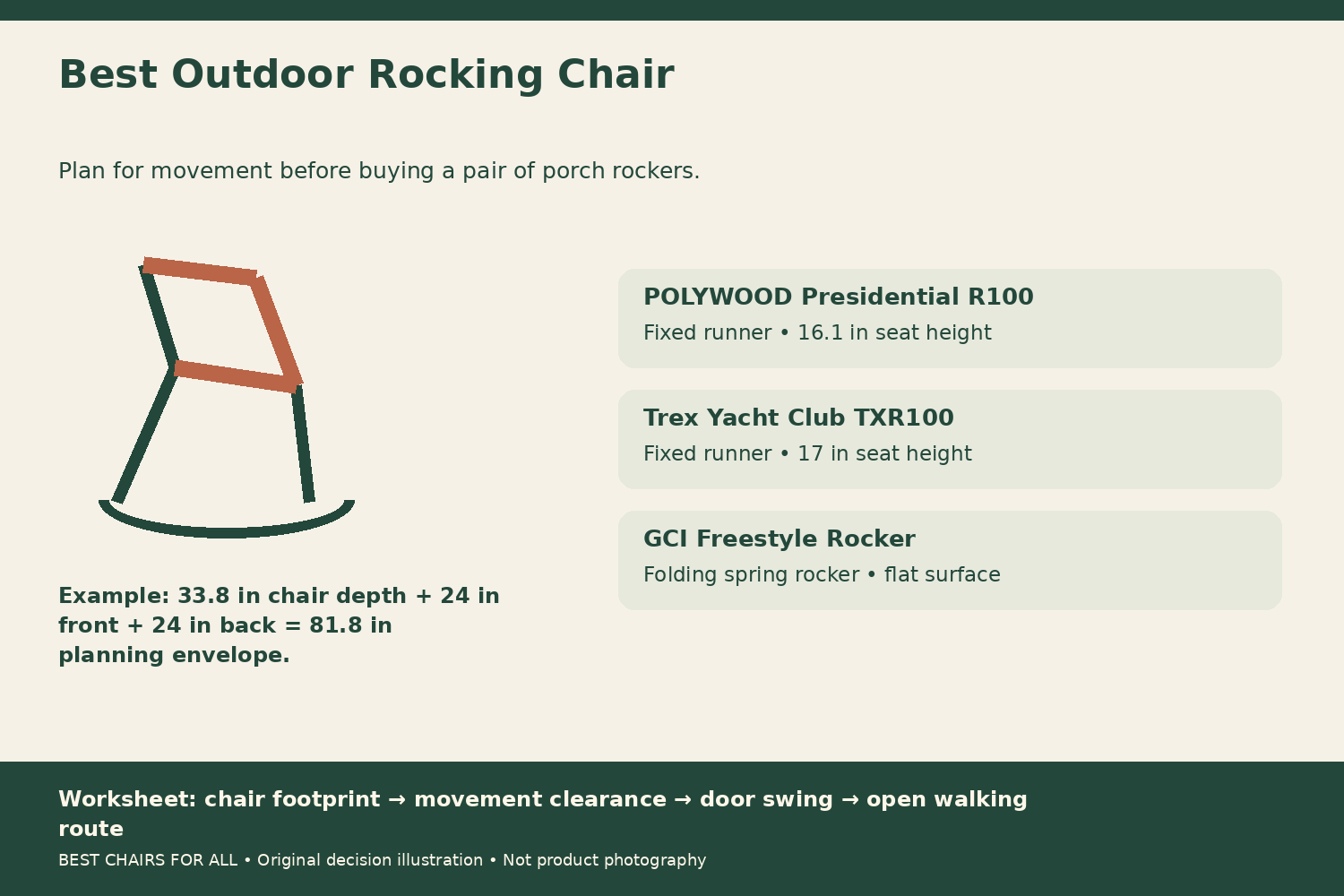
For a fixed runner rocker, outline the manufacturer's overall width and depth with tape. Then add the specified movement clearance. Both the Presidential and Yacht Club pages recommend two to three feet in front and behind. This recommendation is larger than many people expect from the chair's still footprint, and it is a strong reason to plan before ordering a pair.
Here is a worked example using a 33.8-inch overall depth and the lower end of that manufacturer recommendation. Adding 24 inches at each end creates an 81.8-inch planning envelope. Using 36 inches at each end creates 105.8 inches. These are arithmetic planning examples, not alternative product dimensions or a guarantee that every user rocks through the same distance.
Next draw the chair beside any side table. Keep the table where your hand can reach it without leaning across a runner, and check its position through the full motion. Do not tuck a table into the arc simply because it fits while the rocker is upright. Also check the space behind the backrest at the most reclined point.
For a spring rocker, use its own open footprint and operating instructions instead of importing a runner-rocker clearance figure. Mark the expected movement and access area, place an existing chair inside that outline, and walk the route while carrying a tray or opening the door. The purpose is to discover conflicts while tape is still the only thing on the floor.
Record four results: usable rectangle, chair outline, movement envelope, and remaining walking route. If one of those is unknown, pause the purchase until it is measured. Do not solve a cramped porch by reducing a maker's recommended clearance.
Check body fit before choosing a finish
Measure a familiar chair that feels comfortable. Record its seat height at the front, usable width between the arms, and depth from the front edge to the back support. Overall chair width is not the same thing as usable seat width. A wide-looking frame can still constrain hips or forearms.
At the trial sit, place your feet naturally and let your shoulders settle. Notice whether you can contact the back without the front edge pressing behind your knees. Reach for both armrests. Try standing after several minutes, with the rocker settled and following the manufacturer's instructions. A chair that only feels easy during a quick sit may reveal a mismatch once you relax into it.
If you expect to use a cushion, test the cushion too. Its thickness raises you above the original seat and changes the relationship between your elbows and the arms. Ties should be appropriate for the chair and kept clear of moving parts. An attractive universal cushion can be a poor match for a contoured seat.
For a shared porch, prioritize the person who has the fewest comfortable alternatives. Two identical chairs create visual balance, but two different seat geometries may create a more usable space. Matching color is optional; dependable fit is the practical requirement.
Weather exposure and realistic upkeep
The POLYWOOD page specifies cleaning its lumber with soap, water, and a soft-bristle brush. Follow that material-specific guidance rather than transferring an abrasive treatment from a painted wood chair. Outdoor durability claims do not mean that dirt, salt deposits, or residue should be left indefinitely on hardware and joints.
For the folding GCI chair, consult the maker's support instructions for fabric and mechanism care. Let it dry before storage. A damp folded seat creates a different environment from an open seat that drains and receives airflow. If a mechanism develops resistance or damage, contact the manufacturer instead of modifying springs or drilling replacement mounting holes.
Consider seasonal logistics during the purchase. Decide where cushions will dry, where the folding frame will hang or stand, and how a rigid rocker will be protected when it is not in use. A storage plan that requires moving a heavy grill every evening is unlikely to survive the first busy week.
Wind deserves its own plan. A heavy chair is still furniture that may move in severe weather, and cushions can leave before the frame does. Follow local weather advice and store or secure items using methods the furniture manufacturer permits. Do not treat a general all-weather description as an anchoring specification.
What to compare at checkout
Compare the exact model, quantity, finish, assembly requirement, delivery method, and return costs. A chair price and a two-chair set price are easy to confuse in search results. Some colors may have different prices or lead times. This guide makes no fixed budget promise because retailer totals change and Amazon search links do not verify a particular seller's inventory.
Read the return policy before assembly, especially for large rigid furniture. Determine whether the seller accepts an assembled chair, who pays freight, and what packaging must be retained. Keep the box until you have verified the model and inspected the parts. Photograph shipping damage before discarding packaging.
If ordering replacement hardware or cushions later, use the model identifier from your own chair and receipt. Similar collection names do not establish interchangeability. The same habit helps when a retailer title combines several variants under one listing.
Questions that often decide the purchase
Can a porch rocker work on gravel? The runner needs a surface on which it can move predictably. POLYWOOD's page notes that pea gravel may not damage its chair but is unlikely to provide much rocking motion. A level hard surface is the more practical starting point; do not select a runner rocker expecting it to correct unstable ground.
Is a portable rocker a patio-furniture replacement? It can be, if you value folding and will store it appropriately. It is less convincing when your priority is a rigid sculpted seat, coordinated furniture, or leaving the entire setup outside between visits.
Should you buy the higher-capacity model automatically? Capacity is a required limit, not a comfort score. Once every user is within the published limit, examine seat geometry, arms, motion, and storage. Extra capacity alone does not tell you whether your feet reach comfortably or whether the porch door opens.
For a permanent porch, begin with the Presidential and compare the Yacht Club's fit. For transport, begin with the Freestyle. Make the final choice only after the movement envelope, seated fit, and storage plan all pass.
Something unclear or out of date? Send a correction with this article’s title and the detail to check.
Sources, research & corrections policy ↗