As an Amazon Associate, we earn from qualifying purchases. Read our affiliate disclosure.
The best outdoor dining chair should work during a meal, when someone pulls it out, and when the table needs cleaning. Those demands are different from choosing a lounge chair for a quiet corner. Backrest angle, arm clearance, usable space between table legs, and the daily handling routine determine whether an attractive dining set is pleasant to use.
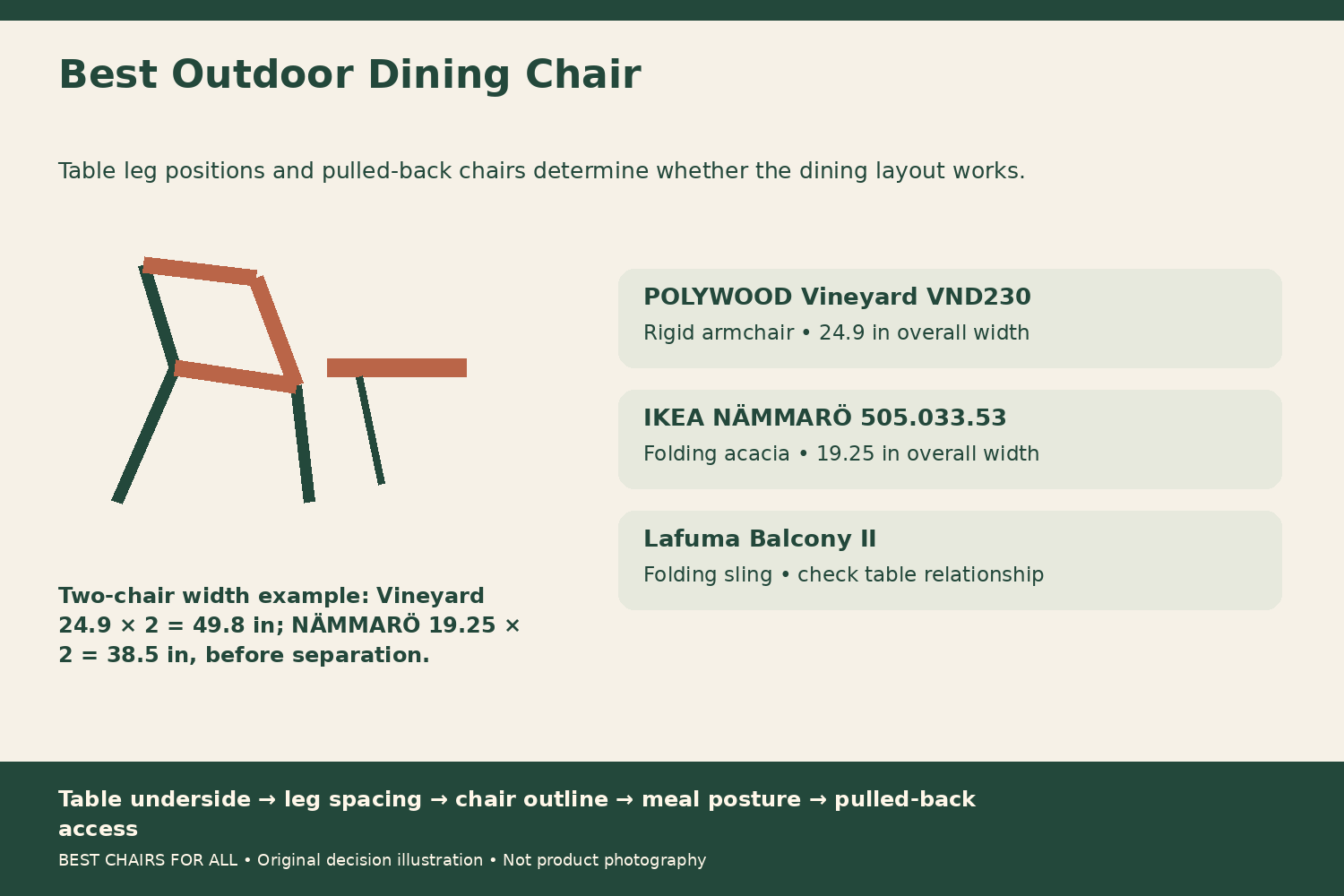
This guide compares the POLYWOOD Vineyard Dining Arm Chair VND230, IKEA NÄMMARÖ folding outdoor chair 505.033.53, and Lafuma Balcony II Colorblock Batyline Iso. The Vineyard is the permanent armchair candidate. The NÄMMARÖ is the solid-acacia folding option. The Balcony II is the folding sling alternative when a wood seat is not the preferred surface.
Recommendations are based on manufacturer information reviewed November 6, 2026. We have not performed food-stain, assembly, comfort, or weathering tests. We make no fixed price promise, and an Amazon search link does not establish current inventory or a verified delivered offer. Match the exact model before comparing any specifications.
Start with the table you actually have
Measure the distance between the table legs at the points where a chair must enter. Look beneath the top for an apron, diagonal brace, stretcher, or pedestal base. These details can interfere with arms, knees, and chair legs even when the outside table dimensions appear generous.
Write the intended seating positions on a drawing. A table advertised for six does not mean six of every available chair will fit comfortably. The usable arrangement depends on the table construction, chair width, and how the end positions interact with the side positions.
Then choose the role of arms. Arms can provide a comfortable place to rest between courses, but they may prevent a chair from tucking under a low apron. An armless folding chair can simplify storage and side-by-side placement while offering a different seated experience. Treat this as a functional choice rather than a decoration rule.
Three outdoor dining chairs worth comparing
POLYWOOD Vineyard VND230: for a permanent armed place setting
The Vineyard Dining Arm Chair specification lists a 19.3-inch seat width, 17-inch seat height, 24.5-inch arm height, 26-pound chair weight, and 300-pound capacity. Its overall width is 24.9 inches. The HDPE-lumber construction is relevant when you want a substantial rigid dining chair rather than a fabric seat.
It is the candidate to investigate when meals outdoors are frequent and you have room for the chairs to remain beside the table. Try how the seat supports you while reaching a plate, not only how it feels when leaning back after dinner. A dining chair should support the activity at the table as well as the pause between meals.
Its limitation is the combination of arm clearance and handling weight. POLYWOOD says it is designed to tuck beneath its own dining tables, but that does not establish fit beneath an unrelated table's apron. Moving several 26-pound chairs for sweeping is also a real part of ownership.
Check matching Vineyard VND230 listings on Amazon (paid link). Counter-height and bar-height chairs are not equivalent matches.
IKEA NÄMMARÖ folding chair 505.033.53: for extra places and solid wood
The IKEA US NÄMMARÖ page identifies solid acacia with acrylic stain and a folding frame intended for convenient storage. It lists a 17.75-inch seat height, 17.375-inch seat width, and a tested-for figure of 243 pounds. Its 19.25-inch overall width provides a useful comparison with the Vineyard's wider armed frame.
Choose it for consideration when dining attendance varies and extra chairs need to store between gatherings. A wood seat also creates a different contact surface from the Balcony II sling. If you add a pad, evaluate the complete combination at your table instead of assuming it leaves the seated relationship unchanged.
The compromise is wood care. IKEA recommends regular cleaning, protection from unnecessary exposure, and periodic restaining to prevent drying and moisture penetration. That is a different maintenance commitment from HDPE lumber. Select it because you want the wood-and-folding combination and accept that routine, not because outdoor furniture is assumed to need no attention.
Search matching IKEA NÄMMARÖ 505.033.53 listings on Amazon (paid link). IKEA is the primary source; an Amazon match is not guaranteed.
Lafuma Balcony II Batyline Iso: for a folding sling seat
The Balcony II manufacturer page describes an open-weave Batyline Iso seat, steel-tube construction, slightly inclined back, and a folding arrangement secured by a sliding ring. It is worth comparing if you prefer a sling to a hard seat and need chairs that can clear the dining area after use.
The dining question is how the seat feels when you sit toward a table. A fabric seat can support the body differently from a rigid slatted surface. Try a normal meal posture with feet resting comfortably and shoulders relaxed. Do not select it solely because it folds into an appealingly compact shape.
Its limitation is the need to match current model dimensions and user limits from its own documentation. We do not borrow a capacity from a Lafuma recliner. Check the exact chair, including the folding lock and underside shape, against the table before buying several for a permanent group.
Check matching Lafuma Balcony II listings on Amazon (paid link). A replacement sling or a bistro set is a different purchase.
A six-place layout worksheet
Draw the table legs, then place chair outlines at the intended six positions. Start with outside chair width rather than seat width. For illustration, two Vineyard chairs placed along one side occupy a nominal 49.8 inches before any space between them. Two NÄMMARÖ folding chairs occupy a nominal 38.5 inches by the same simple width addition.
That calculation does not prescribe a spacing standard or establish comfort. It shows why selecting a chair can change whether a table arrangement works. Add the practical separation needed for your users, arms, table construction, and movement. Do not squeeze six places onto the drawing simply because the product title says six-person table.
Now sketch the chairs pulled back for standing. Check the wall, railing, door swing, grill access, and adjacent furniture. A layout that fits only with all seats pushed in is an incomplete dining plan. Preserve the routes people actually use while others remain seated.
At each end position, check how the table leg or pedestal meets the chair's leg path. An end chair can fit in the empty space but still leave little room for the user's knees. Try those end positions explicitly rather than assuming the side-seat trial applies everywhere.
Label every measurement as published or measured. Use published dimensions for initial outlines and verify critical clearances at the actual table. Photography can suggest a relationship, but it cannot establish whether your particular apron or brace sits where an armrest needs to pass.
Build a meal-posture trial
Place a plate or an equivalent cool, empty object on the table. Sit in the candidate chair as you would during a meal. Check whether you can reach the ordinary eating area without sliding to the edge, lifting your shoulders, or leaning around a table obstruction.
Then rest between courses. If arms are present, notice whether your forearms settle comfortably and whether the armrests interfere with moving nearer the table. If the chair is armless, check whether you still have the support you want for a longer gathering. Neither arrangement is automatically better for everyone.
Try standing and sitting with a neighboring chair occupied or represented by an outline. Dining chairs are rarely used alone in the middle of an empty patio. The ability to leave without moving another person's chair is part of the fit assessment.
If pads will be used, repeat with the intended pad. Its thickness raises the seated body relative to the tabletop and can change how much of the backrest supports you. Ties should suit the chair and remain clear of folding joints. A universal pad is not guaranteed to reproduce the manufacturer's original seated arrangement.
Cleaning after meals without mixing material instructions
For the Vineyard's lumber, use the cleaning method supplied by POLYWOOD, which includes soap, water, and a soft-bristle brush. Do not assume a solvent suitable for a metal table is appropriate for the chair. Address residue around joints and slats according to the maker's guidance.
For NÄMMARÖ, IKEA specifies a mild soapy solution followed by wiping dry, along with periodic restaining and protected storage where practical. The manufacturer suggests restaining, for example, once or twice a year; actual timing should follow the chair's condition and current instructions. Do not substitute an unrelated furniture oil simply because the chair is wood.
For Balcony II, follow Lafuma's soapy-water guidance for Batyline and the instructions for the steel frame and folding parts. Keep the seat and mechanism free of meal debris before folding. A fabric described as draining still needs appropriate cleaning and drying before extended storage.
Make the cleaning routine visible in the buying decision. A chair used daily beside food needs a routine you can maintain, not only a material claim you like. If moving every chair is required to clean underneath, assess that movement with the person who will actually do it.
Permanent places, occasional guests, and mixed sets
A useful outdoor dining arrangement may combine permanent armchairs with folding extra places. If you do this, compare seated heights and table relationships rather than matching color alone. Two chairs that look coordinated can place diners at noticeably different levels.
Store guest chairs where they are easy to retrieve and correctly deploy. Check every folding lock before use and keep the instructions for the exact model. Avoid making an occasional guest seat so inconvenient to assemble or reach that it is replaced by an unsuitable improvised stool.
For a large purchase, test one chair first when practical and the seller's terms permit. A single fit trial can reveal table-apron interference, an uncomfortable seat edge, or a storage problem before the same issue is repeated across a complete set. Inspect assembly and finish quality without claiming the trial proves long-term durability.
Keep an uneven patio surface out of the table-clearance calculation until it is measured at the actual chair position. Nominal dimensions assume a relationship that paving joints and slopes can change.
Make the dining function decide
Begin with the Vineyard for a permanent rigid armchair, NÄMMARÖ for a folding acacia guest-seat arrangement, and Balcony II for folding sling seating. Let the table drawing and meal trial decide which one serves your ordinary meals.
Check model numbers, chair quantity, pad inclusion, assembly requirements, and return shipping before paying. Different finishes and sellers can change the delivered total, so this guide does not attach an unverified budget label to any candidate. A comfortable place at the table is the outcome to buy; a coordinated photograph is only the starting idea.
Something unclear or out of date? Send a correction with this article’s title and the detail to check.
Sources, research & corrections policy ↗