As an Amazon Associate, we earn from qualifying purchases. Read our affiliate disclosure.
For a small nursery, compare the DaVinci Olive for a narrow two-piece station, the DaVinci Gabby for chair-only gliding, and the Babyletto Kiwi when an integrated footrest is worth reserving a longer operating zone. The best option is the one that preserves adult fit and a clear route through the room in use. A small upright rectangle is only the beginning of that decision.
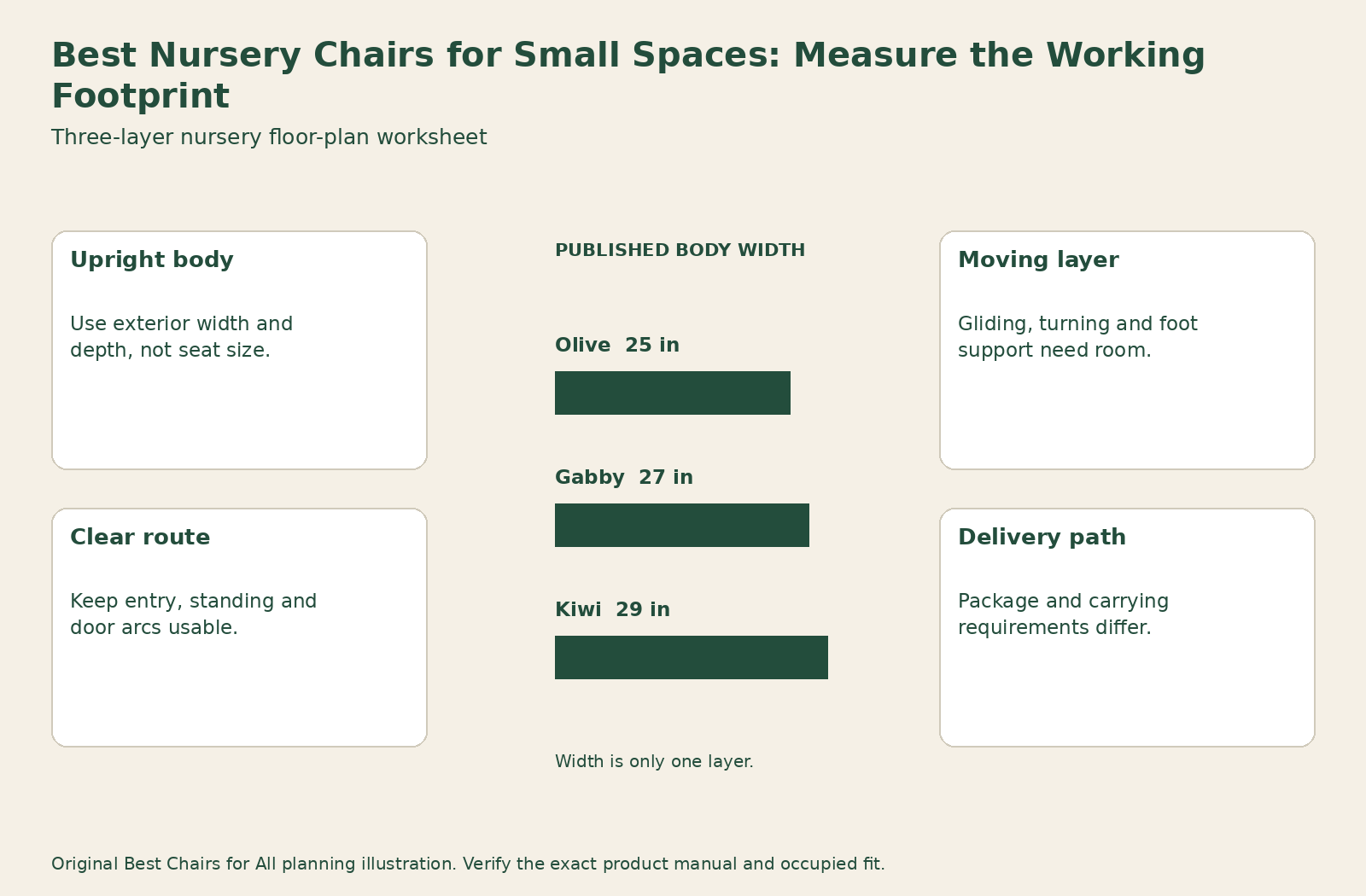
We checked manufacturer dimensions on November 6, 2026 and used them to build this layout comparison. We have not measured actual movement envelopes or tested these chairs in a room. The accompanying diagram is a planning aid rather than a scaled product drawing. Amazon links search matching names; the correct upholstery, base, version, and delivery configuration still need confirmation.
These chairs are for awake adult caregiving, not infant sleep. If there is any chance you may fall asleep while feeding, avoid an armchair or couch and follow NICHD safe-sleep guidance. Move a sleeping baby to an appropriate separate infant sleep space; a reclined nursery chair is not that space.
Make three floor-plan layers
Start with fixed furniture, doors, windows, heaters, and the route you need to keep open. Mark the crib or bassinet as a separate sleep space with the clearances required by its own instructions. Do not allow a chair’s movement to push supplies, cords, or adult comfort accessories into that space. A chair should fit around the nursery’s essential functions rather than displace them.
The second layer is the chair in its normal upright position. Use the manufacturer’s overall width and depth, not seat width. The third layer is occupied movement: gliding, turning, deployed foot support, and the adult’s path into and out of the seat. Keep these layers visually different on paper. Only the first two can be drawn from a simple product table; the last needs guidance and an actual movement check.
Compare these verified starting rectangles
The DaVinci Olive Glider and Ottoman is listed at 25 inches wide by 31.5 inches deep, plus its separate ottoman. The DaVinci Gabby Pillowback Swivel Glider is 27 by 33.5 inches. The Babyletto Kiwi Electronic Recliner and Swivel Glider is 29 by 38 inches upright and has a published 64-inch extended length. Those values screen possible positions; they are not manufacturer permission to place a moving chair against a wall or another object.
A width difference can matter more than a floor-area calculation if the room has a narrow passage. Conversely, a slightly wider chair can work better if it removes a separate ottoman from the circulation route. Compare the shape that the room can accommodate rather than multiplying width by depth and choosing the smallest resulting number. A single area figure loses the direction in which space is needed.
Three different small-room strategies
1. DaVinci Olive Glider and Ottoman
Best for: a narrow chair body with a separately planned foot zone.
Olive is the narrowest furniture body in this comparison at 25 inches, which makes it the first shape to mark on a tight floor plan. It also has the shortest published upright depth here at 31.5 inches. Those dimensions can preserve a side route beside the seat when a wider recliner would be awkward.
The included ottoman changes the calculation. You need to place a second piece that is 20.6 inches long and 17.5 inches wide, with room for the adult’s preferred leg relationship and a clear way to stand. It is not enough to draw the chair rectangle and count the remaining floor as free. Olive can be compact in width while still using substantial forward space.
Product Details
| Brand | DaVinci |
|---|---|
| Dimensions | 31.5 in deep × 25 in wide × 39.25 in high |
| Seat | 21.25 in deep × 19.5 in wide; 20 in high |
| Back above seat | 24 in |
| Ottoman | 20.6 × 17.5 × 16.25 in |
| Motion | 360-degree swivel and gliding; separate included ottoman |
Pros
- Smallest listed chair width of these candidates.
- Separate foot support can be repositioned for the actual layout.
Cons
- Two-piece use needs more planning than the chair footprint suggests.
- The 19.5-inch seat width can limit adult fit despite room savings.
Choose Olive when the narrow body improves the room and you can give the ottoman a useful position that does not block access. Do not keep the foot piece in a doorway merely because it matches the chair.
2. DaVinci Gabby Pillowback Swivel Glider
Best for: a chair-only glider layout.
Gabby offers a useful middle shape: 27 inches wide and 33.5 inches deep, with no integrated reclining footrest specified. It is a candidate for someone who wants gliding without reserving a recliner’s extended leg-rest zone. Its pillowback and 41.25-inch overall height should be judged separately from its floor use.
At 19.5 inches, the published seat width matches Olive rather than giving a wider adult area. Its 20-inch depth is shorter, which may matter to fit more than the two-inch difference in exterior width. If you later add an ottoman, redo the floor plan from scratch; a chair-only recommendation should not quietly inherit a two-piece footprint.
Product Details
| Brand | DaVinci |
|---|---|
| Dimensions | 33.5 in deep × 27 in wide × 41.25 in high |
| Seat | 20 in deep × 19.5 in wide; 20.25 in high |
| Back above seat | 27.5 in |
| Motion | Swivel and gliding; no built-in reclining footrest |
Pros
- No deployed reclining length needs to be accommodated for its stated function.
- Shorter seat depth than the other two candidates.
Cons
- Still needs room for normal swivel and gliding.
- Adding foot support later can consume the space you intended to save.
Gabby is the most straightforward candidate here when you deliberately want a chair-only station and its seat fits. It is a weaker choice if you already know you need a footrest but have not reserved room for one.
3. Babyletto Kiwi Electronic Recliner and Swivel Glider
Best for: an integrated footrest when full operating room is available.
Kiwi can make sense in a small nursery that has a long clear zone but limited width. Its 29-inch body is wider than Olive or Gabby, yet its integrated footrest can close into the chair instead of requiring ottoman storage. This is a different space-saving strategy, not proof that the chair uses less space overall.
The key number is its 64-inch fully reclined length against a 38-inch upright depth. Your plan must account for the extended arrangement and the manufacturer’s clearances, as well as a reachable outlet. A short corner that fits the closed chair can still fail immediately when the leg rest opens. Its 270-degree swivel also needs a motion check around nearby furniture.
Product Details
| Brand | Babyletto |
|---|---|
| Dimensions | 38 in deep × 29 in wide × 41 in high |
| Seat | 22 in deep × 21.75 in wide; 20.25 in high |
| Back above seat | 25.5 in |
| Fully reclined length | 64 in |
| Motion | Power recline; 270-degree swivel; glides upright |
Pros
- Retracting foot support avoids a separate loose floor piece.
- A 29-inch exterior is a clear screening dimension.
Cons
- Largest listed upright depth and an extended 64-inch length here.
- Requires cord placement outside moving and walking areas.
Keep Kiwi only if your drawing shows usable extended space and a clear exit in the positions you need. Reject it when the only way to fit it is to stop the mechanism against another piece of furniture.
Work through a constrained corner
Imagine a hypothetical clear zone that is 36 inches wide and 72 inches deep before accounting for any product-specific clearances or exit route. Olive’s chair body would leave eleven inches of nominal width, Gabby nine, and Kiwi seven. None of those remainders is an approved passage or safety margin. They simply show why you must draw the actual route and consult the product instructions rather than treating a subtraction as a clearance standard.
In depth, Kiwi’s 64-inch listed extended length leaves eight inches within that hypothetical 72-inch zone before other needs. That may be insufficient for the layout once wall clearance and movement are considered. Olive’s 31.5-inch chair plus a 20.6-inch ottoman totals 52.1 inches if the pieces were aligned end-to-end, but the adult’s desired gap and gliding motion are still missing. The arithmetic is a warning against assuming either arrangement automatically fits.
Measure clearance behind a nursery glider through its full movement before deciding that a compact stationary footprint solves the room layout.
Gabby does not have that same deployed footrest requirement, but the adult still needs feet, movement, and an exit. A chair-only layout can be the more coherent choice when the extra support is not necessary. If the adult cannot sit comfortably without a separate foot support, however, the smaller drawing is not a successful solution. Room fit and body fit have to pass together.
Check turning near real objects
Do not draw a generic swivel circle from half the overall width. The pivot location and shape of the chair affect which corners sweep outward, and a published swivel angle does not provide that full geometry. Ask the manufacturer for relevant placement information and make a controlled empty-chair check after assembly. Keep furniture and people clear while you learn the intended motion.
Pay attention to the side table. A surface that is convenient when the chair faces forward may obstruct the arm when it turns. Keep it outside the moving envelope and within an ordinary useful reach. Likewise, a low shelf behind the chair can meet the backrest before the seat seems close to the wall. Check at more than one height rather than measuring only at the baseboard.
Measure the delivery route separately
A chair that fits the room can still be difficult to get into it. Compare the package and approved assembled-delivery information with the entrance, stair turns, hallway, and nursery door. Ask what assembly is intended and whether the seller provides the configuration you expect. Do not assume an arm or base can be removed merely because a photograph suggests a seam.
For a narrow entrance, obtain the seller’s actual delivery requirements before ordering. A product’s 25-inch exterior width is not a guaranteed minimum doorway opening, especially when packaging, handles, orientation, and safe carrying matter. Keep the room drawing and delivery-path notes as separate evidence. Solving one does not establish the other.
Use a space decision worksheet
Use rows for upright body, moving zone, foot support, adult exit, supplies, electrical route, and delivery access. Put each candidate in its own column and mark verified, unresolved, or unsuitable. Add a sketch reference so an observation such as “ottoman blocks door arc” remains clear. Avoid a combined score that lets an attractive low price erase a failed exit route.
If the room changes, update only the affected rows. Moving a dresser may resolve a forward clearance issue while leaving the doorway unchanged. Removing an ottoman may open the route but alter adult fit. These are concrete changes you can evaluate; they are more useful than repeatedly searching for a smaller chair without knowing which dimension is causing the failure.
Pick the strategy that survives actual use
Favor Olive when the narrow chair and separate foot piece can be positioned coherently. Favor Gabby when a fitting chair-only arrangement preserves the required routes. Consider Kiwi when a longer clear zone supports its complete recline and you prefer retracting the foot support. None deserves the room if the occupied arrangement crowds the sleep space, catches furniture, or requires awkward entry.
When the chair arrives, repeat the moving-zone and exit checks before routine caregiving, and preserve the return deadline for unresolved fit. Match the final base and upholstery to the dimensions you researched because configurations can change. A successful small nursery has a chair that works within the room’s routes and tasks, not simply one that can be squeezed into a corner while closed.
Something unclear or out of date? Send a correction with this article’s title and the detail to check.
Sources, research & corrections policy ↗