Inspect a bean bag’s closure, seams and filling containment before children use it. A missing zipper pull is not necessarily damage: some products deliberately use a child-resistant locking slider. Never add a permanent pull or defeat a closure to make cleaning easier; identify the exact product and follow its instructions.
The hazard is access to the inside
The CPSC Ace Bayou recall reannouncement describes children opening zippers, entering the chairs and becoming trapped, or accessing foam beads that can cause choking or suffocation. The visible zipper is therefore part of the containment system, not merely a convenience feature. An attractive cover and comfortable filling do not resolve an accessible interior.
Do not ask a child to try the zipper as a test. Adults should inspect the product away from children, keeping the filling inaccessible. If beads are leaking, a seam is opening or the closure appears defeated, take the chair away from children immediately and seek the manufacturer’s or applicable recall instructions. Supervision is not a substitute for correcting accessible filling.
Identify whether the zipper is intended to open
Find the manufacturer, model, label and instructions. Some bean-filled products are designed to be refilled with a specific locking closure; others are not intended to be opened. A zipper without a pull can be deliberately disabled or use an adult-operated locking mechanism. Those designs should not be treated as equivalent simply because neither has a normal tab.
Photograph the closure as found without opening it. Ask the manufacturer whether it is complete and how it should remain secured. A secondhand owner may have added a key ring, string or replacement pull that defeats the intended arrangement. Do not accept such a modification as harmless because it looks neat. The relevant question is whether the exact product still has the manufacturer’s intended protection against access.
A manufacturer example explains the absent pull
Big Joe’s January 2026 bean-refill instructions say its bean-filled products have two zippers and identify a child-safety locking head on the outer zipper. That is a product-specific explanation for an unfamiliar slider, not a universal opening method for all bean bags. Use the matching directions only for the documented product and keep children away from any opening or filling task.
If the closure does not work as the instructions describe, stop rather than forcing it with pliers, lubricating it or cutting the fabric beside it. Ask the manufacturer about repair or replacement. Do not leave a tool or improvised pull attached afterward. An adult-access feature should not be converted into an ordinary zipper that anyone can open at the next use.
Inspect seams and the liner as well as the slider
The CPSC reseller safety guidance identifies escaped filling and seams that can come apart as bean-bag concerns alongside accessible zippers. A functioning lock protects only its opening. Damage elsewhere can still release filling. Inspect the outer surface, sewn joins, closure ends and any visible liner without pulling hard enough to create damage or opening a sealed product.
Note holes, torn stitching, abrasion, a stretched closure or loose pellets nearby. Keep a damaged product out of use and contain access to any escaped material while arranging the appropriate cleanup and remedy. Do not simply sweep up a few beads and return the chair to the playroom without finding the source. A remaining leak can be hard to see under the chair until more filling has escaped.
Separate the washable cover from the filling enclosure
Some furniture uses an outer decorative cover around a separate filled liner; another product’s cover may itself contain the beads. Do not unzip something that looks like a removable cover until the manual confirms which construction you have and how the closure is handled. A washing label on the outer fabric does not authorize emptying loose filling in a room children use.
For permitted cover removal, follow the manufacturer’s complete sequence, including access control, any liner handling and restoration of all closures. Keep empty covers, refill packs and opening tools away from children. If a product includes more than one closure, verify each one after the task. The outer cover being closed does not prove the inner containment is complete, and an intact liner does not justify a defeated child-resistant outer closure.
Use current recalls without turning an old notice into clearance
Search the current CPSC database using the manufacturer and identifiers, then read any relevant affected-unit description. The Ace Bayou reannouncement concerns a specific recalled group and its published remedy. Do not apply that remedy to unrelated bean bags or assume every locking arrangement should look like the recalled chair after repair. If an affected-unit question remains unclear, contact the manufacturer or CPSC.
A seller may claim a repair was completed. Obtain evidence that matches the official remedy and ask the responsible company about verification when necessary. Do not use an aftermarket staple, glue, cable tie or a home-sewn closure as a general substitute for an official repair. A search without an obvious result does not certify that an unidentified bean bag is safe, complete or compliant.
Recognize what foreign guidance can and cannot establish
The Australian ACCC consumer bean-bag guide tells buyers to look for a child-resistant fastener, sturdy seams and secured warnings, and to keep beans and covers away from children. That is useful safety context. Its discussion of a mandatory Australian standard is not a statement that every US product has passed that standard or that a US owner can infer compliance from appearance.
Keep the country and product distinction visible when researching a closure. A manufacturer’s overseas version may use different labels or instructions. Ask for the document for the version sold to you. Do not describe a “safety zipper” as childproof or guaranteed to prevent all access. An inspection can identify missing or damaged features, but it cannot reproduce the product’s laboratory testing or establish an unverified certification.
Do not use a bean bag for infant sleep
A closure that contains filling does not make a soft bean bag an infant sleep surface. NIH Safe to Sleep guidance calls for an appropriate firm, flat, separate infant sleep space and warns against soft adult seating. Do not put a baby in the bean bag to sleep, leave them there unattended or sleep with them while using it. The zipper hazard and the sleep-surface hazard are separate.
For older children using an age-appropriate product as intended, keep ordinary rough play from becoming jumping, diving or climbing inside a cover. Explain to every caregiver that the interior is not a hiding space. Store the instructions with the model photograph so future cleaning or refilling begins from the same identified product rather than a guessed construction.
Bean bag closure and filling-containment inspection
| Check | Evidence and decision |
|---|---|
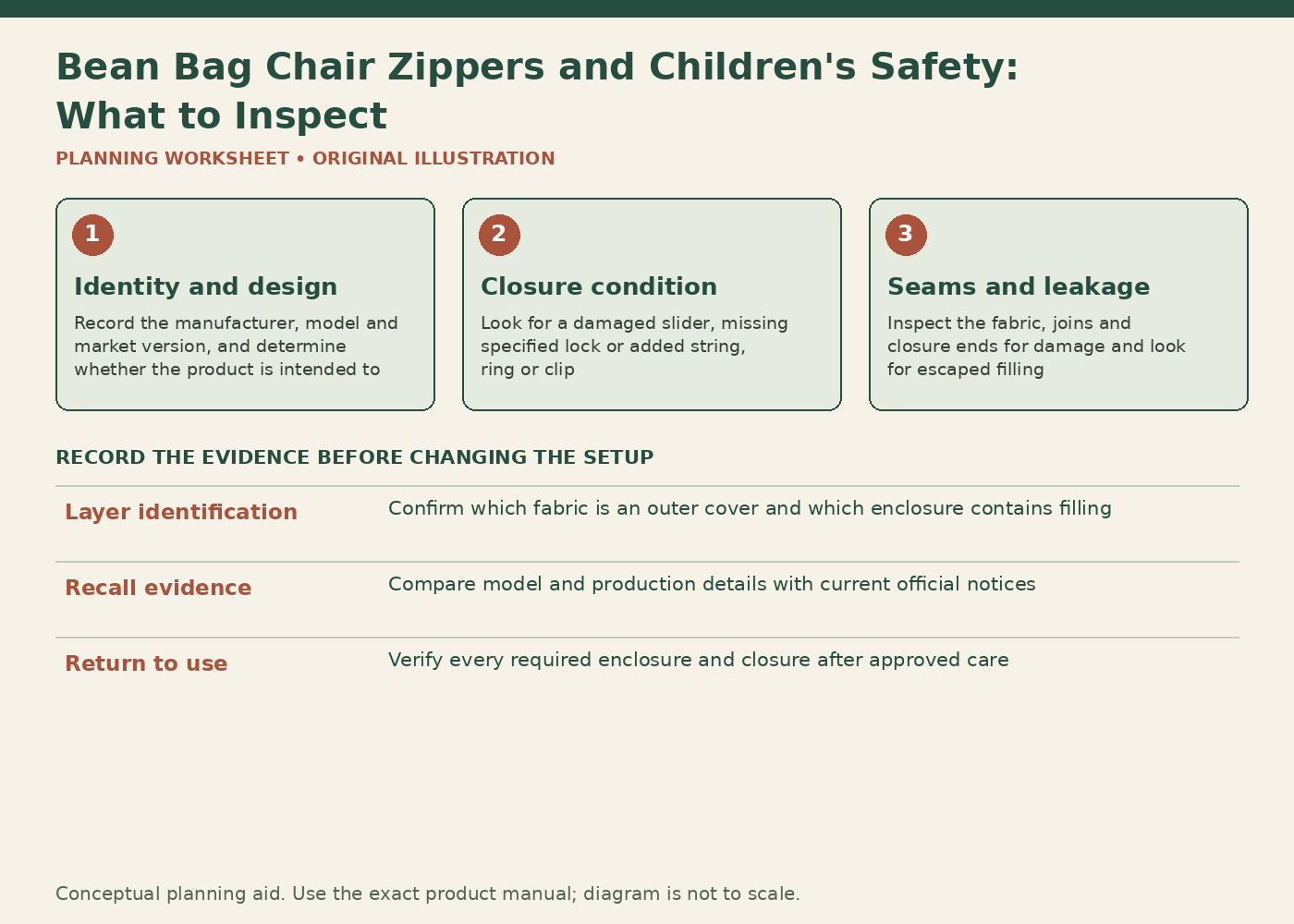
| Identity and design | Record the manufacturer, model and market version, and determine whether the product is intended to be opened or refilled. An absent pull can be intentional. Do not add one until the manufacturer establishes the correct complete arrangement. |
| Closure condition | Look for a damaged slider, missing specified lock or added string, ring or clip. Photograph the condition without opening the chair. Keep children away and seek the prescribed remedy if access protection is uncertain. |
| Seams and leakage | Inspect the fabric, joins and closure ends for damage and look for escaped filling. A secure-looking zipper cannot compensate for a torn seam. Remove a leaking product from use and address the source before considering reuse. |
| Layer identification | Confirm which fabric is an outer cover and which enclosure contains filling. Follow only the permitted removal procedure. Keep detached covers, refill material and opening tools out of children’s access throughout the task. |
| Recall evidence | Compare model and production details with current official notices. Verify a claimed repair against its published remedy. Do not use an unrelated recall’s hardware or an improvised permanent fastening to repair another design. |
| Return to use | Verify every required enclosure and closure after approved care. Remove any temporary opening aid according to the instructions and store it separately. Keep the product unavailable if filling containment or locking operation remains unresolved. |
Worked example
A parent receives a used bean bag with a key ring attached to a slider where the pull would normally be. The seller says the ring makes washing easier. The inspection record identifies an added part, not an approved feature. The parent photographs the label and closure, keeps the chair away from children and asks the manufacturer whether that slider is meant to lock and whether the modification damaged it.
Suppose the manufacturer confirms that a removable outer cover surrounds a separate filled liner. The parent still follows the prescribed procedure for both layers instead of assuming the liner makes the outer closure irrelevant. If beads are already present on the floor, identifying the leak becomes a separate stop condition. This example shows why checking only whether the zipper slides misses the safety question: the important outcome is inaccessible filling and a complete intended closure system, not easier opening. No home modification or successful empty inspection establishes a safety certification. Keep the manufacturer’s written response with the chair’s identification record for the next caregiver.
Sources checked November 6, 2026
Use the current document for the exact model, market and production revision. These sources establish the cited instructions and distinctions; they do not certify an individual chair or replace a personal assessment where one is needed.
- CPSC: Ace Bayou bean bag chair recall reannouncement
- CPSC: Resellers Guide to Selling Safer Products, 2025
- Big Joe Support: Bean-filled product zipper and refill instructions, January 2026
- ACCC Product Safety: Bean bags consumer safety guide
- NIH Safe to Sleep: Ways to Reduce Baby’s Risk
- CPSC recalls and product safety warnings
Something unclear or out of date? Send a correction with this article’s title and the detail to check.
Sources, research & corrections policy ↗