There is no universal clearance behind a nursery glider. The required space depends on the exact chair, whether it swivels or reclines, and where the manufacturer measures clearance. Plan the moving envelope and the walking route together before committing to a corner.
Start with the manufacturer’s reference point
Overall depth describes the chair in a stated configuration. Wall clearance describes a relationship between the chair and a wall, and fully reclined length describes another configuration. They are not interchangeable. Pottery Barn Kids’ Kiwi listing gives separate upright, reclined and rear-clearance figures; Babyletto’s current Kiwi page identifies a current manual model and its dimensions. Use the document matching the actual chair instead of mixing figures from both.
Ask whether rear clearance is measured from the back upholstery, rear of the base or another identified point, and whether it covers glide, swivel, recline or all permitted operation. If the manual omits a required figure, obtain it from the manufacturer. A generic online recommendation of a few inches is not a substitute.
Draw three envelopes
Begin with the upright chair and its base. Add the maximum movement permitted during gliding, then the side sweep during swivel if present. Finally add recline and the extending footrest. Use different tape colors or separate sketches so you can see which feature causes a collision. Do not intentionally operate the chair into a wall to discover its limit.
Keep the moving chair clear of curtains, radiators, cords, shelves and reachable objects. A soft curtain can still catch or enter a mechanism; its flexibility is not clearance. A table must stay outside the chair’s sweep while remaining usable without an awkward reach.
Include people and the route
A furniture drawing often leaves out the adult’s knees, feet and space needed to stand. Mark where the user normally approaches and exits. Include an ottoman only in its realistic use position. Check whether the extended chair blocks the room door, closet or access to the baby’s sleep space.
Do not solve a tight fit by moving the crib against hanging fabric, accessible cords or another hazard. Reassess the whole layout. The useful output is a room that works in the chair’s permitted configurations, not a photograph in which every object appears to fit when the chair is closed.
Recheck after accessories and floor changes
An added base or different floor covering can alter height or movement relationships. Record these changes and confirm they are approved for the specific chair. Check product identity and current notices, including the CPSC Kiwi electronic recliner USB recall when relevant. That recall concerns specified affected units; it is neither a statement about all nursery chairs nor clearance for a chair outside an obvious search result.
Measurement and comparison worksheet
| Checkpoint | What to record and why it changes the decision |
|---|---|
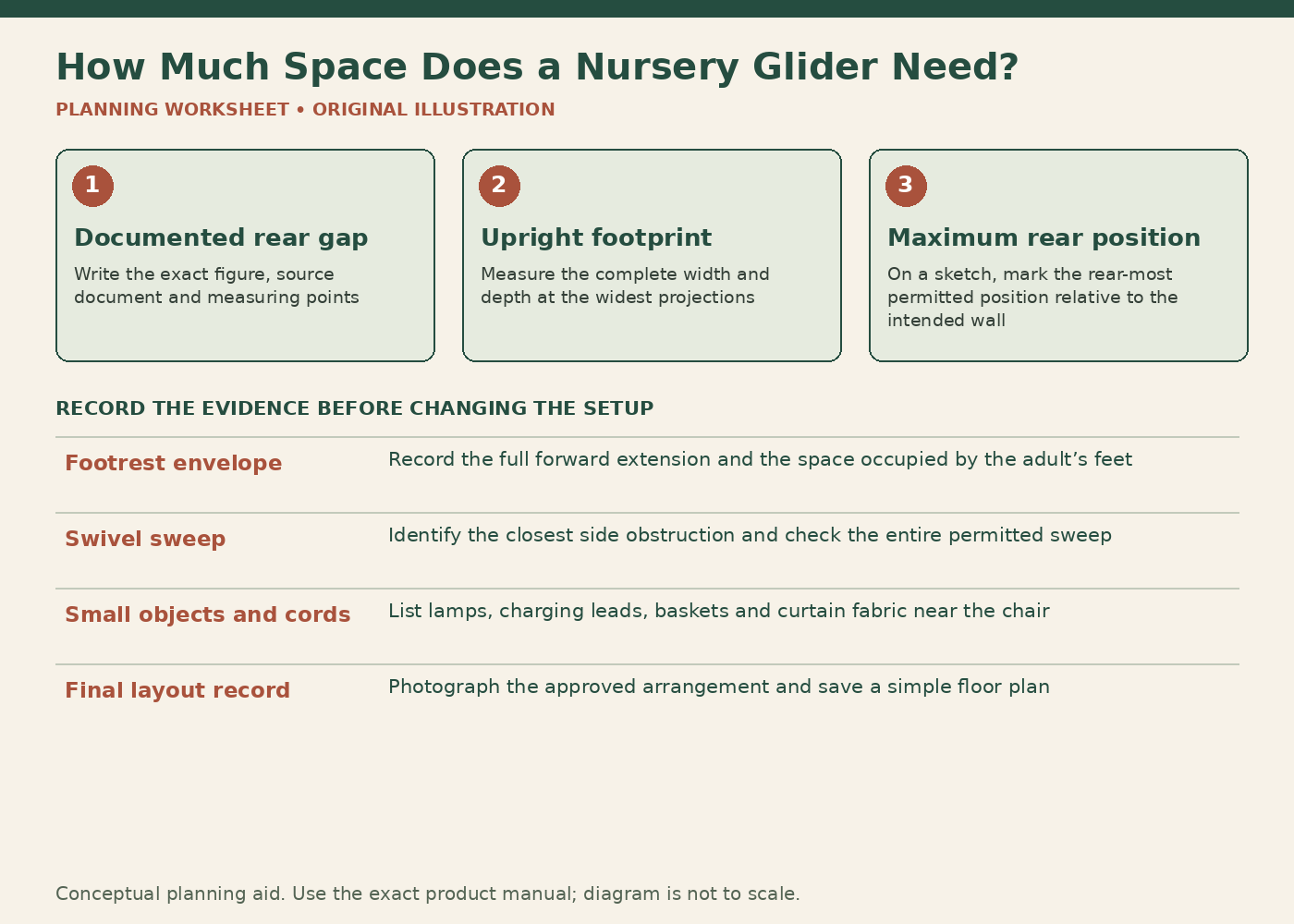
| Documented rear gap | Write the exact figure, source document and measuring points. Note whether the manufacturer specifies separate requirements for glide and recline. If the information is missing, put “manufacturer response needed” rather than guessing a convenient number. |
| Upright footprint | Measure the complete width and depth at the widest projections. Record the base separately if useful. A floor-level circle or runner outline cannot stand in for the upper arms and back when planning nearby furniture. |
| Maximum rear position | On a sketch, mark the rear-most permitted position relative to the intended wall. Include projecting trim and a windowsill. Use the manufacturer’s data and an unobstructed demonstration, without hands behind the moving back. |
| Footrest envelope | Record the full forward extension and the space occupied by the adult’s feet. Mark the remaining walking route. A path that exists only when nobody reclines may be inconvenient or unsuitable for the household’s intended routine. |
| Swivel sweep | Identify the closest side obstruction and check the entire permitted sweep. A dresser drawer and a door also move; consider the combinations you actually need rather than checking every item in its closed position. |
| Small objects and cords | List lamps, charging leads, baskets and curtain fabric near the chair. Keep them outside moving parts and away from children. A tidy-looking loop of cable behind the back is still a loop within the mechanism’s environment. |
| Final layout record | Photograph the approved arrangement and save a simple floor plan. Repeat the check after moving the chair, changing its base or adding an ottoman. Include instructions for anyone who might push the chair back while cleaning. |
Worked example: use the result, not just the number
Suppose a hypothetical chair needs a manufacturer-specified 12-inch gap measured from its rear upholstery, and its upright depth is 36 inches. A 48-inch wall-to-front allocation describes only that upright relationship: 12 plus 36. It does not prove that a separate 60-inch reclined envelope fits, because the reclined position may extend in more than one direction.
Write each figure beside its own reference points. If the manufacturer supplies a complete reclined-placement diagram, use that diagram. If it supplies only length, ask how the chair sits within that length and what rear gap remains required. The arithmetic is a way to find missing information, not a reason to subtract the same clearance twice or to assume the base remains centered. The final drawing must also show a workable route with the chair occupied.
Build the floor plan from one fixed datum
Choose a fixed wall face as your starting line. Measure to the nearest immovable object in front, then mark the chair position using the manual’s clearance reference. A baseboard, radiator or window trim can be closer to the moving chair than the wall surface itself. Record the closest projection at the height where it could make contact; a floor measurement alone can miss a projecting sill.
Draw an overhead plan and a side view. The overhead plan shows width, swivel sweep and the route around the chair. The side view shows the moving back, wall projections and forward footrest. These views answer different questions. On each, label the chair configuration and the source of the dimension. If the manufacturer supplies only overall reclined length, do not invent how much of that length extends behind the upright base. Request the missing relationship.
Use published dimensions without mixing revisions
The current Babyletto Kiwi manual-model page lists model M11277PBEW, assembled dimensions of 38 inches long by 29 inches wide by 41 inches high, and a fully reclined length of 64 inches. The Pottery Barn Kids Kiwi listing separately lists 32 inches of wall clearance for full recline. Those are examples of different fields and potentially different versions, not numbers to combine into a new universal placement formula.
When you ask a supplier for clearance, attach the exact order configuration. Request an annotated sketch showing the rear-most point, front-most point, wall reference and whether gliding remains available in recline. Save the response with the order. A statement that the chair is “compact” or fits “small nurseries” does not replace the missing diagram. If a listing contains contradictory descriptions of manual and powered functions, resolve the contradiction before relying on its dimensions.
Run a conflict check with nearby objects
List every object within reach of the proposed chair, then give each its own moving or access envelope. A dresser needs room for the drawer and the adult using it. A closet door needs its arc. A side table needs to remain outside the chair’s sweep while supporting items that cannot fall into the linkage. Do not count the same floor strip as a recliner footrest zone and an always-clear access route without acknowledging that conflict.
Use a blank plan to compare two positions. In position A, the chair can recline fully but blocks the closet. In position B, it clears the closet but the swivel arm would strike the dresser. Label these specific conflicts and decide which can be removed by an approved rearrangement. Limiting a chair’s movement by trapping it between furniture is not an approved substitute for the required operating space. Ask the manufacturer about any genuine locking feature rather than assuming friction against the wall will control travel.
Check the setup after delivery without creating a pinch test
Before operating the assembled chair, compare its actual position with the documented layout. Keep the baby, children and pets away. Remove packaging, temporary leads and tools from the area. Have one adult operate the chair according to the manual while an observer watches from outside its movement. Stop before contact; do not intentionally compress upholstery against a wall or use a hand to judge a shrinking gap.
Photograph the final chair position with its reference line visible. A small removable floor marker outside the moving mechanism can help adults restore that position after cleaning, provided it does not create a trip hazard or damage the floor. Recheck after a rug, ottoman or base change. If the documented movement still cannot be achieved without an obstruction, keep that function unused and obtain manufacturer guidance or choose a different layout; do not shorten a required gap based on a single uneventful trial.
For an unusually shaped room, take the labeled drawing to the manufacturer or furniture provider before ordering. A verified alternative chair location can be more useful than trying to preserve a corner that cannot accommodate the documented movement.
Official references and document checks
The linked documents below were researched for this article on November 6, 2026. Manufacturer instructions, available configurations and safety notices can change. Consult the document for the exact product in front of you; references to another market or an older revision provide context and do not establish compatibility for your chair.
- Pottery Barn Kids: Babyletto Kiwi dimensions and care
- Babyletto Kiwi Recliner and Swivel Glider, current model specifications
- CPSC: Babyletto Kiwi electronic recliner USB recall
- NIH Safe to Sleep: Ways to Reduce Baby’s Risk
Something unclear or out of date? Send a correction with this article’s title and the detail to check.
Sources, research & corrections policy ↗