As an Amazon Associate, we earn from qualifying purchases. Read our affiliate disclosure.
The best baby feeding chair supports a repeatable meal routine: appropriate upright seating, the complete restraint, easy adult access, and cleaning you can finish before the next use. Compare IKEA ANTILOP for a simple dedicated high chair, Chicco Zest for a light folding high chair, and Chicco Bento for an attached booster or separately permitted floor feeding mode. The correct type depends on the child’s readiness and the supporting furniture, not just the tray shape.
We reviewed current US manufacturer information, the Bento mode-specific manual, and official safety guidance on November 6, 2026. We have not performed feeding trials or made clinical positioning assessments. This guide focuses on the before-meal and after-meal workflow, including what needs to be clean and checked, so the buying decision reflects how caregivers actually prepare and supervise food.
Choose the feeding setup before accessories
| Chair | Published dimensions | Useful meal feature | Important condition |
|---|---|---|---|
| IKEA ANTILOP | 24 W ×26 D ×35⅜ H in | Simple polypropylene shell; detachable legs | Sit unaided; maximum 33 lb; optional tray in checked listing |
| Chicco Zest | 21.25 ×26 ×34.25 in;9.5 lb | One-piece seat; folds; rear-leg tray storage | Correct feeding configuration and five-point harness |
| Chicco Bento | 17 ×14 ×17.5 in;5.5 lb | Included tray; two height positions; folding | Booster and floor feeding modes have different requirements |
ANTILOP: dedicated upright meals with a straightforward shell
The current ANTILOP US listing includes the safety belt and a polypropylene shell on steel legs. It is intended for children able to sit unaided, up to three years or 33 pounds. The white chair showed $18.99 before the optional tray, with local stock dependent on a postcode check. That price should not be described as the complete delivered feeding setup where the tray or delivery adds a charge.
Its overall floor base is 24 by 26 inches, with a 35⅜-inch height and 21¼-inch seat height. The published seat is 9⅞ inches wide and 8⅝ inches deep. Those actual dimensions are more useful than assuming a fixed bucket fits every eligible child equally. Do not add unapproved cushioning, modify the harness, or attach a homemade support to compensate for an unsuitable fit.
The simple shell is attractive when ordinary wiping is a priority and the chair can stay assembled near the eating area. IKEA specifies mild soapy cleaning followed by drying. It is less useful when the room must reset between every meal or the child needs an approved adjustment system the fixed chair does not provide. Count the complete base and caregiver approach space rather than judging the chair by its small tray photograph.
Zest: manageable weight for a room that resets after meals
The Zest Capri manufacturer page lists a 9.5-pound assembled chair measuring 21.25 by 26 by 34.25 inches. Its one-piece seat is wipeable, the supplied tray stores on the rear legs, and the frame folds for storage. The page showed $69.99 and in-stock status during research. Those are practical advantages when a feeding area must later become a play or work space.
Zest includes a five-point harness and advertises several later configurations. For infant meals, use the complete current feeding setup, not the toddler-chair or youth-stool appearance from a conversion photograph. The overall six-month-to 60-pound product range spans different modes, so it does not establish that every eligible infant fits or that every configuration supports the same use. Read the actual instructions and verify readiness independently of the later capacity claim.
This is the first candidate to investigate if light weight and folding are daily needs. It is less useful if fine seat and foot-platform adjustments are the main priority. The current text listing does not give a complete reliable folded-size measurement, so obtain that before buying for a fitted cupboard. Also note that Chicco says to spot-clean the harness and air dry it, not machine wash it; the easy shell does not eliminate restraint cleaning.
Bento: a compact seat, with the host chair part of the product system
The Bento 3-in-1 measures 17 by 14 by 17.5 inches assembled, folds to 19.5 by 14 by 4.5 inches, and weighs 5.5 pounds. It includes a tray, two height positions, and separate booster, floor feeding, and later toddler-chair modes. The listing showed $34.99, with selected-style availability to be confirmed. It is useful to investigate when you want a compact feeding system rather than a full-height dedicated frame.
For booster use, the US Bento manual requires unassisted upright sitting, both adult-chair attachment straps, and a suitable full-sized dining chair. Minimum host dimensions are 15⅝ inches of seat width,14¼ inches of depth, and a 12-inch backrest. It prohibits unstable, folding, pedestal, and bar-stool arrangements. A small product footprint does not make it compatible with an inadequate host chair.
Floor feeding mode follows different rules, including floor-only placement, unassisted head control, the snug child restraint, and stopping when the child can climb out or walk. Do not use that head-control wording as a shortcut to booster readiness or readiness for solid food. Bento is less useful if no supporting chair passes the manual or the desired mode is inappropriate for the child. Compare its actual mode to the meal routine rather than treating three advertised uses as one universal permission.
The meal-preparation sequence to rehearse
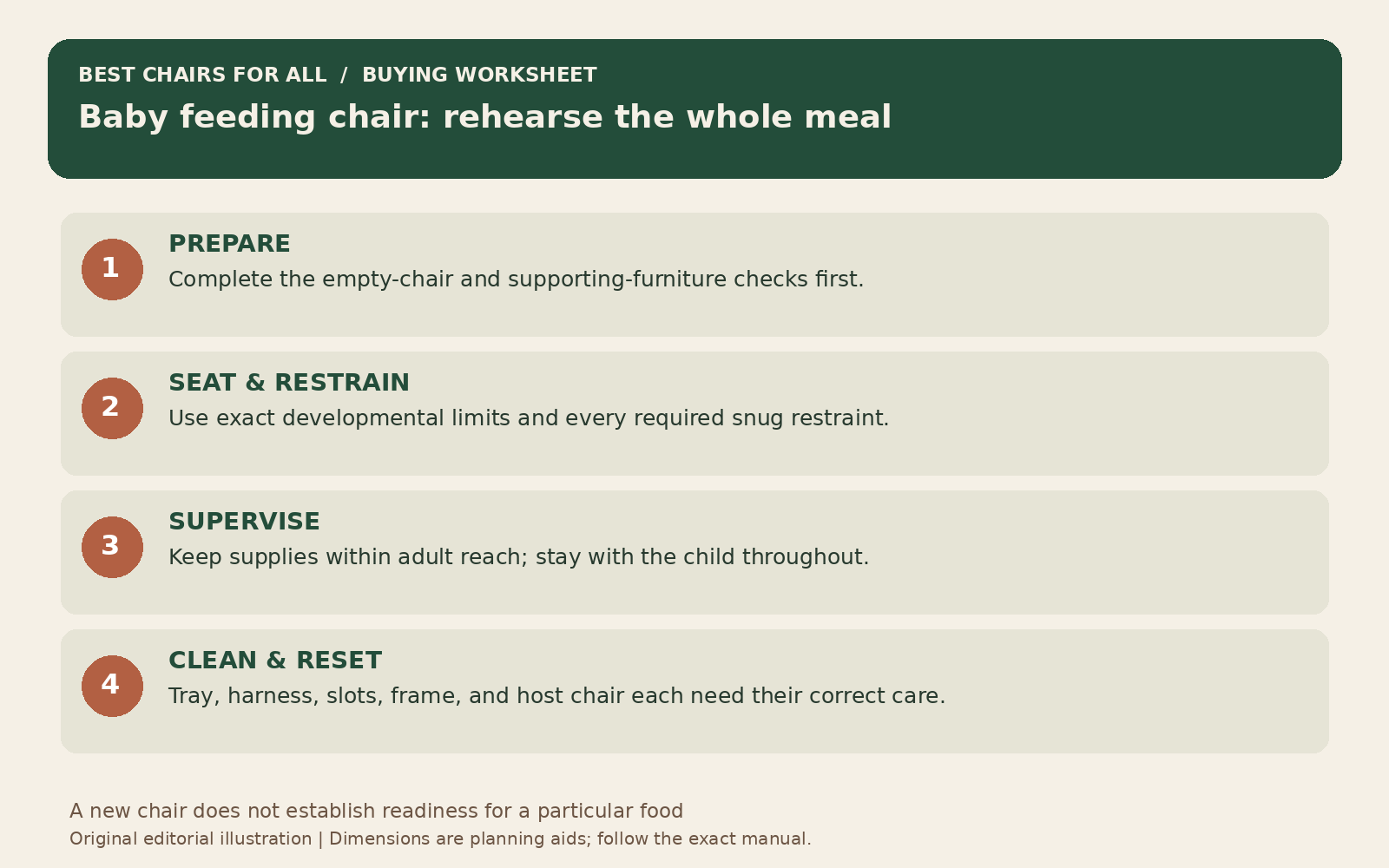
Before purchasing, rehearse five steps with the intended empty feeding area: position the chair, prepare the required components, place supplies within adult reach, seat and restrain the eligible child, and remain with the child during the meal. The equipment should make that sequence practical without encouraging a caregiver to walk away for a forgotten item or balance hot food over the child.
Keep the chair on the permitted firm level support, with the entire frame or attached system secured. For a standalone model, inspect the legs and locks; for a booster, inspect the host chair and both attachment straps. Check the child harness independently. A tray is a food surface, not a restraint, and a tray that clicks into place does not prove every other part is secure.
Prepare the ordinary meal supplies before seating the child. Place hot liquids, sharp utensils, cords, and items that could be pulled down outside reach. Stay near and supervise throughout. If you need to leave, make an appropriate separate arrangement for the child rather than treating the feeding chair as unattended containment. The useful chair is one that fits this realistic sequence, not one whose marketing photograph shows a clutter-free table.
A cleanup-time map, without fabricated timing claims
List the parts that receive food: tray top, tray underside, restraint buckle, strap slots, seat seams, leg junctions, and the supporting adult chair where applicable. Then record the approved cleaning method and drying location for each. We have not timed cleaning these products, so there is no fastest-chair score. The worksheet instead reveals whether the routine requires laundry, dishwasher space, hand washing, or ordinary wiping.
For ANTILOP, the shell and frame use IKEA’s mild-soap wipe-and-dry directions. For Zest, the harness needs its prescribed spot clean and air drying even though the seat has no fabric liner. Bento’s tray can go in the top dishwasher rack, while its harness should not be machine washed. Those differences can change a purchase decision in a household with limited drying space or no dishwasher.
Do not spray every component with the same cleaner simply because the tray feels like plastic. Harnesses, foam, coatings, and hardware may have different requirements. After cleaning, reassemble only as directed, inspect the restraint and attachments, and dry parts appropriately. Damaged or sticky locks need attention before the next meal; they should not be forced into service around food residue.
A worked meal-station footprint
Suppose a dining corner offers a 30-by 32-inch clear floor rectangle. ANTILOP’s 24-by 26-inch base fits inside it on paper, leaving six inches overall in each direction. Zest’s 21.25-by 26-inch dimensions also fit as a bounding box. Neither result includes the adult standing area, tray approach, a nearby cabinet door, or a neighboring dining chair pulled out for dinner. Tape the complete outline and rehearse the actual preparation and removal sequence.
Bento appears smaller, but its 17-by 14-inch product size is not its complete dining footprint. Add the adult host chair and its movement at the table. An existing dining chair may occupy as much floor area as a dedicated high chair while adding strap inspections and extra cleanup underneath. The booster is genuinely useful when the host arrangement works, rather than simply because its catalog dimensions are smaller.
Check the tabletop and underside apron too. A seat that raises the child cannot solve a collision between the tray or shell and a low apron. Do not force an occupied chair under a table or add unapproved blocks beneath a booster. If the permitted setup fails the station, select another appropriate product or rearrange the eating area while keeping access clear.
Readiness is separate from the purchase
A new feeding chair does not establish that an infant is ready for a particular food, unsupported sitting, or an unrestrained seat. Follow the exact product’s developmental requirements and obtain qualified individualized feeding advice where needed. We do not prescribe a first-solids schedule, a posture treatment, or a chair for a specific diagnosis. Those decisions require context a manufacturer feature list cannot provide.
Use an upright appropriate feeding setup and all required restraints. A reclining feature on another product does not make reclined infant feeding or sleep an acceptable alternative. Do not use loose pillows or towels to fit a child who is too small or lacks the required control. If the approved configuration does not support the child appropriately, stop and seek the correct guidance rather than altering the seat.
The handoff between caregivers
Keep a short configuration card with the model name, the permitted mode, the restraint instructions, cleaning directions, and a link or saved copy of the manual. This is especially useful for Bento because a grandparent may recognize the same shell but not know whether it is set up for floor use or attached booster use. A familiar appearance should not replace the actual setup check.
If two homes use different chairs, make separate cards rather than transferring one model’s rules. Bento’s host-chair dimensions are not the dimensions of another Chicco booster. Zest’s later stool-mode harness removal is not a rule for ANTILOP. The clearest routine is one in which each adult can identify the exact product, current configuration, and required restraints before the child enters it.
Search the current CPSC recall database by model and date code, register the purchase, and keep its label readable. CPSC’s high-chair guidance emphasizes a snug restraint, close supervision, and preventing standing or climbing. None of these products is a sleep surface, bath seat, vehicle restraint, or way to carry a seated child.
Choose ANTILOP for a simple permanent feeding station, Zest when a light folding chair suits the room, or Bento when the exact mode, child readiness, and supporting furniture all pass the manual. Confirm the complete package, current selected stock, and return conditions. The best feeding chair is the one that makes the entire supervised meal and cleanup routine workable without shortcuts around fit or restraint.
Something unclear or out of date? Send a correction with this article’s title and the detail to check.
Sources, research & corrections policy ↗