As an Amazon Associate, we earn from qualifying purchases. Read our affiliate disclosure.
The best lightweight camping chair is not automatically the lightest chair on a specification sheet. A chair carried a short distance from a car can justify more fabric and a more substantial seat than one carried all day. The useful question is how much chair you will carry, how far you will carry it, and what you need it to do when you arrive.
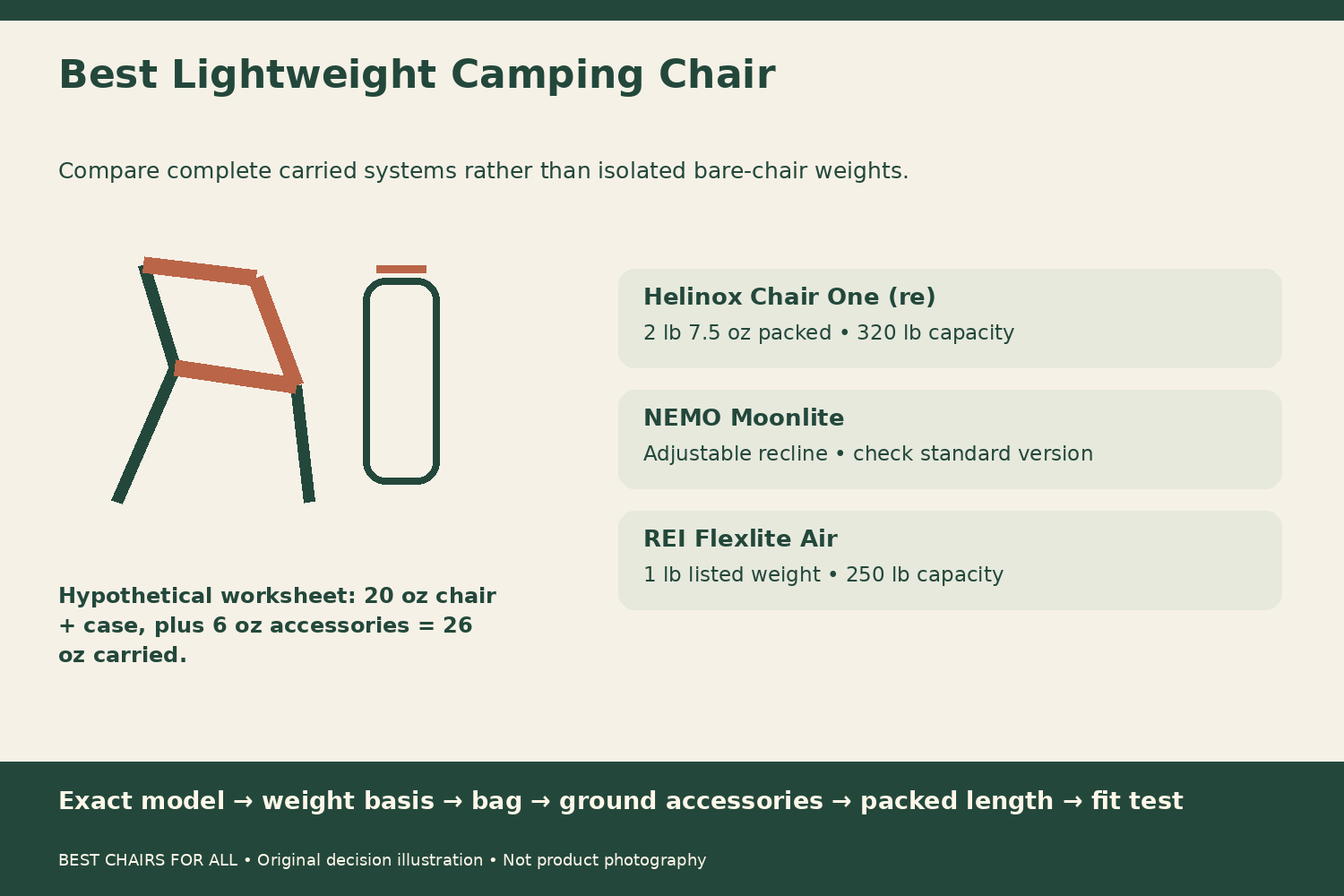
Our three researched candidates are the Helinox Chair One (re), NEMO Moonlite Reclining Camp Chair, and REI Co-op Flexlite Air Chair. The Helinox is the starting point for a packable general-purpose seat; the NEMO is worth comparing when adjustable reclining matters; the REI is the stripped-down option when a one-pound published weight matters more than extra features. No comparative field testing is claimed here.
We reviewed manufacturer information November 6, 2026. The recommendations are conditional on fit and the exact version sold. Prices and inventory are changeable, so this guide does not promise a fixed budget or describe Amazon search results as confirmed offers.
First decide what lightweight means for your trip
For a short walk from a campground parking space, total carrying bulk and the handle or bag may matter as much as ounces. For a train journey, packed length may determine whether the chair fits inside a backpack. For a hike, the whole carried weight becomes more important. Define your use before comparing products built for different priorities.
Compare camping chair packed size versus weight against the actual carrying method, rather than choosing on the lightest number alone.
Do not compare a chair's assembled weight with another chair's packed weight. A bag, ground sheet, cup holder, and shoulder strap all travel with you if you use them. Record the complete system rather than congratulating yourself on a small bare-frame figure while carrying several accessories in a second pouch.
Seat height also requires care. Different manufacturers can measure different points on a suspended seat, and fabric moves under a person. Treat the listed value as a shopping clue. Your actual ability to settle in, reach the ground, and stand is the more useful assessment.
Three models with different compromises
Helinox Chair One (re): for general-purpose packability
The Chair One (re) page lists a 320-pound capacity and distinguishes a 2-pound-4-ounce assembled weight from a 2-pound-7.5-ounce packed weight. The published case measures 15.5 by 4.5 by 5.5 inches. Its second tension line, side pocket, mesh panels, and shock-corded frame explain why it deserves comparison with simpler low-weight chairs.
This is the model to investigate when you want a small travel package without making minimum weight the only objective. A side pocket can keep a phone away from dirt, and a case with a handle helps move it around camp. Those features may be worthwhile for a campground weekend even though a dedicated ultralight backpacker may prefer fewer ounces.
Its limitation is category confusion. It is not the original Chair One, and it is not the Chair Zero. Search results can group those names closely, so check the label and specifications. If your requirement is a chair around one pound, this particular packed configuration does not meet it.
Check matching Helinox Chair One (re) listings on Amazon (paid link). Confirm that the seller means the redesigned model.
NEMO Moonlite Reclining Camp Chair: for adjustable sitting angles
The Moonlite manufacturer page describes adjustable reclining through its armrest straps, a mesh seat, forged aluminum hubs, and ball-and-socket seat connections. That combination makes the Moonlite useful to compare when your camping evening includes both sitting up for conversation and leaning back to relax.
The design advantage is a change in angle without adding a separate footrest or carrying a full-size zero gravity recliner. The important fit check is whether the adjustment remains comfortable when you sit in your preferred position. A reclining mechanism is only useful if its practical range includes the posture you want.
The standard Moonlite is a different product from Moonlite Elite. We are not borrowing the Elite's weight claim for this chair. Check the current packed specification of the actual Moonlite offer and include the zippered carrying case in your comparison. Choose another model if your primary requirement is the smallest possible system, or if you dislike a suspended mesh seat.
Check matching NEMO Moonlite Reclining Camp Chair listings on Amazon (paid link). Read the full model name before comparing prices.
REI Co-op Flexlite Air: for minimizing carried weight
REI's own Flexlite Air page lists a one-pound weight, 250-pound capacity, an 11-inch seat height, and a packed size of 4.5 by 15 inches. The seat material is listed as 70-denier ripstop nylon over an aluminum frame. These are the maker's published specifications rather than measurements from our testing.
The appeal is straightforward: this is a low-weight elevated seat that can fit into a trail-oriented packing plan. It suits someone who wants back support at camp and accepts a compact seat rather than a high-backed lounge chair. It also provides a useful comparison point when deciding how much added weight extra features are worth.
The tradeoff is the low seat and minimalist format. If rising from a low chair is difficult, do not let the appealing weight overrule that practical issue. Check width, seat shape, and stability on suitable ground before deciding. A listed load capacity does not establish individual comfort or guarantee that the chair suits every surface.
Search Amazon for matching REI Flexlite Air listings (paid link). REI is the primary product source; Amazon search availability is not verified.
Build a complete carry-system worksheet
Create five columns: exact model, chair weight basis, included bag, accessories you intend to carry, and final system weight. Put an unknown mark beside any figure that does not say whether it includes the bag. Contact the seller or manufacturer rather than combining incompatible numbers.
Here is a hypothetical packing example, not a claim about any shortlisted chair. Suppose a chair and case together weigh 20 ounces, and your chosen ground protection and pocket accessories add 6 ounces. Your carry decision concerns 26 ounces. If another system totals 30 ounces but includes the support you actually need, the real difference is 4 ounces rather than the difference between their bare-chair advertisements.
Record packed length separately from weight. Cut a paper strip to the stated length and hold it against the intended backpack compartment. Allow for the actual three-dimensional bag, rigid poles, and the way other gear fills the space. A chair that theoretically fits by diagonal may be frustrating to insert after your food and rain gear are packed.
Then carry your normal trip load around the block with a comparable added weight securely inside. This does not test the chair itself, but it tests whether your proposed luggage arrangement is sensible. On a short campground approach, a slightly larger chair might be irrelevant. On public transport with groceries and a child in tow, a poorly placed bag can be the decisive problem.
Give every accessory a specific job. A phone pocket may replace nothing if your jacket already has one. A ground sheet may be essential at your intended campsite. A cup holder might be useful at a concert but unnecessary on a hike with a bottle you can close. Remove accessories because you do not need their function, not simply to achieve a nicer spreadsheet number.
Comfort checks that a weight chart cannot settle
Assemble the chair completely according to its instructions, with poles fully seated and the correct seat attachments engaged. Place it on suitable level ground. Check every connection before applying full weight. Do not use uneven assembly or deliberately loose fabric as a comfort adjustment.
Sit for more than a quick photograph. Let your hips settle, rest your arms naturally, and look at something at the height you normally would around camp. Notice pressure behind the thighs, across the shoulder blades, and at the seat sides. A narrow suspended seat can feel different after several minutes than it does during an enthusiastic first sit.
Try the activity you will actually do. Read a book, hold a closed bottle, or sit upright as though talking across a small camp table. A chair that feels excellent for reclining may place you too low for a particular dining table. Likewise, a chair selected for tent-side reading may not need the same upright posture as a cooking-area seat.
Stand normally and assess the movement. A very light chair should not become a mobility aid unless specifically designed for that purpose. If you need substantial support during transfers, investigate a chair intended to provide the required arrangement and obtain individual guidance where necessary.
Ground, weather, and camp placement
Small chair feet concentrate force on the ground. Firm level soil, loose sand, damp grass, and a wooden platform behave differently. Use accessories that the maker approves for the exact chair when a larger ground-contact area is needed. Include them in the packing worksheet rather than treating them as weightless.
Do not level a chair with unstable rocks or lean it backward onto two legs. Move to suitable ground. Keep chairs clear of cooking equipment, open flames, and routes where someone may step over legs or straps. Lightweight fabric and poles are still equipment that can be damaged by heat or careless placement.
Dry the seat and bag before storing them for a long period. Remove sand and grit from connection areas using the maker's care guidance. If a pole, hub, or seam becomes damaged, contact the brand about the appropriate repair rather than forcing it back into service. A compact chair depends on its parts working together as designed.
A useful reason to keep the bag
Keep the frame, seat, and small accessories together when moving between stops. A missing corner attachment or forgotten case can turn a light chair into an awkward loose bundle. Assign one pocket in your vehicle or pack to the complete chair system, and check it during departure. Consistent packing is especially helpful when several people use visually similar chairs at the same campsite.
Buying questions before you check out
Does the listing describe the current model or an earlier version? Is the stated weight packed or assembled? Are the carry case and necessary attachments included? What happens if you assemble it indoors and find the seat unsuitable? Those questions are more useful than comparing a star rating without understanding the model behind it.
Avoid assuming a lower price proves better value. Add delivered cost, intended accessories, and return charges. If the weight difference is small for your trip, a model you can try locally may be the better purchasing route. This guide does not attach a budget label to a chair without a validated current total.
For a versatile compact seat, start by trying the Chair One (re). For changing angles, compare the standard Moonlite. For a stricter carry-weight target, investigate the Flexlite Air. Choose the one whose complete system and seated fit both make sense for the trip you have planned.
Something unclear or out of date? Send a correction with this article’s title and the detail to check.
Sources, research & corrections policy ↗