As an Amazon Associate, we earn from qualifying purchases. Read our affiliate disclosure. Amazon buttons open model-matching searches; verify the seller, exact configuration, current price and stock.
The best ice fishing chair is the one that fits your shelter, winter clothing and pattern of moving between holes. A chair with luxurious padding can be a poor choice when its frame blocks the doorway. A light tripod can be convenient to carry yet uncomfortable if its seat geometry does not suit you. Start with the actual fishing space and a clothed fit check, then compare weight and padding.
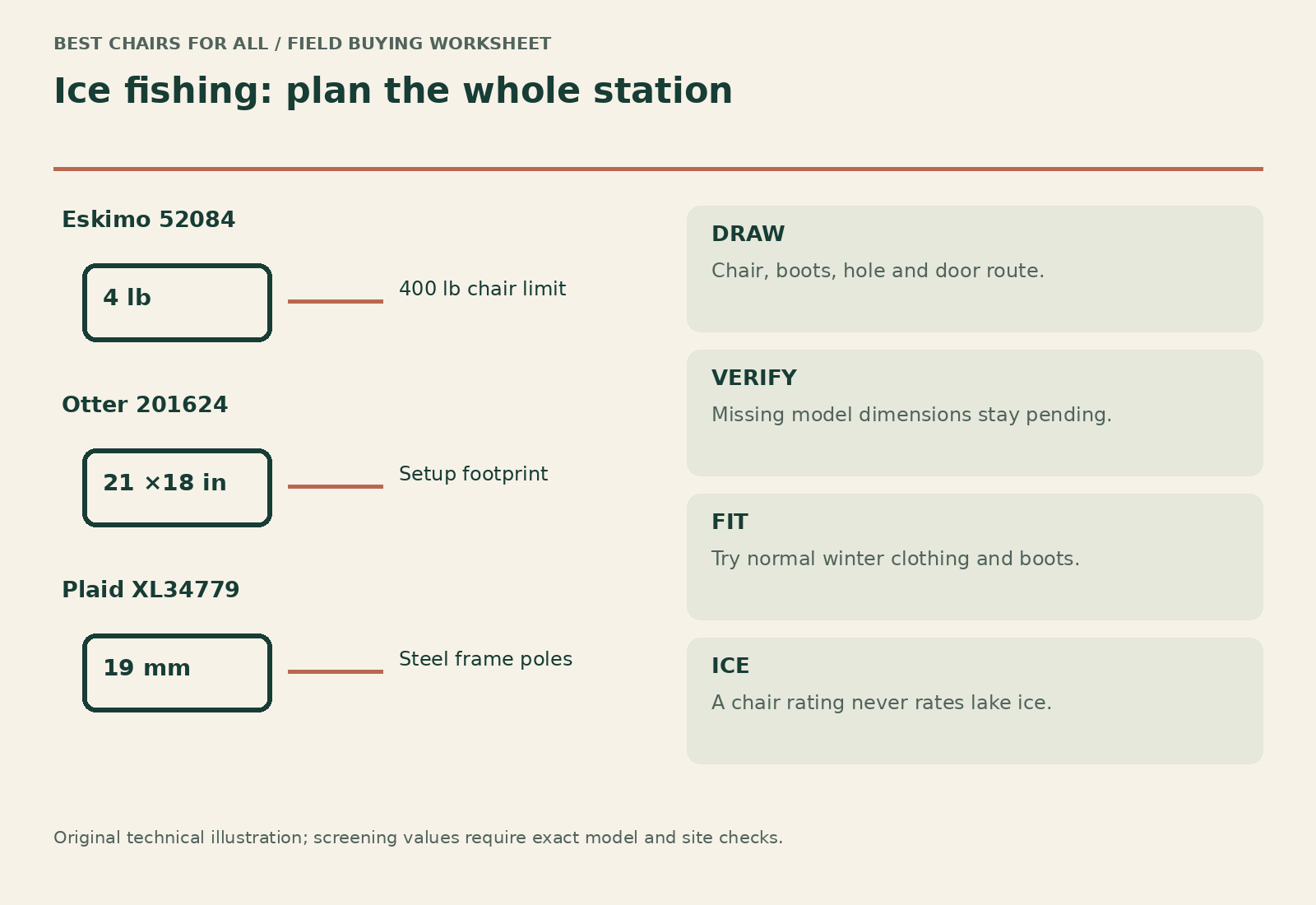
Our first candidate for mobile anglers is the Eskimo Aluminum XL Tripod Chair 52084 because its current manufacturer page publishes a 4 lb weight and 400 lb chair limit. For a more padded stationary seat, the Otter XL Padded Tri-Pod Chair 201624 deserves a look, subject to confirming its occupant limit. The Eskimo Plaid XL 34779 offers a steel-frame alternative with a larger seat panel and storage pocket; do not transfer the aluminum model’s weight or rating to it. These are researched options, not chairs we have field-tested.
Chair capacity never establishes whether lake ice can carry a person or a fishing setup. The Minnesota DNR ice safety page explains that appearance and thickness alone cannot determine ice strength and that no ice is 100 percent safe. Check current local conditions and restrictions independently of this furniture comparison. Do not use chair feet, padding or a low carrying weight as evidence of ice safety.
| Exact model | Verified reason to consider it | Unresolved buying gate |
|---|---|---|
| Eskimo Aluminum XL 52084 | 4 lb aluminum tripod;400 lb published chair limit | Get deployed and folded dimensions for your shelter |
| Otter XL Padded201624 | 21 ×18 ×33 in setup; padded back and adjustable lumbar | Confirm occupant limit and bare chair weight |
| Eskimo Plaid XL 34779 | 19 mm steel poles;600D fabric; larger panel and side pocket | Confirm occupant limit, seat height and packed size |
Product documentation checked November 6, 2026: Eskimo Aluminum XL Tripod Chair52084, Eskimo Plaid XL Folding Ice Chair34779, Otter XL Padded Tri-Pod Chair201624, Minnesota DNR: traveling on ice and preparation. The model-specific comparison below uses those published details rather than physical tests.
1. Eskimo Aluminum XL Tripod Chair 52084
Best for: First candidate for moving often.
The four-pound published chair weight gives this exact aluminum model the clearest mobile-use case in this comparison.
Eskimo identifies 52084 as an aluminum-frame XL tripod with 19 mm poles, an attached strap and a 400 lb occupant rating. Confirm its footprint and packed size rather than assuming they match a steel version.
Product Details
| Brand | Eskimo |
|---|---|
| Frame | Aluminum;19 mm poles |
| Published chair weight | 4 lb |
| Published occupant limit | 400 lb |
| Carry system | Attached strap |
Pros
- Documented 4 lb chair weight
- Published 400 lb limit for this exact model
Cons
- Deployed and folded dimensions need confirmation
- No insulation value or low-temperature rating established
Choose for carrying convenience after the clothed fit and shelter-layout checks.
2. Otter XL Padded Tri-Pod Chair 201624
Best for: Padded stationary candidate.
The Otter offers seat, lumbar and backrest padding for an angler who expects the chair to remain in one station.
The primary page lists a 21 by 18 inch setup footprint and 33 inch overall height. Adjustable lumbar support is a fit feature, without an established medical or thermal outcome.
Product Details
| Brand | Otter Outdoors |
|---|---|
| Setup dimensions | 21 W ×18 D ×33 H in |
| Padding | Seat, lumbar and backrest |
| Back adjustment | Adjustable lumbar support |
| Occupant limit | Not stated on checked primary product page |
Pros
- Documented deployed footprint
- Padded surfaces and adjustable lumbar
Cons
- Occupant limit not stated on checked page
- Listed product weight may include packaging; verify bare chair
Resolve the load limit before purchase, then draw this exact footprint in your shelter.
3. Eskimo Plaid XL Folding Ice Chair 34779
Best for: Steel XL alternative.
The steel Plaid XL34779 provides a larger seat panel and taller design than the brand’s standard plaid model.
Its current page specifies 19 mm steel poles, 600 denier fabric, a carry strap and a side mesh pocket. These facts do not establish the aluminum chair’s weight or capacity for this version.
Product Details
| Brand | Eskimo |
|---|---|
| Frame | 19 mm steel poles |
| Fabric | 600 denier |
| Design | Taller XL seat; side mesh pocket |
| Limit and footprint | Confirm current unit label before purchase |
Pros
- Attached strap and side pocket
- Specific steel-frame construction verified
Cons
- Load rating and dimensions require confirmation
- Pocket contents add moving bulk
Consider only after the exact unit label supplies the fit and load information you need.
Choose for hole-hopping or a settled shelter
Moving repeatedly rewards a chair you can fold, lift and set aside without unpacking several loose pieces. The Aluminum XL’s published four-pound weight and attached carry strap give it the clearest documented portability case in this shortlist. That is an editorial judgment from the design, not a timed setup test. Include the rod case, electronics and other gear when deciding whether the entire moving kit works for you.
A settled shelter changes the priorities. If the chair stays in one place, a padded seat and back may matter more than a few pounds saved. Otter lists padding at the seating area, lumbar and backrest along with an adjustable lumbar arrangement. Those features make it the first stationary candidate to examine. They do not establish a treatment for back pain, a thermal rating or a guarantee of comfort for a full day.
The Plaid XL is an alternative for someone who wants the manufacturer’s taller, larger-panel steel design and a small side storage pocket. Its product number34779 matters: a standard Plaid Folding Ice Chair and the newer aluminum version are separate products. Search results often mingle them. If a retailer quotes four pounds and 400 lb while showing a steel plaid chair, resolve the identity before accepting either figure.
Think about the transition between fishing and moving. Where does a wet scoop go when you stand? Does a hanging mesh pocket hit your leg? Can you lift the folded chair while the other hand carries the rod case? These questions decide whether a feature actually suits a mobile session. A large pocket filled with loose tackle may make the chair less convenient to move, even when it looks tidy in a product photograph.
Map a shelter station before comparing comfort
Use a floor sketch with four zones: chair, boots, hole-and-rod working area and doorway route. Add the actual electronics, bucket and bag you bring. Draw the shelter’s usable interior at floor level rather than relying only on its maximum advertised width higher up the walls. Angled walls and inward-hanging fabric can reduce practical space beside a chair back.
For the Otter, start with its documented 21-inch width and18-inch depth as the chair’s setup rectangle. These are overall setup dimensions, not the width of the fabric between your thighs. Add a separately measured boot zone in front, the path used to lift your rod and enough room to stand without catching a shelter wall. Do not infer a required clearance from the33-inch overall height; it describes a different direction.
Here is a deliberately hypothetical worksheet example. Suppose your own floor plan leaves a 50-inch-wide station after excluding the doorway and existing gear. A21-inch chair rectangle leaves 29 inches across that line before you account for anything else. It does not prove that two people fit, that the chair can be placed beside a hole, or that 29 inches is an adequate route. Draw the actual objects and perform an unloaded setup check rather than dividing maximum shelter width by chair width.
Depth deserves its own line. An 18-inch chair footprint in a 46-inch-deep hypothetical station leaves 28 inches before boots and the fishing work area are drawn. A bucket in that remainder can quickly change the arrangement. Your final sketch should show a continuous route to the doorway without stepping over an open hole, fishing line or equipment. If the drawing only works when you move essential gear into the exit, choose a smaller seating arrangement or a larger usable space.
For the two Eskimo models, obtain current deployed drawings instead of copying the Otter rectangle. Their linked pages verify design features but do not provide all the dimensions needed for a precise shelter plan. Mark those fields pending. An empty measurement field is more useful than a falsely precise layout assembled from the dimensions of a similarly named older chair.
| Floor-plan entry | How to record it | Why it changes the choice |
|---|---|---|
| Chair rectangle | Exact deployed width and depth | Controls equipment placement |
| Boot zone | Measure while wearing actual boots | A summer-shoe fit can mislead |
| Rod motion | Trace your normal lift without hooks | Checks shelter wall and roof interference |
| Door route | Keep a continuous unobstructed path | Must work with the chair occupied |
| Stowed package | Record folded length and thickness | Determines sled or vehicle fit |
Check fit while dressed for the session
Winter layers change the relationship between your body and a small seat. Try a comparable seat while wearing your normal outer trousers, coat and boots. Check whether fabric or rigid side members press into the thighs and whether the back supports your chosen fishing posture. An XL label does not provide a usable seat width, and a thick coat can make an apparently roomy seat feel quite different.
Seat height affects more than getting into the chair. With heavy boots on, notice whether your feet rest in an ordinary position and whether you can rise without hauling on an unsupported chair back or nearby shelter pole. A low seat may suit a particular hole arrangement but require a deeper bend. A taller seat can fit another arrangement while putting a rod tip closer to the roof. Neither is universally preferable.
An adjustable lumbar component also needs a practical check. Position it using the manufacturer’s instructions, then see whether it contacts your lower back through your clothing or sits behind a bulky coat pocket. Keep essential safety equipment accessible rather than trapped between the chair and your body. Storage convenience should not decide where equipment needed during an emergency is carried.
If the chair’s weight limit is central to your purchase, obtain that limit in writing for the exact model. The current 52084 page explicitly publishes400 lb. The Otter and Plaid XL pages we checked do not state an occupant limit clearly enough for us to recommend them to someone requiring a particular rating. Their construction, padding and XL names cannot fill that gap. Ask the brand or choose a model whose current label answers the question.
Padding is a comfort feature, not a cold-exposure plan
Otter’s padded surfaces offer a material difference from a simpler fabric panel, but the manufacturer page supplies no insulation R-value or safe operating temperature. We therefore do not assign one. Likewise, 600 denier describes the Plaid XL fabric specification, not an insulation measurement. A four-pound aluminum frame does not tell us how warm its seat feels.
When assessing comfort, distinguish the seat under you from the clothing and broader weather plan. A cushion may change your sitting height, slide on a shaped fabric seat or interfere with a fold. Use only accessories whose fit and instructions support that arrangement, and do not add bulky material around the chair’s hinges. A convenient padded surface cannot make continued exposure reasonable when conditions or your condition call for leaving.
This guide does not prescribe heater positions or approve portable heaters for a shelter. Any heating appliance introduces a separate manual and ventilation decision. Keep the furniture plan independent from assumptions that the shelter will stay warm. If cold conditions repeatedly force awkward improvised layers over the frame, a different chair design or a shorter session may be the more useful change.
Separate chair inspection from the decision to travel
Inspect the chair before packing: intact fabric attachment points, straight poles, secure feet and a frame that opens fully according to its instructions. A damaged support is a reason to stop using the chair and contact the manufacturer. Do not hammer a bent tube straight, drill an extra locking hole or make a load-bearing repair based on a retailer photograph.
For travel preparation, use the current guidance for your location. The Minnesota DNR preparation page calls for evaluating conditions, measuring ice, communicating your plan and keeping escape equipment accessible. Its recommendations are a reference for that jurisdiction, not a statement about the lake you intend to visit. Check local experts and current restrictions; this buying guide cannot provide a live assessment.
Once back indoors, unpack rather than leaving the wet chair sealed in its bag. Remove debris around folding joints without forcing them, follow the current material-care instructions and allow the chair to dry before storage. Avoid inventing lubricant or cleaning-product requirements from the frame material alone. Keep its label and model number readable so future manual and replacement-part searches identify the right chair.
The choice is straightforward once those separate gates are recorded. Start with the Aluminum XL 52084 for a documented light carry and 400 lb chair rating. Examine the Otter 201624 for a padded settled station after its missing load information is resolved. Consider the steel Plaid XL 34779 when its larger panel, taller design and pocket suit your fit check. Buy the model whose measurements work in your actual floor plan, rather than the one with the broadest ice-fishing label.
Something unclear or out of date? Send a correction with this article’s title and the detail to check.
Sources, research & corrections policy ↗