As an Amazon Associate, we earn from qualifying purchases. Read our affiliate disclosure. Retailer links below search for matching listings; verify the exact model and seller before ordering.
For a hunting blind, I would begin with the Millennium G400 when four-leg adjustment and carrying weight matter, the Browning Huntsman when a stated absolute seat-height range is essential, and the Millennium G100 when its removable-base packing arrangement suits the approach. The best choice depends on the actual blind interior, entry route, and number of occupants. No one model wins those different constraints automatically.
This is a manufacturer-researched buying comparison checked on November 6, 2026. We did not sit in or noise-test these chairs. Their swivel claims describe mechanism travel, and their capacities describe named products under their instructions; neither proves a chair fits your enclosure or remains stable on every surface. Use these ground chairs only in their supported application.
Verified sources and unresolved measurements
The comparison comes from the current G400 manufacturer page, Huntsman specifications, and G100 product details. The two Millennium listings publish matching seat dimensions but do not give a complete deployed-base footprint or absolute seat-height endpoints. We leave those fields unresolved instead of converting the listed 20.75-inch height dimension into a guaranteed sitting height.
Manufacturer and retailer specifications can refer to different revisions. Match the model number and request the current manual before relying on a measurement from an older catalog. Retailer search links below are provided to locate matching listings, not as confirmation that every result has the same base or supplied accessories.
Three blind-chair candidates
1. Millennium G400 Blind Chair G-400-00
Best for: a four-leg backrest chair in a carry-focused blind kit.
The G400 is my starting comparison for a buyer who specifically wants four adjustable legs and a backrest without the listed weight of the steel Huntsman. The specification sheet identifies the exact G-400-00 model, aluminum construction, and a folding seat. Its role here is a portable blind-seat candidate, not an assertion that four legs always outperform a tripod.
Inside a blind, the important unanswered dimensions are the deployed feet and the swept outline with a person seated. The published seat dimensions do not establish either one. Ask the supplier for those measurements and the minimum and maximum seat height; the maker gives 3.5 inches of travel, which is not a complete absolute range. Keep those questions visible before committing to a tight enclosure.
Product Details
| Brand | Millennium |
|---|---|
| Model | G-400-00 |
| Listed weight / capacity | 7.9 lb / 400 lb |
| Listed seat dimensions | 20.75 H × 19.75 W × 16.5 L inches, maker labels |
| Height adjustment travel | 3.5 inches; confirm absolute endpoints |
| Construction | Aluminum; four adjustable legs |
| Movement | 360-degree swivel |
Pros
- Named four-leg configuration with independently useful setup adjustment.
- Listed 7.9-pound weight and carry strap suit a portable blind kit.
Cons
- Seat dimensions alone cannot verify the base footprint or turning clearance.
- A 3.5-inch travel figure does not supply exact seat-height endpoints.
Choose after the blind floor plan and height checks pass. Do not treat its 400-pound capacity as permission to use soft or sloping ground outside the instructions.
2. Browning Huntsman Chair 8526811
Best for: buyers prioritizing a documented raised-seat range.
The Huntsman is the clearest comparison here when a published absolute seat-height range is essential. Its stated 17.5-to-24-inch setting range can be checked against a known suitable sitting position before a purchase. The backrest and armless seat arrangement make it relevant to a blind, provided the whole frame and the user can move without touching the enclosure.
The tradeoff is its 13-pound listed weight and broad flat folded outline. A short carry and roomy vehicle may make that acceptable; a long approach with a bulky blind may not. The manufacturer page displayed mixed general stock wording with the named Charcoal chair variant marked out of stock when researched, so ask about the actual offered chair rather than mistaking the separately listed cover for an available seat.
Product Details
| Brand | Browning |
|---|---|
| Model | 8526811 Huntsman |
| Seat width × depth | 18 × 15 inches |
| Seat height | 17.5–24 inches |
| Backrest height | 18.5 inches |
| Folded dimensions | 24 L × 19 W × 7 H inches |
| Listed weight / capacity | 13 lb / 300 lb |
Additional Product Information
| Construction | Powder-coated steel; TechMesh; three adjustable legs |
|---|
Pros
- Published absolute height range is useful for a window-constrained purchase.
- Listed 18-by-15-inch seat and folded dimensions support a specific fit inquiry.
Cons
- Heavier than the two aluminum Millennium candidates in this comparison.
- Specific chair-variant availability needs confirmation; cover stock is separate.
Prefer it if the verified height range solves your blind requirement and its carry burden is acceptable. Skip it if stock, footprint, or the exact model remains unresolved.
3. Millennium G100 Ground Chair G-100-00
Best for: a three-leg alternative for a kit carried between blind sites.
The G100 gives a blind buyer a third geometry to compare rather than another claim that the heaviest frame must be best. It is listed at 7.4 pounds with a removable tripod base and an under-seat leg-storage arrangement. For someone repeatedly carrying a blind and chair together, that packing concept deserves attention alongside the folding-seat G400.
Its published seat width is the same as the G400’s, so do not expect meaningful space savings from the seat figures alone. The base shape and packed assembly may be different, but those differences need current measurements. Ask how much room the deployed feet occupy and how the legs are secured for the carry configuration. The chair’s advertised full rotation does not mean full rotation is usable inside your blind.
Product Details
| Brand | Millennium |
|---|---|
| Model | G-100-00 |
| Listed weight | 7.4 lb |
| Manufacturer capacity | 400 lb |
| Listed seat dimensions | 20.75 H × 19.75 W × 16.5 L inches, maker labels |
| Height adjustment travel | 3.5 inches; confirm absolute endpoints |
| Construction | Powder-coated aluminum; three-leg base |
Additional Product Information
| Movement | 360-degree swivel |
|---|
Pros
- Manufacturer describes a specific removable-leg carry arrangement.
- Lowest listed empty weight among these three blind candidates.
Cons
- Tripod footprint must be measured; it is not automatically smaller in every direction.
- Absolute height range and packed outline require a supplier answer.
Use it as the carry-oriented alternative only after mapping its actual deployed shape. Do not purchase on seat width alone or transfer an old catalog’s height endpoints to a current listing.
Draw the usable floor, not the advertised blind size
Start with the clear interior at ground level after the blind is correctly erected. Mark wall slopes, frame members, door opening, pockets, and any items that occupy floor space. An advertised overall blind dimension can be larger than the usable chair area, particularly where walls narrow toward the floor or equipment occupies a corner.
Draw the chair as two outlines: the actual deployed feet and the occupied movement area. A seat rectangle represents neither. Include knees, boots, coat bulk, and the space needed to turn or stand normally. Perform this furniture layout exercise without weapons; equipment operation and hunting safety require their own instruction and clearance assessment.
For a one-person blind, reserve a clear entry path and storage location before adding a second bag beside the chair. A chair that fits once you squeeze it through the opening can still obstruct leaving. A purchase should fit the normal setup, not depend on moving essential items every time you stand.
A worked two-person layout warning
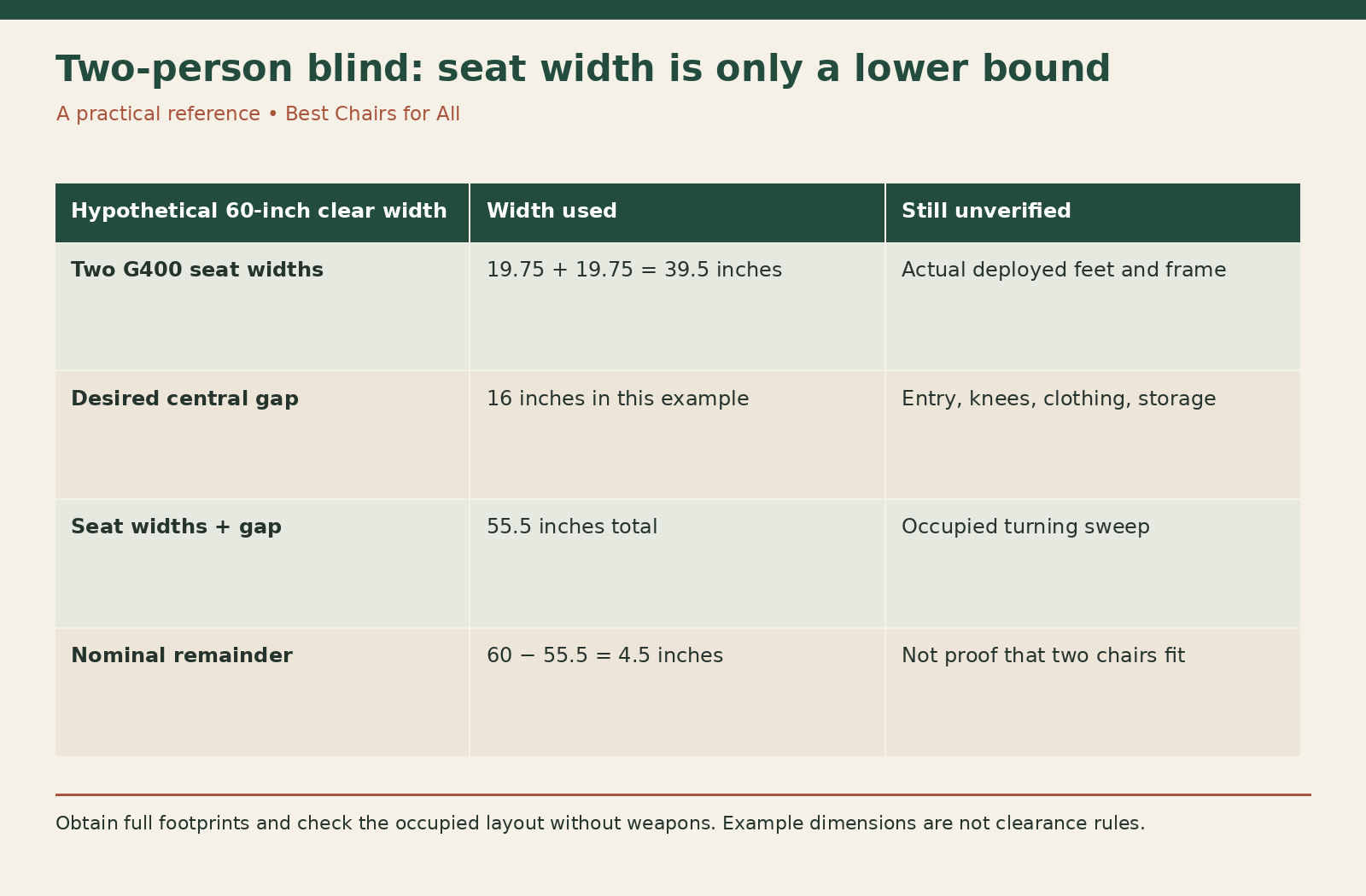
Imagine a hypothetical clear width of 60 inches, two G400 seat widths of 19.75 inches, and a desired 16-inch central gap. The arithmetic gives 19.75 + 19.75 + 16 = 55.5 inches. Only 4.5 inches remain across the whole width beyond that seat-and-gap calculation. This is a lower-bound sketch, not proof that two chairs fit.
Why not? The feet may extend beyond the seat, the occupants need knee and clothing clearance, and the blind walls may slope. A rotating chair also sweeps a wider occupied area than a stationary seat rectangle. Obtain full deployed and occupied outlines before approving the arrangement. If the supplier cannot provide them, arrange a permitted trial or choose a less constrained configuration.
Use tape outlines only on a suitable practice floor where they will not damage the surface. Test ordinary entry, exit, and sitting movements with the correctly assembled chairs. Do not reduce the central gap to a precise universal minimum based on this example; actual users, blind geometry, and instructions determine what works.
Compare packing as a complete blind kit
Write down the packed shelter dimensions and chair shape together. The Huntsman’s published 24-by-19-by-7-inch fold is a panel-like object; the G100’s removable legs suggest a different packing arrangement. Neither shape is automatically better until you compare it with the bag, vehicle opening, and hands available for the approach.
Count every loose assembly and strap. A system that saves bulk but requires a component to be detached needs a reliable way to keep that component with the chair. Ask whether the manufacturer’s carrying method secures all pieces and whether any accessory changes the arrangement.
For an illustrative two-chair load, two listed G400 weights total 15.8 pounds before covers or other supplies. A G400 and Huntsman total 20.9 pounds using the published empty figures. This comparison helps plan the kit; it does not predict who can carry it or whether the heavier combination is more stable.
Treat height as a pass condition
If your blind has a constrained viewing opening, compare the chair’s absolute sitting range with a known suitable setup. Adjustment travel describes the amount of change, not the starting point. A 3.5-inch range could be positioned at very different heights on different products, so a travel figure alone cannot answer the question.
The Huntsman’s stated endpoints make that part of the comparison easier, but the user’s torso height, cushion compression, and distance from the wall still matter. Use our separate blind-window measurement guide for the detailed geometry. This buyer guide does not reproduce that worksheet or infer safe equipment clearance from a viewing position.
Do not compensate for a failed height check by placing loose supports under the legs or adding an unapproved seat stack. Ask about a supported configuration or choose a different chair. A good buy should meet the requirement through intended adjustments.
Make setup access part of the choice
Independently adjustable legs still need enough access to set and inspect their locks. If the chair must be assembled in a cramped blind, consider whether the instructions can be completed before entering and whether the assembled outline passes the door. Do not assume more adjustments are useful when you cannot reach them in the planned arrangement.
Keep hanging fabric and carry straps away from rotating parts. If a chair contacts the wall during ordinary repositioning, a quieter bearing will not remove that contact. Check the occupied sweep and the storage locations rather than applying lubricant to an unrelated sound.
Capacity also remains separate from ground support. Both Millennium models list 400 pounds and the Huntsman lists 300 pounds, but those limits do not authorize a different base, missing foot, or improvised platform. Confirm the entire purchased configuration and follow its instructions.
Purchase only after the layout is resolved
Use four final fields: deployed footprint confirmed, occupied movement checked, required height established, and packed kit workable. Add exact model, seller, accessories, and return conditions. A pending field is a reason to obtain a measurement rather than a reason to assume the largest capacity solves the fit.
For a roomy blind and a carried kit, the G400 is the most useful first comparison. For a height-critical purchase, the Huntsman’s documented endpoints make it worth investigating despite its weight and stock questions. For someone prioritizing the removable-leg transport design, the G100 is the alternative to measure carefully. Choose the candidate that passes your actual layout rather than the one with the strongest generic comfort claim.
Something unclear or out of date? Send a correction with this article’s title and the detail to check.
Sources, research & corrections policy ↗