As an Amazon Associate, we earn from qualifying purchases. Read our affiliate disclosure.
The best folding Adirondack chair is the one you can close, move, store, reopen, and secure correctly without making the process a chore. Folding saves space only when the closed shape fits your storage route and the procedure suits the person using it. It does not automatically make a substantial outdoor chair lightweight, reclining, or easy to carry.
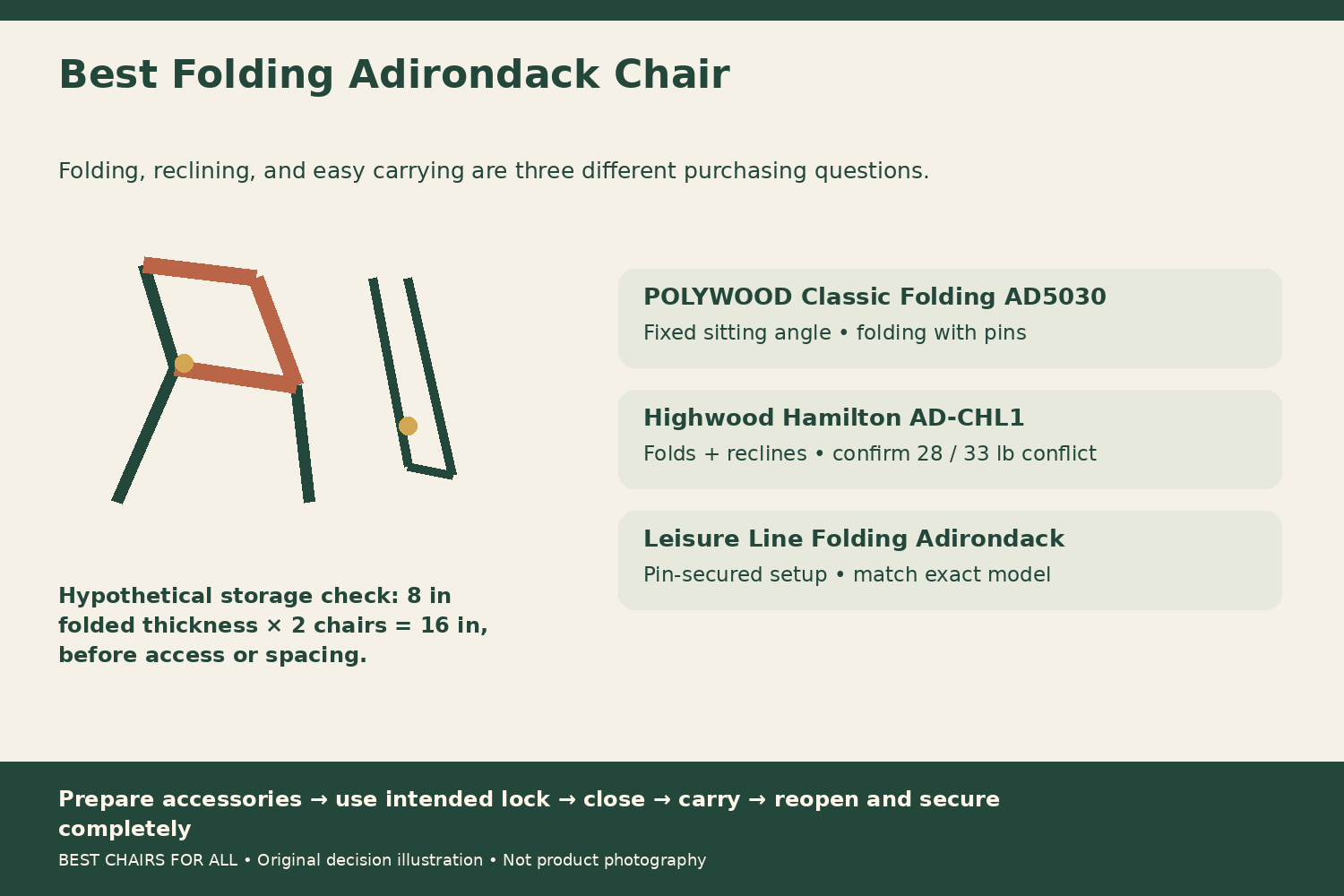
This guide compares the POLYWOOD Classic Folding Adirondack AD5030, Highwood Hamilton Folding and Reclining Adirondack AD-CHL1, and Leisure Line Folding Adirondack Chair. The POLYWOOD has a folding frame with a fixed sitting angle. The Hamilton adds reclining. The Leisure Line offers another HDPE-lumber option with a manufacturer-linked pin-based setup guide.
Our research was reviewed November 6, 2026. We have not measured folding force, carrying effort, pinch resistance, or long-term hinge wear. Where current manufacturer material contains conflicting weight or capacity figures, we leave the uncertainty visible. Prices and stock vary, so model-search links are not verified fixed-price offers.
Distinguish three separate functions
Folding means the chair changes into a storage configuration. Reclining means the occupied seating angle can change through an intended adjustment. Carrying convenience depends on weight, dimensions, grip, and route. One chair can do well at the first function without providing the second or making the third easy.
Decide how frequently the chair will be folded. A seasonal cottage setup may be closed only a few times a year. A narrow patio might require folding after every use. The same procedure can be acceptable in the first situation and frustrating in the second.
Also decide where the chair goes after it closes. Leaning it against a wall, placing it on a shelf, and carrying it through a doorway are different storage tasks. Do not purchase on an open-chair photograph and assume the folded form will fit somewhere later.
Three folding Adirondacks and their distinct compromises
POLYWOOD Classic Folding AD5030: for folding without a reclining back
The AD5030 manufacturer page lists a 34.5-pound weight, 20-inch seat width, 13.9-inch seat height, and 300-pound capacity. It explicitly distinguishes the chair's open sitting position from its folded storage position; the back does not adjust as an occupied recliner.
This is the candidate to investigate when you like a conventional Adirondack position but want the frame to close for storage. Manufacturer guidance on the page explains that the pins beside the seat assembly are removed for folding. Learn the exact procedure from the supplied instructions rather than loosening unrelated hardware.
The tradeoff is handling a substantial chair even after it becomes thinner. If you will fold it daily, try the pin removal and carrying movement before buying a set. Its fixed sitting angle also means you should reject a poor seat fit rather than expecting folding hardware to provide a hidden comfort adjustment.
Check matching POLYWOOD AD5030 listings on Amazon (paid link). The fixed AD4030 is a different model.
Highwood Hamilton AD-CHL1: for folding plus reclining
The Hamilton product page describes both folding and reclining, a 400-pound capacity, and 304 stainless-steel hardware. Its table lists a 14.74-inch seat height and 19.88-inch seat width. The adjustable back is the reason to compare it with a folding chair that provides only one sitting angle.
Choose it for consideration when you expect to change posture during a garden evening, and test those positions separately from the storage operation. A reclining setting should support you where you want it to; the presence of adjustment does not establish that every available position is useful for your proportions.
The page has an unresolved handling-weight discrepancy: its specification table says 28 pounds while another description says 33 pounds. We do not choose the lighter figure to rank it as the easiest chair to carry. Confirm the current assembled weight and folded dimensions with Highwood for the exact chair offered.
Check matching Highwood Hamilton AD-CHL1 listings on Amazon (paid link). King Hamilton is a separate size.
Leisure Line Folding Adirondack: for another pin-secured HDPE design
The Leisure Line product page identifies Tangent Sustainable Lumber, marine-grade stainless hardware, folding construction, and a 300-pound tested capacity. Its matching dimension page lists a 34-pound weight, 20-inch seat width, and 14-inch seat height. Match this specific chair rather than the brand's separate Sheet Folding model.
The useful feature for this guide is its documented setup path. The assembly guide linked by the product page identifies two Adirondack pins, says not to remove the chair screws for unfolding, and explains retaining the pins for later use. That makes pin management a concrete part of the purchase rather than an afterthought.
There is also a capacity discrepancy: the linked multi-brand guide mentions 350 pounds while the product page states 300. Do not rely on the higher number without exact-model confirmation. The direct page showed sold-out messaging and points to Costco availability, so confirm the actual model and fulfillment with the chosen seller.
Check matching Leisure Line Folding Adirondack listings on Amazon (paid link). Confirm the original lumber model and supplied instructions.
A five-stage storage-cycle audit
Use five stages: prepare, unlock, close, carry, and restore. Under each, write what you must do with the exact chair. The purpose is to reveal the entire routine, including the steps omitted from an attractive folded-chair photograph.
For preparation, remove cushions, drinks, books, and loose accessories. Check where those items go. A chair that folds neatly may still leave you carrying a separate cushion, pad, and small parts. If the chair is damp or dirty, include the appropriate cleaning and drying before long storage.
For unlocking, identify the actual lock, pin, or adjustment specified in the manual. Do not assume every bolt is intended to be loosened during normal folding. Practice only the maker's sequence with the chair unoccupied and hands clear of joints. If a component is unusually resistant, seek model-specific support instead of forcing the mechanism.
For closing, inspect the path of the back, arms, and legs. Make sure the storage location has room for that movement and does not catch the frame on a table or railing. A chair may fit once folded while lacking enough room to complete the folding motion where you intend to close it.
For carrying, check grip and route with the closed frame. For restoring, reopen using the instructions and verify the intended locks or pins are fully engaged before use. The storage cycle is complete only when the chair is ready to sit in again, not when it disappears into the garage.
A storage-space calculation with honest inputs
Write the actual folded height, width, and thickness from the manufacturer's current drawing or your own measurement. If any value is absent, ask for it. We do not substitute assembled dimensions for folded ones, and we do not infer thickness from a side photograph.
Here is a hypothetical planning example. If two folded chairs each measure eight inches thick in the permitted storage orientation, their simple combined thickness is sixteen inches before accounting for protective spacing, non-flat protrusions, or access. A storage slot fourteen inches deep would therefore fail that assumed straight arrangement.
Those numbers are an example of the method, not the dimensions of the shortlisted chairs. Repeat it with verified measurements for the model you choose. If a seller cannot establish the folded package and storage fit is the main reason for purchase, that uncertainty should delay the order.
Measure the opening as well as the space behind it. A wide closed chair may fit behind a door while failing to pass through the doorway in a practical orientation. Check turns, steps, and the person who will handle the chair. Thinness alone is an incomplete storage specification.
Pins and small parts need a permanent home
The Leisure Line linked guide specifically tells the owner to store removed pins safely for future use. Build that into the routine: choose a labeled container or the storage arrangement the manufacturer supplies, and keep it associated with the exact chair. Do not leave loose pins where they can fall into gravel or mix with unrelated hardware.
Inspect the parts before reopening. A visually similar pin from another chair is not an approved substitute. If a pin is missing, request the correct replacement rather than installing a convenient bolt or dowel. The intended locking component is part of the design.
For the AD5030, use the product's own instructions and manufacturer support for replacement pins. Do not transfer the Leisure Line pin dimensions or folding sequence to the POLYWOOD. Similar functions do not establish interchangeable hardware or instructions.
Keep any cushioning ties clear during folding. A tie trapped in a joint may make the chair seem resistant or may be damaged by movement. Preparing the accessories first usually makes the routine more understandable than trying to pull fabric free after the frame has begun to close.
Assess sitting comfort independently of folding
After confirming the storage routine, try the occupied chair on suitable level ground. Check the low seated position, back contact, thigh edge, and ordinary standing movement. A folding design should not get a free pass on fit simply because it solves a garage-space problem.
For the Hamilton, compare the supported posture at the positions you expect to use. For the AD5030, evaluate its fixed sitting position honestly. For Leisure Line, check the exact model label and assembled arrangement before applying any number from a similar product page.
If a cushion is part of the plan, test that combination. Extra padding can change how you relate to the arms and backrest. Its storage burden also belongs in the cycle audit. One chair plus a large cushion is still two objects to move when the patio needs to clear.
When a fixed chair may be the more useful choice
If the chair will remain outdoors in one location and never needs compact storage, folding may provide little practical benefit. A fixed model can be a more direct comparison for that use. Select folding because it solves an actual storage or access problem, not merely because another feature appears to mean more value.
Conversely, if daily clearing is essential, prioritize a routine you can repeat comfortably. That may mean a different seating category if these substantial Adirondacks are awkward to move. A product advertised as folding can still be inappropriate for frequent stair carrying or a tiny apartment storage route.
Choose the complete routine, not only the closed shape
Start with the AD5030 for a fixed sitting angle and folding frame, the Hamilton for reclining as well as folding, and Leisure Line for a documented pin-secured alternative. Resolve each model's missing or conflicting specification before relying on it for a critical requirement.
Confirm package quantity, assembly state, cushions, hardware, shipping, and return terms at checkout. This guide makes no fixed budget promise because selected finishes, seller configurations, and delivery costs were not uniformly validated.
The best folding Adirondack should pass the whole storage cycle and still feel right when opened. A chair that closes into a smaller outline but creates awkward lifting, missing pins, or an unsuitable seat has not delivered the convenience you intended to buy.
Something unclear or out of date? Send a correction with this article’s title and the detail to check.
Sources, research & corrections policy ↗