As an Amazon Associate, we earn from qualifying purchases. Read our affiliate disclosure. Amazon buttons open model-matching searches; verify the seller, exact configuration, current price and stock.
Choose a bank-fishing chair around the carry and the reach
For ordinary bank fishing on a suitable firm, level spot, Kijaro Dual Lock is the first comparison when a conventional chair with an open-position lock suits your working posture. Helinox Chair One is the packable alternative for a longer approach. YETI Trailhead is the heavier comparison when an independently tensioned seat and a higher documented load statement matter enough to justify the bulk.
These are research-based selections from official US product information and instructions checked online on November 6, 2026. We have not fished from these chairs, measured noise, tested stability or verified comfort over a long session. This guide concerns portable chairs used on shore. It does not recommend them as boat seats, wading supports, flotation equipment or substitutes for an appropriate fishing location.
| Trip priority | Candidate | Main compromise |
|---|---|---|
| Short carry; conventional working seat | Kijaro Dual Lock | 9.5-pound item and arms to check against rod movement |
| Longer walk; compact packed size | Helinox Chair One | More assembly and flat-solid-ground restriction |
| Short carry; tensioned seat and higher stated load | YETI Trailhead | 13.3-pound chair and long folded package |
Three chairs for distinct shore-fishing jobs
The shortlist does not include an integrated rod holder. That is a separate requirement worth researching by exact model rather than assuming a cup holder can secure a rod. Here the central questions are what you must carry, how you sit to manage tackle and whether the chair fits the selected bank without reaching toward an unstable edge.
Product documentation checked November 6, 2026: Kijaro standard Dual Lock official specifications, Helinox Chair One official US specifications, Helinox Chair One official handling and assembly guide, YETI Trailhead official US dimensions, use and care FAQ. The model-specific comparison below uses those published details rather than physical tests.
1. Kijaro Dual Lock Chair 300 lb
Best for: a conventional shore seat with a defined open position.
Standard Dual Lock weighs a listed 9.5 pounds and has a 300-pound capacity. Its open-position lock, twenty-two-inch listed seat width and sixteen-inch depth give a clear starting comparison for seated tackle tasks on suitable ground.
The arms may help relaxed waiting but can obstruct a particular rod or reel position. Try that movement before choosing it for fishing. This is the standard 300-pound chair, not the similarly named XXL or Elite version. An open lock does not establish stability on every bank surface.
Product Details
| Brand | Kijaro |
|---|---|
| Product weight | 9.5 lb |
| Manufacturer capacity | 300 lb |
| Listed seat size | 22 inches wide × 16 inches deep |
| Mechanism | Locks open and closed |
Pros
- Locks open and closed
- Published conventional-seat dimensions
Cons
- Midweight carry
- Arm clearance needs a task check
Choose it when the normal working reach fits and the route does not require the lightest pack.
2. Helinox Chair One
Best for: a longer walk where compact transport matters.
Chair One lists a packed weight of two pounds two ounces and a fourteen-by-4.5-by-4.5-inch package. Its published capacity is 320 pounds. Those figures make it a different transport proposition from the two larger folding chairs.
The official handling guide calls for flat solid ground and even loading. The compact suspended seat and assembly process need to suit your trip, while exact sitting height should be clarified if critical. This is not a recommendation to place a light chair on a muddy sloping edge.
Product Details
| Brand | Helinox |
|---|---|
| Packed weight | 2 lb 2 oz |
| Packed size | 14 × 4.5 × 4.5 inches |
| Manufacturer capacity | 320 lb |
| Use limitation | Flat, solid surface per handling guide |
Pros
- Small documented packed size
- Much lower listed carry weight
Cons
- Ground restriction remains important
- Sitting position and setup differ from a quad chair
Consider it when you can choose suitable ground and the carry saving addresses a real trip requirement.
3. YETI Trailhead Camp Chair
Best for: a shorter carry with a tensioned seat preference.
Trailhead weighs a listed 13.3 pounds and folds to forty-three by nine by 11.75 inches in YETI’s US FAQ. The manufacturer says it is tested to support up to 500 pounds. Arm and back tensioners establish the intended fabric support.
The bulk and setup steps are real tradeoffs for a mobile angler. YETI explicitly says the fabric is not puncture-resistant, so sharp tackle should be stored separately. The high published load statement is not a claim that the chair is appropriate for every shoreline or that it cannot tip.
Product Details
| Brand | YETI |
|---|---|
| Product weight | 13.3 lb |
| Published load statement | Tested to support up to 500 lb |
| Folded size | 43 × 9 × 11.75 inches |
| Construction feature | Arm and back tensioners |
Pros
- Documented higher load statement
- Specific tensioned-seat setup
Cons
- Heaviest item in this comparison
- Long folded package and puncture limitations
Choose it when the supported seat suits the task and carrying the complete package is acceptable.
Map the fishing tasks before choosing the seat
List the tasks you actually perform while sitting: watching a float, holding a light rod, tying a knot, reaching a bait container or waiting while rods rest in an appropriate separate support. These do not all need the same posture. A deeply relaxed seat may be pleasant between tasks but awkward for repeated tackle work near your knees.
Try the ordinary hand movement with an unrigged rod or another harmless reference in a suitable dry space. Check whether the armrest catches the handle, whether the reel position becomes cramped and whether you must slide forward to reach a bag. This is a layout exercise, not a recommendation to cast from a chair without considering the venue, surrounding people and technique.
Arrange frequently used items where they can be reached without twisting around a loaded chair or extending toward water. A side pocket can hold a small item, but it should not be used as a reason to hang a heavy tackle box from one side. Capacity belongs to the documented intended loading, not an assumed allowance for arbitrary off-center gear.
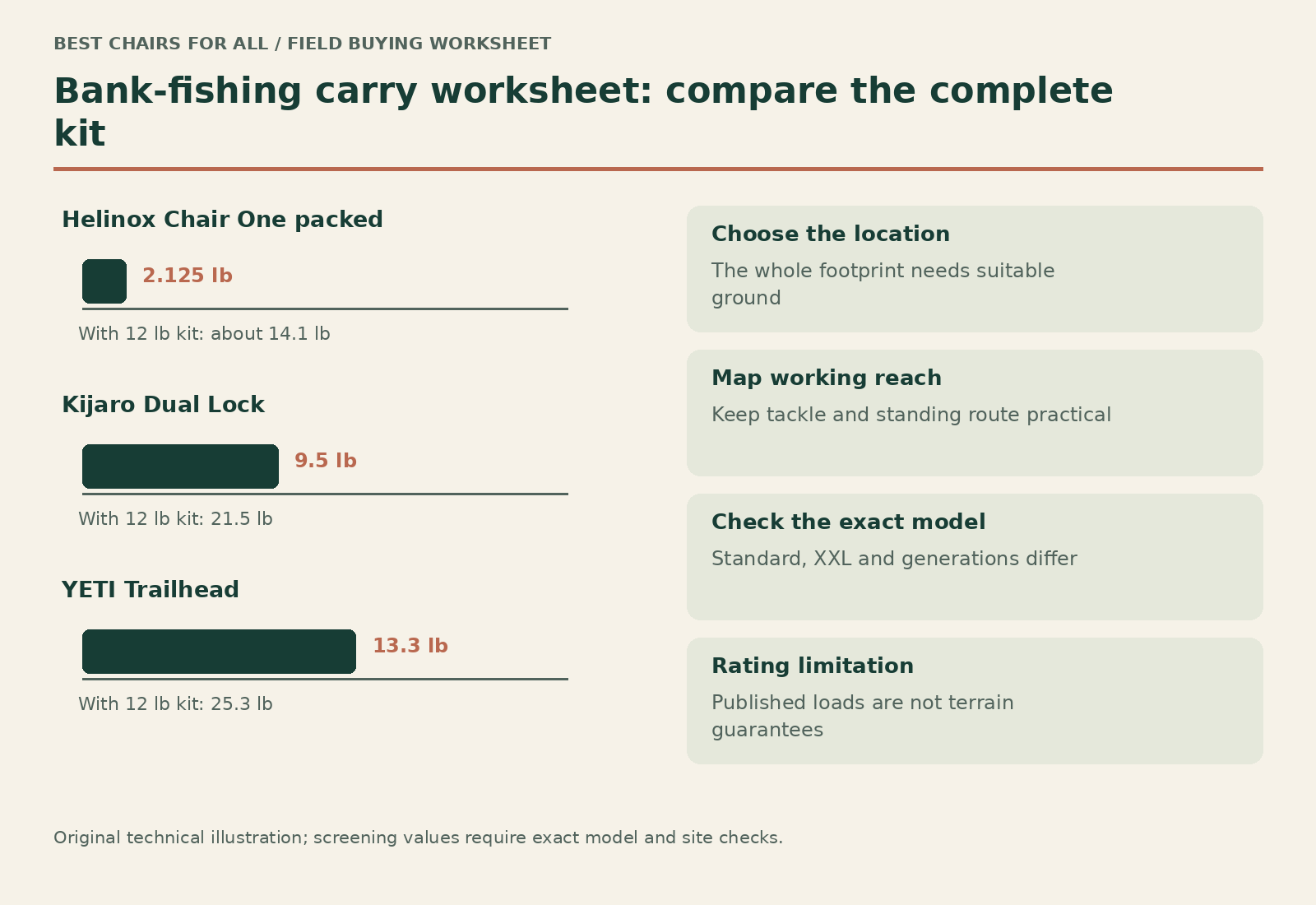
The bank-layout worksheet
Choose the location before forcing a chair into it. Look for an appropriate permitted place with a sound, level surface and adequate room for the chair, feet, equipment and standing movement. A wide footprint does not make an eroding bank or sloping edge suitable. Move the setup to an appropriate area rather than improvising a wedge or extending a leg beyond its design.
For a worked planning example, draw three zones on paper: the chair and normal foot position, frequently used tackle within ordinary reach, and a clear route for standing and managing the rod. Keep that route distinct from the place where rods and lines are arranged. The exact distances depend on the user and site; this guide does not invent a universal setback from every body of water.
Now place a hypothetical bag to one side and note whether a normal reach stays within a balanced sitting position. If it does not, move the bag or stand to retrieve the item. A chair with wider arms may reduce the available reach path, while a small armless chair may allow movement but require a different working height. Evaluate those tradeoffs in the actual setup.
| Zone | Question to resolve | Purchase implication |
|---|---|---|
| Chair and feet | Is the entire intended footprint on suitable ground? | A compact model may fit a small sound area; none fixes bad ground |
| Working reach | Can I manage normal tackle without perching? | Compare seat depth and arm interference |
| Standing route | Can I get up without stepping over rods or bags? | Reserve space beyond the chair outline |
| Carry route | How far and through which gates or paths? | Packed weight and length matter together |
A worked carry-load comparison
Assume the rest of a deliberately simplified fishing kit weighs twelve pounds. Add the manufacturer’s listed chair weight, using packed weight when available. Chair One’s two pounds two ounces produces approximately 14.1 pounds of combined gear. Kijaro’s 9.5-pound chair produces 21.5 pounds, and Trailhead’s 13.3 pounds produces 25.3 pounds. This is arithmetic for planning, not a measurement of a real trip or a statement about what you should carry.
The difference is meaningful on a longer approach, but packed shape can change the decision. Chair One’s listed fourteen-inch package fits a different carrying arrangement from Trailhead’s forty-three-inch folded length. A long chair can interfere with a rod bag, car opening or narrow gate even when its strap makes the weight manageable.
For a drive-up location, that carry penalty may matter less than the preferred sitting surface or ease of repeated setup. Do not buy the lightest chair automatically if its sitting position makes your normal fishing tasks awkward. Conversely, avoid choosing a large higher-capacity chair solely for its impressive number when the required rating and body fit are already satisfied by a lighter suitable model.
Compare the seat as a working surface
Kijaro lists a twenty-two-inch seat width and sixteen-inch depth for the standard Dual Lock. Its published twenty-inch seat-height label is a manufacturer reference; flexible seats compress and different measurement points can produce different apparent heights. Try whether the feet remain supported and whether the seat edge and arms permit the intended hand work.
Helinox Chair One has a more compact suspended-seat arrangement and no conventional full armrests. That can be appealing when transport dominates, but a lower-looking frame in a photograph is not a verified height measurement. The current US page repeats a height value in an inconsistent seat-height field, so obtain a current dimension drawing if exact sitting height is essential.
Trailhead uses tensioners at the arms and back to establish its intended fabric support. Follow the specific setup instructions rather than treating it like a simple unfurl-and-sit quad chair. We do not claim that its surface prevents back pain, is firmer than every alternative or improves bite response. The useful question is whether its actual support suits the working tasks you perform.
Feet, ground and loading limits remain model-specific
The Helinox handling guide explicitly calls for a flat, solid surface and describes its capacity in terms of evenly distributed loading. That limitation matters at a fishing bank, where mud, loose gravel or a sloped patch can be tempting because it is close to the preferred water position. Do not turn portability into an unsupported claim that a chair works on any terrain.
The Kijaro open lock is a setup feature, not a guarantee against sinking or tipping on unsuitable ground. Likewise, Trailhead’s published 500-pound load statement does not make every shoreline stable. Use ratings as exact model limits and screen the actual surface independently. A heavier frame is not an anchor or a repair for eroded soil.
If considering manufacturer-approved foot accessories, confirm the exact model and what the accessory instructions permit. An accessory intended to reduce sinking does not remove all ground restrictions or certify a position near water. Do not modify the frame, improvise leg extensions or mix unsupported parts to make a poor location seem workable.
Hooks, wet gear and cleanup affect ownership
Keep sharp tackle away from the seat fabric and storage pockets. YETI’s FAQ states that Trailhead is not puncture-resistant, a useful reminder that a premium mesh chair should not be used as a hook board. A small tackle tray or appropriate separate container serves a different purpose from a chair’s drink pocket.
After a session, follow the actual chair’s cleaning and drying directions. For Trailhead, YETI describes water for general dirt and mild soap with a soft brush for more stubborn debris. Helinox gives its own care guidance and says its seat should not be machine washed. Do not transfer a hose-down or cleaning-product recommendation from one material to every chair in the bag.
Dry the item before its intended storage and inspect the joints, feet and fabric for damage. Retain the exact product identity for replacement parts or service, particularly where model families include different sizes or generations. A worn component is a reason to seek the supported remedy rather than assume a large original capacity rating remains an unrestricted promise.
Which fishing setup does each chair actually suit?
Start with Kijaro for a conventional bank seat when its arm and depth arrangement works and a midweight carry is acceptable. Choose Chair One when the approach and compact pack are decisive, provided the surface and personal sitting fit satisfy its instructions. Compare Trailhead when a heavier tensioned-seat chair is worth transporting and its full setup is practical.
Before keeping a remotely ordered chair, use ordinary dry tasks to assess the preferred reach, standing movement and packing arrangement. Confirm the seller’s return conditions and do not take an unsuitable chair into a fishing environment just because the return period is running out. The purpose of the trial is to determine whether it fits the trip, not to invent a durability test.
The best fishing chair does not solve every bank, technique or body-fit problem. A sound recommendation identifies the carry tradeoff, the usable working position and the conditions where the chair should be rejected. Make those decisions first, then choose the color, pockets and other conveniences.
Something unclear or out of date? Send a correction with this article’s title and the detail to check.
Sources, research & corrections policy ↗